
ROOF-120 · Lesson 8 of 12 · 26 min
Metals used in roofing
▶ Video coming soon A video version of this lesson is on the way.
Theo Barnes runs Ridgecap's sheet metal shop like a library. Coils of galvanized steel on one rack, prepainted steel on another, aluminum in a separate corner, and copper locked in its own cage at the back. "Never mix them on the bench," he told Rory on his first shop day. "A copper chip left on galvanized flashing will eat a hole in it in a couple of years. And never, ever drop a steel screw in my copper box." He held up a gutter section with a white crust and pinholes along the bottom. "This is what happens when somebody runs a copper roof into an aluminum gutter."
Metals are everywhere on a roof: in flashings, edge metal, copings, counterflashings, gutters and downspouts, metal roof panels, fasteners and the steel deck itself. Each metal has strengths and weaknesses, and some metals attack each other when they touch in the presence of water. This lesson covers the metals roofers use, how their thickness and coatings are specified, how they corrode, how they expand and contract, and how to keep them working together.
Why metal?
Metal is used where a roof needs something stiff, shaped and durable: a coping that sheds water off a parapet, a drip edge that throws water clear of the fascia, step flashings woven into shingles, counterflashing that laps over a membrane, or a whole roof of standing-seam panels. Sheet metal can be bent on a brake into almost any profile, joined by seams, rivets or solder, and it lasts for decades if chosen and installed well. Its main drawbacks are corrosion, thermal movement and the fact that it conducts heat and electricity.
Steel
Plain carbon steel rusts quickly outdoors, so roofing steel is always coated. The coatings are measured by mass of coating per unit area, counting both sides together.
- Galvanized steel is coated with zinc. Zinc corrodes much more slowly than steel, and it protects the steel sacrificially: at a scratch or cut edge, the nearby zinc corrodes in place of the steel. In Canada, the coating is given in grams per square metre, such as Z275 (275 g/m² total), common for exterior flashings, or the lighter Z180. Galvanized steel is made to ASTM A653.
- Aluminum-zinc coated steel (often sold as Galvalume) has a coating of about 55 parts aluminum to 45 parts zinc. It lasts longer than galvanizing in most climates and is the usual base for metal roof panels. A common coating is AZ150 (150 g/m²) or AZM150. It is made to ASTM A792. It should not be used in contact with wet concrete or mortar, and its cut edges are protected less well than galvanizing's.
- Prepainted (coil-coated) steel has a factory paint system over the zinc or aluminum-zinc coating. Paint systems range from polyester types to fluoropolymer (PVDF) finishes, which hold their colour and gloss far longer. The paint adds protection and colour, but scratches and cut edges still depend on the metallic coating underneath.
- Stainless steel resists corrosion through a chromium-rich surface film. Types 304 and 316 (more resistant to salt) are used for fasteners, clips and special flashings. It is strong, hard to work and expensive.
Steel sheet thickness is often given by gauge number, where a smaller number means thicker metal. Because gauge tables differ between steel, galvanized steel, aluminum and copper, specifications increasingly give the actual thickness instead.
| Gauge (galvanized steel) | Approximate thickness | Typical roofing use |
|---|---|---|
| 22 | 0.76 mm (0.030 in) | steel deck, heavy copings |
| 24 | 0.61 mm (0.024 in) | copings, gravel stops, counterflashing, standing-seam panels |
| 26 | 0.46 mm (0.018 in) | drip edge, step flashing, many residential panels |
| 28 | 0.38 mm (0.015 in) | light residential flashing, some exposed-fastener panels |
Worked problem
How thick is a zinc coating?
A flashing is made of Z275 galvanized steel: 275 g of zinc per square metre, counting both sides. Zinc has a density of about 7.14 g/cm³. About how thick is the zinc on each side?
Show solution
- Zinc per side = 275 ÷ 2 = 137.5 g/m².
- One square metre is 10,000 cm², so per side that is 137.5 ÷ 10,000 = 0.01375 g/cm².
- Thickness = mass per area ÷ density = 0.01375 ÷ 7.14 ≈ 0.00193 cm.
- In micrometres (µm): 0.00193 cm × 10,000 ≈ 19 µm.
Answer: About 19 µm per side, thinner than a sheet of paper. That thin layer is all that protects the steel, which is why scratching, grinding and dissimilar metals shorten the life of galvanized flashings so much.
Aluminum
Aluminum is light, does not rust, and forms a thin oxide film that protects it in most outdoor conditions. It is widely used for gutters, downspouts, soffit and fascia, drip edge and prefinished flashings, and sometimes for roof panels. Common sheet thicknesses for flashing and coping are about 0.8 to 1.0 mm (0.032 to 0.040 in).
Aluminum has some limits roofers must respect:
- It expands and contracts about twice as much as steel for the same temperature change.
- It is attacked by alkalis, so it must be kept off wet concrete, mortar and fresh stucco, or separated from them with a coating or membrane.
- It corrodes quickly next to copper, or under water that has run off copper.
- It is attacked by the copper-based preservatives in many modern pressure-treated lumbers when wet, so it needs a separator from treated wood.
- It is softer than steel, so it dents more easily and needs proper support.
Copper
Copper is the traditional premium roofing metal: long-lasting, easy to work and solder, and beautiful as it weathers from bright copper through brown to the green patina seen on old churches like St. Brendan's. A copper flashing or valley can outlast several asphalt roofs. Roofing copper is usually specified by weight per square foot, most commonly 16 oz (about 0.55 mm (0.0216 in) thick) or 20 oz for heavier work, and is made to ASTM B370. Cold-rolled (hard-temper) copper holds its shape for flashings and panels; soft copper is used for forming around odd shapes.
Copper is noble, meaning it sits high in the galvanic series and causes other metals to corrode. Water running off copper carries dissolved copper that attacks galvanized steel, Galvalume and aluminum downstream, even without direct contact, and it stains light-coloured stone and siding green. Copper must be fastened with copper or stainless steel fasteners and cleats, never steel or aluminum.
Worked problem
Weighing copper for the church valleys
St. Brendan's needs two new valleys, each 9 m long, lined with 16 oz copper sheet 600 mm wide. Copper at 16 oz/ft² weighs about 4.88 kg/m². What area of copper is needed, and what does it weigh?
Show solution
- Area = 2 valleys × 9 m × 0.6 m = 10.8 m².
- Weight = 10.8 × 4.88 ≈ 52.7 kg.
Answer: 10.8 m² of copper weighing about 52.7 kg, plus laps and waste. Copper is priced by weight, so this number goes straight into the estimate.
Other roofing metals
- Zinc (architectural or titanium-zinc): used for panels, flashings and gutters, mostly on high-end and European-style work. It weathers to a grey patina, must be ventilated on its underside to avoid corrosion, and is attacked by runoff from copper and by acidic water from some roofing materials.
- Lead: soft and easy to shape, found in old flashings, pipe jacks and church work. Lead is toxic. Cutting, scraping or handling it calls for gloves, no eating or smoking until hands are washed, and the employer's lead procedures. New lead flashings are now rare.
- Terne and tin-plate: steel coated with a lead-tin or tin alloy, painted, found on old standing-seam roofs.
- Lead-coated copper: copper with a thin lead coating, used where copper staining must be avoided; it needs the same lead precautions.
How metals corrode
Corrosion is the slow chemical reaction of a metal with its environment, usually water and oxygen, turning it back into an oxide or salt. Roofers meet several kinds:
- General corrosion: even rusting or oxidation across the surface, speeded up by salt, industrial pollution and standing water.
- Galvanic corrosion: corrosion of one metal caused by contact with a more noble metal when both are wet.
- Crevice and poultice corrosion: corrosion in tight joints, under wet debris or under leaves left in a gutter, where water stays trapped and oxygen cannot reach.
- Cut-edge corrosion: coated steel corroding from sheared edges, holes and scratches where the coating is broken.
- Chemical attack: alkalis from concrete and mortar on aluminum and Galvalume; copper preservatives in treated wood; acidic runoff from some sources; animal droppings.
Galvanic corrosion
When two different metals touch and water connects them, they form a battery. The less noble (more active) metal becomes the anode and corrodes; the more noble metal becomes the cathode and is protected. The further apart the metals sit in the galvanic series, the faster the active one corrodes. Rain, condensation and dew are enough water, and salt makes it much worse.
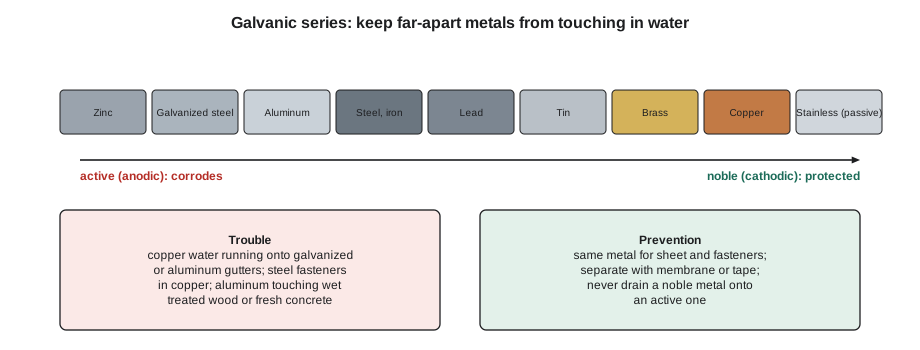
Size matters too. A small anode connected to a large cathode corrodes fast: a steel screw in a copper sheet will rot away quickly. A large anode with a small cathode corrodes slowly: a stainless steel screw in an aluminum gutter is usually acceptable. That is why fastener choice follows the rule of using fasteners as noble as, or more noble than, the sheet they hold, and ideally of the same metal.
The rules for avoiding galvanic corrosion are simple:
- Use the same metal for sheets, cleats and fasteners whenever possible.
- Where different metals must meet, separate them with a non-conductive layer: a self-adhered membrane, a plastic tape or a bituminous coating.
- Never let water run from a more noble metal onto a less noble one. Water flows down the series, from copper toward zinc, never the other way.
- Keep metal chips, filings and swarf off finished surfaces. Hot steel filings from a grinder embed in paint and rust within days.
Thermal movement
Metals expand when warmed and shrink when cooled. On a roof, where a dark metal coping can swing from −25 °C (−13 °F) on a winter night to 60 °C (140 °F) in summer sun, that movement adds up. The change in length is: change = coefficient × length × temperature change.
| Metal | Expansion per degree (approximate) |
|---|---|
| Steel | 12 × 10⁻⁶ per °C (6.5 × 10⁻⁶ per °F) |
| Stainless steel (304) | 17 × 10⁻⁶ per °C (9.6 × 10⁻⁶ per °F) |
| Copper | 17 × 10⁻⁶ per °C (9.4 × 10⁻⁶ per °F) |
| Zinc | 22 × 10⁻⁶ per °C (12.2 × 10⁻⁶ per °F) |
| Aluminum | 23 × 10⁻⁶ per °C (12.8 × 10⁻⁶ per °F) |
Worked problem
How much does a coping grow?
A section of parapet coping is 3.0 m long. Over a year, its temperature ranges through 80 °C. How much does it change length if it is aluminum, steel or copper?
Show solution
- Length = 3.0 m = 3,000 mm.
- Aluminum: 23 × 10⁻⁶ × 3,000 × 80 ≈ 5.5 mm.
- Steel: 12 × 10⁻⁶ × 3,000 × 80 ≈ 2.9 mm.
- Copper: 17 × 10⁻⁶ × 3,000 × 80 ≈ 4.1 mm.
Answer: About 5.5 mm for aluminum, 2.9 mm for steel and 4.1 mm for copper, on every 3 m section. Over a 30 m parapet that is ten times as much, which is why copings are made in short sections with loose joints, never one continuous rigid piece.
Sheet metal is detailed to allow that movement:
- Copings, gravel stops and counterflashings are made in sections about 3 m (10 ft) long with joints that let them slide: lapped joints with sealant, cover plates or standing seams.
- Long runs are held with cleats (continuous or clip cleats) that grip the metal's hemmed edge but let it slide, instead of being nailed through the face.
- Gutters have expansion joints at intervals the manufacturer or the sheet metal standard recommends.
- Standing-seam roof panels are held with clips, some with sliding tabs, so the panels can grow and shrink along their length without tearing fasteners loose.
- Exposed fasteners through the face of long metal pieces are avoided; where they are needed, slotted holes and neoprene washers allow movement.
A metal piece nailed tight at both ends buckles in summer and tears its fasteners or splits its sealant in winter. Wavy, distorted flat metal is called oil canning; it can come from restrained movement, uneven fastening or too thin a metal for the width.
Good sheet metal practice
The sheet metal industry publishes detailed guides for flashings, copings and gutters, such as the SMACNA Architectural Sheet Metal Manual used across North America and the roofing contractors' associations' details. The specification usually calls for one of them. A few rules apply everywhere:
- Hem exposed edges (fold them back on themselves). A hem stiffens the edge, hides the raw cut and gives a cleat something to grip.
- Make the drip on edge metal and copings project far enough to throw water clear of the wall below.
- Slope the tops of copings toward the roof so dirty water does not streak the face of the building.
- Use fasteners compatible with the metal and long enough to reach solid wood or the specified substrate.
- Cut coated steel with snips or shears, not abrasive wheels, which burn the coating and throw hot filings.
- Touch up scratches on prepainted metal with the manufacturer's touch-up paint, sparingly.
- Handle with gloves: sheet metal edges cut deeply.
Metal roofs and condensation
Metal roof panels are excellent conductors and lose heat to a clear night sky quickly, so the underside of a metal roof can drop below the dew point on cool nights even in summer. Unprotected, the condensation drips onto whatever is below. Metal roofs over heated or humid spaces need a continuous underlayment and, on open-framed buildings, an insulation or vapour control layer or a factory-applied anti-condensation backing. Ventilation under the panels also helps. This is another example of building science deciding the details.
Back in Theo's shop
Theo had Rory bend a coping for St. Brendan's in 16 oz copper: hemmed drip edges, sloped top, copper cleats, and laps left loose for movement. When Rory reached for a box of galvanized nails for the cleat, Theo just shook his head and pointed at the copper nails in the cage. "Same metal, every time," he said. "The steel nail would be gone in five years and the coping would be on the sidewalk."
Common mistakes
MistakeFastening copper with steel or galvanized fasteners.
InsteadUse copper or stainless steel fasteners and cleats with copper.
MistakeDraining a copper roof or flashing into an aluminum or galvanized gutter.
InsteadNever let water run from a noble metal onto a less noble one; use the same metal or reroute the water.
MistakeNailing long metal copings tight through the face.
InsteadUse short sections, loose joints and cleats so the metal can expand and contract.
MistakeCutting coated steel with an abrasive wheel on the roof.
InsteadUse snips or shears; hot filings burn the coating and rust on nearby surfaces.
MistakeSetting aluminum flashing directly against wet concrete or treated wood.
InsteadSeparate aluminum from alkaline and treated materials with membrane or a coating.
Summary and key terms
- Roofing steel is protected by zinc, aluminum-zinc or paint coatings, specified by coating mass.
- Aluminum is light and corrosion-resistant but expands a lot and is attacked by alkalis, copper and treated wood.
- Copper is durable and noble; its runoff attacks less noble metals downstream, and it needs copper or stainless fasteners.
- Galvanic corrosion attacks the less noble of two connected, wet metals; separate them and never drain noble onto active.
- Metals expand with temperature: change = coefficient × length × temperature change; allow for movement with sections, cleats and clips.
- Hem edges, slope coping tops, use compatible fasteners and cut coated steel with shears.
- Galvanized steel
- Steel coated with zinc for corrosion protection.
- Aluminum-zinc coating
- A metallic coating of roughly 55 parts aluminum and 45 parts zinc on steel, often sold as Galvalume.
- Gauge
- A number system for sheet thickness in which a smaller number means thicker metal.
- Galvanic corrosion
- Corrosion of the more active of two different metals connected by water.
- Noble metal
- A metal near the protected (cathodic) end of the galvanic series, such as copper.
- Patina
- The protective weathered surface layer that forms on copper and zinc.
- Cleat
- A metal strip or clip that holds sheet metal by its edge while letting it slide.
- Oil canning
- Visible waviness in flat sheet metal surfaces.
Practice problems
Work each problem on paper first, then reveal the answer to check.
Which metal corrodes when copper and galvanized steel touch in water?
Show answer
The galvanized steel (its zinc coating, then the steel).
How much does a 2.4 m steel flashing grow over a 70 °C rise?
Show answer
12 × 10⁻⁶ × 2,400 × 70 ≈ 2.0 mm.
What does Z275 mean?
Show answer
275 g of zinc per square metre, counting both sides.
Why are coping joints left loose?
Show answer
So each section can expand and contract without buckling or tearing fasteners.
What fasteners are used with copper?
Show answer
Copper or stainless steel.
Lesson quiz · 5 questions
Score 60% or more to complete this lesson.
Create a free account to save your progress, take quizzes and earn a certificate.