
ROOF-120 · Lesson 6 of 12 · 24 min
Asphalt and bitumen products
▶ Video coming soon A video version of this lesson is on the way.
Ridgecap's yard has a long rack under a lean-to roof where the bitumen products live. On a rainy morning in June, Marco Lindell walked Rory down it, pulling labels as he went. "Base sheet. Cap sheet, granules. Cap sheet, torch grade. Glass ply felt. Self-adhered underlayment. Roll roofing. Plastic cement, lap cement, primer." He tapped a pallet of shingle bundles at the end. "All of it is made from the same black stuff that comes out of the bottom of an oil refinery. The trick is knowing which one goes where, and why."
Asphalt-based products are the most widely used roofing materials in North America. They cover most houses (as shingles) and a large share of commercial roofs (as built-up roofing and modified bitumen). This lesson explains what roofing asphalt is, how it is graded and modified, and how it is turned into shingles, felts, membranes, underlayments, cements and coatings. You will also work through the arithmetic of exposure, courses, bundles and rolls.
Asphalt, bitumen and coal tar
Bitumen is the general name for sticky, black, waterproof hydrocarbon materials. Roofing bitumen almost always means asphalt: the heavy material left over when crude oil is refined. Canadian and European documents tend to say bitumen; American documents tend to say asphalt. On the job, the two words mean the same thing.
Older roofs, especially built-up roofs from before the 1980s, may contain coal-tar pitch instead. Coal tar is made from coal, not oil. It resists standing water well and was used on dead-level roofs, but its fumes and dust irritate skin and eyes and are linked to cancer. Coal tar and asphalt do not mix well: putting one directly on the other can cause softening and failure. If you suspect coal tar on a re-roof (it is often shinier, more brittle and has a distinctive smell), stop and tell your foreperson so it can be identified and handled safely.
Asphalt is a thermoplastic material: it softens when heated and hardens when cooled. That property is what makes it useful, because it can be melted and applied hot, then cools to a tough, waterproof layer. It is also its weakness. Too cold, it becomes brittle and cracks; too hot, it softens and slides; and sunlight and heat slowly oxidize it, making it harder and more brittle with age.
Grades of roofing asphalt
Asphalt used to bond the plies of built-up roofs is graded by its softening point: the temperature at which it becomes soft enough to flow under a standard test. A softer asphalt (lower softening point) flows better and self-heals small cracks, but slides on steeper slopes. A harder asphalt (higher softening point) stays put on slopes but is less flexible in cold weather.
Canadian specifications refer to CSA A123.4 for asphalt used in built-up roofing, and many also quote the equivalent American types below, because suppliers label cartons for both markets.
| Type | Softening point (approximate) | Used for |
|---|---|---|
| Type I | 57 to 66 °C (135 to 151 °F) | dead-level and nearly level roofs |
| Type II | 70 to 80 °C (158 to 176 °F) | low slopes |
| Type III | 85 to 96 °C (185 to 205 °F) | the general-purpose grade for most low-slope roofs |
| Type IV | 99 to 107 °C (210 to 225 °F) | steeper slopes and hot climates |
Every carton also gives the equiviscous temperature (EVT) range for application and the maximum heating temperature, which you met in ROOF-110. Different types have different temperatures, so read the carton every time; never assume the kettle settings from yesterday's asphalt are right for today's.
Felts and ply sheets
A built-up roof (BUR) is made of several plies of reinforcing felt, each bonded with a layer of hot asphalt, then surfaced with gravel, a cap sheet or a coating. The felts give strength and hold the asphalt in place; the asphalt provides the waterproofing.
- Organic felts were made of paper or rag fibres saturated with asphalt. They absorb water if exposed and have mostly disappeared from new roofing, though organic felt underlayment is still sold.
- Glass fibre ply sheets are thin mats of glass fibres coated with asphalt. They do not rot, are stronger and more stable, and are now the standard BUR ply.
- Base sheets are heavier sheets used as the first layer, often nailed to wood decks or adhered to insulation, as a base for the plies above.
Felts are also used as underlayment on steep roofs. In Canada, asphalt-saturated organic felt underlayment is made to CSA A123.3, and the common weights are often still called No. 15 and No. 30 felt. Many roofers now use synthetic underlayments instead: woven or spun-bonded plastic sheets that are lighter, stronger and less slippery. Synthetic underlayments are approved through product evaluation reports and the shingle maker's instructions rather than a felt standard, so check that the product is accepted by the building department and the shingle warranty.
Modified bitumen
Modified bitumen (mod-bit) takes asphalt and blends it with polymers that change its behaviour, much as rubber or plastic would. The result is a roll membrane, factory-made with a reinforcing mat inside, that is far more flexible and durable than plain asphalt. Mod-bit is usually installed in two plies, a base sheet and a cap sheet, as at Ashgrove Plaza.
| SBS (styrene-butadiene-styrene) | APP (atactic polypropylene) | |
|---|---|---|
| What the polymer does | makes the bitumen rubbery and elastic | makes the bitumen tougher and more plastic |
| Cold flexibility | excellent; stays flexible well below freezing | good, but stiffer in the cold |
| UV resistance | needs granules or a coating to protect it | better on its own, but usually still surfaced |
| How it is applied | torch, hot asphalt, cold adhesive or self-adhered | almost always torched |
| Common use in cold climates | the most common choice | used, but less common |
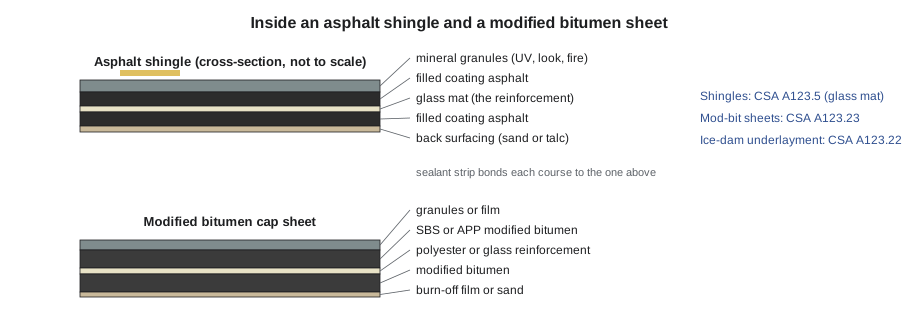
Inside each sheet is a reinforcing mat. Polyester mats stretch, which helps the sheet survive building movement and resist punctures. Glass fibre mats hardly stretch, which keeps the sheet dimensionally stable. Some sheets use both. The surface of a cap sheet is usually coloured mineral granules, which protect the bitumen from UV light, add fire resistance and give the colour. Base sheets and torch-grade sheets have a thin plastic film or sand on the bottom; on torch sheets the film burns off as the torch melts the bitumen, showing the roofer the sheet is hot enough.
Standards for mod-bit sheets set minimum thickness, strength, flexibility at low temperature and other properties. In Canada, the main standard is CSA A123.23; many products also list ASTM D6162, D6163 or D6164 (SBS) and D6222 or D6223 (APP). Self-adhered mod-bit sheets, which have a sticky underside under a release film, are used where torching is not allowed and as ice-dam and valley protection under shingles.
Worked problem
How many rolls of base sheet?
Ashgrove Plaza needs a mod-bit base sheet over 2,600 m² of roof. Each roll is 1 m wide by 15 m long. Side laps are 75 mm and end laps 150 mm. How many rolls cover the field of the roof, before extra for flashings and waste?
Show solution
- Width left exposed after the side lap = 1.000 − 0.075 = 0.925 m.
- Length left after the end lap = 15 − 0.15 = 14.85 m.
- Coverage per roll = 0.925 × 14.85 ≈ 13.74 m².
- Rolls = 2,600 ÷ 13.74 ≈ 189.3, so 190 rolls.
Answer: 190 rolls for the field. Laps take about 8 in 100 of each roll, so never estimate from the gross roll area. Flashings, parapets and waste come on top.
Asphalt shingles
Asphalt shingles cover most houses in Canada and the US. Modern shingles have a glass fibre mat in the middle, coated on both sides with asphalt that has been filled with fine mineral powder to make it tougher and more fire-resistant. The top is covered with ceramic-coated mineral granules for colour, UV protection and fire resistance; the back has sand or talc so bundles do not stick together. A strip of factory-applied sealant bonds each shingle to the one above once the sun warms it. In Canada, glass-mat shingles are made to CSA A123.5. Organic-mat shingles, made on a felt base, have largely left the market.
There are two main styles:
- Three-tab (strip) shingles: a single layer with two cutouts forming three tabs. They give a flat, uniform look and are now less common.
- Laminated (architectural or dimensional) shingles: two layers bonded together, giving a thicker, shadowed look. They are heavier, last longer and resist wind better, and are now the most common type.
Other features to know: algae-resistant granules (containing copper) prevent the black streaks of algae growth; impact-resistant shingles are tested by having steel balls dropped on them and are rated, with Class 4 the highest; and premium shingles can carry higher wind ratings when installed with extra nails and starter strips. Lesson 10 covers wind ratings.
Each shingle has a printed or marked nailing zone. Each manufacturer sets the size of its shingles, the exposure and the number of nails. Common sizes are:
| Shingle type | Typical size | Typical exposure | Bundles per square |
|---|---|---|---|
| Metric three-tab | 1,000 × 333 mm (about 39-3/8 × 13-1/8 in) | 143 mm (5-5/8 in) | 3 |
| Metric laminated | 1,000 × 337 mm (about 39-3/8 × 13-1/4 in) | 143 mm (5-5/8 in) | 3 (some heavy products 4) |
| English three-tab | 305 × 914 mm (12 × 36 in) | 127 mm (5 in) | 3 |
The exposure is the part of each shingle that shows after the next course goes on. Courses are laid up the roof one exposure at a time, so the exposure controls how many courses there are, and the size of the shingle and its exposure together control how many shingles make a square.
Worked problem
Exposure, courses and shingles per square
Keisha's next roof has a slope length of 5,400 mm from the eave to the ridge. The laminated shingles are 1,000 mm × 337 mm with a 143 mm exposure. How many courses run up each slope, and how many shingles make a square?
Show solution
- Courses = slope length ÷ exposure = 5,400 ÷ 143 ≈ 37.8, so 38 courses (the last one is cut to fit under the ridge cap).
- Area each shingle covers = length × exposure = 1.000 m × 0.143 m = 0.143 m².
- One square = 9.29 m², so shingles per square = 9.29 ÷ 0.143 ≈ 65.
- At 3 bundles per square, a bundle holds about 65 ÷ 3 ≈ 22 shingles.
Answer: About 38 courses per slope and about 65 shingles per square, in roughly 22-shingle bundles. Check every wrapper: a different exposure changes both numbers.
Roll roofing
Mineral-surfaced roll roofing is a heavy, granule-surfaced asphalt sheet sold in rolls, used on sheds, garages and porches with slopes too low for shingles. Some types have a wide plain strip along one edge (a selvage) so each course can be lapped and cemented to the next with a double coverage. In Canada, roll roofing is made to CSA A123.2. It is cheap and quick but short-lived compared with a mod-bit membrane, which has largely replaced it on low-slope house roofs.
Cements, primers and coatings
A family of cold-applied asphalt products is used for details, repairs and maintenance:
| Product | What it is | Used for |
|---|---|---|
| Asphalt primer | thin asphalt in solvent (or water) | priming concrete, metal and masonry so bitumen sticks |
| Plastic roofing cement | thick asphalt paste with fibres | sealing flashings, filling small gaps, setting edges |
| Lap cement | thinner asphalt cement | bonding laps of roll roofing and felts |
| Cold-process adhesive | asphalt adhesive applied by squeegee or spray | bonding mod-bit and felt plies without heat |
| Asphalt emulsion | asphalt dispersed in water | coatings and surfacing; must not freeze before curing |
| Aluminum (aluminized) coating | asphalt carrying aluminum flakes | reflective surfacing of smooth bitumen roofs |
| Self-adhered membranes | mod-bit sheets with a sticky back | eaves, valleys, details and torch-free areas |
Cements and primers are not substitutes for proper flashings. A bead of plastic cement may seal a gap for a season, but it hardens and cracks as the sun ages it. Many solvent-based products are flammable and give off vapours, so keep them away from torches and kettles, use them with ventilation and follow the safety data sheet. Some cold-applied products only cure above a minimum temperature, and water-based ones must not freeze.
Storing and handling asphalt products
Asphalt products are damaged by heat, cold, moisture and rough handling long before they reach the roof:
- Store rolls standing on end, on a dry, flat surface, so they do not flatten into ovals or develop creases. Stack no more than the maker allows.
- Store shingle bundles flat, never bent over a ridge or stacked too high, and keep them out of direct sun if stored for long, so the sealant strips do not stick the shingles together.
- In cold weather, keep mod-bit rolls and shingles in a warm place until use. Cold sheets crack when unrolled and cold shingles crack when bent over a ridge. Cold weather also slows the sealant strips, so some makers require hand-sealing shingles with dabs of cement.
- Keep everything dry. Felts and organic products absorb water; wet base sheets blister when torched.
- Watch the dates. Adhesives, primers and sealants have a shelf life printed on the container.
- Spread the load on the roof; a pallet of shingles weighs about a tonne (a ton) or more.
Why asphalt roofs fail
Most asphalt roofs fail through a short list of causes, and most are installation or design problems rather than bad materials:
- Age and oxidation: granules wear off, asphalt hardens and cracks.
- Blisters: pockets of trapped moisture or air between plies expand in the sun and lift the membrane.
- Splits and ridges: built-up roofs crack along insulation joints when the roof moves.
- Poor laps and seams: cold or dirty laps on mod-bit, or too little asphalt between plies on BUR.
- Wrong product for the slope: soft asphalt sliding on a steep roof, or shingles on a slope too low for them.
- Ponding: standing water speeds aging and finds every weak lap.
- Overheated or underheated asphalt: burned asphalt loses its properties; cool asphalt does not bond.
Rory wrote one line from Marco in his notebook: "The black stuff forgives a lot, but not cold laps, wet felts or the wrong slope."
Common mistakes
MistakeApplying asphalt directly over a coal-tar roof.
InsteadIdentify old roofs first; coal tar and asphalt are not compatible without a proper separation, and coal tar needs special handling.
MistakeUsing the same kettle temperature for every asphalt.
InsteadRead each carton for the EVT range and maximum heating temperature.
MistakeEstimating rolls from their gross area.
InsteadSubtract side and end laps to find the true coverage per roll.
MistakeStoring rolls on their sides or bundles bent over the ridge.
InsteadStore rolls on end and bundles flat, dry and out of long sun exposure.
MistakeRelying on plastic cement as a permanent flashing.
InsteadUse proper metal or membrane flashings; cement is for setting and small repairs.
Summary and key terms
- Roofing bitumen is asphalt from oil refining; older roofs may contain coal-tar pitch, which needs identification and care.
- Asphalt is thermoplastic: it softens with heat, stiffens with cold and oxidizes with age.
- BUR asphalt is graded by softening point, from soft Type I to hard Type IV.
- Glass fibre ply sheets and base sheets reinforce built-up roofs; felts and synthetics serve as steep-slope underlayment.
- Modified bitumen adds SBS (elastic) or APP (plastic) polymers and a polyester or glass mat.
- Shingles are glass-mat, filled-asphalt, granule-surfaced units; exposure sets the number of courses and shingles per square.
- Cements, primers and coatings support details and maintenance but do not replace flashings.
- Bitumen
- Black, sticky, waterproof hydrocarbon material; in roofing, usually asphalt.
- Softening point
- The temperature at which asphalt softens enough to flow in a standard test.
- Built-up roof (BUR)
- A roof of several plies of felt bonded with hot asphalt and surfaced.
- Modified bitumen
- Asphalt blended with polymers such as SBS or APP and made into reinforced sheets.
- SBS
- Styrene-butadiene-styrene, a rubbery polymer that makes bitumen elastic.
- APP
- Atactic polypropylene, a plastic polymer that makes bitumen tougher.
- Exposure
- The part of a shingle left exposed to the weather.
- Laminated shingle
- A shingle made of two bonded layers for a thicker look and better performance.
Practice problems
Work each problem on paper first, then reveal the answer to check.
Which modified bitumen stays more flexible in cold weather?
Show answer
SBS.
A shingle is 1,000 mm long with a 143 mm exposure. About how many make a square?
Show answer
9.29 ÷ 0.143 ≈ 65.
A slope is 4,860 mm long. With a 143 mm exposure, how many courses?
Show answer
4,860 ÷ 143 ≈ 34.0, so 34 courses.
Why are torch-grade mod-bit sheets made with a film on the bottom?
Show answer
It keeps rolls from sticking, and it shrinks and burns off when the sheet is hot enough to bond.
How should mod-bit rolls be stored?
Show answer
Standing on end, on a dry, flat surface, kept warm in cold weather.
Lesson quiz · 5 questions
Score 60% or more to complete this lesson.
Create a free account to save your progress, take quizzes and earn a certificate.