
RCDD-115 · Lesson 11 of 12 · 20 min
Outside plant cable types and protection
▶ Video coming soon A video version of this lesson is on the way.
Three cable samples sit on Daniel's desk, sent by suppliers who heard about the Harbourview project. One is stiff and heavy, with a corrugated steel layer under the black jacket. One is light and round, and when Daniel cuts it open there is no gel at all, only dry tapes and yarns around the coloured tubes. The third is flat and thin, with fibres bonded side by side. Roz picks up each in turn. 'All three would work,' she says. 'The question is which one survives the next forty years in this particular ground, with these particular rodents, and which one your splicer can work with on a cold March morning.'
Outside plant cables must survive conditions that indoor cables never meet: water, frost, sunlight, temperature swings, crushing loads, rodents, lightning and the forces of installation. This lesson describes how fibre and copper outside plant cables are built, how to choose among the common types and how to protect them, and how fibres and pairs are identified so that splicers at both ends connect the right ones.
Fibre cable construction
Most outside plant fibre cables use a loose tube design. Fibres, coated to about 250 micrometres or, in newer high-count cables, 200 micrometres, lie loosely inside plastic buffer tubes, usually 6, 12 or 24 fibres per tube. Because the fibres are loose and slightly longer than the tube, the cable can stretch under tension or shrink in cold without straining the glass. The tubes are wound around a central strength member, often of glass-reinforced plastic, and surrounded by water-blocking materials, strength yarns and a polyethylene outer jacket that resists sunlight and moisture.
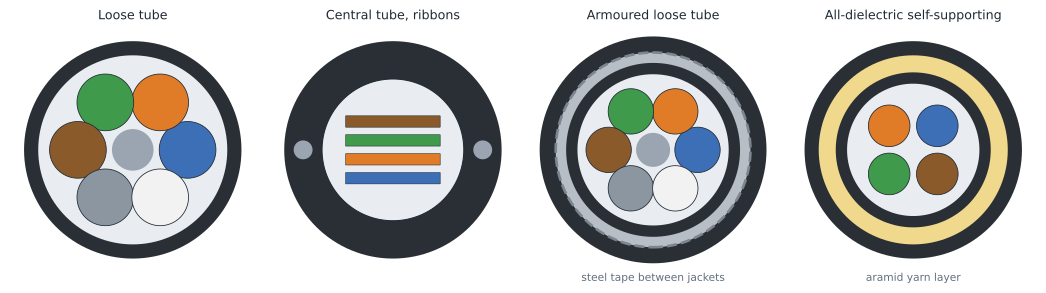
Central tube cables put all the fibres, often in ribbons, in a single large tube with strength members embedded in the jacket. Ribbon cables group fibres side by side in flat ribbons of 12, which can be spliced twelve at a time with a mass fusion splicer, cutting splicing time on high-count cables. Newer rollable or flexible ribbons bond fibres only at intervals, so the ribbon can be rolled into a compact bundle for very high fibre counts in a small cable and flattened again for mass splicing. Microduct cables, very small and light, are blown into small ducts with compressed air and suit dense campus and city networks.
Keeping water out
Water in a fibre cable is a long-term threat. It can freeze and crush fibres, and over many years it can weaken the glass. Older cables filled every space with a petroleum gel. Gel works well but is messy to clean before splicing and takes time on a cold day. Most new cables are dry: they use water-swellable tapes and yarns that absorb any water that enters and swell to block it from travelling along the cable. Dry cables are lighter, cleaner and faster to prepare for splicing, and most splicers prefer them. Some designs still gel-fill the buffer tubes while keeping the core dry.
Jackets and armour
The outer jacket of outside plant cable is usually medium-density or high-density polyethylene, which resists moisture, sunlight and abrasion. It burns readily, which is why these cables must transition to listed indoor cable at the building entrance, as Lesson 10 explained. A cable may have one jacket or two, with armour between them.
Armour is a layer of corrugated steel tape, sometimes coated with plastic, wrapped around the core. It resists crushing and protects against rodents, which are a serious threat to buried and aerial cable in many regions: gophers, squirrels and rats chew jackets, and a single bite can break fibres. Armour also has costs. It makes the cable heavier and stiffer, it is conductive, so it must be bonded at building entrances and in structures, and it adds a path for lightning current into the cable route. Dielectric alternatives use glass yarns or hard jackets that discourage rodents without adding metal.
| Construction | Strengths | Weaknesses | Typical uses |
|---|---|---|---|
| Loose tube, dry, all-dielectric | Light; no bonding; easy splicing | Less crush and rodent resistance than armour | Campus ducts with innerduct |
| Loose tube, armoured | Crush and rodent resistant | Heavier; conductive; must be bonded | Direct burial, rodent areas |
| Ribbon or rollable ribbon | High counts in small diameter; mass splicing | Needs ribbon splicing equipment | High-count backbones, data centre campuses |
| ADSS | Self-supporting; no metal near power | Span and load limits; special hardware | Aerial routes on power poles |
| Figure-eight with messenger | One-pass aerial installation | Messenger is conductive | Aerial routes without existing strand |
| Microduct cable | Very small; blown in | Needs microduct system | Dense campus and city routes |
Fibre types for outside plant
Nearly all outside plant fibre today is singlemode. The most common type follows the ITU-T G.652.D recommendation, a low water peak singlemode fibre that works across the 1310 nm to 1625 nm range. Bend-insensitive singlemode fibres, defined in ITU-T G.657, tolerate tighter bends with less added loss and are common in drop cables, in closures and in high-count cables where fibres are packed tightly; the G.657.A categories are designed to splice and work with G.652.D fibre. The designer should specify the fibre type by recommendation and category so that all cables in a system are compatible.
Identifying fibres and tubes
A splicer at one end of a 144-fibre cable must connect fibre 87 to fibre 87 at the other end. Fibres and tubes are identified by a standard sequence of twelve colours, set in North America by ANSI/TIA-598. The same twelve colours mark the fibres within each tube and the tubes within the cable.
| Position | Colour | Position | Colour |
|---|---|---|---|
| 1 | Blue | 7 | Red |
| 2 | Orange | 8 | Black |
| 3 | Green | 9 | Yellow |
| 4 | Brown | 10 | Violet |
| 5 | Slate | 11 | Rose |
| 6 | White | 12 | Aqua |
With 12 fibres per tube, fibre numbers map directly to tube and fibre colours. Fibres 1 to 12 are in the blue tube, 13 to 24 in the orange tube and so on.
Worked problem
Finding fibre 87
In a 144-fibre loose tube cable with 12 fibres per tube, which tube and which fibre colour is fibre 87?
Show solution
- Tube: 87 ÷ 12 = 7.25, rounded up to 8. Tube 8 is black.
- Fibre in tube: 87 − 12 × 7 = 87 − 84 = 3. Fibre 3 is green.
Answer: Fibre 87 is the green fibre in the black tube.
Copper outside plant cable
Outside plant copper cable carries twisted pairs in counts from a few pairs to thousands, in gauges commonly 24, 22 or 19 AWG. The core is filled with a gel compound to keep water out, or, in older networks, kept dry with air pressure. A metallic shield, usually corrugated aluminium or steel, surrounds the core and must be bonded at every splice and at each building entrance to provide a continuous path for induced currents, as RCDD-113 discussed. Pairs are identified with the standard telephone colour code: groups of 25 pairs formed by five main colours (white, red, black, yellow, violet) combined with five minor colours (blue, orange, green, brown, slate), with larger cables built from colour-coded binder groups of 25 pairs.
Protecting cables in the route
Cable choice is one layer of protection. The route provides the others. Underground, ducts and concrete encasement protect against crushing and digging, marker tape and tracer wire help others find the cable before they dig, and depth protects against frost and surface work. Aerial cables are protected by guards where they run down poles, by slack loops that allow repairs, and by placement away from tree limbs where possible. In structures, cables are racked off the floor, sealed in ducts and tagged.
Rodents deserve specific planning. In northern Minnesota and northwestern Ontario, pocket gophers and other burrowing animals are less of a problem than in the prairies to the west, but squirrels on aerial routes and mice and rats in ducts are common everywhere. Rodent-resistant designs include steel armour, glass yarn armour and hard nylon or polyamide outer jackets. Sealing ducts keeps animals out of the route altogether.
Lightning and induced voltage
Long metallic paths in cable routes, such as armour, copper shields and strand, can pick up voltage from lightning strikes and from faults on nearby power lines. Bonding those paths at intervals and at both ends limits the voltage. All-dielectric fibre cable avoids the problem entirely, which is why many campus designs use dielectric cable in ducts even where armour would add rodent protection. If armour is needed, the designer specifies bonding at each structure and entrance.
Cable handling and storage
Outside plant cable is shipped on reels, and reel length limits how far a single cable can run without a splice. Common reel lengths for fibre are several kilometres, far more than a campus link needs, but large-diameter copper cables may come in shorter lengths, which forces splice points. Reels must be stored and handled so that the cable is not crushed or kinked, and cold-weather installation needs care: polyethylene jackets stiffen in the cold, and many cables have a minimum installation temperature below which they should not be pulled or bent.
Worked problem
Choosing the Harbourview campus cable
The campus cable will run in a dedicated innerduct in a sealed, concrete-encased duct bank, with three maintenance holes and transition splices at both entrances. The college wants easy splicing for future laterals and no metallic paths between buildings. Which construction should Daniel specify?
Show solution
- In a sealed duct bank with innerduct, crush and rodent risks are low, so armour adds little.
- The college wants no metallic paths, which rules out armour and metallic strength members.
- Dry water blocking makes splicing faster and cleaner in cold weather.
- At 144 fibres, loose tube with 12 fibres per tube is easy to splice with single-fibre or ribbon splicers.
Answer: A 144-fibre, all-dielectric, dry-core loose tube singlemode cable with G.652.D fibre, 12 fibres per tube, and a medium-density polyethylene jacket.
Cable specifications that matter
A data sheet for outside plant cable lists many values, and a few of them decide whether a cable suits a route. Maximum rated tensile load during installation sets the pulling limit used in Lesson 7. Long-term rated load, much lower, is the force the cable can carry permanently, which matters for aerial spans and vertical runs. Minimum bend radius is usually given twice: a larger value under tension during installation and a smaller one when installed. Crush resistance tells how much load the cable can take without damage, which matters for direct burial. Operating and installation temperature ranges matter in northern climates, where the installation range may stop work for part of the winter. And the cable's outside diameter decides how many cables fit in an innerduct or duct.
The designer should copy these values into the specification or require cables that meet stated minimums, so that a substitute cable offered by the contractor can be checked against them. Two cables with the same fibre count can differ widely in diameter, weight and tensile rating, and a substitute that is heavier or weaker may not survive the pulls that were planned for the original.
Exam focus: identification
Questions about colour codes are a favourite because the answer can be worked out exactly. Remember the order, blue, orange, green, brown, slate, white, red, black, yellow, violet, rose, aqua, and practise mapping fibre numbers to tubes and positions until it becomes automatic.
Common mistakes
MistakeSpecifying armour everywhere for safety.
InsteadArmour adds weight and a conductive path; in sealed duct with innerduct, dielectric cable is often the better choice.
MistakeMixing fibre types without checking compatibility.
InsteadSpecify fibre by ITU-T recommendation and category so that cables in one system splice and perform together.
MistakeLeaving copper shields unbonded at splices.
InsteadBond shields at every splice and entrance to keep a continuous path.
MistakeInstalling cable below its minimum temperature.
InsteadCheck the maker's installation temperature and plan winter work accordingly.
Summary and key terms
- Most outside plant fibre cable is loose tube singlemode, with fibres in colour-coded tubes around a central strength member.
- Dry water-blocking materials have largely replaced gel; ribbon and rollable ribbon designs pack high counts and allow mass splicing.
- Armour resists crushing and rodents but is heavy and conductive; dielectric designs avoid bonding.
- Fibres and tubes are identified by the twelve-colour sequence: blue, orange, green, brown, slate, white, red, black, yellow, violet, rose and aqua.
- Copper outside plant cable uses filled cores, metallic shields and the 25-pair colour code; shields must be bonded.
- Loose tube
- A cable design with fibres lying loosely in buffer tubes.
- Ribbon fibre
- Fibres bonded side by side for mass splicing.
- Water-swellable tape
- A tape that swells when wet to block water from travelling along a cable.
- Armour
- A metallic layer that protects a cable from crushing and rodents.
- G.652.D
- The ITU-T recommendation for standard low water peak singlemode fibre.
- G.657
- The ITU-T recommendation for bend-insensitive singlemode fibre.
Practice problems
Work each problem on paper first, then reveal the answer to check.
Which tube and fibre colour is fibre 30 in a cable with 12 fibres per tube?
Show answer
Tube 3, green; fibre 6, white.
Why might a designer avoid armoured cable in a sealed duct bank?
Show answer
It adds weight and a conductive path that must be bonded, while the duct already protects it.
What is the advantage of ribbon fibre for high-count cables?
Show answer
Twelve fibres can be spliced at once, and more fibres fit in a smaller cable.
Lesson quiz · 5 questions
Score 60% or more to complete this lesson.
Create a free account to save your progress, take quizzes and earn a certificate.