
RCDD-115 · Lesson 6 of 12 · 20 min
Campus backbone planning
▶ Video coming soon A video version of this lesson is on the way.
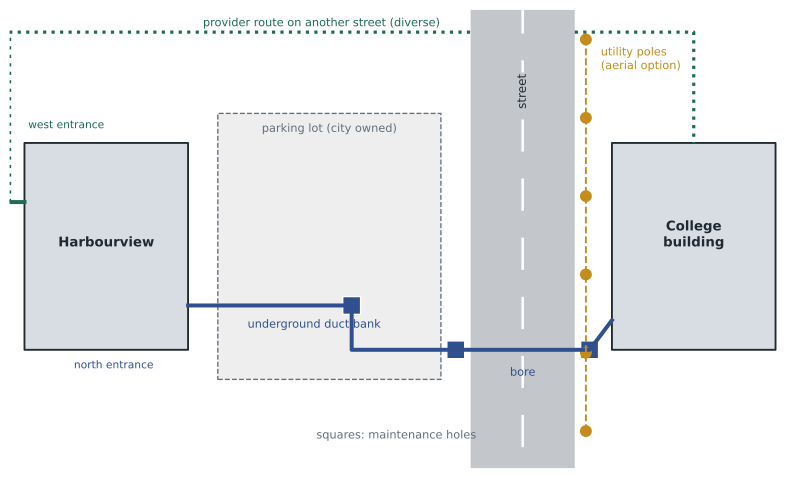
The college's existing building sits 400 m east of the Harbourview site, across a parking lot and a two-lane municipal street. Today the two properties share nothing but a bus stop. By next autumn they must share a network: students will move between classrooms in both buildings, the clinic will send images to the college's teaching labs, and Harbourview's data room will hold the college's backup servers. Roz unrolls the site plan on the big table. 'Inside a building, the pathways are given to us by the architect,' she says. 'Outside, we have to find them ourselves, and every metre crosses someone else's land, pipes or rules. Start with the plan, not the cable.'
A campus backbone connects buildings that belong to one owner or one group of owners, usually on adjacent properties. It is the outside part of the backbone cabling described in ANSI/TIA-568 and ANSI/TIA-758, the customer-owned outside plant standard. Campus design has its own questions: what topology to use, how many fibres to install, which routes are possible, how to make the network survive the loss of one route, and when it makes more sense to lease capacity from a provider than to build. The physical details of underground and aerial pathways come in later lessons; this one is about planning.
Campus topologies
The recommended campus topology is a star. One building houses the main cross-connect, and each other building connects to it with its own backbone cable, terminating at an intermediate cross-connect or directly in that building's entrance facility. A star gives each building a single, predictable path to the core and makes it easy to add buildings. On large campuses, a two-level hierarchy may connect clusters of buildings to an intermediate cross-connect that then links to the main one.
A physical ring, in which cables loop from building to building and back to the start, gives every building two paths to the core: if the ring is cut in one place, traffic flows the other way around. Rings save cable on some campuses and suit networks that can switch direction automatically. Many designers combine the two ideas: a physical star for the cabling structure, plus a second cable from each critical building to a second core location by a different route. The result is called a star with diverse paths, and it gives the redundancy of a ring with the simplicity of a star.
Where is the main cross-connect?
On the Harbourview and college campus there are two candidate cores: the college's existing computer room and Harbourview's new data room. Roz suggests making the college computer room the main cross-connect, because it already holds the college's core network and provider services, and treating Harbourview as a second core location for backup. Each building then connects to the college core by the underground link and has a second, diverse path through a provider service. If the campus grows to a third building, it will connect to both.
Counting fibres
Campus fibre is expensive to install and very cheap per fibre once a cable is in the ground, so designers install many more fibres than today's network needs. The calculation starts from the applications, adds growth and spares, and rounds up to a standard cable size.
Worked problem
Sizing the Harbourview campus cable
The network team needs, today, 4 duplex links between the two cores for the main network, 2 duplex links for the storage replication network and 1 duplex link each for building automation, security and the clinic's imaging system. They expect traffic to double twice in the cable's life and want half again as many spares on top. How many singlemode fibres should the campus cable have?
Show solution
- Duplex links today: 4 + 2 + 1 + 1 + 1 = 9, which is 18 fibres.
- Two doublings: 18 × 4 = 72 fibres.
- Half again as spares: 72 × 1.5 = 108 fibres.
- Round up to a standard cable size: 144 fibres.
Answer: A 144-fibre singlemode cable. The difference in cost between 108 and 144 fibres is small next to the cost of the trench.
Cable sizes follow the construction of the cable. Loose tube cables group fibres in tubes of 6, 12 or 24 fibres, and common counts are 12, 24, 48, 72, 96, 144, 216 and 288 fibres. Ribbon cables, which bond 12 fibres side by side, reach much higher counts in a small diameter and splice twelve fibres at a time. Lesson 11 covers cable construction.
Multimode or singlemode? On a campus, singlemode is almost always the answer. Multimode reach at high speeds is limited to a few hundred metres at best, while singlemode supports today's and tomorrow's applications over many kilometres. The transceivers cost more, but the cable lasts for decades, and a campus cable that limits future speeds is a poor investment. Some campuses add a few multimode fibres for older equipment, but the backbone is singlemode.
Copper on the campus
A few systems still need copper between buildings: older telephone services, some fire alarm and elevator telephone circuits, and controls that predate network connections. Outside plant copper cables are larger, heavier and more expensive than fibre for the capacity they carry, and every copper conductor entering a building must be protected against lightning and power faults, as RCDD-113 showed. Daniel asks the college and the fire alarm designer which circuits really need copper. The answer is a single 25-pair cable for the elevator phones and two fire alarm circuits, which the fire alarm designer prefers to carry on fibre with media converters anyway. Daniel includes the 25-pair cable but notes that it may be removed from the design if the authority having jurisdiction accepts the fibre approach.
Choosing a route
Between two buildings there are usually several possible routes, and each has its own costs, risks and permissions. The designer lists them, walks them and compares them before choosing.
| Route | Advantages | Disadvantages |
|---|---|---|
| Underground duct bank through the parking lot and under the street | Protected from weather and vehicles; spare ducts for future cables; owner controls it | Highest construction cost; street crossing needs a municipal permit; locates and restoration required |
| Aerial on existing utility poles along the street | Lower cost; quick if pole space is available | Depends on pole owner approval and make-ready work; exposed to storms, ice and vehicle strikes |
| Leased fibre or service from a provider | No construction; provider maintains it | Monthly cost; less control; provider route may share risks with the owner's own route |
The route comparison is partly about money and partly about risk. Costs per metre vary widely with soil, rock, paving and the number of crossings, and the designer should get local estimates rather than rely on rules of thumb. But a simple comparison shows why owners often choose underground for their main link despite its cost.
Worked problem
Comparing route costs
An estimator gives these rough figures for the campus link. Underground: 420 m of duct bank at 310 dollars per metre, plus 18,000 dollars for the street crossing and 9,000 dollars for two maintenance holes. Aerial: 460 m along the poles at 55 dollars per metre, plus 22,000 dollars of make-ready work. What does each cost, and what is the difference?
Show solution
- Underground: 420 × 310 = 130,200, plus 18,000 and 9,000, for 157,200 dollars.
- Aerial: 460 × 55 = 25,300, plus 22,000, for 47,300 dollars.
- Difference: 157,200 − 47,300 = 109,900 dollars.
Answer: About 157,000 dollars underground and 47,000 dollars aerial. The college must decide whether ducts it owns, protected from storms and with room for future cables, are worth about 110,000 dollars more.
The college chooses the underground route for its primary link and leases a provider service for the diverse path. Elena's reasoning is simple: the campus link will carry clinic imaging and teaching for thirty years, and the college does not want its network to depend on the condition of someone else's poles. The aerial option remains on file as a backup plan if the street crossing permit is delayed.
Diversity
Diversity means that two paths do not share a single point of failure. It is easy to claim and hard to deliver. Two conduits in the same trench are not diverse. Two cables that leave different buildings but meet in the same maintenance hole are not diverse. A provider service that runs in the same street as the owner's own duct bank may not be diverse. The designer should ask providers for route maps, which they may supply only under a confidentiality agreement, and check where their routes run relative to the owner's.
At Harbourview, the provider's fibre enters from the west side of the building, from a street different from the one the campus duct bank crosses, and reaches the college building from its north side. The two routes never come closer than about 150 m except inside the two buildings, where they enter separate entrance rooms. Daniel records this on the site plan so that future projects do not undo it.
Lease or build?
For campuses whose buildings are far apart, or separated by highways, rail lines or rivers, building a private route may be impractical. Leased options include dark fibre, where the owner leases strands in a provider's cable and lights them with its own equipment; wavelength services, where a provider carries the owner's traffic on a dedicated wavelength; and managed network services. Dark fibre gives the most control and is closest to an owned backbone, but availability depends on the market. The designer's job is to present the options, including the long-term costs and the control each gives, so that the owner can choose.
Documenting the plan
The campus backbone plan should include a site plan showing all routes, buildings, entrance locations and existing utilities; the topology and which building holds each cross-connect; fibre and copper counts with the reasoning behind them; route comparisons and the reasons for the choice; diversity requirements and how they are met; and the permits, easements and approvals needed, which are covered in Lesson 12. Daniel's plan runs to six pages and a drawing. Roz tells him that on a larger campus it would be a separate report delivered before the building design even begins.
Exam focus: campus planning questions
Exam questions about campus backbones usually test judgement rather than arithmetic. Typical questions ask which topology suits a set of buildings, why singlemode is preferred, what makes two routes truly diverse, or which factor should drive the choice between aerial and underground plant. Read each scenario for clues. A question that mentions an owner who wants control and long life points toward owned underground plant. One that mentions a tight budget and existing poles points toward aerial. One that mentions buildings far apart across a highway or river suggests leased services. One that stresses critical operations points toward diverse paths and separate entrances.
Fibre count questions follow the same pattern as the worked example: count today's links, convert to fibres, apply growth and spares, then round up to a standard size. The trap is forgetting that a duplex link uses two fibres, or applying the spare allowance before the growth instead of after. Write the steps down, even when the arithmetic looks easy, and check that the answer is one of the common cable sizes before choosing it.
Common mistakes
MistakeTreating two cables in one trench as diverse.
InsteadDiverse routes must not share a trench, maintenance hole, pole line or entrance.
MistakeChoosing multimode for a campus backbone.
InsteadUse singlemode for campus links; multimode reach at high speeds is too short for future applications.
MistakeSizing fibre counts to today's links.
InsteadAdd growth and spares, then round up to a standard cable size.
MistakeChoosing a route from the plan alone.
InsteadWalk every route, check existing utilities and permits, and get local cost estimates.
Summary and key terms
- A campus backbone connects buildings in a star from a main cross-connect, often with diverse second paths for critical buildings.
- Fibre counts start from today's links, add growth and spares, and round up to a standard cable size; singlemode is the normal choice.
- Copper between buildings should be limited to circuits that need it, because every outside copper conductor needs protection.
- Route choices compare underground, aerial and leased options on cost, risk, control and permits.
- Diversity requires routes that share no trench, structure or entrance.
- Campus backbone
- Cabling that connects buildings within a campus.
- Main cross-connect
- The central distribution point of the campus or building backbone.
- Diverse path
- A second route that shares no single point of failure with the first.
- Dark fibre
- Leased unlit fibre strands that the owner connects with its own equipment.
- Loose tube cable
- A cable in which fibres are grouped loosely in protective tubes.
- Ribbon cable
- A cable in which fibres are bonded side by side in flat ribbons.
Practice problems
Work each problem on paper first, then reveal the answer to check.
A campus needs 12 duplex links today, expects growth of three times and wants a third again as spares. What fibre count is needed before rounding?
Show answer
24 fibres × 3 = 72; 72 × 4/3 = 96 fibres.
Why are two conduits in the same trench not diverse?
Show answer
One excavation or failure can damage both.
Give one advantage and one disadvantage of an aerial campus route.
Show answer
Lower cost or quick installation; exposure to weather and vehicles, or dependence on the pole owner.
Lesson quiz · 5 questions
Score 60% or more to complete this lesson.
Create a free account to save your progress, take quizzes and earn a certificate.