
NUC-200 · Lesson 12 of 12 · 21 min
Nuclear in Canada: CANDU and SMRs
Six months after joining Meridian, Hana is asked to give the closing presentation at a second public session in Oshawa, this time on the bigger picture: where nuclear energy stands in Canada today and where it is heading. Dr. Brennan suggests she tie the whole course together, from the binding energy curve to the accidents, through the story of one country's nuclear program and the project her team is working on. This final lesson follows her preparation.
Canada's nuclear story is unusual. It is one of very few countries to have designed its own reactor type, the CANDU, and built a full industry around it, from uranium mines in Saskatchewan to fuel plants and reactors in Ontario. Nuclear energy supplies roughly half of Ontario's electricity and about 13 to 15 percent of Canada's. The country is now building the first grid-scale small modular reactor in the G7 at Darlington, the project Hana has been supporting.
From ZEEP to CANDU
Canada's program began during the Second World War, when Canadian, British and French scientists worked in Montreal and then at Chalk River on the Ottawa River. The ZEEP reactor at Chalk River, in 1945, was the first reactor to operate outside the United States. The NRX research reactor followed in 1947 and the larger NRU in 1957; NRU supplied medical isotopes for six decades and was the source of much of the neutron-scattering research that earned Bertram Brockhouse a share of the 1994 Nobel Prize in Physics. A serious accident at NRX in 1952 damaged the core; the young Navy officer Jimmy Carter was among those sent to help with the cleanup, and the lessons fed into reactor safety thinking worldwide.
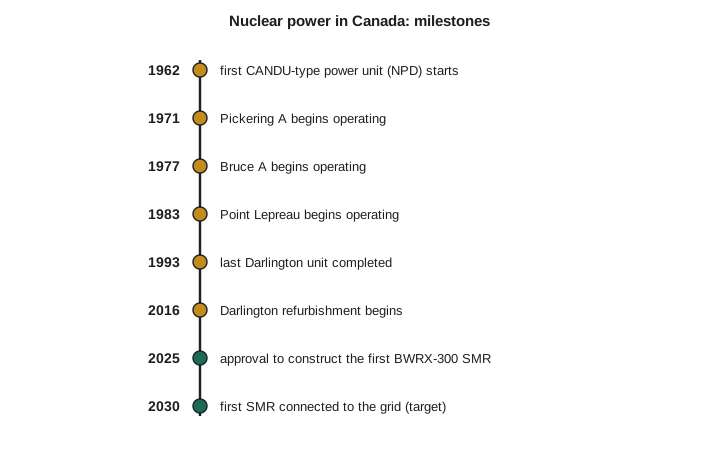
Atomic Energy of Canada Limited, Ontario Hydro and Canadian General Electric then developed the CANDU design. The Nuclear Power Demonstration reactor at Rolphton, Ontario, began operating in 1962, followed by the Douglas Point prototype and then the large multi-unit stations that define Ontario's grid today: Pickering in the early 1970s, Bruce from 1977 and Darlington, completed in 1993. Point Lepreau in New Brunswick and Gentilly-2 in Québec added single units, and CANDU reactors were exported to India, Pakistan, Argentina, South Korea, Romania and China. Lesson 6 explained the features that made CANDU distinct: heavy water, natural uranium, pressure tubes and on-power refuelling.
The fleet today
Canada's operating fleet consists of 17 CANDU units: eight at Bruce, four at Darlington and four at Pickering in Ontario, and one at Point Lepreau in New Brunswick. Bruce, on Lake Huron, is one of the largest operating nuclear plants in the world. The program below adds up the fleet: about 12.8 GW of capacity producing about 95 TWh a year at a typical capacity factor. Pickering's four remaining units are expected to stop for a planned refurbishment that would let them run into the 2060s.
# Canada's operating CANDU fleet and the first SMR units: rough annual energy
# (approximate net capacities; Pickering's remaining units begin refurbishment
# outages after 2026).
fleet = [  # station, units, approximate net MW per unit
    ("Bruce (Ontario)", 8, 820),
    ("Darlington (Ontario)", 4, 878),
    ("Pickering units 5-8 (Ontario)", 4, 516),
    ("Point Lepreau (New Brunswick)", 1, 660),
]
total = 0
for name, n, mw in fleet:
    total += n * mw
    print(f"{name:31}{n:2d} x {mw} MW = {n*mw:6,} MW")
cf = 0.85
print(f"Total about {total/1000:.1f} GW; at {cf:.0%} capacity factor about {total*8760*cf/1e6:.0f} TWh per year")

# Darlington New Nuclear Project: four 300 MWe BWRX-300 units
units, mw_unit, budget = 4, 300, 20.9e9          # budget in Canadian dollars
print(f"\nSMR site: {units*mw_unit} MW, about {units*mw_unit*8760*0.93/1e6:.1f} TWh per year at 93%")
print(f"Project budget per kW, all four units: about {budget/(units*mw_unit*1000):,.0f} dollars")
print(f"First unit alone at 6.1 billion dollars: about {6.1e9/(mw_unit*1000):,.0f} dollars per kW")Bruce (Ontario) 8 x 820 MW = 6,560 MW Darlington (Ontario) 4 x 878 MW = 3,512 MW Pickering units 5-8 (Ontario) 4 x 516 MW = 2,064 MW Point Lepreau (New Brunswick) 1 x 660 MW = 660 MW Total about 12.8 GW; at 85% capacity factor about 95 TWh per year SMR site: 1200 MW, about 9.8 TWh per year at 93% Project budget per kW, all four units: about 17,417 dollars First unit alone at 6.1 billion dollars: about 20,333 dollars per kW
Refurbishment: a second life for CANDU
CANDU reactors need a major refurbishment after about 30 years, mainly to replace their pressure tubes and feeder pipes, which slowly deform under heat and radiation. A refurbishment takes each unit out of service for about three years and allows another 30 or more years of operation. Darlington's four units were refurbished one at a time from 2016, and the project was completed in early 2026, ahead of schedule and on its budget of about 12.8 billion dollars. Bruce Power is part way through a similar program, called the Major Component Replacement, that will run into the 2030s. Refurbishment costs far less per kilowatt than new construction, which is why Ontario has chosen to extend almost its whole fleet.
The Darlington New Nuclear Project
In 2021, OPG selected the GE Vernova Hitachi BWRX-300, a 300 MW electrical boiling water reactor, for its Darlington site, where an environmental assessment for new reactors had been approved years earlier. The CNSC issued a licence to construct the first unit in April 2025, Ontario approved the project in May 2025, and construction began soon after. By early 2026, the three shafts for the reactor building, the tunnel boring machine launch and the cooling water intake had reached full depth, and in April 2026 the 37 metre steel basemat was lowered into the reactor shaft. OPG aims to complete the first unit by the end of the decade and connect it to the grid by the end of 2030, with three more units to follow.
The cost is substantial. OPG's project budget is about 20.9 billion dollars for four units, 1200 MW in total, including about 1.6 billion for systems the units share. The first unit is estimated at 6.1 billion, which includes design and first-of-a-kind work that later units will not need to repeat. The program shows the cost per kilowatt: about 17 400 dollars for the whole project and about 20 300 dollars for the first unit alone. Those figures are higher than for a large reactor in a country with a continuous building program, but supporters argue that later units, at Darlington and elsewhere, will cost less as the supply chain and workforce gain experience.
Why small modular reactors
Ontario's choice of an SMR reflects several of this course's themes. The BWRX-300 uses familiar boiling water physics, conventional enriched fuel and passive cooling, which together reduce the number of components and safety systems. Its size suits a grid that wants to add capacity in steps. And because the same design is planned in the United States, Poland and elsewhere, Ontario hopes its supply chain will build modules for export. There is one notable departure from tradition: after six decades of CANDU, the first new Canadian reactor in a generation is a light water design, chosen for its readiness to deploy rather than for any national technology.
Other provinces are watching closely. Saskatchewan is studying SMRs to replace coal, New Brunswick has supported developers of advanced reactors at Point Lepreau, and Alberta has looked at nuclear heat for oil sands operations. Ontario is also planning large new builds: OPG is studying new large reactors at Wesleyville, east of Darlington, and Bruce Power is assessing a new station, Bruce C, of up to 4800 MW. Either would be the first large reactor started in Canada since Darlington.
Worked problem
Cost per unit of energy
Using the program's figure of 9.8 TWh a year from the four Darlington SMRs, estimate the capital cost per megawatt-hour if the 20.9 billion dollar cost is spread evenly over 60 years of output, ignoring interest.
Show solution
- Lifetime output: \(9.8\ \text{TWh} \times 60 = 588\ \text{TWh} = 5.88 \times 10^8\ \text{MWh}\).
- Cost per MWh: \(2.09 \times 10^{10} / 5.88 \times 10^8 = 35.5\ \text{dollars/MWh}\).
Answer: Without interest, the capital cost per megawatt-hour looks modest. In reality, interest during a long construction period and on the debt afterward can double or triple it, which is why financing and schedule matter so much for nuclear projects, and why government loans and guarantees often play a role.
Nuclear energy and the grid of the future
Ontario's Independent Electricity System Operator expects demand for electricity in the province to rise by about 75 percent by 2050, driven by electric vehicles, heat pumps, new industry and data centres. Its plans call for more of every clean source: wind, solar, storage, hydroelectric imports and new nuclear. Nuclear's role in that mix is the firm, low-carbon supply described in Lesson 1, running around the clock regardless of weather, with storage and hydroelectric plants following daily swings in demand. Ontario's experience since it closed its last coal plant in 2014 shows what that combination can achieve: one of the cleanest large grids in North America, with nuclear and hydroelectric power supplying most of the electricity in a typical year.
The workforce matters as much as the technology. Both new builds and refurbishments need welders, pipefitters, electricians, crane operators, quality inspectors, radiation protection technicians, licensed operators and engineers of every discipline. Many of the people who built and ran the first generation of plants have retired, and colleges and universities have expanded their nuclear programs in response. Meridian's own hiring plans, Dr. Brennan tells Hana, depend less on the price of uranium than on how many skilled people the region can train in the next ten years.
Regulation and the public
The CNSC regulates every nuclear facility and use of nuclear substances in Canada under the Nuclear Safety and Control Act. It holds public hearings before major licensing decisions, and anyone can take part. The Impact Assessment Agency of Canada reviews the environmental effects of large new projects. Indigenous rights are central: the Crown has a duty to consult Indigenous communities whose rights may be affected, and OPG's Darlington project, on the traditional territory of the Williams Treaties First Nations, includes agreements with them. Hana notes that, as Lesson 9 showed, the repository site was selected only after the host communities, including the Wabigoon Lake Ojibway Nation, agreed.
Public opinion has moved toward nuclear energy over the past decade, driven by concern about climate change, reliable supply and rising demand for electricity. Hana's experience at the information sessions confirms what surveys show: people want clear answers about safety, waste and cost, and they respond well when engineers explain the numbers honestly. The questions she heard in Lesson 1 shaped every lesson of this course.
The course in one page
Hana's closing slide summarizes the course. Nuclear energy comes from binding energy, released when heavy nuclei split. Each fission releases about 200 MeV and two or three neutrons, enough to sustain a controlled chain reaction. A moderator slows neutrons, and its absorption decides whether a reactor can use natural or enriched uranium. Radioactive decay follows fixed half-lives, which make it possible to plan shielding, storage and medical doses, and which create decay heat that must always be removed. Radiation doses can be measured and kept low with time, distance and shielding. The fuel cycle runs from mine to repository, with a small volume of high-level waste that must be isolated for a very long time. Accidents have taught the industry to rely on several independent layers of protection and on passive safety. Fusion is making progress but remains for the future.
For engineers, the field offers a wide range of work: reactor physics and thermal hydraulics, materials and chemistry, instrumentation and control, radiation protection, waste management, construction, project management and regulation. Meridian Nuclear Engineering's team on the Darlington project includes all of these. Hana ends her presentation by inviting the audience to visit the project's information centre, and starts preparing for her next role on the construction team.
Common mistakes
MistakeThinking Canada only uses CANDU technology.
InsteadThe first new reactors at Darlington are BWRX-300 light water SMRs.
MistakeAssuming refurbishment is like building a new reactor.
InsteadIt replaces worn components, mainly pressure tubes, at far lower cost per kilowatt.
MistakeComparing capital cost without interest.
InsteadFinancing during construction can multiply the real cost per megawatt-hour.
MistakeTreating a first unit's cost as the cost of every unit.
InsteadFirst-of-a-kind costs include design and learning that later units need not repeat.
MistakeThinking public engagement is optional.
InsteadPublic hearings, consultation and consent shape licensing and siting decisions.
Summary and key terms
- Canada developed its own reactor, CANDU, and nuclear supplies about half of Ontario's electricity.
- Canada's 17 CANDU units total about 12.8 GW; refurbishment extends their life by 30 years or more.
- The Darlington BWRX-300 is the first grid-scale SMR under construction in the G7, aiming for the grid by 2030.
- The four-unit project budget is 20.9 billion dollars, with the first unit at 6.1 billion.
- Cost per kilowatt and financing are the main challenges for new reactors.
- Regulators, public hearings and community consent shape every major project.
- CANDU
- The Canadian pressurized heavy water reactor design.
- Refurbishment
- A major overhaul that replaces worn components to extend a reactor's life.
- Capacity factor
- Actual output divided by the output at full power all the time.
- First-of-a-kind cost
- Extra cost carried by the first unit of a new design.
- Licence renewal
- Regulatory approval to operate a reactor beyond its original licence term.
- Uprate
- An approved increase in a reactor's rated power.
- Construction permit
- An approval from the regulator to build a nuclear facility.
- Small modular reactor
- A reactor of up to about 300 MWe built largely from factory modules.
Practice problems
Work each problem on paper first, then reveal the answer to check.
From the program, what is the total capacity of Canada's fleet?
Show answer
About 12.8 GW.
What is the cost per kilowatt of the first Darlington SMR?
Show answer
6.1 × 10⁹ / 300 000 kW ≈ 20 300 dollars/kW.
A 300 MWe unit runs at 93 percent capacity factor. What is its annual output?
Show answer
300 × 8760 × 0.93 = 2.44 × 10⁶ MWh, about 2.44 TWh.
Why do CANDU reactors need refurbishment after about 30 years?
Show answer
Pressure tubes and feeders slowly deform under heat and radiation and must be replaced.
Give one advantage of building several identical SMRs.
Show answer
Learning, standard parts and shared engineering reduce the cost and time of later units.
Why does interest matter so much for nuclear costs?
Show answer
Long construction periods mean large debts accumulate before the plant earns revenue.
Lesson quiz · 5 questions
Score 60% or more to complete this lesson.
Create a free account to save your progress, take quizzes and earn a certificate.