
NUC-200 · Lesson 2 of 12 · 22 min
Atoms, nuclei and isotopes
The second question on Hana's list came from a high school chemistry teacher: what is actually different about the uranium in a reactor, and why can't any uranium be used? To answer it, Hana goes back to the structure of the atom. Dr. Brennan tells her that every concept in nuclear engineering, from fuel enrichment to radiation shielding, rests on a handful of facts about nuclei: what they are made of, how tightly they are held together, and why some are stable while others are not.
Inside the atom
An atom has a tiny, dense nucleus surrounded by electrons. The nucleus contains protons, which carry a positive charge, and neutrons, which carry none. Together, protons and neutrons are called nucleons. The number of protons is the atomic number \(Z\), and it decides which element the atom is: every atom with 92 protons is uranium, and every atom with 1 proton is hydrogen. The total number of nucleons is the mass number \(A\), and the number of neutrons is \(N = A - Z\).
The nucleus is extraordinarily small. A typical nucleus has a radius of a few femtometres (one femtometre is \(10^{-15}\) m), while the atom as a whole has a radius of about \(10^{-10}\) m. If an atom were the size of a hockey arena, its nucleus would be about the size of a pea at centre ice. Yet the nucleus holds more than 99.9 percent of the atom's mass. Chemistry, which deals with how atoms share and exchange electrons, happens in the vast outer region. Nuclear engineering deals with the nucleus itself, and the energies involved are about a million times larger.
The radius formula says that nuclear volume grows in proportion to the number of nucleons, so all nuclei have about the same density, roughly \(2 \times 10^{17}\ \text{kg/m}^3\). A teaspoon of nuclear matter would weigh hundreds of millions of tonnes. Nucleons behave somewhat like molecules in a drop of liquid, packed closely and held by short-range attraction, and that picture underlies the liquid-drop model used later in this lesson.
Isotopes and nuclide notation
Atoms of the same element can have different numbers of neutrons. These variants are isotopes. Isotopes of an element behave almost identically in chemistry, because chemistry depends on electrons and electrons depend on \(Z\), but they can behave very differently in nuclear processes. A specific combination of \(Z\) and \(N\) is called a nuclide, and is written with the mass number as a superscript before the symbol, for example \(^{235}_{92}\text{U}\), or in plain text as U-235 or uranium-235.
Natural uranium is about 99.27 percent U-238, 0.72 percent U-235 and a trace of U-234. Only U-235 fissions readily when struck by slow neutrons, and that single fact shapes the whole fuel cycle. Reactors that use ordinary water as coolant and moderator need fuel enriched to a few percent U-235, because ordinary water absorbs too many neutrons for natural uranium to sustain a chain reaction. CANDU reactors use heavy water, which absorbs far fewer neutrons, and can run on natural uranium. That is the short answer to the chemistry teacher's question, and Lessons 4, 6 and 9 develop it.
| Nuclide | Protons Z | Neutrons N | Where it matters |
|---|---|---|---|
| Hydrogen-1 | 1 | 0 | ordinary water coolant |
| Hydrogen-2 (deuterium) | 1 | 1 | heavy water moderator, fusion fuel |
| Hydrogen-3 (tritium) | 1 | 2 | fusion fuel, produced in heavy water reactors |
| Uranium-235 | 92 | 143 | fissile fuel |
| Uranium-238 | 92 | 146 | most of the fuel; converts to plutonium-239 |
| Cobalt-60 | 27 | 33 | medical and sterilisation source |
Mass, energy and the atomic mass unit
Nuclear masses are measured in atomic mass units (u), defined so that one atom of carbon-12 has a mass of exactly 12 u. One atomic mass unit is about \(1.6605 \times 10^{-27}\) kg. A proton has a mass of 1.007276 u, a neutron 1.008665 u and an electron 0.000549 u. Tables of nuclear data usually list the mass of the neutral atom, including its electrons, which is why calculations below use the mass of a hydrogen-1 atom (1.007825 u) for each proton: the electrons then cancel automatically.
Einstein's relation \(E = mc^2\) connects mass and energy. Converted into units suited to nuclear work, one atomic mass unit is equivalent to 931.494 MeV of energy. The electron volt (eV) is the energy an electron gains crossing a potential difference of one volt, \(1.602 \times 10^{-19}\) J; one MeV is a million electron volts. Chemical bonds involve a few electron volts; nuclear processes involve millions.
Binding energy
If you add up the masses of the separate protons and neutrons in a nucleus, the total is larger than the measured mass of the nucleus. The difference is the mass defect. It corresponds to the binding energy, the energy that would be needed to pull the nucleus apart into its separate nucleons, or equivalently the energy released when the nucleons come together. Binding energy is what holds nuclei together against the electrical repulsion of their protons, and changes in binding energy are the source of all nuclear energy.
Worked problem
Binding energy of helium-4
An atom of helium-4 has a mass of 4.002602 u. Find its mass defect, binding energy and binding energy per nucleon.
Show solution
- Separate parts: \(2 \times 1.007825 + 2 \times 1.008665 = 4.032980\ \text{u}\).
- Mass defect: \(4.032980 - 4.002602 = 0.030378\ \text{u}\).
- Binding energy: \(0.030378 \times 931.494 = 28.30\ \text{MeV}\).
- Per nucleon: \(28.30 / 4 = 7.07\ \text{MeV}\).
Answer: About 0.75 percent of the mass of the separate nucleons disappears when they bind into helium-4. That is a large fraction by nuclear standards, which is why the helium nucleus, the alpha particle, is so stable and is emitted as a unit in alpha decay.
The binding energy per nucleon, \(B/A\), measures how tightly each nucleon is held on average. Plotting it against mass number gives one of the most important graphs in physics. It rises steeply for light nuclei, peaks at about 8.8 MeV per nucleon near iron-56 and nickel-62, and then falls slowly to about 7.6 MeV per nucleon for uranium.
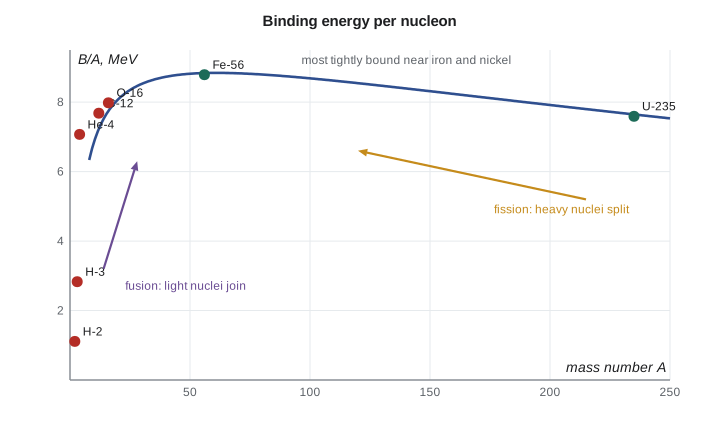
The shape of this curve explains both kinds of nuclear energy. When a heavy nucleus such as uranium-235 splits into two medium-mass fragments, the fragments sit higher on the curve, so they are more tightly bound and the difference is released, about 0.9 MeV per nucleon or roughly 200 MeV per fission. When light nuclei such as deuterium and tritium fuse into helium, they climb the steep left side of the curve, and the energy released per nucleon is even larger. Lesson 4 covers fission and Lesson 11 covers fusion.
# Binding energy from measured atomic masses, and the semi-empirical mass formula.
U = 931.494          # MeV per atomic mass unit
M_H, M_N = 1.007825, 1.008665   # hydrogen-1 atom and neutron, in u
nuclides = [  # name, Z, A, atomic mass in u
    ("He-4", 2, 4, 4.002602),
    ("C-12", 6, 12, 12.000000),
    ("O-16", 8, 16, 15.994915),
    ("Fe-56", 26, 56, 55.934936),
    ("Ni-62", 28, 62, 61.928345),
    ("U-235", 92, 235, 235.043930),
    ("U-238", 92, 238, 238.050788),
]
print(f"{'Nuclide':8}{'Mass defect, u':>16}{'B, MeV':>10}{'B/A, MeV':>10}")
for name, Z, A, m in nuclides:
    defect = Z * M_H + (A - Z) * M_N - m
    B = defect * U
    print(f"{name:8}{defect:>16.6f}{B:>10.1f}{B/A:>10.3f}")

def semf(Z, A, av=15.75, as_=17.8, ac=0.711, aa=23.7, ap=11.18):
    """Binding energy in MeV from the liquid-drop (semi-empirical) mass formula."""
    N = A - Z
    pair = 0.0
    if Z % 2 == 0 and N % 2 == 0: pair = ap / A ** 0.5
    elif Z % 2 == 1 and N % 2 == 1: pair = -ap / A ** 0.5
    return (av * A - as_ * A ** (2/3) - ac * Z * (Z - 1) / A ** (1/3)
            - aa * (A - 2 * Z) ** 2 / A + pair)

print()
for name, Z, A, m in nuclides[3:]:
    B = semf(Z, A)
print(f"Formula for {name}: B = {B:.0f} MeV, B/A = {B/A:.2f} MeV")Nuclide Mass defect, u B, MeV B/A, MeV He-4 0.030378 28.3 7.074 C-12 0.098940 92.2 7.680 O-16 0.137005 127.6 7.976 Fe-56 0.528464 492.3 8.790 Ni-62 0.585365 545.3 8.795 U-235 1.915065 1783.9 7.591 U-238 1.934202 1801.7 7.570 Formula for Fe-56: B = 495 MeV, B/A = 8.85 MeV Formula for Ni-62: B = 550 MeV, B/A = 8.86 MeV Formula for U-235: B = 1796 MeV, B/A = 7.64 MeV Formula for U-238: B = 1815 MeV, B/A = 7.62 MeV
The liquid-drop model
The semi-empirical mass formula, developed in the 1930s by Carl Friedrich von Weizsäcker and Hans Bethe, predicts binding energies well using five terms that treat the nucleus like a charged liquid drop. The volume term says each nucleon is bound to its neighbours, so binding grows with \(A\). The surface term subtracts binding for nucleons at the surface, which have fewer neighbours. The Coulomb term subtracts binding because protons repel each other. The asymmetry term subtracts binding when protons and neutrons are unbalanced. The pairing term adds a little binding when protons and neutrons are paired.
With fitted coefficients, the formula matches measured binding energies to within about one percent for most nuclei heavier than about \(A = 20\), as the program shows. It also explains why the curve has its shape: the surface term hurts light nuclei, and the Coulomb term, which grows as \(Z^2\), hurts heavy nuclei. Between them, binding per nucleon peaks in the middle.
Stability and the valley of stable nuclei
Of the roughly 3300 nuclides that have been observed, only about 250 are stable. Light stable nuclei have roughly equal numbers of protons and neutrons. Heavier ones need extra neutrons, because each added proton increases the electrical repulsion, and neutrons add nuclear attraction without adding charge. By lead, stable nuclei have about 1.5 neutrons per proton. No element heavier than lead has a truly stable isotope; uranium survives in nature only because its main isotopes decay extremely slowly, with half-lives of hundreds of millions to billions of years.
Nuclei with too many neutrons for their proton number tend to undergo beta-minus decay, which converts a neutron into a proton. Those with too few neutrons undergo beta-plus decay or electron capture. Very heavy nuclei can shed mass by alpha decay or, rarely, by spontaneous fission. Fission fragments are born with far too many neutrons for their size, which is why they are intensely radioactive. Lesson 3 explains these decay processes and how fast they happen.
The strong nuclear force
What holds the nucleus together is the strong nuclear force, which acts between nucleons. It is far stronger than the electrical repulsion between protons at short distances, but it fades to almost nothing beyond two or three femtometres. That short range explains much of what this lesson has described. A nucleon feels only its nearest neighbours, so binding grows in proportion to the number of nucleons rather than to its square, and nucleons at the surface are held less tightly. The electrical force, by contrast, reaches across the whole nucleus, so every proton repels every other proton. In a small nucleus the strong force wins easily, but in a large one the accumulated repulsion becomes significant, and eventually it makes very heavy nuclei unstable.
For Hana's public session, the useful image is a crowd of people holding hands with those standing right beside them while a steady wind pushes the whole group apart. A small group holds together firmly. A very large group is held only at the local level, while the push of the wind adds up over the whole crowd, so the group becomes easier to break into two smaller groups. Breaking a very large group in two releases some of that strain, and that is what happens in fission. Dr. Brennan suggests she keep the analogy simple and then show the binding energy curve, which tells the story in numbers.
Common mistakes
MistakeThinking isotopes of an element have different chemistry.
InsteadChemistry depends on electrons, set by Z; isotopes differ only in neutrons and behave almost identically in chemical reactions.
MistakeUsing the proton mass instead of the hydrogen atom mass with tabulated atomic masses.
InsteadTables give atomic masses including electrons, so use m_H = 1.007825 u for each proton so the electrons cancel.
MistakeSaying nuclear energy comes from destroying mass outright.
InsteadIt comes from changes in binding energy; the products have slightly less total mass than the reactants.
MistakeAssuming the most tightly bound nuclei are the heaviest.
InsteadBinding per nucleon peaks near iron and nickel; heavy nuclei are less tightly bound per nucleon.
MistakeCalling all uranium fissile.
InsteadOnly U-235, about 0.72 percent of natural uranium, fissions readily with slow neutrons.
Summary and key terms
- A nucleus contains Z protons and N neutrons; the mass number is A = Z + N.
- Isotopes share Z but differ in N; they have nearly identical chemistry but different nuclear behaviour.
- One atomic mass unit is equivalent to 931.494 MeV.
- Binding energy equals the mass defect times c²; binding per nucleon peaks near iron at about 8.8 MeV.
- Fission of heavy nuclei and fusion of light nuclei both release energy by moving toward the peak.
- The liquid-drop formula predicts binding energies from volume, surface, Coulomb, asymmetry and pairing terms.
- Nucleon
- A proton or neutron.
- Atomic number
- The number of protons Z, which identifies the element.
- Mass number
- The total number of protons and neutrons A.
- Isotope
- One of several nuclides of the same element with different numbers of neutrons.
- Atomic mass unit
- One twelfth of the mass of a carbon-12 atom, about 1.6605 × 10⁻²⁷ kg.
- Mass defect
- The difference between the mass of the separate nucleons and the mass of the bound nucleus.
- Binding energy
- The energy needed to separate a nucleus into its individual protons and neutrons.
- Fissile
- Able to fission after absorbing a slow neutron, as U-235 and Pu-239 are.
Practice problems
Work each problem on paper first, then reveal the answer to check.
How many protons and neutrons are in cobalt-60?
Show answer
Z = 27, N = 60 − 27 = 33.
Estimate the radius of a U-238 nucleus.
Show answer
R = 1.2 × 238^(1/3) = 1.2 × 6.20 = 7.4 fm.
Deuterium has an atomic mass of 2.014102 u. Find its binding energy.
Show answer
Defect = 1.007825 + 1.008665 − 2.014102 = 0.002388 u; B = 2.22 MeV.
Iron-56 has B/A = 8.79 MeV and uranium-235 has 7.59 MeV. If a U-235 nucleus split into fragments with an average B/A of 8.5 MeV, about how much energy would be released?
Show answer
235 × (8.5 − 7.59) ≈ 214 MeV, close to the 200 MeV usually quoted.
Why do heavy stable nuclei have more neutrons than protons?
Show answer
Extra neutrons add attractive nuclear force without adding electrical repulsion, which grows with the square of the proton number.
In the program, add oxygen-16 to the formula comparison. How close is the formula?
Show answer
It gives about 126 MeV against a measured 127.6 MeV, within about 1.5 percent.
Lesson quiz · 5 questions
Score 60% or more to complete this lesson.
Create a free account to save your progress, take quizzes and earn a certificate.