
NUC-200 · Lesson 12 of 12 · 21 min
Nuclear in the US: the fleet and new builds
Six months after joining Meridian, Hana is asked to give the closing presentation at a second public session in Knoxville, this time on the bigger picture: where nuclear energy stands in the United States today and where it is heading. Dr. Brennan suggests she tie the whole course together, from the binding energy curve to the accidents, through the story of one country's nuclear program and the project her team is working on. This final lesson follows her preparation.
The United States built the world's largest nuclear fleet, and it still produces more nuclear electricity than any other country, about 30 percent of the world total. Nuclear energy supplies about 18 percent of US electricity and nearly half of its carbon-free electricity. After decades with few new reactors, the country completed two large units at Vogtle in Georgia in 2023 and 2024, and in September 2026 the NRC issued the first US construction permit for a BWRX-300 small modular reactor, at TVA's Clinch River site in Oak Ridge, the project Hana has been supporting.
From Shippingport to the large fleet
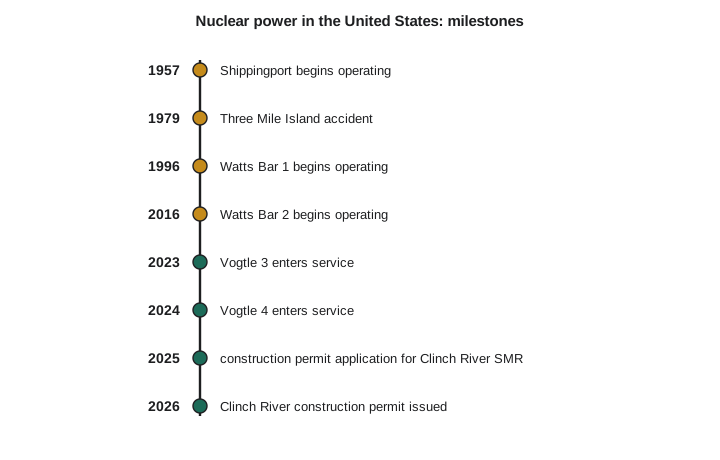
The US program grew out of wartime research, but its civilian side began with the Atomic Energy Act of 1954, which opened nuclear technology to private industry. The Shippingport plant in Pennsylvania, a PWR adapted from naval propulsion work, began supplying the grid in 1957 as the first full-scale nuclear power plant in the country devoted to peaceful use. Utilities then ordered reactors at a remarkable rate: by the mid-1970s, more than 200 units were operating, under construction or on order, almost all of them pressurized or boiling water designs from Westinghouse, General Electric, Combustion Engineering and Babcock and Wilcox.
Many of those orders were later canceled. Construction costs rose sharply in the 1970s with inflation, high interest rates and frequent changes in requirements, demand grew more slowly than forecast, and the Three Mile Island accident in 1979, described in Lesson 10, led to new requirements for operating and planned plants. Between 1978 and the 2010s, almost no new reactors were ordered. Plants already under construction were completed into the 1990s, and TVA's Watts Bar Unit 1 in Tennessee, which entered service in 1996, was the last new reactor of that era. Watts Bar Unit 2, started decades earlier, was finally completed in 2016.
The fleet today
The US fleet consists of 94 operating reactors at 54 plant sites in 28 states, with a combined capacity of about 97 GW, roughly two thirds pressurized water reactors and one third boiling water reactors. TVA operates seven of them at three sites in Tennessee and Alabama: Browns Ferry, Sequoyah and Watts Bar. The program below estimates the fleet's output: about 780 TWh a year at the very high capacity factor the US fleet has achieved for two decades, which is about 18 percent of total generation. Most plants have extended their original 40 year licenses to 60 years, and several have approval to run to 80.
# The US commercial fleet and new builds: rough annual energy and costs
# (approximate values).
reactors, gw, cf = 94, 97.0, 0.92
twh = gw * 8760 * cf / 1000
print(f"{reactors} reactors, about {gw:.0f} GW: about {twh:.0f} TWh per year at {cf:.0%}")
print(f"That is about {twh/4300:.0%} of roughly 4,300 TWh of US generation")

# Large new build: Vogtle Units 3 and 4 in Georgia (two AP1000 units)
v_mw = 2 * 1114
print(f"\nVogtle 3 and 4: {v_mw:,} MW, about {v_mw*8760*0.93/1e6:.1f} TWh per year")
print(f"At roughly 35 billion dollars, about {35e9/(v_mw*1000):,.0f} dollars per kW")

# Small modular reactor: one 300 MWe unit at Clinch River
print(f"One 300 MWe SMR: about {300*8760*0.93/1e6:.2f} TWh per year")
for cost in (5e9, 4e9):
print(f" at {cost/1e9:.0f} billion dollars: {cost/300e3:,.0f} dollars per kW")94 reactors, about 97 GW: about 782 TWh per year at 92% That is about 18% of roughly 4,300 TWh of US generation Vogtle 3 and 4: 2,228 MW, about 18.2 TWh per year At roughly 35 billion dollars, about 15,709 dollars per kW One 300 MWe SMR: about 2.44 TWh per year at 5 billion dollars: 16,667 dollars per kW at 4 billion dollars: 13,333 dollars per kW
License renewals, uprates and restarts
The US fleet has found other ways to grow. License renewals let plants run to 60 and, in some cases, 80 years. Power uprates, achieved with better instruments, fuel and turbine upgrades, have added several gigawatts over the years without building a single new reactor. More recently, rising demand, especially from data centers, has made it worthwhile to restart plants that had been shut down for economic reasons: Holtec's Palisades plant in Michigan was preparing to return to service in 2026, and the former Three Mile Island Unit 1, renamed the Crane Clean Energy Center, is being prepared to restart under a long-term agreement to supply a technology company.
Vogtle and the cost of first-of-a-kind
Vogtle Units 3 and 4, two AP1000 pressurized water reactors in Georgia, were the first new reactors designed and built from scratch in the United States in a generation. The AP1000 introduced passive safety features similar to those Lesson 10 described. But construction began in 2013 with an incomplete design and a supply chain and workforce out of practice. The project ran years late, its lead contractor, Westinghouse, filed for bankruptcy protection in 2017, and the total cost rose to roughly 35 billion dollars, more than double the original estimate. The units entered service in 2023 and 2024 and now run well, but the experience made utilities wary of large new builds.
The program shows Vogtle's cost per kilowatt, about 15 700 dollars. Analysts expect that a further AP1000 built by an experienced team could cost substantially less, because many of Vogtle's costs came from first-of-a-kind problems and rework. Several utilities and the federal government have discussed building more AP1000 units for that reason, and the experience gained at Vogtle is one of the arguments for doing so.
The Clinch River project
TVA, a federally owned utility created in 1933 to develop the Tennessee Valley, has held the Clinch River site in Oak Ridge since the 1980s, when a fast breeder demonstration reactor planned there was canceled. In 2019 the NRC approved an early site permit for small reactors at the site. TVA chose the GE Vernova Hitachi BWRX-300 in 2022, the same design being built at Darlington in Ontario, applied for a construction permit in May 2025 and received it in September 2026, after an NRC review that finished four months ahead of schedule. TVA has not yet announced a construction start, and is negotiating with partners to share costs so that first-of-a-kind expenses do not fall entirely on Valley ratepayers.
Sharing the design with Ontario is deliberate. A standard design built repeatedly is the central idea of SMRs, and TVA, OPG and other utilities have agreed to cooperate on engineering, supply chain and licensing for the BWRX-300. Other advanced projects are moving too: TerraPower is building a sodium-cooled fast reactor with a molten salt energy storage system in Wyoming, X-energy is developing a high-temperature gas reactor for a chemical plant in Texas, and several companies are developing microreactors, with demonstrations planned at national laboratories. Federal policy in 2025 set a goal of quadrupling US nuclear capacity to 400 GW by 2050.
Worked problem
Cost per unit of energy
Using the program's figure of 18.2 TWh a year from Vogtle 3 and 4, estimate the capital cost per megawatt-hour if the 35 billion dollar cost is spread evenly over 60 years of output, ignoring interest.
Show solution
- Lifetime output: \(18.2\ \text{TWh} \times 60 = 1092\ \text{TWh} = 1.09 \times 10^9\ \text{MWh}\).
- Cost per MWh: \(3.5 \times 10^{10} / 1.09 \times 10^9 = 32\ \text{dollars/MWh}\).
Answer: Without interest, the capital cost per megawatt-hour looks modest. In reality, interest during a long construction period and on the debt afterward can double or triple it, which is why financing and schedule matter so much for nuclear projects, and why government loans and guarantees often play a role.
Nuclear energy and the grid of the future
Forecasts of US electricity demand rose sharply in the mid-2020s, after nearly two decades of flat demand, as data centers, new factories and electrification added load. Utilities, including TVA, now plan for growth that they had not seen since the 1970s. Large technology companies have signed long-term contracts for nuclear electricity from existing plants, restarts and future SMRs, because nuclear plants supply firm, low-carbon power around the clock. Nuclear's role in that mix is the firm supply described in Lesson 1, working alongside wind, solar, storage and gas plants that follow the daily swings in demand. TVA's own plans include more nuclear, solar and storage, and the gradual retirement of its remaining coal units.
The workforce matters as much as the technology. Both new builds and refurbishments need welders, pipefitters, electricians, crane operators, quality inspectors, radiation protection technicians, licensed operators and engineers of every discipline. Many of the people who built and ran the first generation of plants have retired, and colleges and universities have expanded their nuclear programs in response. Meridian's own hiring plans, Dr. Brennan tells Hana, depend less on the price of uranium than on how many skilled people the region can train in the next ten years.
Regulation and the public
The NRC regulates civilian nuclear reactors and materials in the United States under the Atomic Energy Act and related laws, and holds public meetings and hearings before major licensing decisions. Under the ADVANCE Act of 2024 and later executive orders, the NRC has been directed to shorten licensing timelines and modernize its rules for advanced reactors, and the Clinch River review was one of the first to show faster results. Environmental reviews under the National Environmental Policy Act accompany each major license. Many states regulate siting and the utilities' costs, and Tennessee has set up state funding to attract nuclear companies to the region.
Public opinion has moved toward nuclear energy over the past decade, driven by concern about climate change, reliable supply and rising demand for electricity. Hana's experience at the information sessions confirms what surveys show: people want clear answers about safety, waste and cost, and they respond well when engineers explain the numbers honestly. The questions she heard in Lesson 1 shaped every lesson of this course.
The course in one page
Hana's closing slide summarizes the course. Nuclear energy comes from binding energy, released when heavy nuclei split. Each fission releases about 200 MeV and two or three neutrons, enough to sustain a controlled chain reaction. A moderator slows neutrons, and its absorption decides whether a reactor can use natural or enriched uranium. Radioactive decay follows fixed half-lives, which make it possible to plan shielding, storage and medical doses, and which create decay heat that must always be removed. Radiation doses can be measured and kept low with time, distance and shielding. The fuel cycle runs from mine to repository, with a small volume of high-level waste that must be isolated for a very long time. Accidents have taught the industry to rely on several independent layers of protection and on passive safety. Fusion is making progress but remains for the future.
For engineers, the field offers a wide range of work: reactor physics and thermal hydraulics, materials and chemistry, instrumentation and control, radiation protection, waste management, construction, project management and regulation. Meridian Nuclear Engineering's team on the Clinch River project includes all of these. Hana ends her presentation by inviting the audience to visit the project's information center, and starts preparing for her next role on the construction team.
Common mistakes
MistakeThinking no new reactors have been built in the US since the 1990s.
InsteadWatts Bar 2 and Vogtle 3 and 4 entered service in 2016, 2023 and 2024.
MistakeAssuming old plants must close at 40 years.
InsteadMost US plants are licensed to 60 years, and some to 80.
MistakeComparing capital cost without interest.
InsteadFinancing during construction can multiply the real cost per megawatt-hour.
MistakeTreating a first unit's cost as the cost of every unit.
InsteadFirst-of-a-kind costs include design and learning that later units need not repeat.
MistakeThinking public engagement is optional.
InsteadPublic hearings, consultation and consent shape licensing and siting decisions.
Summary and key terms
- The US has the world's largest fleet, 94 reactors producing about 18 percent of its electricity.
- License renewals, uprates and restarts extend and grow the existing fleet.
- Vogtle 3 and 4 entered service in 2023 and 2024 at a high first-of-a-kind cost.
- TVA received the first US BWRX-300 construction permit for Clinch River in September 2026.
- Cost per kilowatt and financing are the main challenges for new reactors.
- Regulators, public hearings and community consent shape every major project.
- CANDU
- The Canadian pressurized heavy water reactor design.
- Refurbishment
- A major overhaul that replaces worn components to extend a reactor's life.
- Capacity factor
- Actual output divided by the output at full power all the time.
- First-of-a-kind cost
- Extra cost carried by the first unit of a new design.
- License renewal
- Regulatory approval to operate a reactor beyond its original license term.
- Uprate
- An approved increase in a reactor's rated power.
- Construction permit
- An approval from the regulator to build a nuclear facility.
- Small modular reactor
- A reactor of up to about 300 MWe built largely from factory modules.
Practice problems
Work each problem on paper first, then reveal the answer to check.
From the program, what share of US generation does nuclear supply?
Show answer
About 18 percent.
What is Vogtle 3 and 4's cost per kilowatt?
Show answer
3.5 × 10¹⁰ / 2 228 000 kW ≈ 15 700 dollars/kW.
A 300 MWe unit runs at 93 percent capacity factor. What is its annual output?
Show answer
300 × 8760 × 0.93 = 2.44 × 10⁶ MWh, about 2.44 TWh.
Why might an experienced team build an AP1000 for less than Vogtle?
Show answer
Many of Vogtle's costs came from an incomplete design, rework and an inexperienced supply chain.
Give one advantage of building several identical SMRs.
Show answer
Learning, standard parts and shared engineering reduce the cost and time of later units.
Why does interest matter so much for nuclear costs?
Show answer
Long construction periods mean large debts accumulate before the plant earns revenue.
Lesson quiz · 5 questions
Score 60% or more to complete this lesson.
Create a free account to save your progress, take quizzes and earn a certificate.