
NUC-200 · Lesson 9 of 12 · 22 min
The fuel cycle
Hana's next assignment takes her away from the reactor itself. Marcus Lee, who leads Meridian's fuel and waste group, is preparing a summary for OPG of where the Darlington reactor's fuel will come from and where it will go. He asks Hana to work through the numbers with him. The journey of uranium from the ground to the reactor and on to final disposal is called the nuclear fuel cycle, and it is the subject of this lesson.
An overview of the cycle
The front end of the fuel cycle prepares fuel: uranium is mined and milled, converted to a chemical form suitable for processing, enriched in uranium-235 if the reactor requires it, and fabricated into fuel assemblies. The fuel then spends several years in the reactor. The back end deals with what comes out: used fuel is cooled in pools, moved to dry storage and eventually placed in a deep geological repository. Some countries reprocess used fuel to recover uranium and plutonium for reuse. Each step is regulated, and international safeguards account for the nuclear material at every stage.
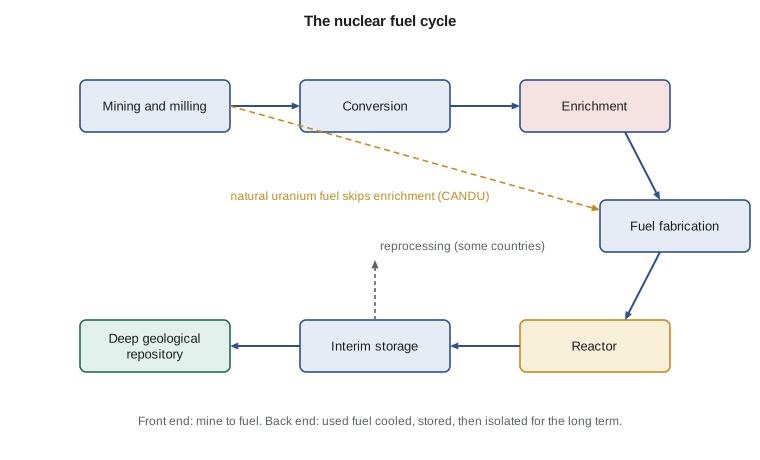
Mining and milling
Uranium is a fairly common element, about as abundant in the Earth's crust as tin. Economic deposits contain from about 0.1 percent uranium oxide to, in exceptional cases, more than 15 percent. Kazakhstan, Canada and Namibia are the largest producers. Canada's mines are in the Athabasca Basin of northern Saskatchewan, which holds the world's highest grade deposits. Uranium is mined in open pits, underground mines or, increasingly, by in-situ recovery, in which a solution pumped through the ore body dissolves the uranium and is brought back to the surface without excavation.
At the mill, ore is crushed and leached with acid or alkali to dissolve the uranium, which is then recovered as a uranium oxide concentrate, \(\text{U}_3\text{O}_8\), a yellow or brown powder called yellowcake. The leftover crushed rock, the tailings, still contains the radium and other decay products of uranium, as Lesson 3 explained, and must be managed for the long term to prevent radon release and water contamination. Modern tailings facilities in Saskatchewan place them in mined-out pits engineered to isolate them from groundwater.
Conversion, enrichment and fabrication
Conversion purifies the concentrate and turns it into the chemical form needed next. For CANDU reactors, the uranium is converted directly to uranium dioxide powder. For enrichment, it is converted to uranium hexafluoride, \(\text{UF}_6\), which becomes a gas at modest temperatures. Cameco operates Canada's refinery at Blind River and its conversion facility at Port Hope, both in Ontario.
Enrichment raises the proportion of uranium-235 from 0.72 percent to the 3 to 5 percent needed by light water reactors. Because the two isotopes are chemically identical, enrichment exploits their tiny difference in mass. Today, essentially all commercial enrichment uses gas centrifuges, in which the slightly heavier uranium-238 molecules concentrate toward the outer wall of a spinning cylinder. The separation in one machine is small, so many are connected in cascades. Commercial enrichment plants operate in a handful of countries under international safeguards, and their output for power reactors is limited to low-enriched uranium, below 20 percent and usually below 5. Some advanced reactors are designed to use fuel between 5 and 20 percent, called HALEU, and its supply is a current challenge for those designs.
Enrichment splits the feed into two streams: the product, enriched in uranium-235, and the tails, or depleted uranium, with about 0.2 to 0.3 percent uranium-235. A simple mass balance on uranium-235 relates the amounts of feed, product and tails. Fuel fabrication then converts the enriched hexafluoride back to uranium dioxide, presses and sinters pellets, loads them into zirconium alloy tubes and assembles them into fuel assemblies, in each case to very tight tolerances and with careful quality control.
Here \(F\) and \(P\) are the masses of feed and product, and \(x_F\), \(x_P\) and \(x_T\) are the uranium-235 fractions in the feed, product and tails. The program applies it to the reference plant's annual fuel need from Lesson 5.
# Uranium needed for one year of fuel: the mass balance at the start of the
# fuel cycle and the volume of used fuel at the end (rounded values).
x_feed, x_tails = 0.00711, 0.0025     # U-235 fraction in natural uranium and in tails
def feed_per_product(x_prod):
    return (x_prod - x_tails) / (x_feed - x_tails)

product = 5.9                          # t of enriched uranium loaded per year (Lesson 5)
for x in (0.035, 0.045, 0.0495):
    f = feed_per_product(x)
    print(f"Fuel at {x:.2%} U-235: {f:4.1f} t natural U per t of fuel, {f*product:5.1f} t per year, tails {f*product-product:5.1f} t")

# Natural-uranium CANDU fuel skips enrichment: feed equals fuel
print(f"Natural uranium fuel (CANDU) for the same heat: 39.4 t per year, no tails")

# Mining: ore needed at two ore grades (fraction of U3O8 in ore)
u_per_u3o8 = 0.848
need_u3o8 = feed_per_product(0.0495) * product / u_per_u3o8
for grade in (0.001, 0.15):
    print(f"Ore at {grade:.1%} U3O8: about {need_u3o8/grade:,.0f} t of ore")

# Used fuel: uranium dioxide at about 10.4 t per cubic metre of pellets
vol = product * 1.134 / 10.4         # UO2 is 1.134 times the uranium mass
print(f"\nUsed fuel pellets per year: about {vol:.2f} m3")Fuel at 3.50% U-235: 7.0 t natural U per t of fuel, 41.6 t per year, tails 35.7 t Fuel at 4.50% U-235: 9.2 t natural U per t of fuel, 54.4 t per year, tails 48.5 t Fuel at 4.95% U-235: 10.2 t natural U per t of fuel, 60.2 t per year, tails 54.3 t Natural uranium fuel (CANDU) for the same heat: 39.4 t per year, no tails Ore at 0.1% U3O8: about 70,934 t of ore Ore at 15.0% U3O8: about 473 t of ore Used fuel pellets per year: about 0.64 m3
Worked problem
Feed for one reload
A reload of 20 t of fuel at 4.5 percent uranium-235 is ordered, with tails at 0.25 percent. How much natural uranium, at 0.711 percent, is needed?
Show solution
- \(F/P = (0.045 - 0.0025)/(0.00711 - 0.0025) = 0.0425/0.00461 = 9.2\).
- \(F = 9.2 \times 20 = 184\ \text{t}\); tails \(= 184 - 20 = 164\ \text{t}\).
Answer: About 184 tonnes of natural uranium give 20 tonnes of fuel. The depleted tails are stored as a resource; they can be used in mixed oxide fuel, fast reactors or for dense industrial products.
Fuel in the reactor
Fuel stays in a light water reactor for three to six years, moved between core positions at each refuelling outage. During that time, about two thirds of the uranium-235 fissions, some uranium-238 becomes plutonium, part of which fissions in turn, and fission products build up. At discharge, used light water fuel is still about 95 percent uranium, mostly uranium-238, with about 1 percent plutonium and 4 to 5 percent fission products and minor actinides. CANDU fuel stays in the reactor for about a year and a half and has a lower burn-up, so it discharges more fuel per unit of energy but with less uranium-235 left in it.
Used fuel storage
Freshly discharged fuel is intensely radioactive and produces substantial decay heat, so it first goes into a deep pool of water next to the reactor. The water cools the fuel and shields workers: a few metres of water is enough to make it safe to stand at the poolside. After several years, when the heat has fallen, fuel can be moved to dry storage, in steel and concrete containers that are cooled by natural air flow and need no power or water. Dry storage is used at most nuclear sites in North America and is designed to last for decades.
The volume is small. All the used fuel produced by Canada's reactors since the 1960s would fit in an area the size of about seven hockey rinks stacked to the height of the boards. The program shows that the reference plant discharges well under a cubic metre of pellets a year. Fuel assemblies take more room than the pellets alone, and containers more still, but the total is still small compared with wastes from other energy sources, because, as Lesson 1 showed, nuclear fuel is so energy-dense.
Reprocessing and recycling
Used fuel can be dissolved and separated chemically into uranium, plutonium and the remaining waste. France, Russia and a few other countries do this, using recovered plutonium in mixed oxide fuel and storing separated uranium for reuse. Reprocessing reduces the volume of high-level waste and recovers energy, but it is more expensive than buying fresh uranium at current prices, and it creates separated plutonium, which needs strict security and safeguards. Canada and the United States do not reprocess commercial fuel and plan to dispose of used fuel directly. Future fast reactors could change the economics by consuming plutonium and long-lived actinides.
Waste categories
| Category | Examples | How it is managed |
|---|---|---|
| Low-level | protective clothing, tools, filters | compacted and stored or placed in near-surface facilities |
| Intermediate-level | resins, reactor components | shielded storage, deeper disposal |
| High-level | used fuel, or waste from reprocessing | cooled, stored, then deep geological disposal |
| Mine and mill tailings | crushed rock with radium | engineered tailings facilities at the mine |
Most radioactive waste by volume is low-level, with little activity. High-level waste is a small volume but contains almost all the radioactivity. Lesson 3 showed that the activity of used fuel falls by about 99 percent within a few decades. After about 1000 years, the remaining activity is dominated by long-lived actinides, and after several hundred thousand years, the radiotoxicity of used fuel falls to about that of the natural uranium ore it came from. That long tail is why disposal is designed for very long periods.
Deep geological repositories
The international consensus is that high-level waste should be placed hundreds of metres underground in stable rock, inside engineered barriers. Used fuel is sealed in corrosion-resistant containers, often copper or steel, surrounded by compacted bentonite clay that swells when wet and blocks water movement, and placed in a rock formation that has been stable for millions of years. Each barrier slows any escape of radioactive material, so that even in the very long term the dose to people at the surface stays far below natural background. Finland's repository at Onkalo, in granite about 430 metres deep, is the first to be completed, with disposal expected to begin in the mid-2020s, and Sweden and France are following.
In Canada, the Nuclear Waste Management Organization (NWMO) selected a site in 2024 in northwestern Ontario, in the area of the Wabigoon Lake Ojibway Nation and the Township of Ignace, after a consent-based siting process that lasted more than a decade. The plan is for a repository about 650 to 800 metres deep in crystalline rock. Regulatory review and licensing by the CNSC will take years, and operation is expected to begin in the 2040s. Low and intermediate-level waste from Ontario's reactors is stored at the Western Waste Management Facility at the Bruce site.
Marcus's summary for OPG also covers transport. Used fuel and other radioactive materials are shipped in packages designed to survive severe accidents, including drops, fire and immersion, and tested to international standards. Decades of shipments worldwide have not caused a release harmful to people.
Costs and responsibility
Fuel is a small part of the cost of nuclear electricity, usually around 10 to 20 percent of the total generating cost, and uranium itself is only part of that, with conversion, enrichment and fabrication making up the rest. That is a sharp contrast with gas plants, where fuel is most of the cost. Doubling the price of uranium raises the cost of nuclear electricity by only a few percent. Waste management costs are also included in the price of electricity: plant owners pay into dedicated funds that will cover storage, transport and disposal, and the decommissioning of the plants themselves. Marcus calls this one of the least appreciated features of nuclear energy: the cost of dealing with its waste is collected while the electricity is sold, rather than left for future generations.
Common mistakes
MistakeThinking used fuel is mostly waste.
InsteadAbout 95 percent of it is still uranium, with some plutonium that could be recycled.
MistakeBelieving enrichment is needed for all reactors.
InsteadCANDU reactors use natural uranium and skip enrichment.
MistakeAssuming nuclear waste stays dangerous at the same level forever.
InsteadActivity falls by about 99 percent in decades; the long-lived remainder is far less active.
MistakeThinking used fuel needs active cooling forever.
InsteadAfter several years in a pool, it can be stored dry with natural air cooling.
MistakeTreating all radioactive waste as the same.
InsteadLow, intermediate and high-level wastes differ greatly in activity and in how they are managed.
Summary and key terms
- The front end is mining, milling, conversion, enrichment and fabrication; the back end is storage, possible reprocessing and disposal.
- Enrichment uses gas centrifuges to raise U-235 from 0.72 percent to a few percent for light water reactors.
- The feed-to-product ratio follows from a mass balance on U-235.
- Used fuel cools in pools for several years, then moves to dry storage.
- High-level waste is small in volume but holds most of the activity.
- Deep geological repositories use multiple barriers to isolate waste for hundreds of thousands of years.
- Yellowcake
- Uranium oxide concentrate produced at a mill.
- Tailings
- Crushed rock left after uranium is extracted, still containing radium.
- Conversion
- Chemical processing of uranium into UO₂ or UF₆.
- Enrichment
- Raising the proportion of U-235 in uranium.
- Depleted uranium
- The tails of enrichment, with less U-235 than natural uranium.
- Dry storage
- Storage of used fuel in air-cooled containers.
- Reprocessing
- Chemical separation of used fuel into uranium, plutonium and waste.
- Deep geological repository
- An engineered facility deep in stable rock for long-term waste isolation.
Practice problems
Work each problem on paper first, then reveal the answer to check.
Find the feed-to-product ratio for 3.5 percent fuel with tails at 0.25 percent.
Show answer
(0.035 − 0.0025)/(0.00711 − 0.0025) = 7.0.
From the program, how much ore at 0.1 percent grade is needed for a year's fuel?
Show answer
About 71 000 t.
Why is pool storage needed before dry storage?
Show answer
Fresh used fuel produces high decay heat; the pool cools and shields it until heat falls.
What fraction of used light water fuel is uranium?
Show answer
About 95 percent.
Name the three barriers in a typical repository design.
Show answer
The container, the bentonite clay buffer and the host rock.
Why does CANDU discharge more fuel per unit of energy?
Show answer
Natural uranium fuel reaches lower burn-up, about 7.5 GWd/t against 50.
Lesson quiz · 5 questions
Score 60% or more to complete this lesson.
Create a free account to save your progress, take quizzes and earn a certificate.