
NUC-200 · Lesson 8 of 12 · 22 min
Nuclear medicine and industrial uses
Not every question at the information session was about electricity. A nurse from the regional hospital in Oshawa asked whether the new reactor would have anything to do with the isotopes her department uses every morning. Lina Morales answers that most people's closest contact with nuclear technology is not a power plant at all but a hospital scan, a sterilized syringe or a smoke detector. Meridian supports several of these uses, and this lesson surveys them: how radioactive isotopes are made, how they diagnose and treat disease, and how industry uses them.
Making radioisotopes
Radioisotopes for medicine and industry are made in two main ways. In a reactor, a target material is placed where neutrons are plentiful, and neutron capture turns stable nuclei into radioactive ones. Cobalt-59 becomes cobalt-60; lutetium-176 or ytterbium-176 targets yield lutetium-177. Some isotopes are separated from the fission products of uranium targets, as molybdenum-99 traditionally has been. In a cyclotron, a particle accelerator, protons or other charged particles strike a target and produce isotopes that are short of neutrons, such as fluorine-18 for positron emission tomography. Cyclotrons are compact enough to sit in or near a hospital, which matters for isotopes with half-lives of minutes to hours.
Canada has long been a major supplier. CANDU reactors at Bruce and Pickering produce much of the world's cobalt-60 in adjuster rods that sit in the core during normal operation, and Bruce Power has produced lutetium-177 for cancer treatment since 2022 using a target system installed in an operating unit. For decades, the NRU research reactor at Chalk River supplied a large share of the world's molybdenum-99 until it was shut down in 2018. Hana is surprised to learn that a power plant can be an isotope factory at the same time.
Diagnostic imaging
Diagnostic nuclear medicine gives a patient a small amount of a radioactive tracer, a radioisotope attached to a molecule that goes to a particular organ or process. A camera outside the body detects the gamma rays and builds an image of where the tracer has gone. Unlike an x-ray or CT image, which shows anatomy, a nuclear medicine image shows function: how well blood reaches the heart muscle, whether bone is being remodelled by a tumour, how the kidneys are filtering. Around the world, tens of millions of such procedures are performed each year.
The workhorse isotope is technetium-99m, used in about 80 percent of nuclear medicine imaging procedures. The m stands for metastable: the nucleus is in an excited state that releases a 140 keV gamma ray with a half-life of 6.01 hours, ideal for imaging. The energy is high enough to escape the body and low enough for efficient detection; the half-life is long enough for an examination and short enough that the activity is soon gone. There are almost no beta particles, so the dose to the patient is low, typically a few millisieverts for a scan.
Positron emission tomography, or PET, uses isotopes that decay by beta-plus emission. The positron travels a millimetre or so, meets an electron and annihilates, producing two gamma rays of 511 keV each that fly apart in opposite directions. A ring of detectors records pairs that arrive at the same moment, and a computer reconstructs where the decays happened. The most common tracer is fluorodeoxyglucose labelled with fluorine-18, half-life 110 minutes, which collects where cells use glucose rapidly, as many cancers do.
The technetium generator
Technetium-99m's short half-life means it cannot be shipped long distances. Instead, hospitals receive a generator, a shielded column holding molybdenum-99, half-life 66 hours, which decays to technetium-99m. Each morning, a technologist passes saline solution through the column. The technetium washes out, a step called elution, while the molybdenum stays bound. The technetium activity then builds up again, approaching transient equilibrium with its parent as described in Lesson 3. A generator supplies a department for about a week.
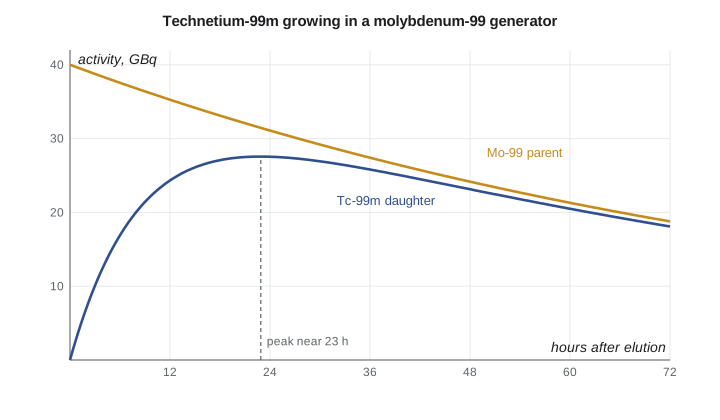
This is the Bateman equation for a parent and daughter. \(A_{p,0}\) is the parent's activity at the last elution, \(\lambda_p\) and \(\lambda_d\) are the decay constants and \(B\) is the branching ratio, the fraction of molybdenum decays that produce technetium-99m, about 0.876. The daughter's activity peaks when its rate of decay equals its rate of production. The program finds the peak and then works out how much activity to draw early in the morning for a patient injection later.
# A technetium-99m generator: molybdenum-99 parent (66.0 h) decays to
# technetium-99m (6.01 h). About 87.6 percent of Mo-99 decays go to Tc-99m.
import math
lp, ld = math.log(2) / 66.0, math.log(2) / 6.01      # decay constants, per hour
BR = 0.876
A_mo0 = 40.0          # GBq of Mo-99 on the generator when it is eluted at t = 0
def tc(t):
    """Tc-99m activity t hours after the last elution (Bateman equation)."""
    return BR * A_mo0 * ld / (ld - lp) * (math.exp(-lp * t) - math.exp(-ld * t))
for t in (2, 6, 12, 23, 48):
    print(f"{t:3d} h after elution: Tc-99m {tc(t):5.1f} GBq, Mo-99 {A_mo0*math.exp(-lp*t):5.1f} GBq")
t_max = math.log(ld / lp) / (ld - lp)
print(f"Tc-99m activity peaks {t_max:.1f} h after elution")

# A patient dose of 800 MBq is needed at 10:00; it is drawn at 07:30
need, wait = 800, 2.5
draw = need * math.exp(ld * wait)
print(f"\nDraw {draw:.0f} MBq at 07:30 to have {need} MBq at 10:00")2 h after elution: Tc-99m 7.1 GBq, Mo-99 39.2 GBq 6 h after elution: Tc-99m 16.9 GBq, Mo-99 37.6 GBq 12 h after elution: Tc-99m 24.3 GBq, Mo-99 35.3 GBq 23 h after elution: Tc-99m 27.6 GBq, Mo-99 31.4 GBq 48 h after elution: Tc-99m 23.1 GBq, Mo-99 24.2 GBq Tc-99m activity peaks 22.9 h after elution Draw 1067 MBq at 07:30 to have 800 MBq at 10:00
Worked problem
Decay correction for a scan
A patient needs 800 MBq of technetium-99m at 10:00. The dose is drawn from the generator at 07:30. What activity should be drawn?
Show solution
- Elapsed time: 2.5 h. Decay constant: \(\lambda = 0.693/6.01 = 0.115\ \text{per hour}\).
- Activity at 07:30: \(800 \times e^{0.115 \times 2.5} = 800 \times 1.334 = 1067\ \text{MBq}\).
Answer: About 1070 MBq, a third more than the dose at injection. Decay correction is routine arithmetic in every nuclear medicine department, and dose calibrators check the activity before each injection.
Radiation therapy
About half of all people with cancer receive radiation therapy at some point in their care. Most treatment uses external beams from linear accelerators, which produce high-energy x-rays and need no radioactive source. Cobalt-60 units, first developed in Canada in 1951, remain in use, and specialized units use dozens of small cobalt-60 sources focused on a single point to treat brain tumours with great precision. Proton therapy uses accelerated protons that deposit most of their energy at a chosen depth, sparing tissue beyond the tumour.
Brachytherapy places sealed sources directly in or next to a tumour. Small iodine-125 seeds implanted in the prostate deliver a high dose to the gland over months while the dose to surrounding tissue stays low, because the low-energy photons travel only a short distance. Iridium-192 sources are moved briefly into position through catheters for high-dose-rate treatments, then withdrawn into a shielded container.
Radiopharmaceutical therapy delivers radiation through the bloodstream. Iodine-131 has been used since the 1940s for overactive thyroid and thyroid cancer, because the thyroid takes up iodine. Newer treatments attach lutetium-177, a beta emitter, to molecules that seek out specific cancer cells, such as those in neuroendocrine tumours and prostate cancer. Alpha emitters such as actinium-225 deposit very high energy over a few cell diameters, killing targeted cells while sparing their neighbours. Demand for these isotopes is growing quickly, and new production in reactors, including power reactors, is a response to that demand.
| Isotope | Half-life | Made in | Main use |
|---|---|---|---|
| Technetium-99m | 6.01 h | from Mo-99 (reactor) | diagnostic imaging |
| Fluorine-18 | 110 min | cyclotron | PET imaging |
| Iodine-131 | 8.02 d | reactor | thyroid treatment |
| Lutetium-177 | 6.6 d | reactor | targeted cancer therapy |
| Iodine-125 | 59.4 d | reactor | brachytherapy seeds |
| Iridium-192 | 73.8 d | reactor | brachytherapy, industrial radiography |
| Cobalt-60 | 5.27 y | reactor | sterilization, therapy |
| Americium-241 | 432 y | from reactor plutonium | smoke detectors, gauges |
Sterilization and food irradiation
Gamma rays from cobalt-60 kill bacteria, viruses and insects without heating the product or leaving it radioactive. Large irradiation facilities pass boxes of medical supplies, such as syringes, gloves, sutures and implants, past racks of cobalt-60 sources. Because the radiation penetrates sealed packaging, products can be sterilized in their final boxes. About 40 percent of the world's single-use medical devices are sterilized this way. Electron beams and x-rays from accelerators do the same job for some products.
Food irradiation uses the same principle at lower doses to kill harmful bacteria such as salmonella and E. coli, to stop sprouting in potatoes and to control insects in fruit and spices. Irradiated food is not radioactive; the gamma rays from cobalt-60 do not have enough energy to make nuclei radioactive. Food safety agencies, including Health Canada and the World Health Organization, have approved it for specific foods, which carry an international symbol called the Radura.
Industrial uses
Industry uses radiation in many quiet ways. Industrial radiography uses iridium-192 or cobalt-60 sources to take gamma-ray images of welds in pipelines, pressure vessels and bridges, revealing cracks that cannot be seen from the surface. Thickness and density gauges measure paper, plastic film, sheet steel and the fill level of cans by how much radiation passes through them. Moisture and density gauges check road compaction. Well-logging tools use neutron and gamma sources to identify rock layers in boreholes. Smoke detectors use a tiny americium-241 source, a few tens of kilobecquerels, to ionize the air in a sensing chamber.
Radioactive tracers also follow flows in industry and the environment: leaks in buried pipes, mixing in chemical reactors, the movement of sediment in rivers and harbours. Each application uses the properties from earlier lessons: the right type of radiation, the right energy and the right half-life for the job. Sealed sources must be tracked from manufacture to disposal, because a lost or stolen high-activity source can cause serious injury to someone who finds it without knowing what it is. the Canadian Nuclear Safety Commission (CNSC) licenses users and keeps a registry of sealed sources.
Other peaceful applications
Radioisotope power systems convert the heat of plutonium-238 decay into electricity for spacecraft that travel too far from the Sun for solar panels; the Voyager probes and the Curiosity and Perseverance rovers use them. Neutron beams from research reactors probe the structure of materials, from aircraft parts to proteins. Mutation breeding with radiation has produced thousands of crop varieties. The sterile insect technique releases male insects sterilized by radiation, which mate without producing offspring, and has eliminated screwworm flies from North America and controlled fruit flies in many regions.
Protecting patients and staff
Nuclear medicine departments apply the same principles Lina uses at the plant. Generators and syringes are handled behind lead or tungsten shields, technologists use tongs and syringe shields to keep their hands at a distance, and work areas are surveyed for contamination at the end of each day. Each patient dose is measured in a calibrator before injection and recorded. Patients who receive diagnostic doses can usually go home straight away; after high-activity iodine-131 therapy, patients may stay in a shielded room for a day or two and receive advice about limiting close contact with young children and pregnant family members for a short period.
Waste from nuclear medicine is mostly short-lived. Syringes, gloves and absorbent pads contaminated with technetium-99m are simply held in shielded storage for a few days, about ten half-lives, until their activity falls to background, and are then disposed of as ordinary medical waste. Hana recognizes the same arithmetic as the iodine-131 waste tank in the Lesson 3 program. The nurse from the hospital is pleased to hear that the principles her department follows are the same ones that govern the reactor down the road.
Supply reliability
Medical isotope supply depends on a small number of research reactors and processing plants around the world, several of them decades old. When two or three of them were shut down at the same time in 2009 and 2010, hospitals in many countries had to delay scans or switch to other tests. Since then, operators have coordinated maintenance schedules, new production routes have been developed, including accelerator-based production of molybdenum-99 and isotopes made in power reactors, and the industry has moved away from highly enriched uranium targets to low-enriched ones, removing a security concern while keeping supply. For Meridian, it means that isotope production is a real design consideration for reactor owners, not a side issue.
Common mistakes
MistakeThinking food or products become radioactive after irradiation.
InsteadCobalt-60 gamma rays cannot make nuclei radioactive; irradiated products are not radioactive.
MistakeAssuming technetium-99m can be shipped like any medicine.
InsteadIts 6-hour half-life means hospitals make it daily from a molybdenum-99 generator.
MistakeBelieving most radiation therapy uses radioactive sources.
InsteadMost uses x-rays from linear accelerators; sources are used for brachytherapy and some specialized units.
MistakeForgetting decay correction.
InsteadActivity must be adjusted for decay between preparation and use.
MistakeTreating lost sealed sources as harmless.
InsteadA high-activity source can cause serious injury, which is why sources are licensed and tracked.
Summary and key terms
- Reactors make neutron-rich isotopes by neutron capture or fission; cyclotrons make neutron-poor isotopes.
- Technetium-99m is used in about 80 percent of imaging procedures and comes from molybdenum-99 generators.
- PET imaging detects pairs of 511 keV photons from positron annihilation.
- Radiation therapy uses accelerator beams, sealed sources and targeted radiopharmaceuticals.
- Cobalt-60 sterilizes a large share of medical devices and some foods without making them radioactive.
- Industry uses radiation for weld inspection, gauging, well logging, tracers and smoke detectors.
- Radiopharmaceutical
- A radioactive drug used for diagnosis or treatment.
- Tracer
- A small amount of radioactive material used to follow a process.
- Metastable state
- A long-lived excited state of a nucleus, marked m, as in Tc-99m.
- Elution
- Washing the daughter isotope out of a generator.
- PET
- Positron emission tomography, imaging based on positron annihilation.
- Brachytherapy
- Radiation therapy with sealed sources placed in or near a tumour.
- Cyclotron
- A circular particle accelerator used to make some medical isotopes.
- Sealed source
- Radioactive material permanently enclosed in a capsule.
Practice problems
Work each problem on paper first, then reveal the answer to check.
Why is a 6-hour half-life well suited to imaging?
Show answer
Long enough for preparation and imaging, short enough that the patient's activity soon falls away.
From the program, when does technetium-99m activity peak after elution?
Show answer
About 22.9 hours.
A 400 MBq dose of fluorine-18 is prepared 55 minutes before injection. What remains at injection?
Show answer
400 × 0.5^(55/110) = 400 × 0.707 = 283 MBq.
How much of a 200 MBq iodine-131 dose remains after 24 days?
Show answer
24/8.02 ≈ 3 half-lives, so about 25 MBq.
Why are iodine-125 seeds suitable for implants?
Show answer
Their low-energy photons travel only a short distance, concentrating dose in the tumour.
What two gamma rays result from positron annihilation?
Show answer
Two 511 keV photons travelling in opposite directions.
Lesson quiz · 5 questions
Score 60% or more to complete this lesson.
Create a free account to save your progress, take quizzes and earn a certificate.