
NUC-200 · Lesson 7 of 12 · 23 min
Radiation and health
The question that drew the most hands at the information session was the simplest one: is it safe to live near a nuclear plant? Hana passes it to Lina Morales, Meridian's radiation protection specialist, who has spent twenty years measuring doses at reactors, hospitals and industrial sites. Lina's view is that the honest answer needs numbers, and that people handle numbers well when they are given a sense of scale. This lesson builds that sense of scale.
Ionizing radiation
The radiation from radioactive decay and fission is ionizing: each particle or photon carries enough energy to knock electrons out of atoms, creating ions. Visible light, radio waves and the microwaves in a kitchen oven do not carry enough energy per photon to do this. In living tissue, ionization can break chemical bonds, including those in DNA. Cells repair most such damage quickly, but a small fraction of damage is repaired incorrectly, and over years this can occasionally lead to cancer. Very large doses kill cells outright and cause the rapid effects known as radiation sickness.
The four main kinds of ionizing radiation behave differently. Alpha particles deposit their energy densely over a very short path and cannot pass through skin, so they matter mainly if alpha emitters are taken into the body. Beta particles travel a little further and can affect skin and the lens of the eye. Gamma rays and x-rays penetrate the whole body. Neutrons, present around operating reactors, also penetrate deeply and are especially damaging per unit of energy. Shielding for each type must be chosen to match.
Measuring dose
The absorbed dose is the energy deposited per kilogram of tissue, measured in grays (Gy), one joule per kilogram. Because different radiations cause different amounts of biological harm for the same energy, the equivalent dose multiplies the absorbed dose by a radiation weighting factor: 1 for gamma, x-rays and beta, 20 for alpha, and between about 2.5 and 20 for neutrons depending on their energy. The effective dose then weights each organ by its sensitivity and adds them up, so that a partial-body exposure can be compared with a uniform one. Both are measured in sieverts (Sv). Everyday doses are small, so the millisievert (mSv), one thousandth of a sievert, is the usual unit.
Here \(D\) is the absorbed dose in grays, \(w_R\) is the radiation weighting factor, \(H\) is the equivalent dose in sieverts, \(w_T\) is the tissue weighting factor and \(E\) is the effective dose. Radiation protection uses effective dose to set limits and compare exposures.
Doses in everyday life
Everyone is exposed to natural radiation all the time: cosmic rays from space, radon gas from the ground, potassium-40 and carbon-14 in the body, and uranium and thorium in rock and building materials. Natural background in Canada averages about 1.8 mSv a year, varying with geology and altitude; the world average is about 2.4 mSv. Medical imaging adds a significant amount for many people: a chest CT scan gives about 7 mSv.
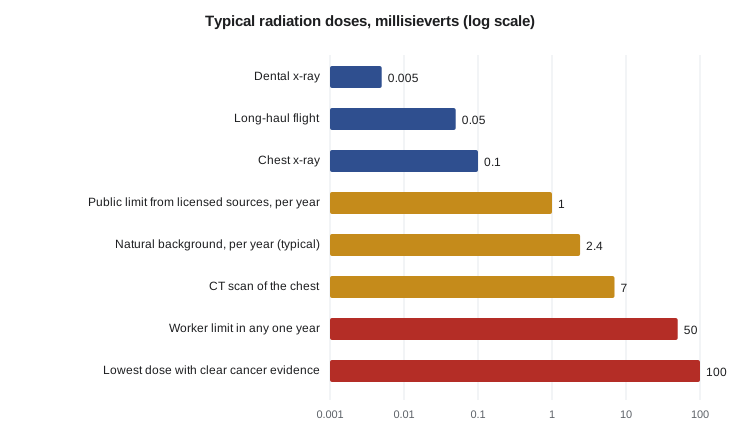
Against that background, the dose to someone living next to an operating nuclear plant from the plant's routine releases is typically well below 0.01 mSv a year, less than one percent of the natural background, and less than the extra cosmic radiation from a single long-haul flight. Plants are licensed by the Canadian Nuclear Safety Commission (CNSC) with release limits set so that the dose to the most exposed member of the public stays far below the public dose limit of 1 mSv a year from licensed activities, and actual doses are a small fraction of that limit.
Health effects and risk
Radiation effects fall into two groups. Deterministic effects, also called tissue reactions, occur only above a threshold dose, and their severity rises with dose. Skin reddening needs a few grays to the skin; acute radiation syndrome begins above about 1 Gy to the whole body, received in a short time; a dose of about 4 to 5 Gy received rapidly is fatal to about half of those exposed without medical treatment. Such doses occur only in serious accidents or mishandled high-activity sources, and almost never to the public.
Stochastic effects, mainly cancer, have no clear threshold; the probability rises with dose, but the severity does not. Studies of the survivors of the 1945 atomic bombings, of patients given radiation treatment and of workers show a clear increase in cancer risk above about 100 mSv. For radiation protection, the International Commission on Radiological Protection (ICRP) assumes a linear no-threshold relationship below that: a small risk proportional to dose, about 5 percent per sievert for fatal cancer in a general population. The assumption is deliberately cautious and widely used for planning, though the true effect of very low doses is too small to measure directly.
Worked problem
Putting a dose in perspective
Using the ICRP coefficient of about 5 percent per sievert, estimate the added lifetime risk of fatal cancer from a dose of 0.01 mSv, a generous estimate of a year's dose next to a nuclear plant.
Show solution
- Convert: \(0.01\ \text{mSv} = 1 \times 10^{-5}\ \text{Sv}\).
- Risk: \(1 \times 10^{-5} \times 0.05 = 5 \times 10^{-7}\), or about one in two million.
Answer: The baseline lifetime risk of dying of cancer from all causes is roughly one in four. The added risk is far too small to detect, which is why Lina describes it as a number for comparison rather than a measurable effect.
Dose limits and ALARA
Radiation protection rests on three principles. Justification: any practice involving radiation must do more good than harm. Optimization: doses must be kept as low as reasonably achievable, a principle known as ALARA, taking costs and benefits into account. Limitation: individual doses must not exceed set limits. Under the Nuclear Safety and Control Act and the regulations made under it, the CNSC sets the limits that apply to nuclear sites in Canada.
| Who | Limit | Notes |
|---|---|---|
| Member of the public | 1 mSv per year | from all licensed activities, excluding medical and natural |
| Nuclear energy worker | 50 mSv in one year, 100 mSv over five years | averages 20 mSv per year over five years |
| Pregnant worker | 4 mSv for the rest of the pregnancy | to protect the developing child |
In practice, ALARA matters more than the limits. Most nuclear plant workers receive less than 1 mSv a year from their work, and plants set internal targets well below the regulatory limits. Every job in a radiation area is planned in advance: Lina's team surveys the area, estimates the dose, chooses shielding and tools, rehearses the task if needed and issues each worker a dosimeter that records the actual dose.
Time, distance and shielding
Three simple tools control external dose. Spend less time near the source, and the dose falls in proportion. Increase the distance, and for a small source the dose rate falls with the square of the distance, the inverse square law. Put shielding between the source and the person, and each half-value layer of shielding halves the dose rate.
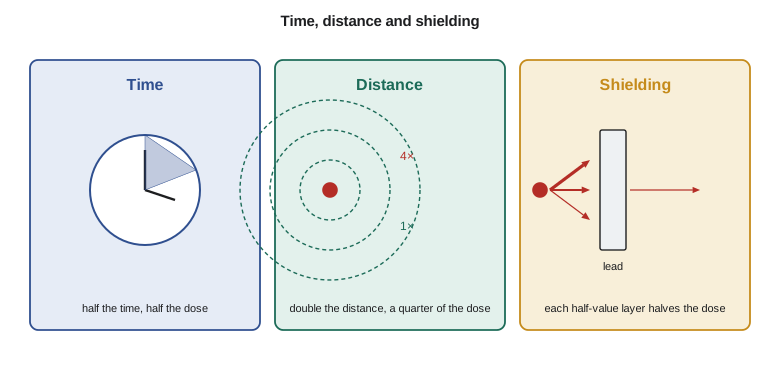
The inverse square law follows from geometry: radiation spreading out from a point covers a sphere whose area grows as \(r^2\). For gamma rays from cobalt-60, the half-value layer is about 1.2 cm of lead, about 2 cm of steel or about 6 cm of concrete. The program applies these rules to plan a maintenance task.
# Time, distance and shielding: dose from a small gamma source.
import math
# A point source gives 2.0 mSv/h at 1 m (illustrative industrial source)
D1 = 2.0
print("Dose rate against distance (inverse square law)")
for r in (0.5, 1, 2, 4, 10):
    print(f"  {r:4.1f} m: {D1 / r**2:7.3f} mSv/h")

# Shielding with half-value layers (HVL): each HVL halves the dose rate
hvl_lead_cm = 1.2       # approximate HVL of lead for cobalt-60 gamma rays
for t_cm in (0, 1.2, 2.4, 6.0):
    print(f"Behind {t_cm:3.1f} cm of lead at 2 m: {D1/4 * 0.5 ** (t_cm/hvl_lead_cm):.4f} mSv/h")

# Planning a task: stay below 0.1 mSv for one worker
limit = 0.1
for r in (1, 2, 3):
    rate = D1 / r**2
    print(f"At {r} m the worker may stay {limit/rate*60:.0f} minutes")

# Annual dose compared with public and worker limits
background = 1.8         # mSv per year, rough average natural background
print(f"\nNatural background: {background} mSv/yr; public limit from licensed sources: 1 mSv/yr")
print("Occupational limit: 50 mSv in any one year")Dose rate against distance (inverse square law) 0.5 m: 8.000 mSv/h 1.0 m: 2.000 mSv/h 2.0 m: 0.500 mSv/h 4.0 m: 0.125 mSv/h 10.0 m: 0.020 mSv/h Behind 0.0 cm of lead at 2 m: 0.5000 mSv/h Behind 1.2 cm of lead at 2 m: 0.2500 mSv/h Behind 2.4 cm of lead at 2 m: 0.1250 mSv/h Behind 6.0 cm of lead at 2 m: 0.0156 mSv/h At 1 m the worker may stay 3 minutes At 2 m the worker may stay 12 minutes At 3 m the worker may stay 27 minutes Natural background: 1.8 mSv/yr; public limit from licensed sources: 1 mSv/yr Occupational limit: 50 mSv in any one year
Worked problem
Planning a job
A gamma source gives 2.0 mSv/h at 1 m. A technician must work at 3 m from it for 20 minutes behind 2.4 cm of lead. What dose does the technician receive?
Show solution
- Distance: \(2.0 \times (1/3)^2 = 0.222\ \text{mSv/h}\).
- Shielding: \(2.4/1.2 = 2\) half-value layers, so \(0.222/4 = 0.056\ \text{mSv/h}\).
- Time: \(0.056 \times 20/60 = 0.019\ \text{mSv}\).
Answer: About 0.02 mSv, a few days of natural background. Without the lead, the dose would be about 0.07 mSv, still small, but ALARA asks whether the lead is worth placing, and for a 20 minute task it usually is.
Internal exposure and contamination
Radioactive material taken into the body, by breathing, swallowing or through a wound, irradiates tissue from inside until it decays or is excreted. The dose depends on the nuclide, its chemical form and how long the body retains it. Iodine concentrates in the thyroid, which is why people near the Chernobyl and Fukushima accidents were advised to take stable potassium iodide tablets, which fill the thyroid with ordinary iodine and block the uptake of radioactive iodine. Caesium spreads through soft tissue and leaves the body over a few months. Protection against internal exposure relies on containment, ventilation, protective clothing and respirators, and on monitoring of air, surfaces and people.
Monitoring and emergency planning
Around every nuclear plant, environmental monitoring programmes sample air, water, soil, milk and fish, and fixed gamma monitors record the dose rate continuously. The results are published, and the CNSC runs its own independent sampling. For Lina, this is the most persuasive answer to the question about living nearby: people can look up what has been measured, not just what has been predicted. Measurements around Darlington show nothing that can be distinguished from natural background beyond the plant boundary.
Emergency planning is the last layer of protection. Plans set out how the public would be warned and, if needed, told to shelter indoors, take potassium iodide tablets or evacuate. In Ontario, residents within 10 km of a nuclear plant receive potassium iodide tablets in advance, and those within 50 km can order them free of charge. The aim is that, even in a severe accident, doses to the public stay low enough that deterministic effects do not occur and the added cancer risk is minimized. Lesson 10 shows that, at Fukushima, the harm from a hurried evacuation of elderly and vulnerable people was greater than the harm from the radiation itself, and that planning now pays close attention to that balance.
Common mistakes
MistakeEquating any radiation with danger.
InsteadRisk depends on dose; everyone receives a few millisieverts a year from natural sources.
MistakeConfusing grays and sieverts.
InsteadGrays measure absorbed energy; sieverts weight it for radiation type and tissue sensitivity.
MistakeThinking the dose limit is a line between safe and unsafe.
InsteadLimits are set well below levels of observed harm, and ALARA keeps doses far below them.
MistakeForgetting that distance works with the square.
InsteadDoubling distance cuts the dose rate to a quarter, not a half.
MistakeAssuming exposure to radiation makes a person radioactive.
InsteadExternal gamma exposure does not; only contamination by radioactive material does.
Summary and key terms
- Ionizing radiation can damage DNA; cells repair most damage, but some can lead to cancer years later.
- Absorbed dose is in grays; equivalent and effective dose, weighted for harm, are in sieverts.
- Natural background gives a few millisieverts a year; a plant's routine releases add far less than one percent.
- Deterministic effects need doses above about 1 Gy; cancer risk is assumed proportional to dose, about 5 percent per sievert.
- Justification, optimization (ALARA) and dose limits are the three principles of protection.
- Time, distance and shielding control external dose; containment and monitoring control internal dose.
- Ionizing radiation
- Radiation energetic enough to remove electrons from atoms.
- Gray
- The unit of absorbed dose, one joule per kilogram.
- Sievert
- The unit of equivalent and effective dose, weighted for biological effect.
- Effective dose
- The sum of organ doses weighted by tissue sensitivity.
- Deterministic effect
- A harmful effect that occurs above a threshold dose.
- Stochastic effect
- An effect, such as cancer, whose probability rises with dose.
- ALARA
- As low as reasonably achievable, the principle of dose optimization.
- Half-value layer
- The thickness of shielding that halves the dose rate.
Practice problems
Work each problem on paper first, then reveal the answer to check.
A dose rate is 0.8 mSv/h at 2 m. What is it at 4 m?
Show answer
0.8 × (2/4)² = 0.2 mSv/h.
An alpha absorbed dose of 0.001 Gy gives what equivalent dose?
Show answer
20 × 0.001 = 0.02 Sv, or 20 mSv.
How many half-value layers cut a dose rate to one sixteenth?
Show answer
Four, since 2⁴ = 16.
From the program, how long may a worker stay at 2 m for a 0.1 mSv budget?
Show answer
Dose rate 0.5 mSv/h, so 0.1/0.5 h = 12 minutes.
Using 5 percent per sievert, estimate the risk from a 7 mSv CT scan.
Show answer
0.007 × 0.05 = 3.5 × 10⁻⁴, about 1 in 2900.
Why are potassium iodide tablets given after a release of radioactive iodine?
Show answer
They saturate the thyroid with stable iodine, blocking uptake of iodine-131.
Lesson quiz · 5 questions
Score 60% or more to complete this lesson.
Create a free account to save your progress, take quizzes and earn a certificate.