
NUC-200 · Lesson 4 of 12 · 22 min
Fission and the chain reaction
At the next team meeting, Dr. Brennan asks Hana to prepare the central part of the information session: how a small amount of uranium can keep a large city supplied with electricity for a year. The answer has two parts. The first is that each fission releases an enormous amount of energy compared with any chemical reaction. The second is that each fission releases neutrons that can cause further fissions, so the process can sustain itself under careful control. This lesson covers both.
What happens in fission
Fission is the splitting of a heavy nucleus into two lighter nuclei, the fission fragments. It was discovered in 1938 by Otto Hahn and Fritz Strassmann, and explained in early 1939 by Lise Meitner and Otto Frisch, who used the liquid-drop picture from Lesson 2. When a uranium-235 nucleus absorbs a neutron, it becomes uranium-236 in a highly excited state. The extra energy sets the nucleus oscillating, like a water drop that has been struck. It stretches into a dumbbell shape, the electrical repulsion between the two ends overcomes the surface tension, and the nucleus splits.
The two fragments are usually unequal in size. A typical split gives one fragment with a mass number near 95 and another near 140, for example krypton and barium, or strontium and xenon, though hundreds of different pairs occur. The fragments fly apart at high speed, driven by their mutual electrical repulsion. Two or three free neutrons are also released, on average about 2.4 for uranium-235 fission by slow neutrons. Gamma rays come out immediately, and the fragments then begin the beta decay chains described in Lesson 3.
Mass number and charge balance on both sides: \(1 + 235 = 141 + 92 + 3\) and \(92 = 56 + 36\). The mass of the products is slightly less than the mass of the reactants, and that missing mass, about 0.2 u, appears as energy.
Where the energy goes
About 200 MeV of energy is released per fission. The binding energy curve from Lesson 2 shows why: uranium sits at about 7.6 MeV per nucleon and the fragments at about 8.5, so roughly 0.9 MeV per nucleon is freed across some 235 nucleons. Most of the energy, about 168 MeV, appears as kinetic energy of the two fragments. They travel only a few micrometres in the fuel before stopping, so their energy becomes heat right inside the fuel pellet. That is convenient: the fuel itself is the heat source, and the coolant carries the heat away.
| Form of energy | Approximate energy (MeV) | Where it is deposited |
|---|---|---|
| Kinetic energy of fragments | 168 | in the fuel, within micrometres |
| Prompt gamma rays | 7 | fuel, coolant and structure |
| Kinetic energy of neutrons | 5 | mostly in the moderator |
| Beta particles from fragment decay | 8 | in the fuel |
| Gamma rays from fragment decay | 7 | fuel, coolant and structure |
| Antineutrinos | 12 | escape entirely, not recoverable |
| Total recoverable heat | about 200 | some extra comes from neutron capture |
Look at the decay contributions in the table. About 15 MeV per fission comes from the radioactive decay of fission products rather than from the split itself. When the chain reaction stops, that part does not stop at once. It is the source of the decay heat discussed in Lessons 3 and 10.
Energy per kilogram
Two hundred MeV is about \(3.2 \times 10^{-11}\) J, which sounds tiny. But a kilogram of uranium-235 contains about \(2.6 \times 10^{24}\) atoms. Fissioning all of them releases over \(8 \times 10^{13}\) J, enough heat to run a 1000 MW thermal reactor for nearly a day. Burning a kilogram of coal releases about 24 MJ. The ratio is about three million to one, and it is the reason a nuclear plant receives a few truckloads of fuel a year while a coal plant of similar size receives trains of coal every day.
# Energy released by fission compared with burning coal, and how the
# neutron population grows or shrinks generation by generation.
N_A = 6.022e23
MEV = 1.602e-13                  # joules per MeV
E_fission = 200 * MEV            # about 200 MeV recoverable per U-235 fission
atoms_per_kg = 1000 / 235.04 * N_A
E_per_kg = atoms_per_kg * E_fission
coal = 24e6                      # J per kg of bituminous coal
print(f"Atoms in 1 kg of U-235: {atoms_per_kg:.3e}")
print(f"Energy from fissioning 1 kg of U-235: {E_per_kg:.2e} J = {E_per_kg/3.6e9:,.0f} MWh of heat")
print(f"Coal with the same heat: {E_per_kg/coal/1000:,.0f} t")
print(f"Fissions per second for 1 W of heat: {1/E_fission:.2e}")

# Neutron multiplication: N(g) = N0 * k**g over successive generations
print()
for k in (0.98, 1.00, 1.02):
    pops = [1000 * k ** g for g in (0, 10, 50, 100)]
print(f"k = {k:.2f}: " + ", ".join(f"{p:,.0f}" for p in pops))Atoms in 1 kg of U-235: 2.562e+24 Energy from fissioning 1 kg of U-235: 8.21e+13 J = 22,803 MWh of heat Coal with the same heat: 3,420 t Fissions per second for 1 W of heat: 3.12e+10 k = 0.98: 1,000, 817, 364, 133 k = 1.00: 1,000, 1,000, 1,000, 1,000 k = 1.02: 1,000, 1,219, 2,692, 7,245
Worked problem
Fissions in a small reactor
A research reactor operates at 10 MW of thermal power. How many fissions occur each second, and what mass of uranium-235 is fissioned in a year of continuous operation?
Show solution
- Energy per fission: \(200 \times 1.602 \times 10^{-13} = 3.20 \times 10^{-11}\ \text{J}\).
- Fission rate: \(10 \times 10^6 / 3.20 \times 10^{-11} = 3.1 \times 10^{17}\ \text{fissions/s}\).
- Seconds in a year: \(3.15 \times 10^7\), so total fissions are \(9.9 \times 10^{24}\).
- Mass: \(9.9 \times 10^{24} / 6.022 \times 10^{23} \times 235\ \text{g} = 3.9\ \text{kg}\).
Answer: A 10 MW research reactor fissions about 4 kg of uranium-235 a year. In practice it uses somewhat more, because some uranium-235 absorbs a neutron without fissioning.
Neutrons and the chain reaction
The neutrons released by fission can be absorbed by other uranium-235 nuclei and cause more fissions. If, on average, exactly one neutron from each fission goes on to cause another fission, the reaction sustains itself at a steady rate. This is a chain reaction, and the condition for a steady one is that the multiplication factor \(k\) equals one.
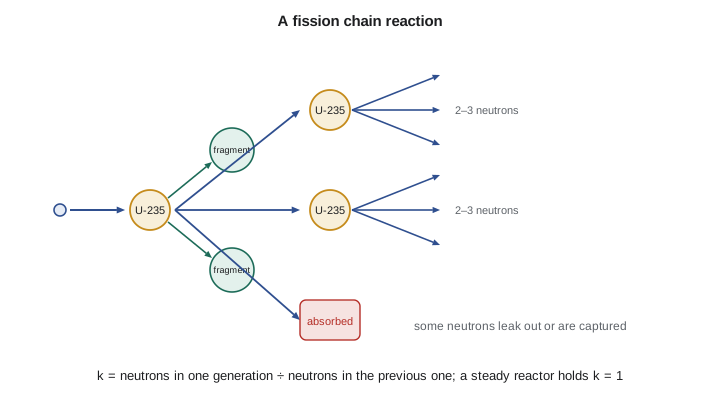
When \(k < 1\), the reactor is subcritical and the neutron population dies away. When \(k = 1\), it is critical and the power is steady. When \(k > 1\), it is supercritical and the power rises. In everyday reactor language, critical is the normal operating condition and means steady, controlled power, not danger. Operators raise power by making \(k\) slightly greater than one for a short time, then return it to one at the new power level.
Most of the neutrons from fission do not cause another fission. Some are captured by uranium-238, which usually does not fission with slow neutrons but becomes uranium-239 and then, after two beta decays, plutonium-239. Some are absorbed by the coolant, the structure, the control rods or by fission products. Some leak out of the core altogether. Designing a reactor is largely a matter of managing this neutron balance so that exactly one neutron per fission, on average, survives to cause the next.
Slowing neutrons down: moderation
Neutrons from fission are fast, with energies around 2 MeV. Uranium-235 is much more likely to fission when struck by a slow, or thermal, neutron, with an energy of about 0.025 eV, the energy of particles in thermal equilibrium at room temperature. The probability of fission, expressed as a cross section, is several hundred times larger for thermal neutrons than for fast ones. Most power reactors therefore slow the neutrons down using a moderator.
A moderator works by collision, like billiard balls. A neutron loses the most energy when it hits something of about its own mass, so light nuclei are best. Hydrogen in ordinary water slows neutrons quickly, but it also absorbs some of them. Deuterium in heavy water slows neutrons more gently and absorbs very few. Carbon in graphite is heavier and needs more collisions, but also absorbs few. The choice of moderator decides what fuel a reactor needs.
| Moderator | Collisions to thermalize (approx.) | Neutron absorption | Fuel it allows |
|---|---|---|---|
| Ordinary water | 18 | moderate | enriched uranium, a few percent U-235 |
| Heavy water | 25 | very low | natural uranium (CANDU) |
| Graphite | 115 | low | natural or slightly enriched uranium |
This explains the answer Hana gave the chemistry teacher in Lesson 2. With heavy water, enough neutrons survive that natural uranium, at 0.72 percent uranium-235, can sustain a chain reaction. With ordinary water, too many neutrons are absorbed, so the proportion of uranium-235 must be raised to a few percent, which is what enrichment does. Some reactors, called fast reactors, use no moderator at all and rely on the higher number of neutrons released when fast neutrons cause fission. Lesson 6 compares the types.
Why a power reactor cannot explode like a bomb
A question that comes up at every public session is whether a reactor could explode like a nuclear weapon. It cannot, and the physics of the chain reaction explains why. A power reactor's fuel contains only a few percent of fissile material, spread through a large core and mixed with moderator, coolant and structure. A rapid, explosive chain reaction requires material of very different composition held together under extreme conditions, which a power reactor does not have and cannot create. If the power of a reactor rises too fast, the fuel heats up and its geometry changes, and the reaction is shut down by those effects long before anything resembling a nuclear explosion is possible.
That does not mean reactors carry no risk. Lesson 10 explains that the real hazards are overheating of the fuel and the release of radioactive material, and that in two major accidents steam or hydrogen explosions damaged the reactor building. The protection against those risks lies in reactor design, control and cooling, the subjects of the next lessons. International safeguards, applied by the International Atomic Energy Agency, track nuclear material in civilian programmes to make sure it stays in peaceful use.
Fertile and fissile materials
A nuclide that fissions readily with slow neutrons is called fissile. Uranium-235 is the only fissile nuclide found in nature in useful amounts; plutonium-239 and uranium-233 are made in reactors. A nuclide that can be turned into a fissile one by capturing a neutron is called fertile. Uranium-238 is fertile, becoming plutonium-239, and thorium-232 is fertile, becoming uranium-233. In a typical power reactor, plutonium made from uranium-238 during operation fissions in place and provides about a third of the energy by the end of the fuel's life. This is why used fuel still contains energy, and why some countries reprocess it, as Lesson 9 describes.
Explaining the chain reaction to the public
Hana tests her explanation on two colleagues outside the engineering team. The first suggestion she gets is to avoid the familiar image of falling dominoes, which suggests that the process always runs away. A better picture, her colleague says, is a campfire that is kept at a steady size by adding just as much wood as burns. Too little wood and it dies down; too much and it grows, but a careful hand keeps it steady for hours. In a reactor, the neutron balance plays the part of the wood, and control rods, moderator and the fuel's own response to temperature are the careful hand. The analogy is imperfect, as all analogies are, but it captures the main idea: a chain reaction in a reactor is a balanced, continuously managed process, not a single event.
The second suggestion is to show how small the fuel is. Dr. Brennan brings a ceramic pellet replica to the session. A single uranium dioxide pellet, about a centimetre across and a centimetre and a half long, produces in a light water reactor roughly as much heat over its life as a tonne of coal, or several hundred litres of oil. People remember a comparison they can hold in their hand far better than one in joules, and the question period after that slide is always the liveliest.
Common mistakes
MistakeThinking critical means a reactor is in danger.
InsteadCritical means k = 1 and steady power; it is the normal operating state.
MistakeAssuming all neutrons from fission cause more fissions.
InsteadMost are captured, absorbed or leak out; only about one per fission continues the chain.
MistakeForgetting that part of fission energy comes later, from fragment decay.
InsteadAbout 7 percent of the heat comes from decay of fission products, which continues after shutdown.
MistakeBelieving a moderator speeds up the reaction by adding energy.
InsteadA moderator slows neutrons, which makes them more likely to cause fission in uranium-235.
MistakeSaying a power reactor could explode like a nuclear weapon.
InsteadIts fuel and configuration make that physically impossible; the real hazards are overheating and release of radioactive material.
Summary and key terms
- Fission splits a heavy nucleus into two fragments plus 2 to 3 neutrons, releasing about 200 MeV.
- Most of the energy appears as kinetic energy of the fragments and becomes heat in the fuel.
- One kilogram of U-235 fissioned releases about 8 × 10¹³ J, millions of times more than a kilogram of coal.
- The multiplication factor k compares successive neutron generations; k = 1 gives steady power.
- Moderators slow neutrons to thermal energies, where U-235 fission is far more likely.
- The moderator's absorption decides whether natural or enriched uranium is needed.
- Fertile U-238 and Th-232 can be turned into fissile Pu-239 and U-233.
- Fission
- The splitting of a heavy nucleus into two lighter nuclei with release of energy and neutrons.
- Fission fragments
- The two nuclei formed in fission, usually radioactive.
- Multiplication factor
- The ratio of neutrons in one generation to those in the previous one, k.
- Critical
- The condition k = 1, giving a steady chain reaction.
- Moderator
- A material of light nuclei that slows neutrons by collisions.
- Thermal neutron
- A neutron slowed to about 0.025 eV, in equilibrium with its surroundings.
- Fissile
- Able to fission readily with slow neutrons, such as U-235 and Pu-239.
- Fertile
- Able to become fissile by capturing a neutron, such as U-238 and Th-232.
Practice problems
Work each problem on paper first, then reveal the answer to check.
Balance the fission reaction n + U-235 → Sr-94 + Xe-140 + ? neutrons.
Show answer
236 = 94 + 140 + x, so x = 2 neutrons. Charge: 92 = 38 + 54.
How much energy in joules does one fission release?
Show answer
200 MeV × 1.602 × 10⁻¹³ J/MeV = 3.2 × 10⁻¹¹ J.
Using the program, how many neutrons remain after 100 generations at k = 0.98, starting from 1000?
Show answer
1000 × 0.98¹⁰⁰ ≈ 133.
Why can CANDU reactors use natural uranium?
Show answer
Heavy water absorbs very few neutrons, so enough survive to sustain the chain reaction with 0.72 percent U-235.
What becomes of U-238 that captures a neutron in a reactor?
Show answer
It becomes U-239, which beta decays to Np-239 and then to Pu-239.
A reactor's power is to be raised. What must operators do to k?
Show answer
Raise it slightly above 1 for a time, then return it to 1 at the new power.
Lesson quiz · 5 questions
Score 60% or more to complete this lesson.
Create a free account to save your progress, take quizzes and earn a certificate.