
NUC-200 · Lesson 3 of 12 · 21 min
Radioactive decay
The third question came from a parent whose son had read about radioactive waste lasting for thousands of years: does radioactivity ever go away, and how long does it take? Hana knows the answer depends entirely on which radioactive material is meant. Some vanish in seconds, others last longer than the age of the Earth, and the rule that connects them is one of the simplest and most reliable laws in science.
What radioactive decay is
An unstable nucleus can change into a more stable one by emitting particles or energy. This is radioactive decay. The original nucleus is the parent and the result is the daughter, which may itself be radioactive. Decay happens spontaneously; it cannot be sped up or slowed down by heat, pressure or chemistry, which is why radioactive materials cannot be made safe by burning or dissolving them. What can be controlled is where the material is, how it is shielded and how long it is kept isolated while it decays.
The main decay modes
Alpha decay emits an alpha particle, a helium-4 nucleus with two protons and two neutrons. The parent loses two from \(Z\) and four from \(A\). Alpha decay is common in heavy nuclei such as uranium, thorium, radium, plutonium and americium. Alpha particles are emitted with a few MeV of energy but are stopped by a sheet of paper or the outer dead layer of skin, so alpha emitters are mainly a hazard if they get inside the body, by inhalation or ingestion.
Beta-minus decay converts a neutron into a proton, emitting an electron and an antineutrino. \(Z\) rises by one and \(A\) stays the same. Nuclei with too many neutrons decay this way, including nearly all fission products, tritium and carbon-14. Beta-plus decay converts a proton into a neutron and emits a positron; electron capture does the same job by absorbing one of the atom's own electrons. Beta particles travel a few millimetres in tissue or a few metres in air and are stopped by a few millimetres of plastic or aluminium.
Gamma emission releases excess energy from a nucleus as a high-energy photon, without changing \(Z\) or \(A\). It usually follows alpha or beta decay, when the daughter is left in an excited state. Gamma rays penetrate deeply and are reduced by dense shielding such as lead, steel or thick concrete, rather than stopped outright. Some heavy nuclei can also decay by spontaneous fission, and a few emit neutrons, which are important in reactor control (Lesson 5).
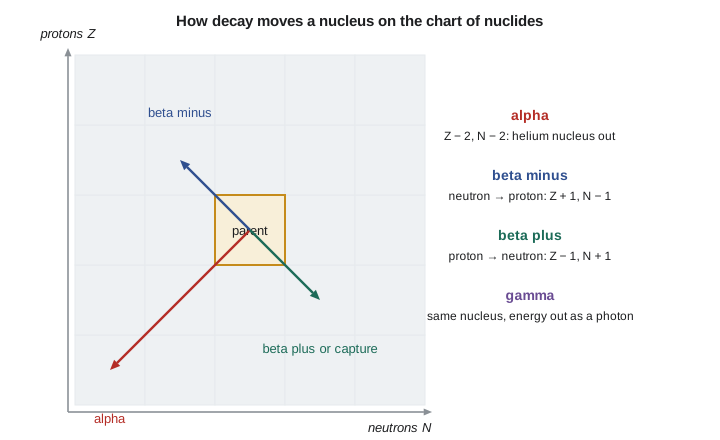
In every decay, the totals of mass number and charge are conserved, which makes it easy to work out the daughter. The energy released, the Q-value, comes from the mass difference between the parent and the products, as in Lesson 2.
The decay law
Radioactive decay is random at the level of a single nucleus: no one can say when a particular atom will decay. For a large number of nuclei, however, the behaviour is perfectly predictable, because each nucleus has the same fixed probability of decaying per unit time. That probability is the decay constant \(\lambda\). The rate of decay is proportional to the number of nuclei present, which leads to exponential decay.
The activity \(A\) of a sample is the number of decays per second, \(A = \lambda N\). Activity is measured in becquerels (Bq), one decay per second. The older unit, the curie (Ci), is \(3.7 \times 10^{10}\) Bq, roughly the activity of one gram of radium-226. A becquerel is tiny: the human body contains about 4000 Bq of potassium-40 and a few thousand becquerels of carbon-14 from food, while a cancer-therapy source may hold hundreds of terabecquerels.
Half-life and mean life
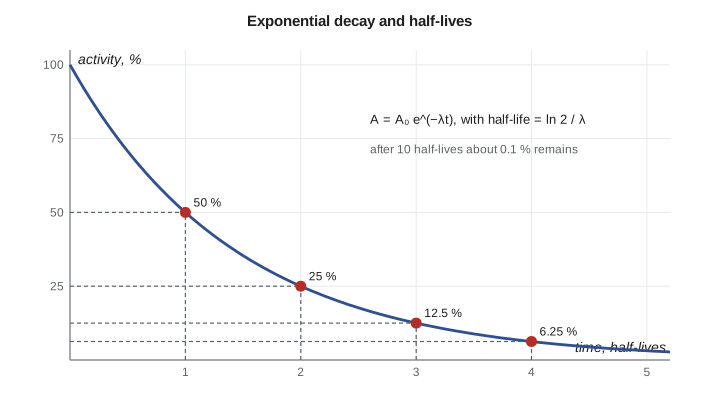
The half-life \(T_{1/2}\) is the time for half of the nuclei to decay, and therefore for the activity to fall by half. After two half-lives a quarter remains, after three an eighth, and after ten about one thousandth. The half-life and decay constant are linked by the natural logarithm of 2. The mean life \(\tau = 1/\lambda\) is the average time a nucleus survives before decaying, about 1.44 half-lives.
| Nuclide | Half-life | Decay | Where it appears |
|---|---|---|---|
| Iodine-131 | 8.02 days | beta and gamma | fission product, thyroid therapy |
| Technetium-99m | 6.01 hours | gamma | medical imaging |
| Cobalt-60 | 5.27 years | beta and gamma | sterilisation, cancer therapy |
| Tritium (H-3) | 12.3 years | weak beta | heavy water reactors, fusion |
| Caesium-137 | 30.1 years | beta and gamma | fission product |
| Plutonium-239 | 24 100 years | alpha | made in reactor fuel |
| Uranium-235 | 704 million years | alpha | natural uranium |
| Uranium-238 | 4.47 billion years | alpha | natural uranium |
This table holds the key to the parent's question. A material with a short half-life is intensely radioactive but disappears quickly; iodine-131 released in an accident is almost gone after three months. A material with a very long half-life decays so slowly that its activity per gram is low; uranium-238 is only mildly radioactive. The materials that need the longest isolation are those with intermediate to long half-lives and significant activity, such as plutonium and some fission products. Used reactor fuel loses about 99 percent of its radioactivity in the first few decades, but the remaining long-lived activity is why repositories are designed for very long periods (Lesson 9).
# Radioactive decay: activity of sources over time.
import math
def activity(A0, half_life, t):
    """Activity after time t, with t and half_life in the same units."""
    return A0 * math.exp(-math.log(2) * t / half_life)

# A cobalt-60 source of 370 GBq (10 Ci), half-life 5.27 years
print("Cobalt-60 source, 370 GBq at the start")
for years in (0, 1, 5.27, 10, 20):
    print(f"  after {years:5.2f} years: {activity(370, 5.27, years):6.1f} GBq")

# Iodine-131 (8.02 days) in a medical waste tank: how long to fall below 1 percent?
t = 8.02 * math.log(100) / math.log(2)
print(f"\nIodine-131 falls to 1 percent after {t:.0f} days ({t/8.02:.1f} half-lives)")

# Caesium-137 released in 1986: fraction left in 2026
left = activity(1.0, 30.1, 2026 - 1986)
print(f"Caesium-137 left after 40 years: {left:.0%}")

# Mean life and decay constant of carbon-14, and dating a sample
half = 5730
lam = math.log(2) / half
print(f"\nCarbon-14: decay constant {lam:.3e} per year, mean life {1/lam:,.0f} years")
ratio = 0.42                        # sample activity / living activity
age = -math.log(ratio) / lam
print(f"A sample at {ratio:.0%} of living activity is about {age:,.0f} years old")Cobalt-60 source, 370 GBq at the start after 0.00 years: 370.0 GBq after 1.00 years: 324.4 GBq after 5.27 years: 185.0 GBq after 10.00 years: 99.3 GBq after 20.00 years: 26.7 GBq Iodine-131 falls to 1 percent after 53 days (6.6 half-lives) Caesium-137 left after 40 years: 40% Carbon-14: decay constant 1.210e-04 per year, mean life 8,267 years A sample at 42% of living activity is about 7,171 years old
Worked problem
How long until a source is replaced?
A hospital cobalt-60 therapy source is replaced when its activity falls to 60 percent of its original value, because treatment times become too long. How long does that take?
Show solution
- Set \(A/A_0 = 0.60 = (1/2)^{t/5.27}\).
- Take logarithms: \(t = 5.27 \times \ln(1/0.60)/\ln 2 = 5.27 \times 0.511/0.693\).
- \(t = 3.88\ \text{years}\).
Answer: The source loses about 12 percent of its activity each year, so it is replaced every four years or so. The old source is still highly radioactive and goes back to the supplier for recycling or long-term management.
Decay chains and equilibrium
Many daughters are themselves radioactive, forming decay chains. Uranium-238 decays through fourteen steps, including radium-226 and radon-222, before ending as stable lead-206. When a long-lived parent feeds a short-lived daughter, the daughter's activity builds up until it equals the parent's activity, a state called secular equilibrium. This is why natural uranium ore contains radium and radon, and why radon gas seeps from soil and rock in many regions. Radon in homes is the largest source of natural radiation exposure for many people, and simple testing and ventilation can reduce it.
When the parent's half-life is longer than the daughter's but not overwhelmingly so, the two reach transient equilibrium, with the daughter's activity tracking the parent's at a fixed ratio. Lesson 8 uses this behaviour in the molybdenum-99 generators that supply technetium-99m to hospitals.
Measuring decay and dating
Because half-lives are fixed, decay works as a clock. Carbon-14, made continuously in the atmosphere by cosmic rays, is taken up by living things. After death, no new carbon-14 enters, and the remaining carbon-14 decays with a half-life of 5730 years. Measuring the fraction left dates organic material up to about 50 000 years old. Uranium-lead dating, using the two uranium decay chains, dates rocks billions of years old and established the age of the Earth at about 4.5 billion years.
Decay inside a reactor
Inside a working reactor, decay never stops. Each fission produces two fragments with far too many neutrons, and each fragment undergoes a chain of beta decays, with gamma emission, until it reaches a stable nuclide. Hundreds of different fission products are present at once, with half-lives from fractions of a second to millions of years. A small fraction of these decays release neutrons a few seconds after fission. These delayed neutrons make up only about 0.65 percent of the neutrons from uranium-235, yet they are what makes a reactor controllable, because they slow the response of the chain reaction enough for control systems to act. Lesson 5 explains how.
The combined decay of all those fission products releases heat even after the chain reaction stops. Just after shutdown, this decay heat is about six to seven percent of the reactor's previous thermal power; within a day it falls below one percent, and it keeps falling for years. That remaining heat is small compared with full power, but in a large reactor it is still many megawatts, so cooling must continue after shutdown. Lesson 10 shows that every major reactor accident has been, at its core, a failure to remove decay heat. For Hana's audience, the key point is that a reactor cannot be switched off like a lamp; it has to be cooled down like a hot stove element that keeps glowing after the power is cut.
Where the public meets decay
Most people encounter radioactive decay without realizing it. Smoke detectors in many homes contain a tiny americium-241 source, an alpha emitter whose particles ionize the air in a chamber; smoke interrupts the current and sets off the alarm. Bananas, potatoes and the human body all contain potassium-40. Granite countertops and brick contain traces of uranium and thorium. Hospitals use short-lived tracers so that patients carry very little activity home. Each of these examples shows the same principle: what matters is the type of radiation, how much activity is present and how close it is, not whether something is radioactive at all. Lesson 7 turns that principle into numbers.
Engineers use the same arithmetic every day. Before maintenance on a pump that has carried reactor coolant, the team measures the dose rate and checks which nuclides dominate it. If the main contributor is a short-lived activation product, waiting a few days may cut the dose rate substantially at no cost. If it is cobalt-60, waiting brings little benefit over the timescale of an outage, so the team relies on shielding, distance and short working times instead. Knowing the half-life of each contributor turns a vague concern about radioactivity into a specific, planned choice. Hana notes this as a good example for the public: radiation work is planned around known decay rates, in much the same way that a construction crew plans around the curing time of concrete.
Common mistakes
MistakeThinking heat, pressure or chemistry can stop radioactive decay.
InsteadDecay rates are fixed by nuclear properties; only isolation, shielding and time reduce the hazard.
MistakeAssuming a long half-life means a material is more dangerous.
InsteadLong half-life means low activity per gram; short half-life means intense but brief activity.
MistakeSaying a substance is gone after two half-lives.
InsteadTwo half-lives leave a quarter; about ten are needed to reach one thousandth.
MistakeTreating all radiation as equally penetrating.
InsteadAlpha is stopped by paper, beta by millimetres of plastic, while gamma needs dense shielding.
MistakeForgetting radioactive daughters.
InsteadMany decays produce radioactive daughters, so a chain's total activity can exceed the parent's alone.
Summary and key terms
- Unstable nuclei decay spontaneously by alpha, beta or gamma emission, and rarely by spontaneous fission.
- Each mode changes Z and A in a fixed way; mass number and charge are conserved.
- N(t) = N₀ e^(−λt); activity A = λN is measured in becquerels.
- Half-life T½ = ln 2/λ; after n half-lives a fraction (1/2)ⁿ remains.
- Short-lived materials are intensely active but disappear quickly; long-lived ones are less active but persist.
- Decay chains can reach secular or transient equilibrium; decay also serves as a clock for dating.
- Parent and daughter
- The nuclide that decays and the nuclide it becomes.
- Alpha particle
- A helium-4 nucleus emitted in alpha decay.
- Beta particle
- An electron or positron emitted in beta decay.
- Gamma ray
- A high-energy photon emitted by an excited nucleus.
- Decay constant
- The probability per unit time that a nucleus decays, λ.
- Activity
- The number of decays per second, measured in becquerels.
- Half-life
- The time for half of the radioactive nuclei in a sample to decay.
- Secular equilibrium
- The state in which a short-lived daughter decays as fast as a long-lived parent produces it.
Practice problems
Work each problem on paper first, then reveal the answer to check.
Write the daughter when radium-226 emits an alpha particle.
Show answer
Radon-222: Z = 88 − 2 = 86, A = 226 − 4 = 222.
Tritium has a half-life of 12.3 years. What fraction remains after 50 years?
Show answer
(1/2)^(50/12.3) = 0.5^4.07 = 0.060, about 6 percent.
Find the decay constant of iodine-131 in per second.
Show answer
λ = 0.693 / (8.02 × 86 400 s) = 1.0 × 10⁻⁶ per second.
A sample has 2.0 × 10¹² atoms of iodine-131. What is its activity?
Show answer
A = λN = 1.0 × 10⁻⁶ × 2.0 × 10¹² = 2.0 × 10⁶ Bq, or 2.0 MBq.
How many half-lives until activity falls below 1/1000 of the original?
Show answer
2¹⁰ = 1024, so about 10 half-lives.
In the program, a wood sample has 60 percent of living carbon-14 activity. How old is it?
Show answer
t = ln(1/0.60)/1.21 × 10⁻⁴ ≈ 4200 years.
Lesson quiz · 5 questions
Score 60% or more to complete this lesson.
Create a free account to save your progress, take quizzes and earn a certificate.