
MSAZ-319 · Lesson 11 of 12 · 19 min
Timed practice plan
▶ Video coming soon A video version of this lesson is on the way.
The study budget in lesson 3 said how many hours each area gets. This lesson turns those hours into dated weeks, with checkpoints to test whether the plan is working and timed practice sets that rehearse exam conditions. Keiko and Marisol wrote the plan on Tuesday, December 8, 2026, six months before it starts, so it is a plan rather than a record: every date from June 2027 is an intention, and the checkpoints exist precisely so that it can change.
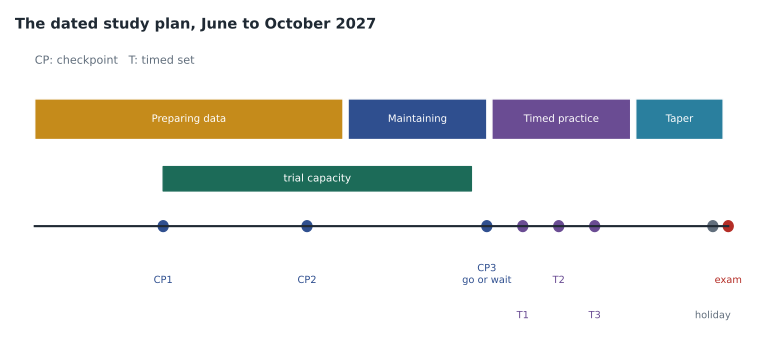
The plan runs from Tuesday, June 1 to the exam on Thursday, October 14, 2027, nineteen and a half weeks. It has three phases: learning, from June to the end of August, when most of the hours go to the review lessons and the labs; timed practice, in September, when the weekly rhythm changes to full-length sets under exam conditions; and taper, in the last three weeks, when the hours fall and the focus moves to rest and the exam-day routine in lesson 12.
The phases
| Phase | Dates (2027) | Main work | Hours, about |
|---|---|---|---|
| Learning: preparing data | June 1 to July 31 | Review lesson 5, labs on lakehouse views, KQL, file sizes, partitioning, orchestration and Type 2 dimensions | 56 |
| Learning: maintaining the solution | August 1 to August 28 | Review lesson 4, labs on project files, Git, deployment pipelines, XMLA and templates | 22 |
| Learning: semantic models | Short sessions throughout | Review lesson 6 and mixed practice sets | 7 |
| Timed practice | September 1 to September 25 | Three full timed sets, error log, targeted review | 18 |
| Taper | September 26 to October 13 | Short mixed sets, rereading lab notes, rest | 7 |
The learning hours are smaller than the area totals in lesson 3 because the timed sets and the taper also count: each full set draws about half its items from preparing data and a quarter from each of the other areas, so with their share of those 25 hours the areas come back to roughly the 70, 27 and 13 hours of the budget.
Checkpoints
A checkpoint is a Saturday session in which Keiko takes a fresh set of 20 practice items per area under timed conditions and compares the scores with the diagnostic and with the target of 16 of 20. There are three: Saturday, June 26, after four weeks; Saturday, July 24, near the end of the preparing data phase; and Saturday, August 28, at the end of the learning phase. The adjustment rule from lesson 3 applies at each: an area at or above 16 gives two hours to the weakest area, and an area that has not improved since the last checkpoint adds a lab and two hours.
The checkpoints also test the plan itself. If the June 26 scores show no change in preparing data after four weeks of work on it, the problem is not the hours but the method, and Marisol's advice is to change the source, for example from reading to labs, rather than to add more of the same. If the scores are rising faster than expected, the plan can bring forward the August topics. The third checkpoint, on August 28, is the go or wait decision described below.
Timed practice sets
September is for rehearsing the exam. On Saturdays, September 4, 11 and 18, Keiko will sit a full practice set of about 50 items, including a case study, in 100 minutes, at the same time of day as the exam is booked, in the same room she will use for the online exam, with the phone in another room and no notes. Each set is followed the next day by an hour of review with the error log. The weekday evenings in September go to the topics the sets expose, not to new material.
Timing is part of what is practised. Lesson 2 suggested a pace of about a minute and a half per item outside the case study and about 25 minutes for a case of six questions. In the first set, Keiko will mark every item that took more than three minutes, and in the review she will ask whether the time went into reading the stem, comparing options or recalling a fact. Long times on reading usually mean the stem-reading habit needs practice; long times on recall mean a topic needs another review.
from datetime import date, timedelta

exam = date(2027, 10, 14)
start = date(2027, 6, 1)
events = {
    "Checkpoint 1": date(2027, 6, 26),
    "Checkpoint 2": date(2027, 7, 24),
    "Checkpoint 3 (go or wait)": date(2027, 8, 28),
    "Timed set 1": date(2027, 9, 4),
    "Timed set 2": date(2027, 9, 11),
    "Timed set 3": date(2027, 9, 18),
    "Last day to reschedule": exam - timedelta(days=1),
}
print(f"Plan length: {(exam - start).days} days")
for name, day in events.items():
    weeks = (exam - day).days / 7
print(f"{day:%a %b %d} {name:28} {weeks:4.1f} weeks before the exam")Plan length: 135 days Sat Jun 26 Checkpoint 1 15.7 weeks before the exam Sat Jul 24 Checkpoint 2 11.7 weeks before the exam Sat Aug 28 Checkpoint 3 (go or wait) 6.7 weeks before the exam Sat Sep 04 Timed set 1 5.7 weeks before the exam Sat Sep 11 Timed set 2 4.7 weeks before the exam Sat Sep 18 Timed set 3 3.7 weeks before the exam Wed Oct 13 Last day to reschedule 0.1 weeks before the exam
What this code does
The listing stores the exam date, the start of the plan and the dates of the checkpoints and timed sets. It first prints how many days the whole plan lasts, then, for each event, prints its weekday and date and how many weeks remain until the exam, so Keiko can see at a glance that the go or wait checkpoint comes about seven weeks before the exam and the last timed set about four weeks before.
The output shows the shape of the plan: the go or wait checkpoint falls about seven weeks before the exam, which leaves room to reschedule; the last timed set falls about four weeks before, which leaves time for one more round of review; and the reschedule deadline is the day before the exam, though Keiko will not wait that long.
The go or wait decision
On Saturday, August 28, Keiko and Marisol will decide whether to keep the October 14 date or move it. The rule they agreed in December is simple. If every area is at 15 or more of 20 and the overall score is at least 48 of 60, the date stays. If one area is below 15, the date stays but September's weekday sessions go to that area. If two or more areas are below 15, or the overall score is below 44, they will move the exam, probably to late November, and extend the learning phase. Pearson VUE allows rescheduling an online exam up to a short time before the appointment without a fee, but the exact rule is on the booking confirmation and should be checked rather than assumed.
| Result at August 28 | Decision | September focus |
|---|---|---|
| All areas 15 or more and overall 48 or more of 60 | Keep October 14 | Timed sets as planned |
| One area below 15 | Keep October 14 | Weekday sessions on the weak area |
| Two or more areas below 15, or overall below 44 | Move the exam, probably to late November | Extend the learning phase |
The taper
In the three weeks before the exam, Keiko's hours drop to about two or three a week. She will reread her lab notes and the error log, do short mixed sets of ten items, and stop adding new material. Thanksgiving Monday, October 11, falls three days before the exam, and Marisol suggested taking it fully off. The last study session is planned for the evening of Tuesday, October 12, a light one, and Wednesday, October 13, is for the system check and the room set-up described in lesson 12.
A month on the calendar
The phases are easier to follow on a calendar. The table below shows the first four weeks of the plan, June 1 to June 26, 2027, using the weekly rhythm from lesson 3: three weekday evenings and a longer Saturday session. Each week has one theme from the preparing data review, and the Saturday of the fourth week is the first checkpoint.
| Week | Tuesday | Wednesday | Thursday | Saturday |
|---|---|---|---|---|
| June 1 | Read: choosing a store and shortcuts | Lab without capacity: sample lakehouse queries in the free features | Ten items, error log | Mixed set of 20 items |
| June 8 | Read: pipelines, dataflows and notebooks | Sketch the orchestration lab | Ten items, error log | Catch-up |
| June 15 | Read: star schema, Type 1 and Type 2 | Write MERGE statements on paper | Ten items, error log | Mixed set of 20 items |
| June 22 | Read: KQL essentials | Reread the week's error log | Ten items on KQL | Checkpoint 1 and start the trial |
The June weeks lean on reading and paper exercises because the trial starts only on June 26. That is deliberate. Keiko learns a feature faster in a lab once she has read about it and seen it in a few items, and the trial's 60 days are better spent on labs that have been prepared than on finding her way around.
When a week is lost
Plans meet real life. The pilot, a family event or a week of illness can take a week out of the plan, and Marisol and Keiko agreed in advance what happens then, so that one lost week does not turn into three. A lost week is not made up by doubling the next one, which tends to produce tired, shallow study. Instead, its theme moves to the next catch-up Saturday, and if there is none before the next checkpoint, the theme with the strongest score in the error log gives up its slot. If two weeks are lost in a row, the go or wait rule is applied early, at the next checkpoint, rather than waiting for August 28.
Keiko also has two buffer weeks built in without labels: the catch-up Saturdays, which are every other week in June and July, and the week of August 30, between the last checkpoint and the first timed set, which has no planned topic. If nothing has slipped by then, the buffer week goes to whichever area scored lowest at the third checkpoint.
Where the practice items come from
The plan needs a lot of practice items: ten on each Thursday, a mixed set on alternate Saturdays, three checkpoints of 60 and three timed sets of about 50, well over 600 in all. Keiko's sources are the free practice assessment on Microsoft Learn, which she can retake and which changes its questions between attempts; the knowledge checks at the end of the Microsoft Learn modules for DP-600; the items in this course; and the cases she and Daniel write for each other. She will avoid sites that claim to have real exam questions, which break the exam agreement candidates accept and are often wrong anyway. For the timed sets, she will build each one from items she has not yet seen and time it herself with a kitchen timer, so that the pressure is real even when the source has no clock of its own.
Worked problem
Checking the go or wait rule
At the August 28 checkpoint, Keiko scores 15 in maintaining the solution, 14 in preparing data and 17 in semantic models. Does the exam date stay, and what does September look like?
Show solution
- The overall score is 15 + 14 + 17 = 46 of 60.
- One area, preparing data, is below 15; the other two are at 15 or more.
- The overall score is 46, between 44 and 48, and only one area is below 15, so the second row of the rule applies.
- The date stays, and September's weekday sessions go to preparing data, while the Saturday timed sets go ahead.
Answer: The October 14 date stays; September weekday sessions focus on preparing data.
Common mistakes
MistakePlan only the hours, not the dates.
InsteadPut dates on phases, checkpoints and timed sets so that slippage is visible.
MistakeTake timed practice sets from the start.
InsteadLearn first, then rehearse under timed conditions in the last six weeks.
MistakeKeep studying hard until the night before.
InsteadTaper in the last three weeks and keep the day before for the system check.
MistakeDecide whether to reschedule the week before.
InsteadMake the go or wait decision about seven weeks before, by a rule agreed in advance.
MistakeAssume rescheduling is always free.
InsteadCheck the rule on the booking confirmation.
Summary and key terms
- The plan has three phases: learning from June to August, timed practice in September, and a taper before the exam.
- Checkpoints on June 26, July 24 and August 28, 2027 test the scores and adjust the hours.
- Timed sets on September 4, 11 and 18 rehearse the exam's length, room and conditions.
- The go or wait decision on August 28 follows a rule agreed in December.
- The taper keeps the last days light and the day before for the system check.
- Checkpoint
- A planned session that measures progress and adjusts the plan.
- Timed practice set
- A full-length set of practice items taken under exam conditions.
- Go or wait decision
- A planned decision whether to keep or move the exam date, based on checkpoint scores.
- Taper
- Reducing study hours in the last weeks before an exam.
- Phase
- A block of weeks in the plan with one main kind of work.
Practice problems
Work each problem on paper first, then reveal the answer to check.
When is the go or wait checkpoint?
Show answer
Saturday, August 28, 2027.
How many timed practice sets are planned?
Show answer
Three, on September 4, 11 and 18.
What happens if two areas are below 15 at the last checkpoint?
Show answer
The exam is moved, probably to late November.
What is planned for Wednesday, October 13?
Show answer
The system check and room set-up.
About how many hours does the plan include?
Show answer
About 110.
Lesson quiz · 5 questions
Score 60% or more to complete this lesson.
Create a free account to save your progress, take quizzes and earn a certificate.