
MSAZ-319 · Lesson 10 of 12 · 20 min
Hands-on practice in a trial capacity
▶ Video coming soon A video version of this lesson is on the way.
Reading and practice items build recognition; labs build the kind of memory that survives a tricky stem. Keiko has used Fabric every working day since the spring, but only in Harrow & Finch's production tenant, where she cannot try features freely, enable tenant settings or break things on purpose. For the labs in her plan she will use a Fabric trial, which gives a capacity for a limited time at no charge. Marisol's rule for the labs is simple: every skill rated not met in lesson 3 gets one lab, and every lab ends with a written answer to the question 'what would an exam item about this ask?'
This lesson describes how to set up a trial safely, the labs in Keiko's plan, and how to time the trial so that it covers the weeks when the labs are scheduled. The terms of the trial are Microsoft's and can change, so candidates should read the current terms on the Fabric trial page before starting.
What the trial gives
Microsoft's Fabric trial page, read in November 2026, says the trial gives free access for 60 days, that the trial capacity is configured as either an F4, with 4 capacity units, or an F64, with 64 capacity units, and that eligible users can change the size from 4 to 64 under the capacity settings. Changing the size does not extend or reset the 60 days. The trial includes up to 1 TB of OneLake storage. A Fabric administrator can turn off the tenant setting that lets users try paid features, in which case the Start trial option is not shown. When the trial ends, access to the trial capacity is revoked, Fabric items such as notebooks and pipelines become inactive until the workspace is assigned to a paid capacity, and the content stays in OneLake for 7 days. A candidate should not plan on an extension.
The size matters for the labs. At 4 capacity units, small labs on lakehouses, notebooks, views and KQL run, slowly but well enough. Some labs are more comfortable with more: a three-stage deployment pipeline with a Direct Lake model in each stage, Spark jobs on the larger samples, and DAX Studio traces against a model with millions of rows all run faster at 64, and the Direct Lake guardrails are lower on smaller sizes. Keiko will check the size the day she starts, and change it to 64 if her account is eligible. If it is not, she will reorder the labs so that the ones that need more capacity run in the Harrow & Finch development workspace, which is on a paid capacity, with her manager's agreement and sample data only.
| Fact | What the trial page said in November 2026 | Check before starting |
|---|---|---|
| Capacity | F4 (4 capacity units) or F64 (64 capacity units); eligible users can change size | Which size the trial starts at |
| Length | 60 days; resizing does not reset the countdown | The end date shown in the portal |
| Who can start one | Users whose tenant setting allows trying paid features | The tenant setting and organization policy |
| Storage | Up to 1 TB in OneLake | Space used by sample data |
| After it ends | Fabric items become inactive; content stays in OneLake for 7 days | Whether to move anything to a paid capacity |
| Cost | No charge for the trial capacity | Any charges for other Azure services used |
Keiko decided not to use the Harrow & Finch tenant for the trial, even though it allows trials, because she wants to enable tenant settings such as XMLA read-write and try them without affecting colleagues. She will use a developer tenant of her own, created for the purpose, with no company data in it. The sample data in Fabric, such as the retail and taxi samples, and data she generates herself are enough for every lab. Nothing from Harrow & Finch, not even a copy of a table, will go into the trial.
Timing the trial
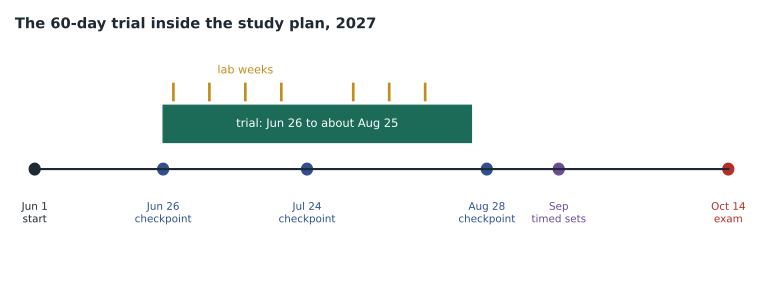
A 60-day trial is long enough for the labs if it starts at the right time. Keiko's plan runs from June 1 to October 14, 2027, and most of the labs fall in June, July and August, when she is reviewing preparing data and maintaining the solution. Starting the trial on Tuesday, June 1 would end it around July 31, too early for the August labs on deployment pipelines and Git. Starting on Saturday, June 26, the day of the first checkpoint, would end it around August 25, covering the July and August labs but not the June ones. Marisol suggested splitting: do the June labs, which mostly need only a lakehouse and notebooks, in the free Power BI and Fabric features already available, and start the trial on June 26 for everything that needs a capacity.
The labs
There are eleven labs, one for each of the seven skills not met and four for skills seen where the diagnostic showed weak spots. Each takes about an hour and has the same shape: a short goal, the steps, a check that it worked, and a note on what an exam item would ask. The table lists them in the order they fall in the plan.
| Week of | Lab | Skill | Check that it worked |
|---|---|---|---|
| June 28 | Create a lakehouse, load a sample, query it through the SQL analytics endpoint and create a view | Views and functions on a lakehouse endpoint | The view returns rows in the SQL editor |
| July 5 | Create an eventhouse, stream sample events with an eventstream, write five KQL queries | Query an eventhouse with KQL | Each query returns the expected rows |
| July 5 | Write a table with many small appends, measure query time, run OPTIMIZE, measure again | Delta file sizes | File count falls and the query is faster |
| July 12 | Partition one table by year and a copy by day, compare file counts and query times | Partitioning schemes | Year partitions are faster for year filters |
| July 12 | Build a dataflow and a notebook and orchestrate both from a pipeline | Orchestration | The dataflow starts only after the notebook succeeds |
| July 19 | Create a Type 2 dimension with MERGE in a warehouse | Slowly changing dimensions | A changed row closes and a new one opens |
| Aug 2 | Save a report as a .pbip project, edit a measure in TMDL, commit to Git | Power BI project files | The commit shows a one-line change |
| Aug 2 | Connect a workspace to Git and use a feature branch and a pull request | Git integration | The merged change appears in the workspace |
| Aug 9 | Build a three-stage deployment pipeline with a rule for the data source | Deployment pipelines | Test and production read different lakehouses |
| Aug 16 | Enable XMLA read-write, query with DAX Studio, deploy a change with Tabular Editor | XMLA endpoint | The change appears and the .pbix download is blocked |
| Aug 16 | Create a .pbit template and a .pbids data source file and open both | Reusable assets | Desktop opens with the layout and the connection |
A lab in detail: views on a lakehouse endpoint
The first lab shows the shape. Goal: create a view on a lakehouse's SQL analytics endpoint that analysts can query with T-SQL, without changing the tables. Steps: create a lakehouse in a trial workspace; load the retail sample into it; open the SQL analytics endpoint; write a view that joins the sales and product tables and renames the columns; query the view; then try to INSERT a row into one of the tables through the endpoint and read the error. Check: the view returns rows, and the INSERT fails. Exam note: 'If an item asks how analysts can query cleaned lakehouse data with T-SQL without a copy and without changing the tables, the answer is a view on the endpoint; if it asks how to write to the tables with T-SQL, the answer is a warehouse.'
The deliberate failure at the end is the part Marisol cares about most. Many exam items are about what a feature cannot do, and the fastest way to remember a limit is to have hit it. Every lab in the plan includes one step that is expected to fail, such as writing through the endpoint, testing row-level security as a workspace Admin, or downloading a .pbix after an XMLA change.
Lab notes that pay off later
Each lab ends with a short note in Keiko's study notebook, and the notes are what she will reread in September, not the lab steps. Marisol asked for a fixed shape so that the notes are quick to write and quick to scan: one line for the goal, one line for the surprise, one line for the limit hit by the deliberate failure, and one or two lines written as an exam item would phrase the decision. A note that says 'the endpoint cannot write to tables' is useful; a note that says 'if analysts need T-SQL over lakehouse data without changing it, choose a view on the endpoint; to write with T-SQL, choose a warehouse' is better, because it is already in the form the exam uses.
| Line | Example from the first lab |
|---|---|
| Goal | Expose cleaned lakehouse data to T-SQL without copying it |
| Surprise | The view could join two lakehouses in the same workspace by three-part names |
| Limit hit | INSERT through the SQL analytics endpoint failed |
| Exam phrasing | T-SQL over lakehouse data, no changes: view on the endpoint; write with T-SQL: warehouse |
Keeping the trial tidy and safe
A trial capacity has no charge, but other Azure services connected to it may have one, such as an Event Hubs namespace created as a source for an eventstream. Keiko will use Fabric's own sample event sources for the streaming lab instead, so nothing outside the trial is billed. She will also keep a short list of everything she creates outside Fabric, if anything, so that it can be removed when the trial ends.
At the end of each lab week she deletes the items she no longer needs, which keeps the workspace list short and makes the deployment pipeline lab easier to follow. On the last day of the trial she will export the notes and any TMDL files from the Git repository, which lives outside the trial and is not affected when the capacity ends. The repository will also hold the small datasets she generated, so that she can rebuild any lab later on another capacity if a checkpoint shows that a skill has slipped.
Finally, Marisol reminded her that labs are a means, not an end. A lab that runs for two hours because of a confusing error is still useful if the note records what caused the error, but a lab that turns into a project is time taken from practice items. Her rule is to stop at ninety minutes, write the note with what was learned so far, and come back to the rest the following week if it still matters.
Worked problem
Choosing a start date
The trial lasts 60 days. Keiko's capacity labs run from the week of June 28 to the week of August 16. If she starts the trial on Saturday, June 26, 2027, will it still be running on Friday, August 20, when the last lab week ends?
Show solution
- Days left in June after June 26: 30 − 26 = 4, so June 27 to 30.
- July has 31 days; August 1 to 20 is 20 days.
- From June 26 to August 20 is 4 + 31 + 20 = 55 days after the start.
- 55 is less than 60, so the trial is still running, with about five days to spare.
Answer: Yes; August 20 is 55 days after June 26, inside the 60-day trial.
Common mistakes
MistakeUse the company's production tenant for labs.
InsteadUse a separate tenant with sample data so tenant settings can be changed safely.
MistakeCopy company data into a trial for realism.
InsteadUse sample data or generated data; nothing confidential goes into a trial.
MistakeStart the trial on the first day of study.
InsteadStart it so that its 60 days cover the weeks that need a capacity.
MistakeA lab is done when it works.
InsteadEnd every lab with a deliberate failure and a note on what an item would ask.
MistakeTrial terms never change.
InsteadRead the current terms before starting.
MistakeEvery trial is an F64.
InsteadThe trial page says it can start at F4 or F64; check the size and change it if eligible.
Summary and key terms
- Labs build the memory that survives a tricky stem; every skill not met gets one.
- In November 2026 the Fabric trial page gave 60 days at F4 or F64 with up to 1 TB of OneLake storage; confirm the current terms first.
- Use a separate tenant and sample data, never company data.
- Time the trial to cover the weeks that need a capacity; Keiko starts hers on June 26.
- Each lab has a goal, steps, a check, a deliberate failure and an exam note.
- Fabric trial
- A time-limited Fabric capacity at no charge for trying Fabric features.
- Trial capacity
- The capacity created for a Fabric trial, to which workspaces are assigned.
- Developer tenant
- A separate Microsoft 365 or Entra tenant used for testing, with no production data.
- Lab
- A short hands-on exercise with a goal, steps and a check that it worked.
- Deliberate failure
- A lab step that is expected to fail, done to learn a limit.
Practice problems
Work each problem on paper first, then reveal the answer to check.
How long does the Fabric trial last according to the trial page in November 2026?
Show answer
60 days.
Why does Keiko use a separate tenant?
Show answer
To change tenant settings safely without company data.
When does Keiko's trial start?
Show answer
Saturday, June 26, 2027.
What is the deliberate failure in the first lab?
Show answer
Trying to INSERT through the SQL analytics endpoint.
How many labs are in the plan?
Show answer
Eleven.
Lesson quiz · 5 questions
Score 60% or more to complete this lesson.
Create a free account to save your progress, take quizzes and earn a certificate.