
MELC-204 · Lesson 9 of 12 · 24 min
Contracts and builders' liens in Manitoba
▶ Video coming soon A video version of this lesson is on the way.
Electrical contractors get paid at the end of a long chain. An owner pays a general contractor, the general contractor pays the trades, and the trades pay their suppliers and workers. When money stops moving anywhere along that chain, everyone below the break feels it. Manitoba's main tool for protecting the people who improve land is The Builders' Liens Act, chapter B91 of the Continuing Consolidation of the Statutes of Manitoba. In 2025, amendments added prompt payment rules and an adjudication system to it. This lesson covers the basic ideas of construction contracts, holdback, liens and the new prompt payment rules, at the level a licence candidate and a new business owner need.
Construction law is detailed and changes. The deadlines in this lesson come from published summaries and should be checked against the current Act and regulations, and against legal advice, before you rely on them for a real claim. Missing a lien deadline usually means losing the lien entirely.
Contracts first
Most payment disputes begin with an unclear contract. A good construction contract states who the parties are, what work is included and excluded, the price or the way the price is calculated, the payment schedule and the documents that support each payment, how changes are priced and approved, who takes out permits, the schedule, insurance and bonding requirements, warranty terms and how disputes will be resolved. On commercial work, owners and general contractors often use standard forms published by the Canadian Construction Documents Committee, such as the stipulated price contract, with supplementary conditions that change the standard terms. Read the supplementary conditions; that is where the risk often moves.
Change orders deserve special attention. On the Corydon Avenue café, the general contractor asks Red River Electric to move the espresso station circuit after the rough-in has passed inspection. Moving it costs labour, material and a reinspection. If Nadia's crew does the work on a verbal request and the price is never agreed in writing, Red River Electric may end up arguing about it months later. The safer practice is a written change order, signed before the work, that states the change, the price and any effect on the schedule.
Holdback
The Builders' Liens Act requires an owner, and each contractor down the chain, to hold back part of every payment for a period after the work is done. The holdback is a fund that protects people further down the chain who might otherwise go unpaid. Published summaries of the Manitoba Act give the holdback as 7.5 in 100 of the contract price payable, or of the value of work done and materials supplied where there is no fixed price. The holdback is kept until the holdback period expires and no liens are registered, or is used to obtain the discharge of liens that are registered. Holdback funds are trust funds and must be dealt with accordingly.
The 2025 amendments extended the holdback period. The Manitoba Heavy Construction Association, reporting on the changes when they took effect, said that the holdback period is now 60 days for all contracts, including those signed before April 1, 2025. Before that, summaries of the Act described release 40 days after substantial completion or completion of a contract or subcontract when no liens were registered. Check the Act for exactly when the period starts and how it applies to your contract.
Worked problem
Calculating holdback on a progress payment
Red River Electric invoices Prairie Build Co. for 64,000 dollars of work completed on the Corydon Avenue café in March. The holdback is 7.5 in 100.
Show solution
- Holdback is 0.075 times 64,000, which is 4,800 dollars.
- The payment due now is 64,000 minus 4,800, or 59,200 dollars.
- The 4,800 dollars is held until the holdback period ends, if no liens are registered.
- Jasmine records the holdback amount for each invoice so that the total owed at the end of the job is clear.
Answer: Expect 59,200 dollars now and 4,800 dollars after the holdback period, if no liens are registered.
# Holdback on progress invoices (7.5 in 100, from published summaries of the Act)
HOLDBACK = 0.075
invoices = [("February", 38_000), ("March", 64_000), ("April", 51_500)]
held_total = 0
for month, amount in invoices:
    held = round(amount * HOLDBACK, 2)
    held_total += held
    print(f"{month:<9} invoice {amount:>9,.2f}  pay now {amount - held:>9,.2f}  held {held:>8,.2f}")
print(f"Total holdback to collect later: {held_total:,.2f} dollars")February invoice 38,000.00 pay now 35,150.00 held 2,850.00 March invoice 64,000.00 pay now 59,200.00 held 4,800.00 April invoice 51,500.00 pay now 47,637.50 held 3,862.50 Total holdback to collect later: 11,512.50 dollars
Prompt payment
Manitoba's prompt payment rules came into effect on April 1, 2025, through amendments to The Builders' Liens Act and new prompt payment regulations. They apply to projects whose prime contracts were signed on or after that date. According to the Manitoba Heavy Construction Association's summary, an owner must pay a contractor within 28 days of receiving a proper invoice, and a contractor must pay its subcontractors within seven days of being paid. The rules also set out what makes an invoice proper and how an owner or contractor can dispute an invoice instead of paying it, by giving notice within set times. Learn the current notice rules from the Act and regulations, because a missed notice can mean an amount becomes payable even though the work is disputed.
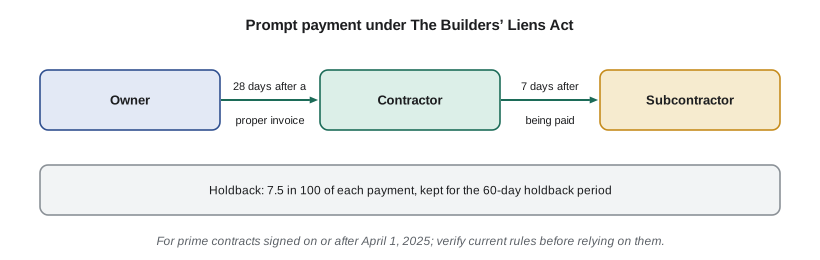
For an electrical subcontractor like Red River Electric, prompt payment changes cash flow planning. On a contract where the rules apply, Nadia can expect payment seven days after the general contractor is paid, and the general contractor can expect payment 28 days after the owner receives a proper invoice. Those timelines only work if the invoices are proper: complete, on time and in the form the contract and regulations require. Jasmine now checks each invoice against the contract's billing requirements before it goes out.
Worked problem
When should the subcontractor be paid?
On a project with a prime contract signed in June 2025, the general contractor sends the owner a proper invoice on May 1 that includes Red River Electric's work. The owner pays on May 29. Nobody has disputed the invoice.
Show solution
- The owner's deadline is 28 days after receiving a proper invoice: May 29. The owner paid on time.
- The general contractor must pay its subcontractors within seven days of being paid.
- Seven days after May 29 is June 5.
- If Red River Electric has not been paid by June 5 and there is no valid dispute notice, the prompt payment and adjudication rules give it options.
Answer: Red River Electric should be paid by June 5.
Adjudication
Prompt payment is backed by adjudication, a fast dispute process in which an adjudicator decides a payment dispute within a short period, with a decision that is binding unless and until it is changed by a court or arbitration. Manitoba established a prompt payment adjudication authority to run the process. Adjudication is designed for the kinds of disputes that used to drag on for months: unpaid invoices, disputed change orders, holdback release and set-off claims. It is usually much faster and cheaper than going to court, and it keeps money moving while the parties argue about the larger issues.
Liens
A builders' lien is a claim against the owner's interest in the land, registered to secure payment for work or materials supplied to improve it. Contractors, subcontractors, suppliers and workers who improve land may have lien rights. A lien must be registered within the time the Act allows, usually counted from when the lien claimant last supplied work or materials, or from completion or abandonment of the contract. If the deadline passes, the lien right is lost. After registration, there are further deadlines to start a court action to enforce the lien. Because the deadlines are short and the procedure is technical, most contractors involve a lawyer as soon as a lien looks likely.
Liens are a serious step. Registering a lien can delay an owner's financing or sale and damage a business relationship. Registering a lien for more than is owed can expose the claimant to liability. Use liens when they are needed to protect a real claim, and use the prompt payment and adjudication tools first where they apply. On public land, such as a highway or a municipal building, lien rights may be replaced by rights against the holdback or against a payment bond; check how the Act applies before starting work for a public owner.
| Tool | What it does | When to think about it |
|---|---|---|
| Written contract and change orders | Defines what is owed | Before any work, and before each change |
| Proper invoice | Starts the prompt payment clock | Every billing period |
| Adjudication | Fast decision on a payment dispute | When payment is late or disputed |
| Holdback | A protected fund for those down the chain | Throughout the job and at completion |
| Lien | Secures payment against the land | Before the registration deadline, when other tools fail |
Practical habits
Most payment problems are prevented by a few habits. Get every contract and change in writing. Invoice promptly and properly. Track every holdback amount and the date its period ends. Calendar every deadline that matters, from invoice dispute periods to lien registration deadlines. Keep daily records of work done, delays and instructions received. And talk to the general contractor or owner early when a payment is late; many problems are clerical and are fixed with a phone call. When they are not, use the tools the Act provides before the deadlines pass.
Disputing an invoice the right way
Prompt payment does not mean that every invoice must be paid regardless of quality or quantity. It means that a party that disagrees with an invoice must say so, in the way and within the time the rules set, rather than simply not paying. The same applies to Red River Electric when it receives invoices from its own suppliers and sub-subcontractors. If the company disputes part of an invoice, it should give the required notice in time, state the amount disputed and the reasons, and pay the undisputed part on schedule.
Disputes are easier to resolve with good records. Daily logs that show which crew worked where, delivery slips for materials, photographs of work at each stage and written instructions from the general contractor all help an adjudicator decide quickly. Jasmine keeps a folder for each job with the contract, every change order, every invoice and payment, and every notice sent or received, filed by date.
Worked problem
A partial dispute
On the Wolseley EV charger job, the condominium corporation receives Red River Electric's proper invoice for 46,000 dollars. The corporation agrees with 40,000 dollars of it but disputes 6,000 dollars for a change it says was never approved.
Show solution
- Under the prompt payment rules, the corporation should give notice of the disputed amount within the required time, with reasons.
- The undisputed 40,000 dollars, less holdback, should be paid on time.
- Holdback on the undisputed part is 0.075 times 40,000, or 3,000 dollars, so 37,000 dollars is due now.
- Red River Electric produces its signed change order. If the parties still disagree, either can refer the 6,000 dollars to adjudication.
Answer: Pay the undisputed amount on time, dispute the rest properly, and use records and adjudication to resolve it.
For the exam, remember the structure rather than every detail: holdback protects those down the chain, prompt payment sets payment timelines once a proper invoice is given, adjudication resolves payment disputes quickly, and liens secure payment against the land within strict deadlines.
Common mistakes
MistakeDoing extra work on a verbal request.
InsteadGet a signed change order with the price before doing the work.
MistakeForgetting the holdback when forecasting cash.
InsteadExpect 7.5 in 100 of each payment to be held until the holdback period ends.
MistakeAssuming prompt payment applies to every contract.
InsteadIt applies to projects whose prime contracts were signed on or after April 1, 2025.
MistakeWaiting until the job ends to think about a lien.
InsteadLien deadlines are short; get advice as soon as payment looks uncertain.
Summary and key terms
- The Builders' Liens Act protects people who improve land through holdback, liens and, since 2025, prompt payment and adjudication.
- Published summaries give Manitoba's holdback as 7.5 in 100; the holdback period is now 60 days for all contracts.
- For prime contracts signed on or after April 1, 2025, owners pay within 28 days of a proper invoice and contractors pay subcontractors within 7 days of being paid.
- Adjudication gives a fast, binding decision on payment disputes.
- Lien rights are lost if not registered within the deadline; get legal advice early.
- Holdback
- A portion of each payment that must be retained for a period to protect lien claimants.
- Proper invoice
- An invoice that meets the requirements of the contract and the prompt payment rules, starting the payment clock.
- Adjudication
- A fast dispute process for construction payment disputes, with a binding interim decision.
- Builders' lien
- A claim registered against land to secure payment for work or materials that improved it.
- Change order
- A written, agreed change to the contract scope, price or schedule.
Practice problems
Work each problem on paper first, then reveal the answer to check.
What holdback do published summaries give for Manitoba?
Show answer
7.5 in 100 of the amount payable.
How long is the holdback period since the 2025 amendments?
Show answer
60 days, for all contracts.
Under prompt payment, how long does an owner have to pay a proper invoice?
Show answer
28 days.
How long does a contractor have to pay a subcontractor after being paid?
Show answer
Seven days.
A progress invoice is 40,000 dollars. How much is held back at 7.5 in 100?
Show answer
3,000 dollars.
Lesson quiz · 5 questions
Score 60% or more to complete this lesson.
Create a free account to save your progress, take quizzes and earn a certificate.