
MELC-204 · Lesson 4 of 12 · 22 min
The exam format and the references allowed
▶ Video coming soon A video version of this lesson is on the way.
The City of Winnipeg contractor exam is unusual among Canadian electrical licensing exams. It is open book, it is written on paper in person, and instead of multiple choice it uses true-or-false and fill-in-the-blank questions. That combination changes how you should prepare. A multiple-choice exam lets you eliminate wrong answers and guess between two; a fill-in-the-blank question gives you nothing to work from except the question and your references. If you cannot find the rule, you cannot write the answer. This lesson describes the format as the City publishes it, looks at each permitted reference and explains how to prepare them so that look-ups take seconds rather than minutes.
The format at a glance
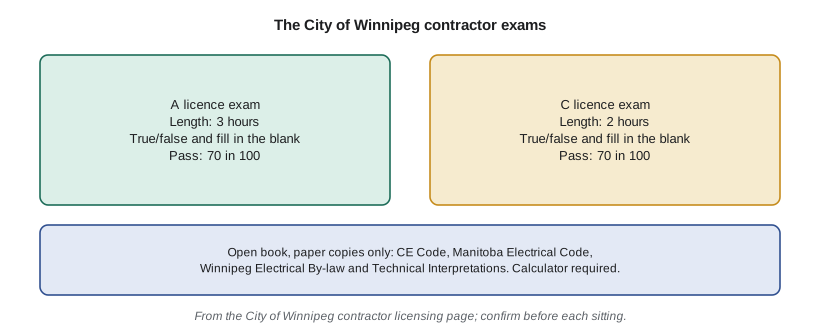
The City's page describes the exams this way. The A licence exam is three hours long. The C licence exam is two hours. Both are written in person, about four times a year, with seats limited. The questions are true or false and fill in the blank. The exam is open book, but candidates must bring paper copies of the permitted references, and phones and other electronic devices must be turned off. A calculator is required. The passing grade is 70 in 100.
The City does not publish the number of questions or the weighting of topics, and this course does not guess at them. What matters for preparation is the style. A true-or-false question tests whether you know a rule exactly, including its conditions and exceptions. A fill-in-the-blank question usually asks for a number, a size, a distance, a rule reference or a term. Both reward precision. A candidate who knows roughly what the code says about a topic will struggle; a candidate who can find the exact rule and read it carefully will do well.
The permitted references
Four references are allowed. The first is the Canadian Electrical Code, Part I, published by CSA Group. This is the national code that Manitoba adopts, and it contains the installation rules, the tables and the appendices. Bring the edition that is in force for the exam date; lesson 5 explains how to check which edition that is. The second is the Manitoba Electrical Code, the provincial regulation that adopts the CE Code and sets out Manitoba's amendments. The amendments change or replace specific rules, so when you look up a rule in the CE Code, you must also check whether Manitoba has amended it.
The third reference is the Winnipeg Electrical By-law, the City by-law that governs electrical permits, inspections and contractor licensing inside the city. It contains the administrative rules that apply in Winnipeg: who needs a permit, how to apply, what inspections are required and what the City can do when work is not done properly. The fourth reference is the set of Technical Interpretations, which explain how the inspection authorities apply particular code rules. Manitoba Hydro publishes technical interpretations for the Manitoba Electrical Code, and the City publishes information bulletins. Check with the City which interpretations it expects candidates to bring, and bring the current edition.
| Reference | What it answers | Typical questions |
|---|---|---|
| CE Code Part I | How installations must be built | Sizes, distances, tables, methods |
| Manitoba Electrical Code | Where Manitoba changes the national rules | Amended rules, Manitoba-only requirements |
| Winnipeg Electrical By-law | Permits, inspections and licensing in the city | Who must get a permit, inspection timing, licence duties |
| Technical Interpretations | How the inspection authority applies a rule | Clarifications, common installations |
Why a calculator is required
The City's insistence on a calculator tells you that some questions involve arithmetic: conductor ampacity with correction factors, demand loads, voltage drop, box fill, conduit fill and similar calculations covered in the earlier courses of this program. A fill-in-the-blank answer to a calculation question must be the number the rules produce, so you need to set up the calculation correctly and round in the way the code expects. Practise with the calculator you will bring. A scientific calculator that you know well is better than a new one with unfamiliar keys.
Not every number on the exam needs arithmetic. Many fill-in-the-blank questions ask for a value that appears directly in a rule or table: a minimum height, a maximum spacing, a clearance or a size. The skill there is finding the right rule and reading it carefully, including any conditions that change the value.
Preparing the references
Open-book exams reward preparation of the books themselves. The City allows paper copies, and candidates commonly use tabs to mark sections and frequently used tables. Before you tab, confirm the City's current rules on what may be written in or attached to references; rules about notes, highlighting and inserted pages vary between licensing bodies and can change. Where tabs and highlighting are allowed, a good system has three features: tabs for every section of the code you expect to use, separate coloured tabs for the most used tables, and a tab in the CE Code beside every rule that Manitoba has amended, so that you never answer from the national text when a Manitoba amendment applies.
Nadia uses three colours. Green tabs mark the code sections: services, conductors, grounding and bonding, wiring methods, protection and control, motors, special locations and the like. Yellow tabs mark the tables she uses most often. Red tabs mark rules that the Manitoba Electrical Code amends, with the amended rule number written on the tab so that she can turn to the Manitoba regulation at once. For the Winnipeg by-law, she tabs the parts on permits, inspections and licence holders' responsibilities, because those are the parts that a code-trained electrician knows least.
Worked problem
Answering a fill-in-the-blank question
A practice question reads: Under the Manitoba Electrical Code, a ground rod electrode installation consists of ____ rods, each at least ____ mm in diameter, spaced at least ____ m apart.
Show solution
- The question names the Manitoba Electrical Code, which signals a Manitoba amendment rather than the national rule.
- Nadia turns to her red tab at the grounding electrode rule in the CE Code, which sends her to the Manitoba amendment.
- The 2026 Manitoba regulation's schedule amends the rod electrode requirement to two rods, at least 15.8 mm in diameter, at least 3 m apart.
- She writes the three numbers and moves on, without re-reading the national rule, which the amendment replaces.
Answer: Two rods, 15.8 mm, 3 m. Always check whether a Manitoba amendment applies before answering from the CE Code.
True or false: reading every word
True-or-false questions look easy, and that is their danger. A statement can be almost right and still be false because of a single word: shall instead of may, minimum instead of maximum, dwelling unit instead of building, or a number that is off by one step in a table. Read the whole statement, find the rule, and compare the statement with the rule word by word. If the statement adds a condition the rule does not have, or leaves out one it does, it is false.
Some statements are about administration rather than installation. A question might say that a licence holder stops being responsible for a permit as soon as an authorized signee is removed from the licence. Under the City's licensing rules, that is false: the licence holder remains responsible for permits taken out by the signee. Questions like this are why the by-law and the City's licensing rules deserve as much study time as the code.
Managing the clock
Three hours sounds generous, but fill-in-the-blank questions take longer than multiple-choice ones because every answer needs a look-up or a calculation. A good plan is two passes. On the first pass, answer every question you can answer quickly, from memory or with a single look-up, and mark the rest. On the second pass, work through the marked questions, starting with the ones you think are quickest. Keep a few minutes at the end to check that every blank has an answer and that units are right. Lesson 12 develops this plan into a full time budget.
# Pass mark arithmetic for the City exam (70 in 100)
import math

def needed(questions, pass_share=0.70):
    return math.ceil(questions * pass_share)

for n in (50, 60, 75, 100):
print(f"{n} questions: at least {needed(n)} correct")50 questions: at least 35 correct 60 questions: at least 42 correct 75 questions: at least 53 correct 100 questions: at least 70 correct
The City does not publish the number of questions, so the script shows several possibilities. Whatever the count, the target is the same: at least 70 in 100, which on a fill-in-the-blank exam means few careless errors.
The C exam
The C licence exam follows the same format, with two hours instead of three, and its questions focus on the work allowed by the candidate's limited licence and on the administrative rules that apply to every licence holder. Arjun, preparing for the C exam with his M-G licence, should still tab the by-law sections on permits, inspections and licence holder duties, because those apply to him exactly as they apply to an A licence holder.
Practising with the references you will bring
Most candidates know more than enough to pass; what they lack is speed in their own books. The best preparation is therefore to practise with exactly the references you will bring, tabbed the way they will be tabbed on the day. Time yourself finding rules. Start with rules you know: pick twenty rule topics at random, such as the minimum burial depth for a direct-buried cable, the required spacing of receptacles along a kitchen counter or the number of conductors allowed in a box, and record how long each look-up takes. Anything over a minute shows a tab or an index entry you need.
The index of the CE Code is a reference in its own right. Learn how it is organized and practise using it for topics that do not have an obvious section. For the Winnipeg Electrical By-law and the Manitoba regulation, which are shorter, a list of contents and a few well-placed tabs usually do the job. For the Technical Interpretations, find out how they are numbered; Manitoba Hydro's are generally keyed to code rules, which means a tab in the CE Code can point you to the interpretation as well as to any amendment.
Worked problem
Timing a set of look-ups
In her first timed practice, Nadia finds 20 rules in 31 minutes. Six took more than two minutes each, all in the by-law or the Manitoba regulation.
Show solution
- Average time: 31 divided by 20 is about 1.6 minutes per look-up.
- The slow look-ups were all in the administrative documents, not the CE Code.
- She adds tabs for the by-law sections on permits, inspections and licence holders, and for each amended rule in the Manitoba regulation.
- A week later the same exercise takes 19 minutes, under a minute per look-up.
Answer: Measure, find the slow spots and fix them with tabs and practice.
Calculation practice belongs in the same sessions. Work problems from the earlier courses in this program, such as conductor ampacity with correction and adjustment factors, demand loads for dwellings and voltage drop, using the calculator you will bring and writing the answer as you would on the exam: a number with its unit. Checking the unit catches a surprising number of errors.
Finally, read the instructions on the exam paper before answering anything. Instructions can set out how to write answers, whether units are required, how to indicate true or false and what to do with rough work. Following them costs nothing; ignoring them can cost marks on questions you actually answered correctly.
Common mistakes
MistakeAnswering from the CE Code without checking for a Manitoba amendment.
InsteadMark amended rules in the CE Code and check the Manitoba Electrical Code before answering.
MistakeTreating true-or-false questions as quick wins.
InsteadCompare the statement with the rule word by word; one changed word makes it false.
MistakeStudying only the code.
InsteadThe by-law and licensing rules are on the exam; tab and study them too.
MistakeBringing an unfamiliar calculator.
InsteadPractise with the calculator you will use, and bring a spare battery.
Summary and key terms
- The A exam is three hours and the C exam two hours; both are true-or-false and fill-in-the-blank, in person, with a pass mark of 70 in 100.
- Permitted references are paper copies of the CE Code, the Manitoba Electrical Code, the Winnipeg Electrical By-law and the Technical Interpretations.
- A calculator is required, and phones and other devices must be off.
- Fill-in-the-blank questions demand precise look-ups and correct calculations.
- Tab the code sections, the most used tables and every rule that Manitoba amends.
- Open book
- An exam where candidates may consult the permitted references.
- Technical Interpretation
- A published explanation of how the inspection authority applies a code rule.
- Winnipeg Electrical By-law
- The City by-law governing electrical permits, inspections and contractor licensing in Winnipeg.
- Amendment
- A change the Manitoba Electrical Code makes to a CE Code rule.
- Two-pass method
- Answering quick questions first and returning to harder look-ups on a second pass.
Practice problems
Work each problem on paper first, then reveal the answer to check.
How long is the A licence exam?
Show answer
Three hours.
What question types does the City use?
Show answer
True or false and fill in the blank.
Name the four permitted references.
Show answer
The CE Code, the Manitoba Electrical Code, the Winnipeg Electrical By-law and the Technical Interpretations.
What is the pass mark?
Show answer
70 in 100.
Why tab amended rules in the CE Code?
Show answer
So you check the Manitoba amendment before answering from the national text.
Lesson quiz · 5 questions
Score 60% or more to complete this lesson.
Create a free account to save your progress, take quizzes and earn a certificate.