
MELC-204 · Lesson 12 of 12 · 19 min
Practice exam review and test-day strategy
▶ Video coming soon A video version of this lesson is on the way.
This last lesson pulls the course together. Nadia's exam is three hours of true-or-false and fill-in-the-blank questions, open book, with paper references and a calculator. She knows the material from the earlier courses in this program and from eight years on the job. What decides the result now is method: how she plans the three hours, how quickly she finds rules, how carefully she reads statements and how she checks her answers. This lesson sets out a time plan, a look-up routine, a review of the administrative topics that candidates most often miss, and a practice set in the style of the exam, with worked answers.
The practice questions here are written for this course from public sources. They are not taken from any City exam, and they do not claim to match its content or weighting. Their purpose is to practise the method.
A time plan for three hours
Fill-in-the-blank questions take longer than multiple-choice ones, because every answer needs a look-up or a calculation and there are no options to eliminate. A two-pass plan works well. On the first pass, about 90 minutes, answer everything you can answer quickly: rules you know well, administrative facts you have memorized and true-or-false statements you can check with a single look-up. Mark the rest with a symbol you will recognize. On the second pass, about 60 minutes, work through the marked questions, starting with the shortest look-ups and leaving long calculations for last. Keep 20 minutes for review and 10 minutes spare for the question that takes longer than you expected.
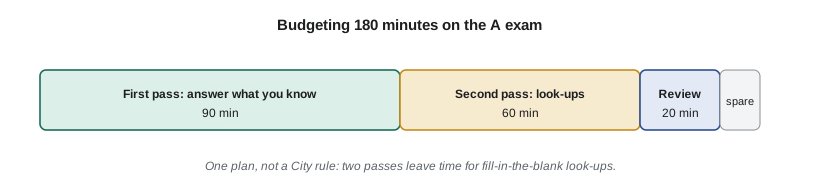
The C exam is two hours. Scale the plan: about 60 minutes for the first pass, 40 for the second, 15 for review and 5 spare. Whatever the length, the principle is the same: never let one hard question eat the time that five easy ones need.
# Scale the two-pass plan to the exam length (A: 180 min, C: 120 min)
plan = {"first pass": 0.50, "second pass": 1/3, "review": 1/9}
for exam, minutes in (("A licence", 180), ("C licence", 120)):
    parts = {k: round(minutes * v) for k, v in plan.items()}
    parts["spare"] = minutes - sum(parts.values())
print(exam, parts)A licence {'first pass': 90, 'second pass': 60, 'review': 20, 'spare': 10}
C licence {'first pass': 60, 'second pass': 40, 'review': 13, 'spare': 7}A look-up routine
For every question that needs a reference, use the same routine. First, decide which reference answers it: the licensing rules and by-law for administration, the CE Code for installation rules, the Manitoba Electrical Code for amendments, and the Technical Interpretations for how a rule is applied. Second, go to the section by its tab, then to the rule. Third, check whether a Manitoba amendment applies; if your CE Code rule has a red tab, turn to the Manitoba regulation. Fourth, read the whole rule, including its subrules, conditions and exceptions, before writing anything. Fifth, write the answer with its unit and, if helpful, the rule number in the margin of your scrap paper so you can check it on review.
The routine feels slow at first and becomes fast with practice. Raymond's suggestion is to do one timed set of twenty look-ups each evening for the last two weeks before the exam, using the same tabbed books you will bring.
Reading true-or-false statements
Treat every true-or-false statement as a claim to test against a rule. Look for the words that carry the meaning: shall and may, minimum and maximum, not less than and not more than, every and some, dwelling unit and building. Check numbers against the rule exactly, including units. Check whether the statement adds or drops a condition. If any part of the statement is wrong, the statement is false. Administrative statements deserve the same care. For example, the statement that a licence holder stops being responsible for permits once a signee is removed from the licence is false under the City's rules.
Administrative topics candidates miss
Electricians who come to the exam from the field usually know the installation rules well and the administrative rules less well. Before the exam, review these points from this course until you can state each without looking. City licences go to individuals, not companies. The A licence needs an H, HC or HI Manitoba licence; the C licence needs an M-B, M-F, M-G, M-S or M-V licence. The licence holder is responsible for all permits under the licence, including those taken out by authorized signees or an associated company, and remains responsible after a signee is removed and after the licence expires, until each permit is closed. Permits cannot be transferred. Licences run for one year; a late fee applies after expiry and the licence becomes inactive after six months. A lapsed Manitoba licence suspends the City licence. Inside Winnipeg the City issues permits and inspects; outside, Manitoba Hydro does, and ITS covers off-grid installations outside Winnipeg.
A practice set
Work through the following set with your references and a timer, allowing about two and a half minutes per item. Answers follow. Where an answer depends on a code rule, the explanation names the rule area; check the exact text in your own copy.
- 1. True or false: The City of Winnipeg issues contractor licences to corporations that employ a licensed journeyperson.
- 2. Fill in the blank: To write the A licence exam, an applicant must hold a Manitoba journeyperson licence of class H, HC or ____.
- 3. True or false: Permits for an installation in Selkirk are issued by Manitoba Hydro.
- 4. Fill in the blank: Under the Manitoba amendment to the rod electrode rule, two rods are installed at least ____ m apart.
- 5. True or false: A licence holder's responsibility for a permit ends when the authorized signee who took it out is removed from the licence.
- 6. Fill in the blank: A City licence not renewed within ____ months of expiry becomes inactive.
- 7. True or false: Section 4.1 of The Electricians' Licence Act allows an apprentice to work alone if the journeyperson is reachable by phone.
- 8. Fill in the blank: Under Manitoba's prompt payment rules, an owner must pay a proper invoice within ____ days.
- 9. True or false: Manitoba Hydro permits for incomplete work renew automatically for 12-month terms until closed.
- 10. Fill in the blank: Employers must report a workplace injury to WCB Manitoba within ____ business days.
- 11. True or false: A homeowner with a self-wire permit may connect a standby generator.
- 12. Fill in the blank: Manitoba Regulation 30/2026 adopts the ____ edition of the CE Code Part I.
Answers. 1: False; City licences are issued only to individuals. 2: HI. 3: True; Selkirk is outside Winnipeg, so Manitoba Hydro issues permits for installations on its grid. 4: 3 m. 5: False; responsibility continues until the permit is closed. 6: Six. 7: False; supervision must be direct and personal, on the same job. 8: 28, for prime contracts signed on or after April 1, 2025. 9: True. 10: Five. 11: False; Manitoba Hydro lists generators among the work only a licensed electrician may do. 12: The 26th edition, CSA C22.1:24.
Worked problem
Scoring the practice set
Nadia gets ten of the twelve practice items right in 28 minutes. She missed item 6, writing three months, and item 11, writing true.
Show solution
- Ten out of twelve is about 83 in 100, above the pass mark of 70 in 100.
- Both errors are administrative, not technical, which matches the pattern Raymond warned about.
- Her time of 28 minutes for 12 items is just over two minutes each, within her plan.
- She adds the renewal rule and the licensed-only work list to her final review sheet.
Answer: Use practice results to find weak topics, then review those topics rather than re-reading everything.
# Practice set tracker: score and topic of each miss
answers = {1: "F", 2: "HI", 3: "T", 4: "3", 5: "F", 6: "6", 7: "F", 8: "28",
           9: "T", 10: "5", 11: "F", 12: "26th"}
nadia   = {1: "F", 2: "HI", 3: "T", 4: "3", 5: "F", 6: "3", 7: "F", 8: "28",
           9: "T", 10: "5", 11: "T", 12: "26th"}
topics = {6: "licence renewal", 11: "licensed-only work"}
missed = [q for q in answers if nadia[q] != answers[q]]
score = len(answers) - len(missed)
print(f"Score {score}/{len(answers)} = {100 * score / len(answers):.0f} in 100")
for q in missed:
print(f"Review item {q}: {topics.get(q, 'see answer key')}")Score 10/12 = 83 in 100 Review item 6: licence renewal Review item 11: licensed-only work
The day before and the day of
The day before the exam, do not try to learn anything new. Check your references: the right edition of the CE Code, the current Manitoba Electrical Code regulation, the Winnipeg Electrical By-law and the Technical Interpretations, all on paper, with tabs secure. Put the calculator, a spare battery, pencils, an eraser, photo identification and the confirmation email together in one bag. Confirm the location and how you will get there. Sleep.
On the day, arrive early. Read the instructions on the paper carefully; if anything is unclear, ask before the clock starts. Start the first pass at once. Write clearly, because a fill-in-the-blank answer that cannot be read is wrong. Include units where the question implies them. On review, check that every blank has an answer: a blank is always wrong, and a careful best attempt may be right. Then hand in the paper and do not dwell on individual questions on the drive home.
| Time | Task |
|---|---|
| Night before | Pack references, calculator, battery, ID, confirmation |
| Arrival | At least 20 minutes early; settle in |
| Minutes 0 to 90 | First pass: quick answers, mark the rest |
| Minutes 90 to 150 | Second pass: look-ups and calculations |
| Minutes 150 to 170 | Review: blanks, units, true-or-false wording |
| Minutes 170 to 180 | Spare time for the hardest question |
After the exam
When the result arrives, there are two paths. If Nadia passes, the licence is issued for a one-year term, and the duties in lesson 7 begin: she decides whom to authorize as signees, starts taking out permits for new city jobs, and Jasmine adds her licence and both expiry dates to the company register. If she does not pass, she books the next sitting, reviews the topics where she lost time, and repeats the timed practice. Either way, Raymond's retirement plan stays on track, because Luc is booked for the following sitting as a backup.
Building your final review sheet
In the last week, make one page of facts you keep getting wrong, and nothing else. It is not a summary of the course; it is a list of your own weak points, built from your practice results. Nadia's sheet has twelve lines: the six-month renewal rule, the City licence classes, the licensed-only work list, the 28-day and seven-day prompt payment periods, the holdback figure, the two-rod grounding amendment, and a few code tables she tends to misread. She reads it each morning in the last week and once more in the car park before the exam. The sheet does not go into the exam room; its job is done before she walks in.
Practice also builds calm. A candidate who has sat at the kitchen table with the same books, the same calculator and a three-hour timer twice already knows how the time feels, where the tabs are and how to recover from a hard question. On the day, the exam room feels familiar rather than threatening, and that calm is worth several marks.
Common mistakes
MistakeSpending twenty minutes on one hard question early in the exam.
InsteadMark it, move on and return on the second pass.
MistakeAnswering from memory without checking for a Manitoba amendment.
InsteadUse the look-up routine, including the amendment check, every time.
MistakeLeaving blanks.
InsteadWrite a careful best answer; a blank is always wrong.
MistakeReviewing only technical topics.
InsteadAdministrative rules are where field-trained candidates most often lose marks.
Summary and key terms
- Use a two-pass time plan: quick answers first, look-ups and calculations second, with time for review.
- Follow the same look-up routine for every reference question, including the Manitoba amendment check.
- Test true-or-false statements word by word against the rule.
- Know the administrative rules cold: individual licences, eligibility, permit responsibility, renewal and the inspection authorities.
- Prepare references and supplies the day before, arrive early and leave no blanks.
- First pass
- Answering all quick questions before spending time on hard ones.
- Second pass
- Returning to marked questions for look-ups and calculations.
- Look-up routine
- A fixed sequence for finding and checking a rule in the references.
- Review sheet
- A short list of the facts and rules a candidate keeps missing.
- Backup sitting
- A later exam date booked or planned in case the first attempt is not passed.
Practice problems
Work each problem on paper first, then reveal the answer to check.
How would you divide the two hours of the C exam?
Show answer
About 60 minutes first pass, 40 second pass, 15 review and 5 spare.
What is the fourth step of the look-up routine?
Show answer
Read the whole rule, including subrules, conditions and exceptions.
Why should you never leave a blank?
Show answer
A blank is always wrong; a careful best attempt may be right.
Name three items to pack the night before.
Show answer
Any three of: paper references, calculator, spare battery, pencils, eraser, photo ID, confirmation email.
A candidate scores 9 out of 12 on a practice set. Is that above 70 in 100?
Show answer
Yes; 9 out of 12 is 75 in 100.
Lesson quiz · 5 questions
Score 60% or more to complete this lesson.
Create a free account to save your progress, take quizzes and earn a certificate.