
MELC-204 · Lesson 8 of 12 · 24 min
Contractor licensing, insurance and bonding
▶ Video coming soon A video version of this lesson is on the way.
A City of Winnipeg licence lets an individual take out electrical permits. It does not, on its own, make anyone a business. Running an electrical contracting company in Manitoba also involves choosing a business structure, registering it, collecting and remitting taxes, covering workers under the workers compensation system, buying the right insurance and, on many commercial and public jobs, providing bonds. Some of these obligations come from statute and some come from the contracts that owners and general contractors ask you to sign. This lesson covers the business side at the level a licence candidate needs, using Red River Electric's situation as Raymond prepares to step back.
Business and tax law change often and depend on individual circumstances. Treat this lesson as a map of the questions to ask, and get current advice from an accountant, a lawyer, your insurance broker and the relevant government offices before making decisions.
The licence and the business are different things
Because the City issues licences only to individuals, every contracting company that works in Winnipeg depends on at least one licensed person. The company itself might be a sole proprietorship, a partnership or a corporation. In a sole proprietorship, the owner and the business are legally the same person, and the owner is personally liable for the business's debts. In a partnership, two or more people carry on business together and usually share liability. A corporation is a separate legal person: it owns its assets, signs its contracts and owes its debts, and its shareholders' liability is generally limited to what they invested.
Red River Electric Ltd. is a corporation, with Raymond as its main shareholder. The corporation employs Nadia and the rest of the crew, signs contracts with customers and holds the Manitoba Hydro ePermits account through its responsible journeyperson. The City licence, however, is Raymond's personal licence, and soon Nadia's. A licence holder who works for a corporation should understand that the corporation's limited liability does not shield the licence holder from responsibilities that the City's rules place on the licence holder personally.
| Structure | Who is liable for debts | Typical use |
|---|---|---|
| Sole proprietorship | The owner personally | One-person shop starting out |
| Partnership | The partners, usually jointly | Two or more trades people in business together |
| Corporation | The corporation; shareholders generally limited to their investment | Growing company with employees and larger contracts |
Registration and taxes
In Manitoba, businesses register with the Companies Office: corporations are incorporated under The Corporations Act, and many sole proprietors and partnerships register a business name. Federally, a business that sells taxable goods and services above the small-supplier threshold registers for the goods and services tax with the Canada Revenue Agency, and an employer opens a payroll account to remit income tax deductions, Canada Pension Plan contributions and employment insurance premiums for employees. Manitoba has its own retail sales tax, administered by the Province, which applies to many goods and some services. Contractors need to understand how it applies to materials they buy and install, because the rules for construction contracts are not the same as the rules for retail sales. Ask the Province or an accountant how the current rules apply to your contracts.
Jasmine keeps a calendar of filing dates for Red River Electric: payroll remittances, sales tax returns, the annual corporate return and the workers compensation payroll report. Missing a remittance date costs interest and penalties, and repeated problems can hurt the company's standing with lenders and bonding companies.
Workers compensation
The Workers Compensation Board of Manitoba provides no-fault insurance for workplace injuries. Employers in industries covered by the system register with the WCB, report their payroll and pay premiums based on their industry rate and their own claim history. In return, covered workers receive benefits for workplace injuries, and the employer is generally protected from being sued by those workers. Construction trades, including electrical contracting, are among the industries where coverage is expected; check with the WCB to confirm how the rules apply to your company and to any owners or family members who work in it.
The WCB also requires employers to report injuries. Its employer page says that employers must report an injury within five business days from the date the worker was injured or the day the employer found out about it, and that late reporting brings a fine or penalty. General contractors often ask subcontractors to show that their WCB account is in good standing before paying them, because a general contractor can become responsible for unpaid premiums of a subcontractor in some situations. Red River Electric gets these requests on most commercial jobs, including the Corydon Avenue café.
Worked problem
Counting the WCB reporting days
Ben cuts his hand on a sharp knockout at the St. Vital duplex on a Thursday morning and needs stitches. The supervisor tells the office the same day.
Show solution
- The WCB requires the employer to report within five business days of the injury or of learning about it.
- The injury and the employer's knowledge are both on Thursday.
- Counting business days: Friday is day one, then Monday, Tuesday, Wednesday and Thursday are days two to five.
- Jasmine reports on Friday, well within the limit, using the details the supervisor recorded on Thursday.
Answer: Report by the following Thursday at the latest; reporting the next business day is better.
Insurance
Insurance is mostly a matter of contract and prudence rather than statute, but it is not optional in practice. Commercial general liability insurance covers claims by third parties for injury or property damage caused by the contractor's operations, such as a fire caused by a faulty connection or a ceiling damaged when a crew drops a ladder. Owners and general contractors usually set minimum limits in their contracts and ask for a certificate of insurance before work starts, often naming them as additional insureds. Other policies a contractor may carry include automobile insurance for company vehicles, tools and equipment coverage, and, for design-build work, professional liability coverage.
Read the insurance clauses in every contract. A contract may require higher limits than the company carries, a specific form of certificate or notice to the owner before a policy is cancelled. Signing a contract whose insurance requirements you cannot meet is a breach from day one. Jasmine sends every new contract's insurance section to the company's broker before Raymond signs.
Bonds
A surety bond is a three-party promise. The contractor, called the principal, promises to do something; the owner, called the obligee, is the party protected; and the surety, usually an insurance company, guarantees that the promise will be kept. If the contractor defaults, the surety steps in to pay or arrange completion, and then seeks repayment from the contractor. A bond is therefore not insurance for the contractor. It is credit, and sureties examine a contractor's finances, experience and record before issuing bonds.
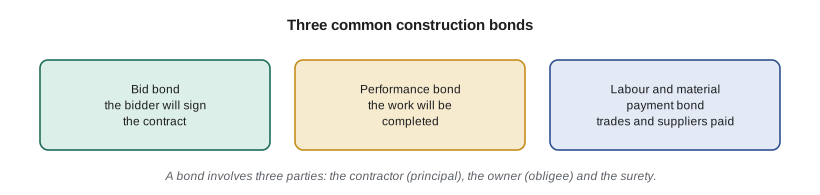
Three bonds are common in construction. A bid bond, or bid security, guarantees that a bidder whose tender is accepted will sign the contract and provide the required performance and payment bonds. A performance bond guarantees that the contractor will complete the work according to the contract. A labour and material payment bond guarantees that the contractor will pay its subcontractors and suppliers. Public owners and many large private owners require bonds on major projects; amounts are set by the contract, often as a fraction of the contract price.
Worked problem
Sizing the bonds on a tender
A school division tenders a lighting and controls upgrade. The tender requires a bid bond of 10 in 100 of the bid price and, if the contract is awarded, a performance bond and a labour and material payment bond each of 50 in 100 of the contract price. Red River Electric's bid is 480,000 dollars.
Show solution
- Bid bond: 0.10 times 480,000 is 48,000 dollars, submitted with the tender.
- If awarded at the bid price, the performance bond is 0.50 times 480,000, or 240,000 dollars.
- The labour and material payment bond is also 240,000 dollars.
- Before tendering, Raymond confirms with the surety that the company's bonding capacity covers a contract of this size.
Answer: 48,000 dollars of bid security, then two 240,000-dollar bonds if the contract is awarded. The fractions here are examples; always use the tender's figures.
# Bond amounts for a tender (fractions come from the tender documents)
bid_price = 480_000
fractions = {"bid bond": 0.10, "performance bond": 0.50, "labour and material bond": 0.50}
for name, share in fractions.items():
print(f"{name:<26} {share * bid_price:>10,.0f} dollars")bid bond 48,000 dollars performance bond 240,000 dollars labour and material bond 240,000 dollars
Consumer protection and residential work
Residential customers are protected by consumer law in ways that commercial customers are not. Manitoba's consumer protection legislation regulates matters such as direct sales made at a customer's home, written contract requirements and cancellation rights for some kinds of contracts. A contractor who sells residential work door to door or signs contracts in customers' homes should check whether those rules apply and build them into the company's paperwork. The safe practice for all residential work is a written contract that describes the work, the price, the payment schedule, the permit and inspection arrangements and how changes will be handled.
Building a business that can be bonded
Sureties lend their credit, so they look at a contractor the way a bank does. They review financial statements, often prepared or reviewed by an accountant, the company's working capital and debt, its work in progress, its experience with similar projects, the owners' personal finances and the company's history of completing jobs and paying suppliers. A new contractor usually starts with small bonds and builds capacity as it shows a record of profitable, completed work.
Raymond's advice to Nadia, who may one day own the company, is to treat the bonding relationship as a long-term one. Keep clean books, file taxes and remittances on time, avoid taking on work much larger than anything the company has done before, and talk to the surety before bidding on a large bonded project rather than after winning it. A contractor that can provide bonds can bid on public and institutional work that is closed to contractors that cannot.
Worked problem
Checking an insurance requirement
Prairie Build Co.'s subcontract for the Corydon Avenue café requires commercial general liability insurance of at least 5 million dollars per occurrence, with Prairie Build named as an additional insured, and a certificate delivered before work starts. Red River Electric's policy has a limit of 2 million dollars.
Show solution
- The contract limit of 5 million dollars is higher than the company's 2 million dollar policy.
- Jasmine sends the requirement to the broker, who quotes an umbrella policy to raise the limit.
- Raymond decides whether to buy the extra coverage or negotiate the requirement before signing.
- Once coverage is in place, the broker issues a certificate naming Prairie Build as an additional insured.
Answer: Resolve insurance gaps before signing; a certificate that cannot be delivered is a breach on the first day.
Finally, keep the business paperwork as carefully as the electrical paperwork. Contracts, insurance certificates, bonds, WCB clearances and tax filings all have dates attached, and the consequences of missing one can be as serious as missing a permit. Jasmine's calendar for Red River Electric covers both kinds of deadline in one place.
None of this is examined in the same depth as the code, but the City expects licence holders to run their permits responsibly, and a contractor whose business is in trouble often cuts corners on the electrical side too. Sound business habits support the licence.
Common mistakes
MistakeThinking a corporation can hold the City licence.
InsteadLicences go to individuals; the company relies on a licensed person.
MistakeTreating a bond as insurance for the contractor.
InsteadA bond protects the owner; the surety recovers its losses from the contractor.
MistakeReporting an injury to the WCB when it is convenient.
InsteadReport within five business days of the injury or of learning about it.
MistakeSigning a contract without checking its insurance clauses.
InsteadConfirm with your broker that you can meet the required limits and certificates.
Summary and key terms
- A City licence belongs to an individual; the contracting business may be a sole proprietorship, a partnership or a corporation.
- Businesses register with the Companies Office and handle federal and provincial taxes and payroll remittances.
- Employers must report injuries to WCB Manitoba within five business days; general contractors often ask for proof of good standing.
- Commercial general liability insurance and contract-required certificates are standard on most jobs.
- Bid, performance and labour and material payment bonds protect owners; the surety recovers from the contractor.
- Principal
- In a bond, the contractor whose obligation is guaranteed.
- Obligee
- In a bond, the party protected, usually the owner.
- Surety
- The company that guarantees the contractor's obligation under a bond.
- Certificate of insurance
- A document from the insurer or broker showing the policies and limits in force.
- Bonding capacity
- The total value of bonded work a surety will support for a contractor.
Practice problems
Work each problem on paper first, then reveal the answer to check.
Who are the three parties to a surety bond?
Show answer
The principal (contractor), the obligee (owner) and the surety.
Which bond guarantees that subcontractors and suppliers are paid?
Show answer
The labour and material payment bond.
Within how many business days must an employer report an injury to WCB Manitoba?
Show answer
Five business days.
A tender requires a bid bond of 10 in 100 on a 250,000-dollar bid. How much is the bid bond?
Show answer
25,000 dollars.
Does a corporation's limited liability shield the licence holder from City licensing responsibilities?
Show answer
No; those responsibilities rest on the licence holder personally.
Lesson quiz · 5 questions
Score 60% or more to complete this lesson.
Create a free account to save your progress, take quizzes and earn a certificate.