
MELC-204 · Lesson 5 of 12 · 20 min
The Canadian Electrical Code as adopted in Manitoba
▶ Video coming soon A video version of this lesson is on the way.
Every installation rule Nadia uses on the job, and every technical question on the City exam, traces back to one document: the Canadian Electrical Code, Part I. But the CE Code is a standard published by CSA Group, not a law. It becomes law in Manitoba only because a provincial regulation adopts it, and that regulation also changes some of its rules. Knowing which edition is in force, how Manitoba adopts it, where the Manitoba amendments sit and how the inspection authorities interpret it is basic exam knowledge. It also prevents expensive mistakes on site, such as installing to a national rule that Manitoba has replaced.
This lesson covers the legal chain from the CE Code to the installation, the recent changes to how Manitoba makes and enforces its electrical code, a sample of the Manitoba amendments and the role of interpretations and bulletins. As always in this program, code text is not reproduced; rules are named by number and described in plain language. Bring your own copy of the code and the regulation, and check every number against them.
From standard to law
CSA Group revises the CE Code Part I on a three-year cycle. The 2024 edition, the 26th, is designated CSA C22.1:24. Each province and territory decides whether and when to adopt a new edition, and what to change. In Manitoba, adoption is done by a regulation called the Manitoba Electrical Code. For many years that regulation was made by Manitoba Hydro's board under The Manitoba Hydro Act, and the City of Winnipeg adopted the CSA standard separately in its own Electrical By-law, with its own amendments. The two sets of amendments did not always match, which meant that an installation acceptable in Selkirk might need a change in Winnipeg.
The Building and Electrical Permitting Improvement Act, which came into force on March 1, 2024, changed that arrangement. According to the Province's information on the Act, it creates one provincial electrical code under The Manitoba Hydro Act, moves the power to make that code from Manitoba Hydro's board to the provincial cabinet, and requires the City of Winnipeg to adopt and enforce the Manitoba Electrical Code within its boundaries. Manitoba Hydro and the City worked to reconcile their amendments. The Act also created independent technical adjudicators to hear appeals of permitting decisions, and allowed performance standards for permit timelines to be set by regulation. Lesson 6 returns to those.
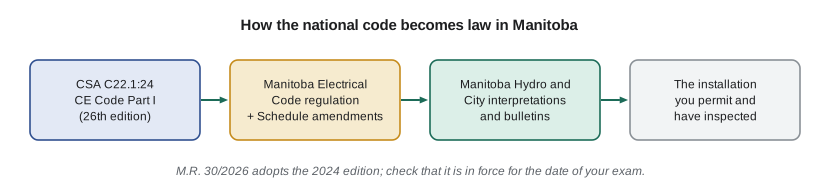
The 2026 Manitoba Electrical Code regulation
In 2026 the Province registered Manitoba Regulation 30/2026, a new Manitoba Electrical Code. Section 1 incorporates the CE Code Part I, 26th edition, CSA C22.1:24, by reference, subject to the regulation's own application section and the amendments in its schedule. The regulation repeals the earlier Manitoba Electrical Code, Manitoba Regulation 76/2018. Its application section says the code governs wiring and related facilities connected to Manitoba Hydro's grid in Manitoba, and it excludes mines and quarries governed by The Mines and Minerals Act.
The regulation does not come into force on a fixed calendar date. It takes effect when a related provision of The Manitoba Hydro Amendment Act is proclaimed. Before the exam, check whether the 2026 regulation is in force and which edition the City expects candidates to bring. Manitoba Hydro's codes and standards page and the City's licensing page are the places to look, and the City can answer the question directly. Bring the edition that applies on your exam date, together with the Manitoba regulation that adopts it.
The regulation's information note also explains how administration works. Outside Winnipeg, permitting and inspection happen under section 25 of The Manitoba Hydro Act. Inside Winnipeg, they happen under the Winnipeg Electrical By-law, made under The City of Winnipeg Charter. For that reason, the Manitoba regulation repeals several of the administrative rules in Section 2 of the CE Code, such as the national rules on permits, applications for inspection and the powers of rejection. In Manitoba, those matters are governed by the Hydro Act and the by-law, not by Section 2 of the national code.
A sample of the Manitoba amendments
The schedule to the 2026 regulation contains the Manitoba amendments. The list below is a sample, described in plain language, to show the kinds of changes Manitoba makes. It is not a complete list. Read the schedule itself and mark each amended rule in your copy of the CE Code.
| Code area | Rule (as numbered in the CE Code) | What the Manitoba amendment does, in brief |
|---|---|---|
| Definitions | Section 0 | Adds a definition of owner |
| Services | 6-212 and 6-400 | Qualifies wiring-space requirements with if practicable; supply authority metering standards prevail over Rules 6-402 to 6-412 in a conflict |
| Loads | 8-102 and 8-202 | Applies voltage drop limits to the branch circuit only; adds EV charging loads at full demand in apartment-type buildings, subject to load management options |
| Grounding | 10-102, 10-116 and 10-210 | Requires two rod electrodes, at least 15.8 mm in diameter and at least 3 m apart; grounding conductors continuous except for listed connection types |
| Cable trays | 12-2208 | Metal cable trays bonded at intervals of no more than 15 m |
| Renewables | 64-110 | Single-phase inverters and ac modules not to be connected to three-phase systems |
| Temporary wiring | 76-006 | Specifies how service equipment is mounted, by service size and supply type |
The schedule also amends rules on panelboard protection on the transformer primary, hazardous locations, high-voltage station ground electrodes and disconnecting means for machine-room-less elevators. Each of these is a potential fill-in-the-blank question, because each changes a number, a location or a condition from the national text. The grounding example is a good one to memorize: the national rule allows other arrangements, but Manitoba requires two rods with a minimum diameter and spacing.
Worked problem
Applying an amendment on the St. Vital duplex
Luc is setting the grounding electrodes for the new service at the St. Vital infill duplex. The CE Code rule on rod electrodes allows a single rod in some situations. Luc asks whether one rod is enough.
Show solution
- Start with the CE Code rule on rod electrodes in Section 10.
- Check the Manitoba Electrical Code schedule for amendments to that rule.
- The Manitoba amendment requires two rods, each at least 15.8 mm in diameter, spaced at least 3 m apart.
- The duplex is in Winnipeg, and the City applies the Manitoba Electrical Code, so the amendment applies.
Answer: Install two rods meeting the Manitoba diameter and spacing requirements; one rod is not enough in Manitoba.
Interpretations, bulletins and guides
Between the code and the installation sit the interpretations published by the inspection authorities. Manitoba Hydro publishes Technical Interpretations for the Manitoba Electrical Code, a Residential Wiring Guide, customer metering standards and a series of informative bulletins. When this course was written, its codes and standards page listed bulletins on topics such as LED luminaire conversions, electrical plan review, approved equipment, cryptocurrency mining equipment, damage and interference, protection of persons and property, services, livestock and poultry areas, patient care areas, solar photovoltaic labels and rapid shutdown, pool bonding, and campgrounds and recreational vehicle parks. The City of Winnipeg publishes its own information bulletins for work inside the city.
Interpretations do not change the law, but they tell you how the inspector will apply it. If an interpretation explains how a rule applies to a common installation, follow it; the inspector will. The Technical Interpretations are also one of the permitted references in the exam room, so tab the ones that relate to frequently tested topics such as services, grounding, receptacle placement in dwellings and EV charging.
Approved equipment
The CE Code requires electrical equipment to be approved, which in practice means certified by a recognized certification body and marked accordingly. Manitoba Hydro's contractor page notes that it recognizes certification and inspection bodies for equipment approval, listed in a provincial government document. Equipment without a recognized mark needs special acceptance before it is used. In Manitoba, Inspection and Technical Services handles special acceptance, using a provincial form. The Electricians' Licence Act also makes it an offence to sell, offer for sale or install electrical equipment that is not approved.
Raymond tells Nadia about a café owner who bought an imported espresso machine online, without a Canadian certification mark, and expected Red River Electric to connect it. The right answer was to stop and arrange special acceptance or a certified replacement, not to connect it and hope the inspector would not notice. That kind of scenario appears on exams as a true-or-false question about who may install unapproved equipment.
Keeping your references current
The code you bring to the exam must match the edition in force. Code update seminars help: Manitoba Hydro has presented seminars and question-and-answer sessions on the 2024 Manitoba Electrical Code. Buy your copy of the CE Code from CSA Group or an authorized seller, print the current Manitoba regulation from the Manitoba Laws website, and download the current Technical Interpretations and the Winnipeg Electrical By-law. Check the dates on all four before the exam.
# Nadia's amendment tracker: CE Code rules that Manitoba amends (sample)
amended = {
    "6-212": "services: wiring space if practicable",
    "8-102": "voltage drop: branch circuit only",
    "8-202": "EV charging load in apartment-type buildings",
    "10-102": "two rod electrodes, 15.8 mm, 3 m apart",
    "12-2208": "bond metal cable tray every 15 m or less",
    "64-110": "single-phase inverters not on three-phase systems",
}
lookups = ["8-102", "26-700", "10-102", "4-004"]
for rule in lookups:
    note = amended.get(rule, "no Manitoba amendment in this sample: use the CE Code text")
print(f"Rule {rule:<8} {note}")Rule 8-102 voltage drop: branch circuit only Rule 26-700 no Manitoba amendment in this sample: use the CE Code text Rule 10-102 two rod electrodes, 15.8 mm, 3 m apart Rule 4-004 no Manitoba amendment in this sample: use the CE Code text
A tracker like this is only as good as its source. Build yours from the schedule to the regulation, not from memory or from someone else's list.
When the code and an interpretation seem to disagree
Occasionally a candidate finds what looks like a conflict between the CE Code text, a Manitoba amendment and an interpretation. The order of authority is straightforward. The Manitoba Electrical Code regulation is the law, and it consists of the CE Code as amended by the schedule; where the schedule changes a rule, the changed rule applies. Interpretations explain how the inspection authority applies the law, and they cannot override it. In practice, apparent conflicts usually disappear when you read the full rule, including its subrules and the appendix notes, together with the amendment and the interpretation. On the exam, if a question names a specific reference, answer from that reference.
On the job, the same order applies, with one practical addition: if you are unsure how a rule applies to an unusual installation, ask the inspection authority before you build it. Manitoba Hydro and the City both accept questions from contractors, and a short call before rough-in costs far less than rework after an inspection.
A good habit for both the exam and the job is to note, beside each tab, the source that governs: CE for a national rule that applies unchanged, MB for a rule that Manitoba amends, and TI where a Technical Interpretation explains how the rule is applied. Three letters on a tab can save a minute on a question and an argument on a site.
Common mistakes
MistakeBringing an old edition of the CE Code.
InsteadCheck which edition the Manitoba Electrical Code adopts on your exam date and bring that one.
MistakeApplying Section 2 of the CE Code for permits in Winnipeg.
InsteadManitoba repeals several Section 2 administrative rules; permits are governed by the by-law and the Hydro Act.
MistakeAssuming Winnipeg has different code amendments from the rest of Manitoba.
InsteadThe permitting reforms require the City to adopt and enforce the Manitoba Electrical Code.
MistakeConnecting uncertified equipment because the customer bought it.
InsteadUnapproved equipment needs special acceptance or replacement before it is installed.
Summary and key terms
- The CE Code Part I becomes law in Manitoba through the Manitoba Electrical Code regulation, which adds Manitoba amendments.
- M.R. 30/2026 adopts the 26th edition, CSA C22.1:24, and repeals M.R. 76/2018; check that it is in force for your exam date.
- The Building and Electrical Permitting Improvement Act created one provincial electrical code, which the City of Winnipeg must adopt and enforce.
- Manitoba amendments change specific rules, such as requiring two rod electrodes and bonding metal cable tray at set intervals.
- Technical Interpretations and bulletins explain how inspectors apply the code and are permitted exam references.
- CSA C22.1:24
- The 2024 edition (26th) of the Canadian Electrical Code, Part I.
- Incorporation by reference
- Adopting a standard as law by naming it in a regulation rather than reprinting it.
- Special acceptance
- A process for accepting electrical equipment that lacks a recognized certification mark.
- Building and Electrical Permitting Improvement Act
- The 2024 Manitoba law that unified the provincial electrical code and created permit adjudication.
- Informative bulletin
- A Manitoba Hydro publication explaining how a code topic is applied.
Practice problems
Work each problem on paper first, then reveal the answer to check.
Which CE Code edition does M.R. 30/2026 adopt?
Show answer
The 26th edition, CSA C22.1:24.
Which earlier regulation does M.R. 30/2026 repeal?
Show answer
The Manitoba Electrical Code, M.R. 76/2018.
Under the Manitoba amendment, how many rod electrodes are required, and how far apart?
Show answer
Two rods, at least 3 m apart (each at least 15.8 mm in diameter).
Who handles special acceptance of uncertified equipment in Manitoba?
Show answer
Inspection and Technical Services Manitoba.
Why are some Section 2 rules repealed in Manitoba?
Show answer
Permits and inspections are governed by The Manitoba Hydro Act and the Winnipeg Electrical By-law instead.
Lesson quiz · 5 questions
Score 60% or more to complete this lesson.
Create a free account to save your progress, take quizzes and earn a certificate.