
MELC-204 · Lesson 6 of 12 · 20 min
Permits, inspections and the inspection authority
▶ Video coming soon A video version of this lesson is on the way.
An electrical permit is the hinge between the licence and the installation. The licence says who may do the work; the permit says that a particular job has been registered with the inspection authority, that fees have been paid and that the work will be inspected. In Manitoba, permits and inspections are mandatory under provincial law, and the inspection authority depends on where the work is. This lesson explains who issues permits and inspects in each part of the province, how a permit moves from application to closure, what the permit holder must do along the way and how the recent permitting reforms affect timelines and appeals.
Who is the inspection authority?
Manitoba has two main electrical inspection authorities. Inside the City of Winnipeg, the City issues electrical permits and carries out inspections under its Electrical By-law, made under The City of Winnipeg Charter. Everywhere else in Manitoba where an installation is connected to Manitoba Hydro's grid, Manitoba Hydro issues permits and inspects, acting under section 25 of The Manitoba Hydro Act. Manitoba Hydro's contractor page states the split simply: within Winnipeg city limits, the City issues permits and inspections; outside city limits, Manitoba Hydro does.
A third authority covers installations that are not connected to the grid. Inspection and Technical Services Manitoba is the authority having jurisdiction for off-grid installations outside the City of Winnipeg, such as a remote cabin with its own solar panels and batteries, and it takes inspection requests for those installations. Mines and quarries are excluded from the Manitoba Electrical Code and fall under mining legislation. When a job is unusual, confirm the authority before you start rather than after.
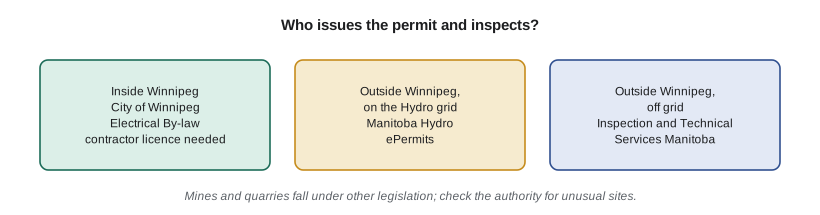
Red River Electric's season shows all of this in practice. The St. Vital duplex, the Corydon Avenue café and the Wolseley condominium chargers are all inside Winnipeg, so their permits come from the City and need a City licence holder. The grain dryer upgrade near Steinbach is outside Winnipeg and connected to the grid, so its permit comes from Manitoba Hydro through the company's ePermits account. If the farm owner later asked for an off-grid solar system on a remote quarter section, ITS would be the authority for that installation.
No work before the permit
The basic rule is the same everywhere in Manitoba: obtain the permit before electrical work starts. Manitoba Hydro's contractor page says that before any electrical work is started, you must have an electrical permit, and its terms and conditions for permit account holders say that work cannot begin until the permit has been issued. The City applies the same principle under its by-law. Starting without a permit can lead to stop-work orders, additional fees and, for licence holders, consequences for the licence.
Emergency repairs are the usual exception people ask about. If a service is damaged at two in the morning and must be repaired to restore heat, the inspection authority's rules on emergency work apply; contact the authority as soon as possible and apply for the permit promptly. Do not treat urgency as a reason to skip the permit altogether. Check the by-law and Manitoba Hydro's rules for the exact procedure, because the exam may ask about it.
Applying for a permit
Manitoba Hydro has accepted electrical permit applications only through its ePermits system since June 15, 2024. Registering a new contractor account can take up to five business days, so a new contractor should register well before the first job. The account is linked to a valid Manitoba journeyperson licence, and the account holder agrees to Manitoba Hydro's terms and conditions, which make them responsible for the installations covered by all permits under the account. Inside Winnipeg, permit applications go through the City's Permits Online system and must be made under a City contractor licence, by the licence holder or an authorized signee.
The application describes the work, the address and, depending on the job, the service size, the number of circuits or the equipment being installed. Fees are set in published schedules. Manitoba Hydro publishes separate fee schedules for residential contractors, commercial contractors and self-wire customers, and the City publishes its fees in its fees and charges schedule. Larger or more complex installations may need plans submitted for review before the permit is issued; Manitoba Hydro has a bulletin on electrical plan review. Check the requirements for the type of job before you apply.
Inspections
Inspections are mandatory. Manitoba Hydro's page stresses two practical conditions: all wiring must be visible at the time of inspection, and all equipment must be approved. The usual pattern is a rough-in inspection before walls and ceilings are closed, and a final inspection when the work is complete. Larger jobs may have more stages. The permit holder requests each inspection when the work is ready, through ePermits outside Winnipeg or through the City's system inside it.
The Electricians' Licence Act contains a related rule for permit holders: work must not be concealed until it has been inspected or the inspection authority has authorized it, and when the work is complete the permit holder notifies the authority, after which an inspector may issue a certificate of approval. Covering wiring before inspection is one of the most common causes of trouble. If drywall goes up over uninspected wiring, the inspector can require it to be opened.
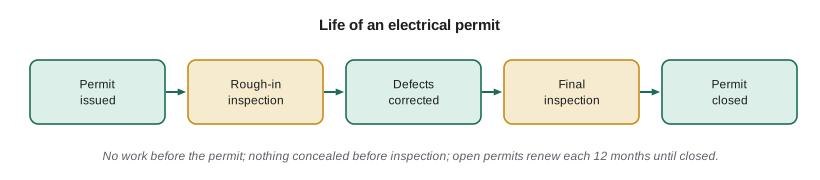
When an inspector finds a defect, the permit holder must correct it. Manitoba Hydro's terms and conditions require the account holder to correct wiring defects identified by the inspection department immediately. The City's by-law gives its inspectors similar powers. A defect report is not a judgment on the electrician's skill; it is a list of items to fix before the installation can be accepted. Keep a record of defects and corrections on each job, because patterns tell you where your crew needs training.
Permit terms and closing permits
Permits do not last forever, but they do not simply expire either. Manitoba Hydro's page explains that permits renew automatically for 12-month terms until the work is completed after the final inspection or the permit is otherwise closed, and a renewal fee applies. If work cannot be completed, the account holder contacts Manitoba Hydro to request an extension or gives written notice that the work will not be completed. The City has similar rules for permits inside Winnipeg.
The practical lesson is that an open permit is an ongoing obligation and an ongoing cost. Jasmine runs a monthly report of every open permit under Red River Electric's ePermits account and under Raymond's City licence. Any permit older than six months gets a phone call to the site supervisor: is the job finished and waiting for a final inspection, is it on hold, or has the customer cancelled? Permits that should be closed are closed, and the ones that remain open are tracked.
Worked problem
An open permit that nobody remembers
Raymond's monthly report shows a City permit taken out 14 months ago for a basement renovation in River Heights. The homeowner stopped the project after the rough-in inspection, and nobody followed up.
Show solution
- The permit is still open under Raymond's licence, so he remains responsible for it.
- Under the City's rules the permit has passed a 12-month term, so a renewal fee may apply.
- Jasmine calls the homeowner, who says the renovation will not resume this year.
- Raymond contacts the City to cancel or close the permit according to its procedure, so that the obligation and the fees stop.
Answer: Close or cancel abandoned permits promptly; an open permit keeps the licence holder responsible and can keep generating fees.
Homeowner and self-wire permits
The Electricians' Licence Act allows the Province to issue electrical wiring permits as well as licences, and permit holders may do electrical work only on premises they own or have approval to occupy. In practice, both Manitoba Hydro and the City have processes for homeowners who want to do their own wiring; Manitoba Hydro, for example, publishes a fee schedule for self-wire customers. Homeowner permits come with limits. Manitoba Hydro's contractor page lists work that only a licensed electrician may do: work in hazardous locations, on hot tubs and pools, on renewable energy systems and generators, on the consumer's service and within a national park.
Exam questions about homeowner permits usually test the limits. A homeowner with a permit may wire a circuit in the garage of the house they own and occupy, subject to inspection. They may not do work for anyone else, they may not hire an unlicensed person to do it for them, and they may not install a generator connection or a service upgrade under a homeowner permit.
Timelines and appeals under the permitting reforms
The Building and Electrical Permitting Improvement Act, in force since March 1, 2024, allows the Province to set performance standards for permitting authorities by regulation, including timeframes for electrical permits. The Province consulted on a proposed regulation that would require Manitoba Hydro and the City of Winnipeg to notify applicants, carry out inspections and make decisions within fixed timeframes. If an authority misses a standard, the applicant can seek a compliance determination, and the authority may be ordered to decide by a fixed date. The Act also lets independent technical adjudicators hear appeals of permitting decisions and code enforcement orders instead of elected officials.
For a contractor, the reforms mean two things. First, check the current performance standards so you know what turnaround to expect and when to follow up. Second, if you disagree with an inspection decision, there is now a formal technical route for appeal. Start by talking to the inspector and the supervisor, because most disagreements end there, but know that the adjudication process exists.
from datetime import date

# Open-permit check for Red River Electric (sample data)
today = date(2027, 2, 1)
permits = [
    ("City", "St. Vital duplex", date(2026, 9, 14), "rough-in passed"),
    ("City", "River Heights basement", date(2025, 12, 3), "rough-in passed"),
    ("Hydro", "Steinbach grain dryer", date(2026, 10, 20), "final booked"),
    ("City", "Wolseley EV chargers", date(2026, 6, 2), "in progress"),
]
for authority, job, issued, status in permits:
    months = (today.year - issued.year) * 12 + today.month - issued.month
    flag = "FOLLOW UP" if months >= 6 else "ok"
print(f"{authority:<6} {job:<24} {months:>2} months {status:<16} {flag}")City St. Vital duplex 5 months rough-in passed ok City River Heights basement 14 months rough-in passed FOLLOW UP Hydro Steinbach grain dryer 4 months final booked ok City Wolseley EV chargers 8 months in progress FOLLOW UP
The report flags any permit open six months or more, which is a company practice rather than a legal rule. The legal rules are the authority's terms for renewal, extension and closure.
Preparing for a smooth inspection
Inspectors work to schedules, and a job that is not ready wastes their time and yours. Before requesting an inspection, walk the job with the permit in hand: is every part of the permitted work complete for this stage, is all wiring visible, are boxes and devices labelled where required, is the panel directory started, and can the inspector get into every space? Red River Electric's site leads use a short list for rough-in and final inspections and leave a copy of the permit and any plans on site. When an inspector leaves a defect list, the site lead photographs the corrections and keeps the photos with the permit record.
Common mistakes
MistakeApplying to Manitoba Hydro for a permit inside Winnipeg.
InsteadInside city limits, the City issues permits and inspects; outside, Manitoba Hydro does.
MistakeStarting rough-in before the permit is issued.
InsteadWork cannot begin until the permit is issued.
MistakeClosing walls before the rough-in inspection.
InsteadWiring must be visible for inspection and must not be concealed until inspected or authorized.
MistakeIgnoring old open permits.
InsteadPermits renew for 12-month terms with fees until closed; track and close them.
Summary and key terms
- The City of Winnipeg issues permits and inspects inside the city; Manitoba Hydro does so outside it on the grid; ITS covers off-grid installations outside Winnipeg.
- Work cannot start until the permit is issued, and wiring must be visible and equipment approved at inspection.
- Manitoba Hydro accepts permit applications only through ePermits, since June 15, 2024.
- Permits renew automatically for 12-month terms, with a renewal fee, until closed after final inspection.
- The permitting reforms allow performance standards for permit timelines and independent technical appeals.
- Inspection authority
- The body that issues permits and inspects installations: the City, Manitoba Hydro or ITS.
- Rough-in inspection
- An inspection of wiring before it is concealed by finishes.
- Certificate of approval
- A document an inspector may issue when completed work is accepted.
- Self-wire permit
- A permit allowing a homeowner to do limited electrical work in premises they own and occupy.
- Compliance determination
- A review under the permitting reforms when an authority misses a performance standard.
Practice problems
Work each problem on paper first, then reveal the answer to check.
Who issues the permit for the Steinbach grain dryer?
Show answer
Manitoba Hydro, because the farm is outside Winnipeg and on the grid.
Since when has Manitoba Hydro accepted permit applications only through ePermits?
Show answer
June 15, 2024.
How long can registration for a new ePermits account take?
Show answer
Up to five business days.
What two conditions does Manitoba Hydro stress for inspections?
Show answer
All wiring must be visible and all equipment must be approved.
Name two kinds of work Manitoba Hydro says only a licensed electrician may do.
Show answer
Any two of: hazardous locations, hot tubs and pools, renewable energy systems and generators, the consumer's service, work in a national park.
Lesson quiz · 5 questions
Score 60% or more to complete this lesson.
Create a free account to save your progress, take quizzes and earn a certificate.