
MELC-204 · Lesson 1 of 12 · 21 min
How electrical licensing works in Manitoba
▶ Video coming soon A video version of this lesson is on the way.
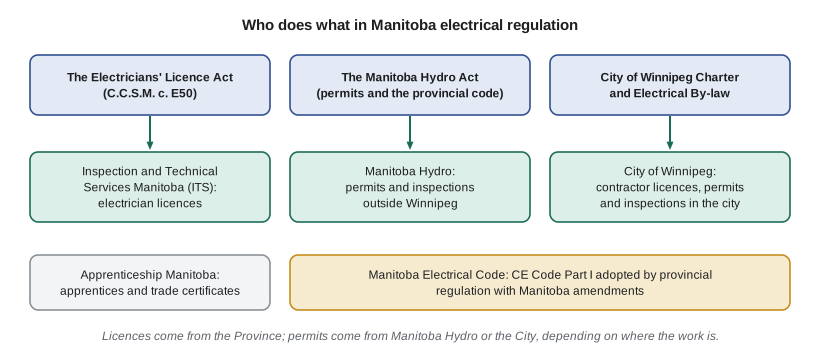
Manitoba does not regulate electrical work the way Ontario or Alberta does, and candidates who come to this course after reading about other provinces often carry assumptions that do not fit. There is no single provincial agency that licenses electricians, issues every permit and runs a master-level exam for contractors. Instead, three bodies share the work. The Province, through Inspection and Technical Services Manitoba, licenses the people who do electrical work. Manitoba Hydro issues electrical permits and inspects installations everywhere outside the City of Winnipeg. The City of Winnipeg issues its own permits, carries out its own inspections and licenses the electrical contractors who may take out permits inside the city. The exam this course prepares you for is the City of Winnipeg electrical contractor exam, and to pass it you need to know which of those three bodies answers which question.
This course follows Nadia Kowalchuk, a construction electrician who has held a Manitoba journeyperson licence since 2019 and works for Red River Electric Ltd. in the St. James area of Winnipeg. The company's owner, Raymond Thiessen, has held a City of Winnipeg A licence for more than twenty years, and every permit the company takes out inside the city is taken out under his licence. Raymond plans to retire within two years. Red River Electric needs another licence holder, and Raymond has asked Nadia to write the A licence exam at the next sitting. Jasmine Mercier runs the office and keeps the licence, permit and insurance records. Luc Gagné is a senior journeyperson, Ben Friesen is a third-year apprentice, and Arjun Sidhu is a refrigeration mechanic who holds a limited licence and wants a contractor licence of his own. This season the company is wiring an infill duplex in St. Vital, fitting out a café on Corydon Avenue for a general contractor, upgrading a grain dryer on a farm near Steinbach and adding electric vehicle chargers to a condominium in Wolseley.
Everything in this course comes from public sources: The Electricians' Licence Act and the regulations under it, bulletins from Inspection and Technical Services Manitoba, the City of Winnipeg's contractor licensing pages, Manitoba Hydro's permit pages and the provincial regulation that adopts the Manitoba Electrical Code. No code text is reproduced. Fees, exam dates and rules change, so treat every detail here as a starting point and confirm it with the City, Manitoba Hydro or the Province before you rely on it.
The licensing statute
The foundation is The Electricians' Licence Act, chapter E50 of the Continuing Consolidation of the Statutes of Manitoba. Section 2 applies the Act to anyone who does electrical work in Manitoba, whether for themselves or for others, and to anyone who sells or offers to sell electrical equipment. Section 4 sets out the general rule: nobody may do electrical work unless the Act allows it. The people it allows are licence holders, permit holders, and apprentices and trainees working under the conditions the Act sets. Section 4.1 adds that apprentices and trainees must work under the direct and personal supervision of a qualified licence holder on the same job. Section 16 closes the loop from the employer's side: nobody may employ or engage a person to do electrical work unless that person is authorized to do it.
The Act also contains exemptions. Utility employees working on utility equipment under their employer's supervision are outside it, and section 3 lets anyone do simple domestic tasks such as replacing a lamp, plugging in equipment or replacing a fuse. People whose main occupation is something else and who only service radios, televisions or small appliances also have a limited exemption. These exemptions are narrow. A homeowner who wants to wire a basement needs a permit, and a general contractor who wants to move receptacles during a renovation needs a licensed electrician to do it. Exam questions sometimes describe a person and a task and ask whether a licence is required, so read the facts carefully.
Inspection and Technical Services Manitoba
Inspection and Technical Services Manitoba, usually shortened to ITS, is the provincial branch that administers The Electricians' Licence Act. It is part of the provincial department responsible for labour. ITS sets the qualification criteria for electrician licences, runs examinations for specialized and limited licences, issues and renews licences, and employs electrical inspectors who check that people doing electrical work are licensed and are following acceptable standards. ITS also handles the special acceptance of electrical equipment that does not carry a recognized certification mark, and it acts as the authority having jurisdiction for off-grid installations outside Winnipeg.
ITS works with Apprenticeship Manitoba, which registers apprentices and manages trade training, and with Manitoba Hydro. A construction electrician who completes an apprenticeship in Manitoba receives a journeyperson licence from the Province; the apprenticeship side and the licensing side are linked but they are not the same office. The Act also provides for a board of electrical examiners, appointed by the provincial cabinet, with members from the department, Manitoba Hydro, the City of Winnipeg, employers and employees. The board sets the subjects for examinations and reports to the minister.
The licence families
ITS publishes a bulletin, ITS 21-036, that lists the electrician licences and what each one allows. The journeyperson licences are the HC licence for construction electricians, the HI licence for industrial electricians and the PE licence for power electricians, who work only on power generation, transmission and supply equipment. Older journeyperson licences carry the letter H. The HC and HI licences allow electrical work on any building or installation. Below them sit the limited specialized trade licences, known as M licences. Each has its own letter and a narrow scope: M-B for electric signs, M-F for alarm installers, M-G for refrigeration mechanics, M-S for fire alarm technicians, M-V for voice, data and video work, and several others, including licences for elevator mechanics, generator technicians and instrument mechanics.
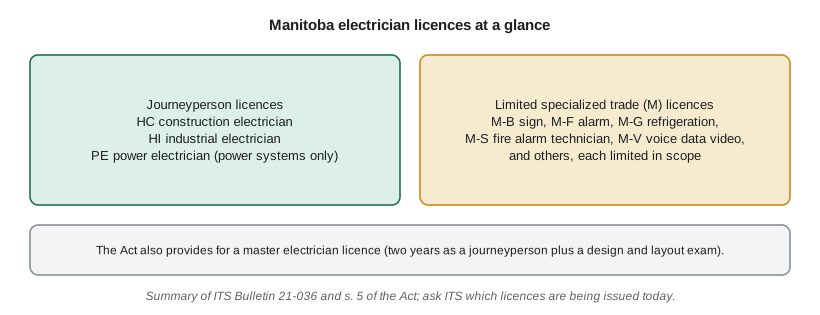
Section 5 of the Act also lists a master electrician licence, available to a person who has worked as a journeyperson for at least two years and has passed an examination in design and layout. The current ITS licence bulletin does not list a master electrician licence among the licences it describes, and the City of Winnipeg contractor licence does not require one. If you are interested in the provincial master licence, ask ITS directly whether it is being issued and how to apply. For the City contractor licence, which is what this course covers, the provincial journeyperson licence is the starting point.
Three separate permissions
It helps to separate three permissions that people often blur together. The first is the right to do electrical work with your own hands, which comes from a provincial licence or, for an apprentice, from registration and supervision. The second is the right to take out permits, which outside Winnipeg comes from having a Manitoba Hydro ePermits account backed by a valid journeyperson licence, and inside Winnipeg comes from holding a City of Winnipeg contractor licence. The third is the right to run a business, which depends on the general law of business registration, taxes, workers compensation and contracts rather than on any electrical licence.
| Permission | Document | Issued by |
|---|---|---|
| Do the electrical work | Journeyperson or limited (M) licence | Province (ITS) |
| Take out permits outside Winnipeg | ePermits account backed by a journeyperson licence | Manitoba Hydro |
| Take out permits inside Winnipeg | City of Winnipeg A or C contractor licence | City of Winnipeg |
| Make the installation legal | Electrical permit and inspection | Manitoba Hydro or the City |
Nadia's position shows how these fit together. Her HC licence lets her do any electrical work, and she already takes out permits outside the city through Red River Electric's ePermits account. Inside Winnipeg, she can act as an authorized signee on Raymond's City licence, but the permits are his responsibility. Once she passes the A exam and receives her own City licence, she can take out permits in Winnipeg in her own right and take on the legal responsibility that goes with them.
Worked problem
Who may do this work?
A renovation company in Charleswood is redoing a kitchen. Its carpenter, who holds no electrician licence, offers to move two receptacles and add under-cabinet lighting. The house is inside Winnipeg.
Show solution
- Moving receptacles and adding lighting is electrical work under the Act, not a simple domestic task such as replacing a lamp.
- The carpenter is not a licence holder, a permit holder or a supervised apprentice, so section 4 forbids him from doing it.
- Section 16 also forbids the renovation company from engaging him to do it.
- Inside Winnipeg, the electrical work needs a City permit, which a City licensed contractor takes out before work starts.
Answer: The renovation company should subcontract the wiring to a licensed electrical contractor such as Red River Electric, which takes out the City permit and has a licensed electrician do the work.
Where the code comes from
The technical rules for installations come from the Canadian Electrical Code, Part I, published by CSA Group. Manitoba gives it legal force through a provincial regulation called the Manitoba Electrical Code, which adopts the CE Code by reference and adds Manitoba amendments. A 2026 regulation adopts the 2024 edition, the 26th, and repeals the earlier Manitoba Electrical Code regulation. The Building and Electrical Permitting Improvement Act moved the power to make the provincial electrical code to the provincial cabinet and requires the City of Winnipeg to apply the same Manitoba Electrical Code inside its boundaries. Lesson 5 covers the adoption in detail. For now, remember that the code you bring to the exam room is the CE Code as Manitoba has adopted and amended it, together with the interpretations that Manitoba Hydro and the City publish.
What the City exam expects you to know
The City of Winnipeg A licence exam is an open-book, in-person exam with true-or-false and fill-in-the-blank questions. You may bring paper copies of the CE Code, the Manitoba Electrical Code, the Winnipeg Electrical By-law and the Technical Interpretations. Because the questions test whether you can find and apply rules under time pressure, a clear picture of who regulates what saves time: if a question is about who may do the work, the answer usually lies in the licensing Act; if it is about permits and inspections in Winnipeg, the by-law; if it is about how an installation must be built, the code and its interpretations. Lesson 4 covers the format in detail, and lessons 6 and 7 cover permits and the licence holder's duties.
Raymond suggests that Nadia start by building a one-page map like the figure above, with the three bodies across the top and the documents each one produces underneath. He has watched several journeypersons fail the exam because they knew the wiring rules but could not find the administrative ones quickly.
# Nadia's question sorter: which body or document answers which kind of question?
sources = {
    "Can an unlicensed carpenter move a receptacle?": "The Electricians' Licence Act",
    "Who issues a permit for a farm near Steinbach?": "Manitoba Hydro",
    "Who issues a permit for a house in St. Vital?": "City of Winnipeg",
    "Minimum receptacle spacing in a kitchen": "Manitoba Electrical Code (CE Code + amendments)",
    "Can a refrigeration mechanic get a contractor licence?": "City licensing rules (C licence)",
}
for question, source in sources.items():
    print(f"{question:<55} -> {source}")
print(len(sources), "questions sorted")Can an unlicensed carpenter move a receptacle? -> The Electricians' Licence Act Who issues a permit for a farm near Steinbach? -> Manitoba Hydro Who issues a permit for a house in St. Vital? -> City of Winnipeg Minimum receptacle spacing in a kitchen -> Manitoba Electrical Code (CE Code + amendments) Can a refrigeration mechanic get a contractor licence? -> City licensing rules (C licence) 5 questions sorted
Some questions draw on more than one source, and the exam may combine them. But starting in the right place saves minutes on every question.
Common mistakes
MistakeAssuming Manitoba has an Ontario-style provincial contractor licence with a master electrician exam.
InsteadIn Winnipeg, the contractor licence comes from the City; outside Winnipeg, a journeyperson licence backs a Manitoba Hydro ePermits account.
MistakeThinking Manitoba Hydro issues permits inside Winnipeg.
InsteadInside city limits, the City of Winnipeg issues permits and inspects; Manitoba Hydro does so outside the city.
MistakeBelieving a City contractor licence can be issued to a company.
InsteadCity licences are issued to individuals only; companies use a licensed individual's licence.
MistakeTreating any homeowner or handyperson task as exempt.
InsteadOnly simple domestic tasks are exempt; other electrical work needs a licensed person or a permit holder.
Summary and key terms
- The Electricians' Licence Act requires electrical work to be done by licence holders, permit holders or supervised apprentices and trainees.
- Inspection and Technical Services Manitoba administers the Act, issues licences and inspects for compliance with the licensing rules.
- Journeyperson licences are HC, HI and PE; limited specialized trade licences carry M letters and narrow scopes.
- Manitoba Hydro issues permits and inspects outside Winnipeg; the City of Winnipeg does so inside the city and licenses electrical contractors.
- The Manitoba Electrical Code adopts the CE Code Part I with Manitoba amendments.
- ITS
- Inspection and Technical Services Manitoba, the provincial branch that administers The Electricians' Licence Act.
- HC licence
- The journeyperson licence for construction electricians.
- M licence
- A limited specialized trade licence allowing electrical work tied to another trade, such as signs or refrigeration.
- Authorized signee
- A person a City licence holder authorizes to take out permits under that licence.
- Manitoba Electrical Code
- The provincial regulation that adopts the CE Code Part I with Manitoba amendments.
Practice problems
Work each problem on paper first, then reveal the answer to check.
Which statute governs who may do electrical work in Manitoba?
Show answer
The Electricians' Licence Act, C.C.S.M. c. E50.
Who issues electrical permits for a house in Brandon?
Show answer
Manitoba Hydro, because Brandon is outside the City of Winnipeg.
What licence does a construction electrician hold?
Show answer
An HC journeyperson licence.
Can Red River Electric Ltd. hold a City of Winnipeg contractor licence in its own name?
Show answer
No; City licences are issued only to individuals.
Which section of the Act requires apprentices to work under direct and personal supervision?
Show answer
Section 4.1.
Lesson quiz · 5 questions
Score 60% or more to complete this lesson.
Create a free account to save your progress, take quizzes and earn a certificate.