
MELC-204 · Lesson 10 of 12 · 22 min
Occupational health and safety law for electrical contractors
▶ Video coming soon A video version of this lesson is on the way.
Electrical work is one of the few trades where a single mistake can kill instantly, and the law reflects that. In Manitoba, workplace safety is governed by The Workplace Safety and Health Act and the Workplace Safety and Health Regulation made under it. The Act sets out the duties of employers, supervisors, workers, contractors and others; the regulation fills in the detail, including a part devoted to electrical safety and rules on locking out energy sources. A licence holder who supervises crews needs to know these duties well, because the person who directs the work carries legal responsibility for how it is done. This lesson covers the framework, the duties that matter most for electrical contractors, and the practical controls that keep crews safe.
As with the other business and legal lessons in this course, the aim is to show the structure and the key ideas. Read the current Act and regulation, and Manitoba's guidance, for the exact requirements. Section and part numbers can change when the regulation is amended.
The framework
The Workplace Safety and Health Act, chapter W210 of the Continuing Consolidation of the Statutes of Manitoba, applies to most workplaces in the province. It is administered by the provincial workplace safety and health branch, whose safety and health officers inspect workplaces, investigate incidents and issue improvement and stop-work orders. The Workplace Safety and Health Regulation, Manitoba Regulation 217/2006, sets out detailed requirements for hazards common to many workplaces, from first aid and personal protective equipment to fall protection, confined spaces, lockout and electrical safety. Separate rules apply to mines.
The Act is built on the internal responsibility system: everyone at a workplace has a part to play in safety, in proportion to their authority and control. Employers set up safe systems of work, supervisors make sure the work is done safely, workers follow safe procedures and report hazards, and safety committees and representatives give workers a voice. Enforcement by officers backs up that system but does not replace it.
Employers, supervisors and workers
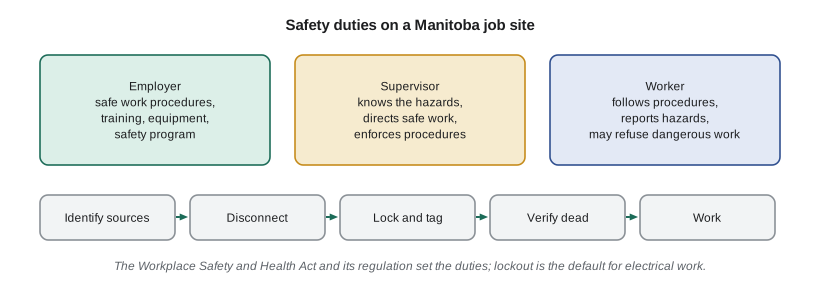
An employer's duties include providing and maintaining a safe workplace and safe equipment, establishing safe work procedures, providing the information, instruction, training and supervision workers need, and making sure workers use the protective equipment the work requires. Larger employers must have a written workplace safety and health program. Red River Electric, as the employer, is responsible for having procedures for lockout, work near energized parts, ladders and fall protection, and for training its crews in them.
A supervisor's duties focus on the people they direct: knowing the hazards of the work, making sure workers follow the safe procedures, and correcting unsafe acts and conditions. When Nadia runs the St. Vital duplex job as the licence holder and site lead, she is a supervisor in the legal sense, and the duties apply to her personally. A worker's duties include working safely, using the required protective equipment, following procedures and reporting hazards. Workers also have the right to refuse work they reasonably believe is dangerous, and they are protected from reprisal for exercising that right or raising safety concerns.
Workplaces with 20 or more regular workers must have a safety and health committee, according to the Province's guidance on committees. Smaller workplaces may need a safety and health representative. The committee or representative takes part in inspections, investigations and the development of safety procedures. Red River Electric, with its crews and office staff, should confirm whether its headcount requires a committee, and count all regular workers when it does.
Prime contractors and multi-employer sites
Construction sites often have several employers working side by side. The Act places duties on prime contractors at construction projects with more than one employer, including coordinating the work so that one employer's activities do not endanger another's workers. On the Corydon Avenue café, Prairie Build Co. is the general contractor and will usually be the prime contractor, responsible for site-wide coordination. Red River Electric remains responsible for its own workers and its own work: its lockout procedures, its ladders and lifts, and its control of energized equipment.
Coordination matters most where trades interact. A drywall crew should not close a wall before the electrical rough-in inspection; a plumber should not cut into a wall where a live circuit runs; and nobody should re-energize a panel that another trade has locked out. Site meetings, a shared schedule and clear lockout rules for shared equipment prevent most of these conflicts.
Electrical hazards and lockout
The regulation's electrical safety part addresses work on or near electrical equipment. The guiding principle is to work de-energized whenever possible. Before working on equipment, isolate it from every energy source, lock and tag the isolating devices, and verify that it is de-energized before touching it. Work on or near energized equipment is allowed only where de-energizing is not possible or creates a greater hazard, and then only by qualified workers using safe work procedures and appropriate protective equipment. The lockout requirements in the regulation apply to all hazardous energy, including stored energy in capacitors and mechanical energy in machinery.
Lockout has a simple sequence: identify every energy source, notify affected people, shut the equipment down, isolate each source, apply a personal lock and tag to each isolating device, release or restrain stored energy, and verify the equipment is de-energized with a properly tested meter before work starts. Each worker applies their own lock. When the work is done, each worker removes only their own lock after checking that the equipment is safe to re-energize.
Worked problem
Lockout on the grain dryer
On the farm near Steinbach, Luc and Ben are replacing the motor starter for the grain dryer's fan. The dryer has a three-phase supply, a control transformer, and a fan that can windmill in a strong breeze.
Show solution
- Identify sources: the three-phase feeder, the control circuit supplied from the control transformer, and mechanical energy from the fan.
- Shut down the dryer and open the disconnect for the feeder; confirm the control circuit has no separate supply.
- Luc and Ben each apply their own lock and tag to the disconnect.
- Block the fan so it cannot turn, then test the starter terminals with a meter that has been checked on a known live source.
- Only after a zero-energy reading on every conductor do they start work.
Answer: Every source is isolated and locked by each worker, stored and mechanical energy is controlled, and absence of voltage is verified before work begins.
Arc flash and shock protection
When work on or near energized equipment cannot be avoided, the employer must assess the shock and arc flash hazards and choose controls. The Canadian standard for workplace electrical safety, CSA Z462, sets out a method for doing that, including approach boundaries, energized work permits and the selection of arc-rated clothing and other protective equipment. Many Manitoba employers and owners require Z462-based procedures, and safety officers use it as a reference for good practice. A licence holder should know the basic ideas: the limited and restricted approach boundaries for shock, the arc flash boundary, and the hierarchy of controls, which puts elimination by de-energizing first and protective equipment last.
Overhead lines and utilities
Contact with overhead power lines kills workers every year in Canada, often when a ladder, a boom or a long piece of material touches a line. Manitoba Hydro publishes safe limits of approach for working near its lines, and the regulation requires precautions when work brings people or equipment close to energized lines. Before work near an overhead line, contact Manitoba Hydro to arrange de-energizing, covering or guarding, and plan the work so that nothing can come within the limits of approach. Underground lines are just as important: request locates before any digging, such as a trench for a garage feeder.
Reporting and investigating
Serious incidents must be reported to the workplace safety and health branch promptly, and the scene of a serious incident generally must not be disturbed except to help injured people or prevent further harm until an officer allows it. Check the Act and regulation for which incidents are reportable and how quickly. Separately, the WCB requires employers to report workplace injuries within five business days of the injury or of learning about it. An employer should also investigate incidents and near misses, find the causes and fix them; a near miss today is often a serious injury next month if nothing changes.
# Pre-task check for electrical work (a planning aid, not a legal checklist)
task = {
    "de-energized": True,
    "all sources identified": True,
    "personal locks applied": 2,
    "workers on task": 2,
    "absence of voltage verified": True,
    "overhead lines within reach": False,
}
problems = []
if not task["de-energized"]:
    problems.append("energized work: needs justification, permit and PPE assessment")
if not task["all sources identified"]:
    problems.append("identify every energy source first")
if task["personal locks applied"] < task["workers on task"]:
    problems.append("each worker must apply a personal lock")
if not task["absence of voltage verified"]:
    problems.append("verify absence of voltage before work")
if task["overhead lines within reach"]:
    problems.append("contact the utility and plan limits of approach")
print("Ready to work" if not problems else "Stop: " + "; ".join(problems))Ready to work
A safety program for a small contractor
A written safety and health program sounds like paperwork for large companies, but it is simply the employer's plan for meeting its duties. For an electrical contractor, it usually includes a statement of policy, a hazard assessment for typical tasks, written safe work procedures for the most hazardous ones, a training plan and records, rules for protective equipment, an inspection schedule for tools and equipment, an incident reporting and investigation procedure, and a way for workers to raise concerns. Provincial guidance and industry safety associations provide templates that a small company can adapt.
Red River Electric's program is fifteen pages long. Its most important parts are the procedures for lockout, work near energized equipment, ladders and fall protection, and work near overhead lines; a list of the training each worker has completed and when it expires; and a monthly toolbox talk that Nadia now leads. When an inspector or a general contractor asks for the company's safety program, Jasmine can send it the same day.
Worked problem
Planning a task near an overhead line
At a house in Charleswood, Red River Electric is replacing a service mast. The overhead service drop and a nearby distribution line are within reach of a ladder.
Show solution
- The crew cannot work on or near the service drop while it is energized.
- Nadia contacts Manitoba Hydro to arrange disconnection of the service and to ask about the distribution line.
- She plans ladder placement so that neither the ladder nor material can come within Manitoba Hydro's limits of approach to the distribution line.
- The work proceeds only after the service is confirmed disconnected and the plan is reviewed with the crew.
Answer: Get the utility involved before the work, and plan so that people, tools and materials stay outside the limits of approach.
Safety training also has expiry dates. First aid certificates, fall protection training and arc flash training all need renewal, and the employer should keep records showing who has completed what and when. A worker who has not been trained in the company's lockout procedure should not be assigned to lockout work until they have been.
Supervisors should also watch for the less obvious hazards of electrical work: heat stress in attics in July, cold stress on rural jobs in January, and fatigue after long driving days to distant sites. These are covered by the same general duties to provide a safe workplace and to plan work so that people can do it safely.
Common mistakes
MistakeThinking safety duties belong only to the employer.
InsteadSupervisors and workers have their own legal duties; a site lead is a supervisor.
MistakeSharing one lock for a crew.
InsteadEach worker applies and removes their own lock.
MistakeTesting for voltage with an unchecked meter.
InsteadCheck the meter on a known live source before and after testing.
MistakeWaiting to report an injury to the WCB.
InsteadReport within five business days of the injury or of learning about it.
Summary and key terms
- The Workplace Safety and Health Act and M.R. 217/2006 govern workplace safety in Manitoba, with a part on electrical safety and rules on lockout.
- Employers, supervisors and workers each have legal duties; workers may refuse dangerous work without reprisal.
- Workplaces with 20 or more regular workers need a safety and health committee.
- Work de-energized whenever possible; isolate, lock, tag and verify before work, with each worker applying a personal lock.
- Use CSA Z462 methods for unavoidable energized work, respect limits of approach to power lines and report incidents and injuries on time.
- Internal responsibility system
- The principle that everyone at a workplace shares responsibility for safety according to their authority.
- Lockout
- Isolating energy sources and securing them with personal locks and tags so equipment cannot be energized.
- Prime contractor
- The party responsible for coordinating safety at a construction project with more than one employer.
- Arc flash boundary
- The distance at which a person could receive a burn injury from an arc flash.
- Limits of approach
- Minimum distances from energized power lines that people and equipment must not enter.
Practice problems
Work each problem on paper first, then reveal the answer to check.
Which statute governs workplace safety in Manitoba?
Show answer
The Workplace Safety and Health Act, C.C.S.M. c. W210.
At what size must a Manitoba workplace have a safety and health committee?
Show answer
20 or more regular workers.
Who removes a worker's personal lock?
Show answer
The worker who applied it, after confirming it is safe.
Which Canadian standard covers workplace electrical safety and arc flash?
Show answer
CSA Z462.
What should you do before digging a trench for a garage feeder?
Show answer
Request locates for underground lines.
Lesson quiz · 5 questions
Score 60% or more to complete this lesson.
Create a free account to save your progress, take quizzes and earn a certificate.