
LES-114 · Lesson 7 of 12 · 19 min
Responding to a person in suicidal crisis
▶ Video coming soon A video version of this lesson is on the way.
Morales begins this class differently. She tells the students that the topic may be personal for some of them, that it is fine to step out, and that she and Desjardins will stay after class for anyone who wants to talk. She writes the 9-8-8 number on the board. 'This is the most important lesson in the course,' she says. 'Every one of you will, at some point in your career, talk with someone who is thinking about ending their life. What you say can help them get through that night.'
She also explains how the class will talk about suicide. They will use the phrase 'died by suicide' rather than 'committed suicide', because 'committed' suggests a crime or a sin and adds to the shame that keeps people from seeking help. They will not discuss methods in detail, because research shows that detailed descriptions can increase risk for vulnerable people, and because officers need to know how to respond, not how harm happens. And they will remember that most people who think about suicide do not die by suicide, and that suicidal crises are often temporary. 'Help works,' she says. 'That is the message.'
The scale of the problem
About 4,500 people die by suicide in Canada each year, around a dozen every day, and many more attempt suicide or think about it. Rates are higher among men, among middle-aged and older men in particular, and in some Indigenous communities, especially among young people, where the effects of colonization and the loss of land, language and culture have been linked to the risk. The Public Health Agency of Canada reports that suicide is a leading cause of death for young people. Police officers often respond to people in suicidal crisis, through well-being checks, calls from family or friends, calls from crisis lines that need an in-person response, and calls where a person has been injured.
Asking directly
Morales addresses the most common fear first. Many people, including officers, worry that asking someone whether they are thinking about suicide will put the idea in their head. Research has consistently found that it does not. Asking directly, in plain words, tells the person that it is safe to talk about it, and many people feel relief at being asked. She recommends a simple question: 'Are you thinking about suicide?' or 'Are you thinking about killing yourself?' Vague questions, such as 'You're not going to do anything stupid, are you?', invite a no and communicate that the asker does not want to hear the truth.
If the person says yes, the officer listens. They do not argue, lecture, minimize the person's pain or offer quick fixes. They acknowledge what they hear: 'It sounds like you've been carrying a lot, and you feel like there's no way out.' They ask about the person's reasons for dying and their reasons for living, because most people in a suicidal crisis feel both, and the reasons for living are what responders can build on. They ask whether the person has a plan and whether they have access to the means, because those answers shape the response. And they never promise to keep a disclosure secret, because they may need to share it to keep the person safe.
Signs of risk and protective factors
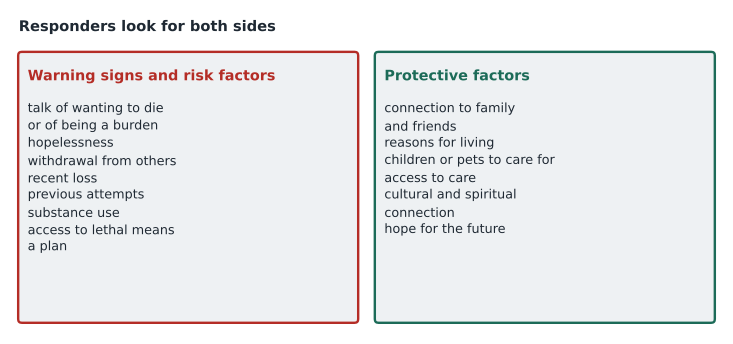
The warning signs of suicide are things a person says or does that suggest they may be thinking about suicide now. They include talking about wanting to die or being a burden to others, expressing hopelessness, withdrawing from people, giving away possessions, saying goodbye, a sudden calm after a period of depression, increased drinking or drug use, and looking for ways to harm themselves. Risk factors are longer-term conditions that raise risk: previous attempts, mental illness, substance use, chronic pain, a family history of suicide, trauma, isolation, and recent losses such as a breakup, a job, a home or a death. Protective factors lower risk: connection to family, friends and community, responsibility for children or pets, access to care, cultural and spiritual beliefs, problem-solving skills and hope.
None of these factors predicts with certainty who will die by suicide. Morales emphasizes that officers are not doing a clinical risk assessment. They are gathering enough information to decide what the person needs right now and to pass that information on to the clinicians who will do the assessment.
Means safety
One of the best-supported ways to reduce suicide deaths is to put time and distance between a person in crisis and the most dangerous means of harm. Suicidal crises often pass, and when lethal means are not easily available during the worst hours, many people survive and do not later die by suicide. For officers, means safety usually means asking about firearms and medications, and working with the person and their family to store them safely or remove them from the home for a while. In Canada, an officer can seize firearms without a warrant under section 117.04 of the Criminal Code when it is not desirable, for reasons of safety, to possess them and it is not practicable to obtain a warrant, and federal law now also allows anyone to apply for an emergency order prohibiting a person from possessing firearms. Morales adds that removing means is most effective when it is done respectfully and explained as temporary safety, not punishment.
A well-being check
Kaplan describes a call from last autumn. At 22:15, a university student called 9-1-1 because her roommate, Maya, had sent her a message saying she was sorry for everything and would not be a problem anymore. The roommate was out of town. Kaplan and Morales went to the apartment with a patrol officer. Maya answered the door after several minutes, red-eyed and quiet. Kaplan introduced herself and said, 'Your roommate was worried about a message you sent. Can we talk for a few minutes?' Maya let them in.
Morales sat at the kitchen table and asked plainly whether Maya was thinking about suicide. Maya said yes, and began to cry. Over the next hour, she talked about failing two courses, a breakup and feeling that her parents would be better off without the cost of her tuition. Morales asked about her reasons for living. Maya mentioned her younger brother and her cat. She agreed to call her parents with Morales beside her, and to go to the hospital with her mother, who drove in from an hour away. Before leaving, Morales asked whether there was anything in the apartment Maya might use to harm herself, and Maya handed over a bottle of pills, which her mother took. 'There was no force, no handcuffs and no legal form,' Kaplan says. 'Just a question asked plainly and a lot of listening.'
Crisis lines and follow-up
Since November 30, 2023, people anywhere in Canada can call or text 9-8-8 for the Suicide Crisis Helpline, which is coordinated by the Centre for Addiction and Mental Health with local and provincial partners. Responders answered more than 300,000 calls and texts in its first year. Port Ardent dispatchers can transfer callers who are not in immediate danger to the crisis line, and the crisis line can ask police to attend when someone is at imminent risk. Kaplan says the two services work best when they talk to each other: a crisis line worker can stay on the phone with a person while officers are on the way.
Morales stresses that the period after a crisis is especially dangerous, including the days and weeks after leaving hospital. Brief follow-up, such as a phone call or a card from a clinician, has been shown to reduce suicide attempts. Port Ardent's co-response team calls back people they have seen within 72 hours, and Morales says many people tell her that the call was the first time they felt someone cared what happened next.
When a person tries to provoke police
Desjardins addresses a rare but serious situation. Some people in a suicidal crisis behave in ways meant to make officers use deadly force against them, for example by pointing what looks like a weapon at officers or advancing while demanding to be shot. This is sometimes called suicide by cop. Signs can include statements about wanting to die and wanting police to do it, a refusal to comply combined with no attempt to escape, a deadline set by the person, and a weapon that may not be real. Recognizing the possibility does not change the law on use of force, and officers must protect themselves and others. But it can change tactics: more distance, more cover, more time, specialized negotiators, and less-lethal options planned in advance. Many of these situations end safely when officers recognize them early and slow them down.
Port Ardent suicide-related calls
The program below summarizes the outcomes of Port Ardent's 2025 calls in which the main concern was a person thinking about suicide, as recorded by the attending officer.
# Port Ardent 2025: calls where the main concern was a person thinking about suicide
outcomes = {"went to hospital voluntarily": 412,
            "taken to hospital under mental health law": 238,
            "stayed home with a safety plan and a support person": 297,
            "connected to the crisis line or co-response follow-up": 186,
            "person not located or already with care": 67}
total = sum(outcomes.values())
for k, v in outcomes.items():
    print(f"{k:56} {v:4}  {v / total:.2f}")
legal = outcomes["taken to hospital under mental health law"]
print("calls resolved without a legal power:", total - legal, f"({(total - legal) / total:.2f})")went to hospital voluntarily 412 0.34 taken to hospital under mental health law 238 0.20 stayed home with a safety plan and a support person 297 0.25 connected to the crisis line or co-response follow-up 186 0.15 person not located or already with care 67 0.06 calls resolved without a legal power: 962 (0.80)
Of 1,200 calls, about four in five were resolved without officers using any legal power. More people went to hospital voluntarily than under mental health law, and about one call in four ended with the person staying home, safely, with a plan and someone to support them. Kaplan points out that these outcomes depend on time: a voluntary decision usually takes longer to reach than an apprehension, and officers who are rushed toward the next call may be tempted to take the faster option.
Worked problem
Asking the question
An officer is sent to check on a 58-year-old man after his ex-wife reports that he posted a message online saying goodbye to his friends. He answers the door, says he is fine and asks the officer to leave. He has been drinking. In the hallway behind him, the officer sees a gun cabinet. What should the officer do?
Show solution
- Stay calm and respectful, and explain why you came: 'Your ex-wife saw your message and was worried. I'd like to make sure you're okay.'
- Ask directly and plainly: 'Are you thinking about suicide?' Listen to the answer without arguing or lecturing.
- Ask about reasons for living and about a plan, and ask about the firearms in the cabinet.
- Call for support: a second officer, the co-response team or a supervisor, and consider the crisis line.
- Work toward means safety: ask whether he would agree to have the firearms stored elsewhere for now, and consider seizure under section 117.04 if he is at risk and will not agree.
- Decide on the next step based on what you learn: voluntary hospital, a support person and follow-up, or, if the legal test is met, a mental health apprehension.
Answer: The officer should ask directly about suicide, listen, address access to the firearms, call for support and choose the least intrusive response that keeps him safe.
Common mistakes
MistakeAsking about suicide can put the idea in someone's head.
InsteadResearch shows asking directly does not increase risk and often brings relief.
MistakePeople who talk about suicide will not act on it.
InsteadTalking about suicide is a warning sign and should always be taken seriously.
MistakeA person who seems suddenly calm after depression is improving.
InsteadSudden calm can be a warning sign, for example after a decision has been made.
MistakeRemoving firearms or medications is a punishment.
InsteadMeans safety is temporary protection during a crisis and is one of the best-supported prevention strategies.
Summary and key terms
- Use safe language, such as 'died by suicide', and do not discuss methods in detail.
- Asking directly about suicide does not increase risk; ask plainly and listen.
- Look for warning signs, risk factors and protective factors, and ask about a plan and access to means.
- Means safety, putting time and distance between a person and lethal means, saves lives.
- 9-8-8 and crisis teams can support people who are not in immediate danger; follow-up after a crisis reduces risk.
- Most suicide-related calls are resolved without legal powers; time makes voluntary outcomes more likely.
- Sign of suicide risk
- Something a person says or does that suggests they may be thinking about suicide now.
- Means safety
- Reducing a person's access to lethal means during a period of risk.
- Safety plan
- A written list of coping steps, supports and contacts a person agrees to use in a crisis.
- Postvention
- Support for families, friends and responders after a suicide.
- Suicide by cop
- A situation in which a person in suicidal crisis tries to provoke police into using deadly force.
Practice problems
Work each problem on paper first, then reveal the answer to check.
Why does Morales use 'died by suicide' rather than 'committed suicide'?
Show answer
'Committed' suggests a crime or sin and adds to shame that keeps people from seeking help.
What question does Morales recommend asking?
Show answer
'Are you thinking about suicide?' asked directly and plainly.
In the code example, what share of calls were resolved without a legal power?
Show answer
962 of 1,200, about 0.80.
What is means safety?
Show answer
Putting time and distance between a person in crisis and lethal means, such as firearms and medications.
Lesson quiz · 5 questions
Score 60% or more to complete this lesson.
Create a free account to save your progress, take quizzes and earn a certificate.