
LES-114 · Lesson 3 of 12 · 19 min
Substance use, overdose and concurrent disorders
▶ Video coming soon A video version of this lesson is on the way.
Constable Nora Kaplan visits the class in her uniform, with a small red case clipped to her duty belt. She opens it and passes around a nasal spray. 'This is naloxone,' she says. 'Last year, Port Ardent officers used it on 61 people. Most of them are alive because someone carried it.' Kaplan spent five years on patrol before joining the co-response team. She tells the class that substance use touches more of her calls than any other single issue: people intoxicated in public, people in withdrawal, people whose mental illness gets worse when they use, families frightened by a relative's drinking, and overdoses.
Substance use is a health issue
Morales sets out the basic picture. Many people use alcohol, cannabis or other drugs without serious harm. Some develop a substance use disorder, which clinicians diagnose when use continues despite harm to health, work or relationships, when the person cannot cut down despite trying, and when tolerance and withdrawal develop. Addiction is now understood as a health condition that changes how the brain responds to reward and stress. It is not a moral failure, and people do recover, often after several attempts. Officers who see the same person repeatedly can easily lose sight of that. Morales asks the class to remember that the person they meet on the worst day of their addiction may be in recovery two years later.
In Canada, the toxic drug crisis has killed more than 50,000 people since 2016, most of them from opioids such as fentanyl, and some provinces have seen more deaths from drug toxicity than from car crashes, homicides and suicides combined. British Columbia declared a public health emergency in 2016, and other provinces have followed with their own strategies. Increasingly, the drug supply is unpredictable: fentanyl is mixed with other drugs, and veterinary sedatives such as xylazine, along with new synthetic opioids, have appeared in the supply, sometimes making overdoses harder to reverse.
Recognizing intoxication and withdrawal
Kaplan describes what officers commonly see. Alcohol intoxication brings slurred speech, poor balance, poor judgment and, at high levels, vomiting, confusion and unconsciousness. A person who is very drunk and cannot be woken is a medical emergency, not a prisoner. Opioids cause drowsiness, slow breathing and small pupils. Stimulants such as cocaine and methamphetamine cause rapid speech, restlessness, a racing heart, sweating and, sometimes, paranoia and psychosis that can last for days with methamphetamine. Cannabis can cause anxiety, panic and, in high doses or in vulnerable people, psychotic symptoms.
Withdrawal can be as dangerous as intoxication. Alcohol withdrawal can cause tremors, sweating, hallucinations and seizures, and in severe cases a life-threatening condition called delirium tremens, usually two to four days after the last drink. Withdrawal from sedatives called benzodiazepines can also cause seizures. Opioid withdrawal is painful and miserable but rarely fatal on its own. Kaplan tells the class that people in police cells have died of withdrawal and of medical conditions mistaken for drunkenness. That is why booking screens ask about alcohol and drug use, and why a person who gets worse in a cell is sent to hospital.
Concurrent disorders
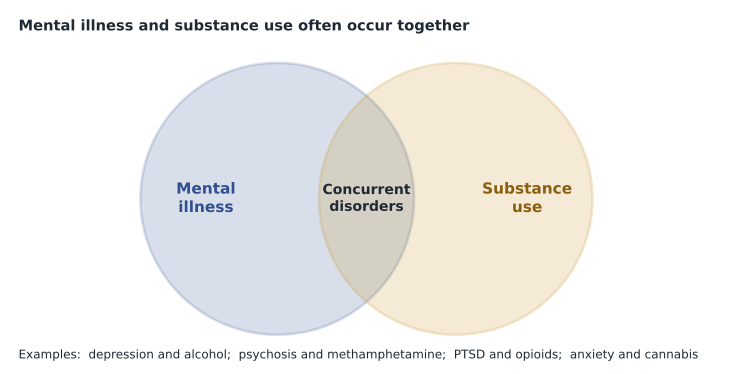
Clinicians in Canada use the term concurrent disorders for a mental illness and a substance use disorder in the same person. They are common: a large share of people treated for addiction also have a mental illness, and many people with serious mental illness use alcohol or drugs. Some people use substances to cope with symptoms such as anxiety, voices or memories of trauma. Some substances trigger or worsen symptoms. On a call, it is often impossible to tell which came first, and it does not matter much. What matters is that the person may need both medical and mental health care, and that intoxication can make a crisis more volatile.
Morales points out a practical problem. Some hospitals and crisis services have historically turned away people who are intoxicated, telling officers to come back when the person is sober, while some addiction services do not accept people with active psychosis. People with concurrent problems can fall through every gap. Port Ardent's co-response team keeps a list of which services accept which people at which hours, and Kaplan says it is the most useful document in her car.
Responding to an overdose
Kaplan teaches the steps the class will practise in the scenario lab. First, make sure the scene is safe and call for paramedics. Second, check for a response: speak loudly, rub the breastbone firmly. Signs of an opioid overdose include no response, slow or stopped breathing, blue or grey lips and fingertips, and pinpoint pupils. Third, give naloxone, usually one spray into a nostril, and support breathing. Officers trained in rescue breathing or using a bag and mask give breaths; others follow their service's first aid protocol. Fourth, if there is no response after two to three minutes, give another dose. Fifth, place the person in the recovery position if they are breathing, stay with them and hand over to paramedics.
Naloxone works only on opioids and wears off sooner than many opioids do, so a person can slip back into overdose after waking up. People who wake up suddenly may also be confused, in withdrawal, sick and upset, and some will want to leave. Kaplan says the moment of waking is a time for calm explanation: 'You stopped breathing. I gave you naloxone. The paramedics are here to check you.' It is not the moment for questions about where the drugs came from.
Marco asks about stories of officers overdosing from touching fentanyl. Kaplan says that medical toxicology organizations have reviewed this concern and concluded that brief skin contact with fentanyl is very unlikely to cause an overdose, and that the symptoms reported in some viral stories did not match opioid toxicity. Officers should still wear gloves, avoid creating dust and wash their hands, as with any unknown substance. But fear of exposure must never stop an officer from helping someone who has stopped breathing.
Overdose immunity
Since 2017, the federal Good Samaritan Drug Overdose Act has protected people who call 9-1-1 for an overdose, and anyone at the scene when help arrives, from charges of simple possession of a controlled substance. It also protects them from charges for breaching conditions of pretrial release, probation, conditional sentences or parole that relate to simple possession. It does not protect against other offences, such as trafficking, or against outstanding warrants. Research and coroners' reviews have found that many people still fear calling, so officers' behaviour at overdose scenes matters: if people see arrests at overdose calls, they will not call next time.
Kaplan describes Port Ardent's practice. Officers attend overdose calls with paramedics, focus on life-saving first, and do not search people or the scene for drugs unless there is a separate lawful reason, such as evidence of trafficking or a weapon. Afterward, the co-response team or a peer outreach worker may follow up with the person within 72 hours, when they may be more open to treatment. 'The goal of an overdose call is a person who is still breathing tomorrow,' she says.
Priya asks whether harm reduction encourages drug use. Morales answers that the evidence on naloxone distribution, supervised consumption and drug checking services points the other way: they reduce deaths and infections without increasing use, and they create contact with workers who can offer treatment when the person is ready. Harm reduction does not mean approving of drug use. It means keeping people alive and healthy enough to recover. For officers, it shows up in small choices: carrying naloxone, not confiscating clean supplies from someone leaving a health service, knowing where treatment and withdrawal services are, and treating people who use drugs with the same courtesy as anyone else. Kaplan adds that many people she meets have been treated with contempt by almost everyone they deal with, and that a little respect is often what makes them willing to talk.
Port Ardent overdose responses
The program below summarizes the overdose calls where Port Ardent officers arrived before paramedics in 2025 and gave naloxone, and the outcomes recorded.
# Port Ardent 2025: overdose calls where officers gave naloxone before paramedics arrived
cases = [
    # (doses given, responded before paramedics arrived, survived to hospital or refused transport)
    *[(1, True, True)] * 34, *[(2, True, True)] * 14, *[(2, False, True)] * 6,
    *[(3, True, True)] * 2, *[(3, False, True)] * 2, *[(2, False, False)] * 2,
    *[(1, False, False)] * 1,
]
n = len(cases)
survived = sum(1 for d, r, s in cases if s)
more_than_one = sum(1 for d, r, s in cases if d > 1)
doses = sum(d for d, r, s in cases)
print("people given naloxone by officers:", n)
print("survived:", survived, f"({survived / n:.2f})")
print("needed more than one dose:", more_than_one)
print("average doses per person:", round(doses / n, 2))people given naloxone by officers: 61 survived: 58 (0.95) needed more than one dose: 26 average doses per person: 1.49
Of the 61 people Port Ardent officers gave naloxone to, 58 survived. More than four in ten needed more than one dose, which reflects the strength of fentanyl and other substances in the local supply. Kaplan notes that three people died despite naloxone, two of them alone in a washroom for an unknown time before being found. 'That is the hardest part of this work,' she says. 'And it is why we talk about never using alone, which is a message we can give people when we meet them.'
Intoxication, crisis and the law
Desjardins connects this lesson to the class's earlier work on police powers. Ontario's Liquor Licence and Control Act allows an officer to arrest a person who is intoxicated in a public place if it is necessary for the safety of the person or another, and the person must be released when they no longer pose a risk. Many services, including Port Ardent, prefer sobering or withdrawal management centres over police cells where they exist, because cells are a poor place to monitor a person whose condition can change. When a person is in crisis and intoxicated, officers cannot wait for sobriety to see whether a mental health concern is real. They assess the person as they are, and treat any medical warning sign as urgent.
Worked problem
An overdose in a shelter washroom
At 15:10, staff at a downtown shelter call 9-1-1 because a man in his thirties is unresponsive on a washroom floor. An officer arrives before paramedics. The man is breathing about four times a minute, his lips are blue and a used needle is beside him. Staff say his name is Trevor and he has used the shelter for months. What should the officer do?
Show solution
- Make sure the scene is safe: put on gloves and move the needle away with care, without picking it up by hand if a container is not available.
- Confirm that paramedics are coming and update them that the man is barely breathing.
- Try to rouse him by name and with a firm rub of the breastbone. When he does not respond, give one dose of naloxone in a nostril and support his breathing as trained.
- After two to three minutes with no response, give a second dose. When he begins breathing more strongly, place him in the recovery position.
- When he wakes, explain calmly what happened, stay with him and hand over to paramedics. Do not search him for drugs or question him about his supplier.
- Record the time of each dose and the response for paramedics, and pass his name to the outreach team for follow-up.
Answer: The officer should treat the call as a medical emergency: call for paramedics, give naloxone and support breathing, repeat if needed, stay with the man, and leave enforcement out of it.
Common mistakes
MistakeAddiction is a choice that people could stop if they wanted to.
InsteadSubstance use disorder is a health condition; recovery is possible and often takes several attempts.
MistakeA person who cannot be woken is just very drunk and can sleep it off in a cell.
InsteadA person who cannot be woken is a medical emergency and needs paramedics.
MistakeTouching fentanyl can make an officer overdose.
InsteadBrief skin contact is very unlikely to cause overdose; use gloves and wash hands, but never delay life-saving help.
MistakeOne dose of naloxone is always enough.
InsteadSome overdoses need several doses, and naloxone can wear off before the opioid does.
Summary and key terms
- Substance use disorder is a health condition; people recover, often after several attempts.
- Intoxication and withdrawal can both be life-threatening; alcohol and sedative withdrawal can cause seizures.
- Concurrent disorders, mental illness and substance use together, are common and can fall through gaps between services.
- For an overdose: scene safety, paramedics, check response, naloxone and breathing support, repeat if needed, recovery position and stay.
- The Good Samaritan Drug Overdose Act protects callers and people at the scene from simple possession charges and related breaches.
- Overdose calls are life-saving calls; enforcement at those scenes discourages people from calling next time.
- Substance use disorder
- A health condition in which use continues despite harm, with loss of control, tolerance or withdrawal.
- Naloxone
- A medication that temporarily reverses opioid overdose.
- Withdrawal
- Physical and mental symptoms when a person stops or reduces a substance their body has adapted to.
- Delirium tremens
- A severe, potentially fatal form of alcohol withdrawal with confusion, hallucinations and seizures.
- Recovery position
- A side-lying position that keeps the airway open in an unconscious, breathing person.
- Harm reduction
- Approaches that reduce the harms of substance use without requiring the person to stop using.
Practice problems
Work each problem on paper first, then reveal the answer to check.
What are the signs of an opioid overdose?
Show answer
No response, slow or stopped breathing, blue or grey lips and fingertips, and pinpoint pupils.
In the code example, how many people needed more than one dose of naloxone?
Show answer
26 of 61.
Why can a person slip back into overdose after naloxone?
Show answer
Naloxone wears off sooner than many opioids.
What does the Good Samaritan Drug Overdose Act protect against?
Show answer
Charges of simple possession, and breaches of certain conditions related to simple possession, for people who call or are at the scene.
Lesson quiz · 5 questions
Score 60% or more to complete this lesson.
Create a free account to save your progress, take quizzes and earn a certificate.