
LES-114 · Lesson 10 of 12 · 19 min
Co-response teams, crisis lines and alternative responses
▶ Video coming soon A video version of this lesson is on the way.
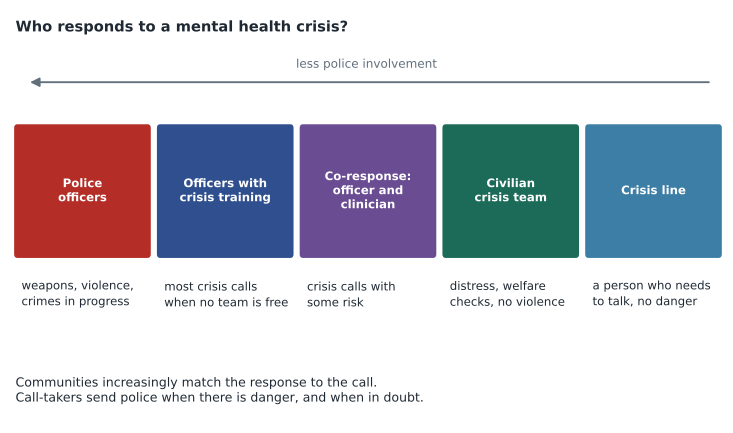
Desjardins begins with a question for the class: who should respond when someone is in a mental health crisis? Amara says the police, because they come at any hour. Jesse says it depends on whether anyone is in danger. Linh, from her experience as a call-taker, says that many callers do not want police at all; they want someone to talk to their son or their mother. Marco says that he would want an officer there if a weapon was involved. Desjardins says they are all right, and that the answer most communities are moving toward is not one service but several, matched to the call.
The crisis intervention team model
The first widely adopted model began in Memphis, Tennessee, in 1988, after police shot and killed Joseph Robinson, a man in a mental health crisis, the year before. The Memphis model, known as crisis intervention teams, or CIT, trains a group of volunteer patrol officers in a 40-hour course on mental illness, de-escalation and local services, so that a trained officer can be sent to crisis calls on every shift. It also builds partnerships with hospitals, mental health agencies, families and people with lived experience, and often a receiving centre where officers can bring people quickly. Many Canadian services have adopted CIT-style training for some or all officers. Research has found that CIT training improves officers' knowledge and attitudes and increases referrals to treatment, though studies of effects on arrests and injuries have been mixed.
Co-response
In co-response, a police officer and a mental health clinician respond together, as Kaplan and Morales do. One of the oldest programs is Car 87 in Vancouver, which has paired a police officer with a psychiatric nurse since 1978. In Ontario, Hamilton's Crisis Outreach and Support Team and mobile crisis rapid response teams in Hamilton, Toronto and many other cities pair officers with nurses or social workers from local hospitals or agencies. Co-response teams can assess people on the spot, connect them with services, and often resolve calls without a trip to hospital. When a hospital visit is needed, the clinician's assessment can speed the handover.
Morales describes what she brings that an officer alone does not: clinical knowledge, access to health records with consent, relationships with local services, and the ability to make some referrals directly. Kaplan describes what she brings: safety, legal powers when they are needed, and the ability to respond to calls where there is a risk of violence. 'Neither of us could do this job alone,' Morales says. The limits of co-response are mostly about scale. A team covers only some hours, and in Port Ardent, until February 2026, there was only one team, on weekday afternoons and evenings.
Civilian crisis teams
Some communities send health workers without police to crisis calls that do not involve a risk of violence. Toronto's Community Crisis Service, launched as a pilot in 2022 and later expanded across the city, sends teams of trained crisis workers from community agencies to people in crisis, through referrals from 9-1-1 and the 2-1-1 line. Denver's Support Team Assisted Response, known as STAR, began in 2020 and sends a clinician and a paramedic to calls such as people in distress, welfare checks and minor disturbances. A study of its first months found that reports of less serious crimes fell by about a third in the areas it served, with no rise in violent crime.
Desjardins asks the class what the CAHOOTS story teaches. Priya says that a program is only as good as its funding. Linh says that when it closed, those calls did not disappear; they went back to police. Desjardins agrees and adds a third lesson: civilian teams work best when they are part of a system, with clear rules for which calls they take, a way to call police quickly if a call turns dangerous, and stable money.
Crisis lines and the call centre
Since 9-8-8 launched in November 2023, people across Canada can call or text a national number for suicide crisis support. Local crisis lines, such as those run by Canadian Mental Health Association branches, and 2-1-1 for social services also play a role. Some emergency communication centres now place mental health clinicians in the call centre itself, where they can take calls transferred from 9-1-1 and either resolve them by phone or decide what kind of response to send. Linh says that in Port Ardent, about 600 calls a year were transferred to the crisis line in 2025, and that the service plans to place a clinician in the communication centre on weekday evenings starting in the summer of 2026.
Marco asks how call-takers decide which calls are safe to send to a civilian team or a crisis line. Linh explains that the service uses a set of questions: whether anyone is injured, whether there are weapons, whether there is violence or a threat of violence, whether the person is at imminent risk of suicide, and whether a crime requiring police is involved. A call with none of these can often go to the crisis line or a civilian team. A call with any of them goes to police, with the co-response team if it is available. She adds that call-takers make mistakes in both directions, and that the policy requires them to send police when in doubt.
Receiving centres and handovers
A response is only as good as the place it can take a person. Kaplan explains that one of the main reasons calls end at the emergency department is that there is nowhere else to go. Crisis stabilization or receiving centres, open around the clock, accept people brought in by police, paramedics or crisis teams, and can assess them faster and in a calmer setting than a busy emergency department. Some communities also have short-stay crisis beds, sobering centres and withdrawal management services. Each of these makes it easier for officers to hand a person over quickly and get back on the road.
Port Ardent's new transfer agreement with the hospital, signed in January 2026, created a dedicated handover process: officers call ahead from the car, a crisis nurse meets them at a separate entrance, and the hospital aims to accept custody within 45 minutes. The co-response team's clinicians can also complete an initial assessment on scene, which the hospital accepts.
Early results in Port Ardent
The program below compares the first quarter of 2025 with the first quarter of 2026, after the second co-response team began in February and the transfer agreement took effect in January.
# Port Ardent mental health calls, January to March 2025 and 2026
q = {"2025": {"calls": 1290, "co-response attended": 210, "taken to hospital": 371,
              "under mental health law": 158, "median handover minutes": 110},
     "2026": {"calls": 1335, "co-response attended": 402, "taken to hospital": 322,
              "under mental health law": 121, "median handover minutes": 52}}
for year in ("2025", "2026"):
    d = q[year]
    print(year, "co-response share", round(d["co-response attended"] / d["calls"], 2),
          "hospital rate", round(d["taken to hospital"] / d["calls"], 3),
          "involuntary rate", round(d["under mental health law"] / d["calls"], 3),
          "median handover", d["median handover minutes"])
saved = (q["2025"]["median handover minutes"] - q["2026"]["median handover minutes"]) * q["2026"]["taken to hospital"] * 2 / 60
print("rough officer-hours saved at hospital in the quarter:", round(saved))2025 co-response share 0.16 hospital rate 0.288 involuntary rate 0.122 median handover 110 2026 co-response share 0.3 hospital rate 0.241 involuntary rate 0.091 median handover 52 rough officer-hours saved at hospital in the quarter: 623
In the first quarter of 2026, the co-response team attended about three calls in ten, up from about one in six. A smaller share of calls ended at hospital, fewer people were taken involuntarily, and the median handover time fell by more than half, saving a rough estimate of 600 officer-hours in three months. Desjardins warns that one quarter is too short to draw firm conclusions: winter call volumes vary, and the comparison does not control for other changes. The service has asked a university to evaluate the program over two years.
Peers and families
A growing number of programs include peer support workers: people with their own lived experience of mental illness, addiction or homelessness, trained to support others. Peers can build trust quickly with people who distrust professionals, help them navigate services and stay in touch after a crisis. Port Ardent's co-response team works with two peer workers from a local agency, who follow up with people after calls and sometimes join visits. Morales says that people often tell a peer things they would never tell a nurse or an officer, simply because the peer has been there.
Families are also part of the system. They are often the first to notice that a relative is becoming unwell, the ones who call, and the ones who live with the outcome. Desjardins tells the class that families of people with serious mental illness have been among the strongest advocates for crisis intervention training, and that many CIT courses include sessions where family members and people with lived experience speak to officers about what helped and what hurt. Kaplan says that she always tries to tell families what will happen next, who to call and what their rights are, because a family that understands the system is far more likely to ask for help early, before the next crisis becomes an emergency. Privacy laws limit what officers and clinicians can share without consent, but they do not prevent officers from listening to families or giving them general information about services.
What the evidence says, and what it does not
Morales summarizes. Reviews of co-response programs have found that they tend to reduce involuntary apprehensions and time spent at hospital, and that people in crisis and their families usually prefer them. Civilian teams appear to handle many calls safely, with very few requiring police backup. CIT training improves officers' knowledge and confidence. But many evaluations are small, short or lack comparison groups, and programs vary widely, so the evidence is not as strong as advocates sometimes claim. The most consistent finding, she says, is that no model works without enough community services behind it: housing, treatment, crisis beds and follow-up. A crisis response is a door, and it matters what is on the other side.
Jesse adds a point about his own community. Many First Nations have built crisis responses around their own culture, with Elders, land-based healing and community wellness workers, sometimes working with the First Nations police service. Morales agrees that the best model for a community is one designed with it.
Worked problem
Matching the response to the call
A call-taker receives four calls in one evening. First, a mother says her adult daughter has been crying for hours and says she cannot cope, with no weapons or threats. Second, a man says his brother, who has schizophrenia, is shouting and holding a kitchen knife in the backyard. Third, a store reports a man sleeping in the doorway who will not wake easily. Fourth, a caller says a neighbour is playing loud music and acting strangely. Which response fits each?
Show solution
- First call: no danger is reported; a transfer to the crisis line or a civilian crisis team is appropriate, with police if the risk changes.
- Second call: a weapon is involved; send police, with the co-response team if available and a supervisor, and plan for time and distance.
- Third call: this may be a medical emergency, such as an overdose or hypothermia; send paramedics first, with police if needed.
- Fourth call: likely a disturbance with a possible mental health concern; a patrol officer, ideally CIT-trained, or a co-response team.
- In every case, call-takers send police when in doubt and pass on all information.
Answer: Crisis line or civilian team for the first, police with co-response for the second, paramedics for the third, and a trained officer or co-response team for the fourth.
Common mistakes
MistakeCrisis calls should always go to police.
InsteadMany calls can go to crisis lines, civilian teams or paramedics; police are needed when there is danger or a crime.
MistakeCivilian teams have replaced police for mental health calls.
InsteadCivilian teams handle some calls; police remain necessary for calls involving violence or weapons.
MistakeCo-response programs are proven to work everywhere.
InsteadEvidence is promising but mixed and depends on local services and funding.
MistakeA new program solves the problem.
InsteadPrograms need stable funding, clear call rules and services on the other side.
Summary and key terms
- The crisis intervention team model, from Memphis in 1988, trains volunteer officers and builds community partnerships.
- Co-response pairs an officer with a clinician; it can reduce apprehensions and hospital time but covers limited hours.
- Civilian teams such as STAR handle low-risk calls; the end of CAHOOTS in Eugene shows the importance of stable funding.
- 9-8-8, local crisis lines and clinicians in call centres can resolve many calls without in-person response.
- Receiving centres and handover agreements shorten waits and improve care.
- No model works without community services behind it; designs should fit the community.
- CIT
- Crisis intervention team: the Memphis model of trained volunteer officers and community partnerships.
- Co-response
- A police officer and a mental health clinician responding together.
- Civilian crisis team
- Health or crisis workers who respond to some calls without police.
- Receiving centre
- A facility open around the clock that accepts people in crisis from police and others.
- Call diversion
- Transferring suitable emergency calls to a crisis line or clinician instead of sending police.
Practice problems
Work each problem on paper first, then reveal the answer to check.
What event led to the Memphis CIT model?
Show answer
The 1987 police shooting of Joseph Robinson, a man in a mental health crisis.
Why did CAHOOTS end in Eugene in 2025?
Show answer
Its operator and the city said they lacked the funding to continue it.
In the code example, what was the co-response share of calls in 2026?
Show answer
402 of 1,335, about 0.30.
What questions help call-takers decide where to send a call?
Show answer
Injuries, weapons, violence or threats, imminent suicide risk and whether a crime requiring police is involved.
Lesson quiz · 5 questions
Score 60% or more to complete this lesson.
Create a free account to save your progress, take quizzes and earn a certificate.