
LES-114 · Lesson 2 of 12 · 20 min
Understanding mental illness: what officers may see
▶ Video coming soon A video version of this lesson is on the way.
Morales begins the second class with a warning. 'You are not going to diagnose anyone,' she says. 'Psychiatrists take years to learn to do that, and they still get it wrong. What you can learn is to recognize the signs that a person's thinking, mood or perception is not working the way it usually does, to understand roughly what they may be experiencing, and to adjust how you talk to them.' She explains that a mental illness is a health condition that changes how a person thinks, feels or behaves, causes distress or makes it hard to function at work, at home or in relationships, and lasts long enough to be more than an ordinary bad week.
Clinicians in Canada use two main classification systems: the Diagnostic and Statistical Manual of Mental Disorders, published by the American Psychiatric Association and now in a revised fifth edition, and the International Classification of Diseases, published by the World Health Organization and now in its eleventh edition. Both describe disorders by their symptoms and how long they last. Neither is a test an officer can apply on a doorstep. Morales mentions them so that the class recognizes the names when they read a hospital report or hear a clinician use them.
A continuum, not a switch
Morales draws a horizontal line across the whiteboard with four sections. On the left is 'healthy': normal mood swings, good sleep, steady functioning. Next is 'reacting': irritability, worry, trouble sleeping after a stressful event. Then 'injured': persistent anxiety or sadness, pulling away from others, trouble concentrating. On the right is 'ill': symptoms that are severe, last for weeks and make it hard to function. This model is used in the Road to Mental Readiness program developed for the Canadian Armed Forces and adapted by the Mental Health Commission of Canada for police and other workplaces. Everyone moves along the line during their life, she says, including police officers, which the class will return to in lesson 11.
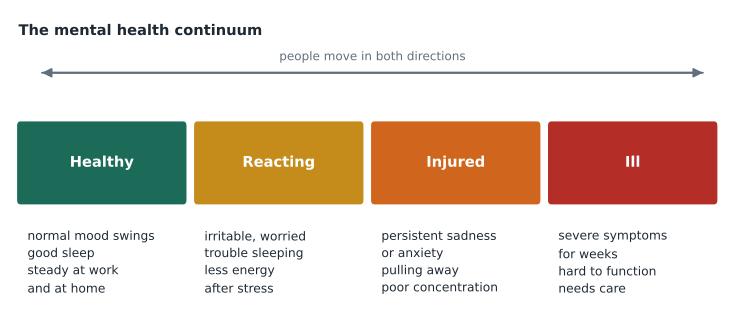
The continuum matters on the street because a person who is 'ill' today may be 'healthy' next month, and because the same person may look very different on different calls. A man who was shouting and frightened during a manic episode in March may be calm, embarrassed and grateful when an officer meets him again in May. Treating him as a permanent danger because of one call is both unfair and inaccurate.
How common is mental illness?
The Canadian Mental Health Association estimates that in any given year, about one person in five in Canada experiences a mental health problem or illness, and that by the age of 40, about half of the population has had one. Statistics Canada's surveys find that anxiety and depression are the most common, and that young adults report the highest rates. Priya Sandhu runs the numbers for Port Ardent in the program below.
# Expected number of Port Ardent residents with a condition in a year,
# using rounded national rates per 1,000 adults (illustrative)
adults = 79_000
rates_per_1000 = {"any mental illness": 210, "anxiety disorder": 100,
                  "major depression": 50, "bipolar disorder": 10,
                  "schizophrenia or other psychosis": 7}
for k, r in rates_per_1000.items():
    print(f"{k:34} about {adults * r // 1000:6} adults")
calls = 5400
print("mental health calls in 2025:", calls)
print("calls per 100 adults with any mental illness:",
round(calls / (adults * 210 / 1000) * 100, 1))any mental illness about 16590 adults anxiety disorder about 7900 adults major depression about 3950 adults bipolar disorder about 790 adults schizophrenia or other psychosis about 553 adults mental health calls in 2025: 5400 calls per 100 adults with any mental illness: 32.5
If one adult in five has a mental illness in a year, about 16,600 adults in Port Ardent do. The service answered 5,400 mental health calls, and some people were the subject of several. So the great majority of people living with mental illness in the city never meet a police officer about it. Officers see a narrow and unrepresentative slice: people at their worst moments, often when treatment has failed or was never available. Morales warns the class not to let that slice define their picture of mental illness.
Mood disorders
Major depression is more than sadness. A person may lose interest in everything, sleep too much or too little, stop eating, feel worthless or guilty, have trouble thinking and, in some cases, think about suicide. On a call, an officer might find a person who is withdrawn, slow to answer, tearful or flat, who has not left the apartment for days. They may not seem to be in crisis at all, yet they may be at high risk. Lesson 7 deals with suicidal crisis in detail.
Bipolar disorder involves periods of depression and periods of mania. During a manic episode, a person may sleep very little, talk rapidly and jump between ideas, feel unusually powerful or important, spend money recklessly or take risks they would never normally take. They may be irritable when others try to slow them down. Officers often meet people in mania because their behaviour has alarmed someone: a man directing traffic at an intersection, a woman who has given away her furniture, a student who has emailed the university president at 03:00. Morales advises officers to keep their own speech slow and calm, to avoid arguing about grand ideas and to focus on immediate safety and practical next steps.
Anxiety and panic
Anxiety disorders are the most common mental illnesses. A panic attack can feel to the person like a heart attack: a pounding heart, chest pain, shortness of breath, dizziness, a sense of doom. Officers may be called to a panic attack in a store or on a bus. Because the symptoms can overlap with real cardiac emergencies, Morales tells the class to call paramedics when in doubt. A calm voice, slow breathing together and a quieter space often help. Shouting commands at a person in a panic attack makes it worse.
Psychosis and schizophrenia
Psychosis means losing contact with shared reality. A person may have hallucinations, most often hearing voices that others do not hear, or delusions, which are fixed false beliefs, such as being watched by cameras in the walls, being poisoned or having a special mission. Their speech may be disorganized and hard to follow. Psychosis can occur in schizophrenia, in bipolar disorder, in severe depression, with some drugs, with some medical illnesses and during withdrawal from alcohol. Schizophrenia usually first appears in the late teens or twenties, and about one person in a hundred will develop it in their lifetime.
Morales describes a call from last year. A 19-year-old university student, home for the holidays, was found by his mother talking to the television and refusing to eat because he believed the food had been tampered with. It was his first episode of psychosis. The officers who attended did not challenge his beliefs and did not agree with them. They acknowledged that he seemed frightened, asked what would help him feel safer, and offered to drive him and his mother to the hospital, where an early psychosis program took him on. 'First episodes are a crucial moment,' Morales says. 'Early treatment improves outcomes. A frightening first encounter with police can make a young person avoid help for years.'
How should an officer talk to someone who is hearing voices? Morales gives four tips. Ask about the voices plainly: 'Are you hearing voices right now? What are they saying?' Do not pretend to hear them, and do not argue that they are not real; acknowledge that they are real to the person. Keep sentences short and repeat key information, because the person may be distracted. Ask whether the voices are telling them to do anything, because voices that command harm are a safety concern that should be passed to clinicians.
Trauma and post-traumatic stress
Post-traumatic stress disorder can follow events such as assault, war, serious collisions, abuse or disasters. People may relive the event in flashbacks or nightmares, avoid reminders, feel constantly on guard and react strongly to sudden noises or being touched. Many people police meet in crisis have long histories of trauma, including childhood abuse, intimate partner violence or the intergenerational effects of residential schools. A shouted command, a hand on the shoulder from behind or handcuffs can trigger a reaction that looks like aggression but is fear. Trauma-informed practice, which the class will see throughout the course, means assuming that trauma may be present and acting in ways that do not repeat it: explaining, asking before touching, offering choices.
Personality disorders and other conditions
Some people live with longstanding patterns of thinking and relating that cause them great distress, which clinicians may diagnose as personality disorders. Borderline personality disorder, for example, involves intense and rapidly shifting emotions, a deep fear of abandonment and, in some people, repeated self-harm. These are among the most stigmatized conditions, even among health workers. Morales asks the class to remember that the behaviour usually grows out of pain and often out of early trauma, and that consistent, calm, respectful responses help more than impatience. Eating disorders, obsessive-compulsive disorder and others also occur, though they less often bring police to the door.
Medication and why people stop it
Many people with serious mental illness take medication, and it often helps. But antipsychotic and mood-stabilizing medications can have hard side effects: weight gain, drowsiness, restlessness so intense the person cannot sit still, tremors, stiffness or sexual side effects. People also stop medication because they feel well and believe they no longer need it, because they cannot afford it, because the illness itself makes them doubt they are ill, or because they distrust the people who prescribed it. When a family member says 'he stopped his meds', an officer should hear it as information, not as an accusation. Morales adds that restlessness from medication can look like agitation, and that a person may move constantly because their body will not let them stop.
Danger and stigma
Marco asks the question everyone is thinking: are people with mental illness more violent? Morales answers carefully. Large studies have found that most people with mental illness are never violent, and that they are far more likely to be victims of violence than perpetrators. Some factors are linked to a higher risk of violence: a history of violence, substance use, recent threats, and untreated psychosis with paranoid beliefs about a specific person. These are the same kinds of factors officers already consider. A diagnosis alone tells an officer very little. Stigma, on the other hand, causes real harm: it discourages people from seeking help, and it leads officers to treat a frightened person as a threat.
Worked problem
Recognizing signs without diagnosing
An officer is sent to a coffee shop where a woman in her forties has been talking loudly to herself for an hour. Staff say she is not threatening anyone but is upsetting customers. When the officer arrives, she is whispering, looking at the ceiling and says, 'They are listening through the lights.' What should the officer notice and do?
Show solution
- Look for the signs: talking to herself, a fixed belief about being listened to, attention on the lights. These suggest she may be experiencing psychosis; the officer does not need a diagnosis.
- Check safety: no weapon, no threats, staff are not in danger. There is time.
- Approach calmly at an angle, introduce yourself by name and ask hers. Speak softly and in short sentences.
- Acknowledge her fear without agreeing or arguing: 'That sounds frightening. I can't hear anything, but I believe it is real for you.'
- Ask what would help: a quieter place, someone to call, a ride to a clinic or hospital, or a call to the co-response team or crisis line.
Answer: The officer should recognize signs of possible psychosis, confirm there is no immediate danger, and use calm, respectful communication to offer support and options.
Common mistakes
MistakeOfficers should decide what illness a person has.
InsteadOfficers recognize signs and adjust their approach; diagnosis belongs to clinicians.
MistakeA person hearing voices should be told the voices are not real.
InsteadAcknowledge that the voices are real to the person, without pretending to hear them, and ask what they are saying.
MistakePeople with mental illness are usually violent.
InsteadMost are never violent and are more likely to be victims; specific risk factors matter, not the diagnosis.
MistakeA person who stopped their medication is being irresponsible.
InsteadPeople stop medication for many reasons, including side effects, cost and the illness itself.
Summary and key terms
- Mental illness changes thinking, mood or behaviour, causes distress or difficulty functioning and lasts more than a few days.
- Mental health is a continuum: healthy, reacting, injured and ill, and people move in both directions.
- About one adult in five has a mental illness in a year, but police meet only a small, unrepresentative share of them.
- Mood disorders, anxiety, psychosis, trauma-related disorders and personality disorders each call for adjustments in communication.
- Medication side effects and reasons for stopping treatment are part of the picture.
- Risk of violence depends on specific factors, not on a diagnosis; stigma causes harm.
- Psychosis
- A loss of contact with shared reality, including hallucinations or delusions.
- Hallucination
- A perception, such as hearing a voice, that others do not share.
- Delusion
- A fixed false belief that is not changed by evidence.
- Mania
- A period of elevated or irritable mood, little sleep, rapid speech and risky behaviour.
- Trauma-informed practice
- Acting in ways that assume trauma may be present and avoid repeating it.
- Stigma
- Negative attitudes and stereotypes that lead to discrimination against people with mental illness.
Practice problems
Work each problem on paper first, then reveal the answer to check.
What are the four sections of the continuum model?
Show answer
Healthy, reacting, injured and ill.
In the code example, about how many Port Ardent adults would have any mental illness in a year?
Show answer
About 16,590, using 210 per 1,000 of 79,000 adults.
Name two tips for talking with a person who is hearing voices.
Show answer
Ask about the voices plainly; acknowledge they are real to the person without pretending to hear them; keep sentences short; ask whether they command anything.
Give three reasons a person might stop taking medication.
Show answer
Side effects, cost, feeling well, the illness causing doubt about being ill, or distrust of prescribers.
Lesson quiz · 5 questions
Score 60% or more to complete this lesson.
Create a free account to save your progress, take quizzes and earn a certificate.