
LES-114 · Lesson 5 of 12 · 20 min
Recognizing a crisis: assessment on approach
▶ Video coming soon A video version of this lesson is on the way.
For the rest of the course, the class follows one call from start to finish. Morales hands out a copy of the call record, with names changed to protect the people involved. At 21:40 on Thursday, February 12, 2026, a woman named Joan Halverson called 9-1-1 from an apartment building at 418 Calder Street. She said that her neighbour in unit 3B, a man in his thirties, had been shouting and banging for an hour, had smashed the light fixture in the hallway with a broom handle, and had told her through the door that 'if they keep watching me, I'll make them stop.' She was frightened but not hurt. She did not know whether he had any weapons.
The call-taker coded it as a disturbance with a possible mental health concern and sent a patrol car. Because the co-response team was on shift, the dispatcher also sent Kaplan and Morales. 'That decision was the first good thing that happened on this call,' Desjardins says. 'Most of what makes a crisis call go well happens before anyone knocks on the door.'
What is a crisis?
Morales defines a crisis as a state in which a person's usual ways of coping are overwhelmed by an event or by their own symptoms, so that they cannot manage their thoughts, feelings or behaviour as they normally would. A crisis is usually temporary. It may be triggered by a loss, a conflict, an eviction notice, a change in medication, drug use, or an illness getting worse. A person in crisis is often frightened, confused or desperate, and their thinking may narrow so that they cannot see options that would be obvious to them on a better day. The job of the responder is not to fix the underlying problem tonight. It is to help the person get through the crisis safely, so that the underlying problem can be addressed later.
Gathering information on the way
Kaplan describes what she did during the nine-minute drive. She asked dispatch to check the address and the name the caller gave, Adam Kerrigan. There were two previous calls. In 2023, officers had driven him voluntarily to hospital after his mother called with concerns about his mental health; the note said he had a diagnosis of schizophrenia, had been calm when spoken to slowly and by name, and had a sister, Claire, who was his main support. In 2024, there had been a well-being check after he missed appointments; he was fine. There were no weapons-related entries, no firearms licence and no firearms registered at the address, and no history of violence.
She also asked the call-taker to stay on the line with Mrs. Halverson, to ask her to stay inside her own apartment with the door locked, and to find out whether anyone else was in unit 3B. The answer was no. Morales, meanwhile, checked whether Adam was a client of any service the team worked with. He was on the list of an assertive community treatment team, a group of clinicians who support people with serious mental illness in the community, but the team had not seen him for six weeks.
Desjardins stops the story to make a point. None of this information was certain, and some of it could have been out of date. But it changed the picture completely. Without it, officers would have been going to a man who had smashed a light and made a threat. With it, they were going to a man with a known illness, no history of violence, a sister who could help and a treatment team who knew him. That difference shapes every decision that follows.
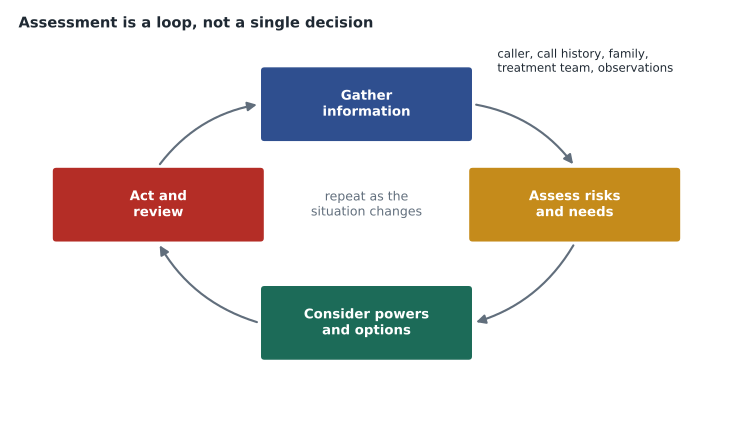
A decision-making loop
Canadian police services train officers with a use of force framework that puts assessment at the centre: the officer continuously assesses the situation, plans and acts, and keeps reassessing as things change. Many services also teach a critical decision-making model. The steps are similar everywhere: gather information; assess the situation, the threats and the risks; consider the powers and policies that apply; identify options and choose the best one; act; then review and start again. Kaplan says the most important word is 'again'. A crisis changes minute by minute, and an officer who makes one assessment at the door and never revisits it will miss what matters.
Arriving and setting up
The patrol car arrived first, with Constable Dev Malhotra. Following Port Ardent's policy for crisis calls, he did not go up alone. He waited in the lobby for Kaplan and Morales, who arrived two minutes later, and the three of them spoke for a minute before going up. They agreed who would talk, who would watch and where each would stand. Kaplan would make contact, Morales would join the conversation once it was safe, and Malhotra would stand back as cover, watching Adam's hands and the hallway. They turned their radios down and agreed that only one person would speak at a time.
On the third floor, they found the hallway dark, with glass from the light fixture on the carpet. They spoke briefly with Mrs. Halverson through her door, then positioned themselves at an angle to Adam's door, not directly in front of it, with an open hallway behind them. Kaplan explains why: standing to the side of a door keeps an officer out of the path of anyone or anything coming through it, and an open line of retreat lets officers create distance if they need to, which makes it less likely that they will need to use force.
What to observe
Morales gives the class a framework for observation. Look at the person: their appearance, clothing, hygiene, injuries, how they move, whether they are holding anything. Listen to how they speak: fast or slow, loud or quiet, organized or jumbled, whether they seem to be responding to things others cannot hear. Note their mood: frightened, angry, flat, elated, tearful. Take in the environment: signs of drug or alcohol use, empty medication bottles, a lack of food, a mess that suggests days of distress, objects that could be used as weapons, other people. Watch what changes when you speak.
When Adam opened his door a few centimetres, Kaplan could see that he was thin and unshaven, wearing a T-shirt in a cold apartment, holding the broom handle in his right hand, and looking past her at the ceiling. He spoke quickly and quietly: 'They put cameras in the lights. You know that. Why are you here?' Behind him, she could see aluminium foil taped over the windows. Morales later told the class that each of these details was useful: the foil and the focus on the lights suggested a fixed belief about being watched, the broom handle was a possible weapon but was being held loosely and pointed at the floor, and his first question was a request for information, which gave Kaplan something to answer.
Risk factors and protective factors
The class builds a list of factors that raise the risk of harm on a crisis call: a weapon or access to one, especially a firearm; recent threats or violence; a history of violence; intoxication; voices commanding harm; paranoid beliefs about a specific person; recent loss, such as a death, a breakup, an eviction or a job; statements about suicide; and a feeling of being trapped. They also list protective factors: a support person who can help, a treatment team, past positive contact with police, willingness to talk, reasons for living such as children or pets, and time.
Kaplan stresses that these lists are aids to judgment, not scores. In Adam's case, the risk factors included the broom handle, the statement to the neighbour and his belief that he was being watched. The protective factors included his history of calm contact, his sister, his treatment team, the absence of other weapons and the fact that he had opened the door and asked a question. Taken together, they suggested that there was time, that the main risk was to the neighbour he believed was watching him, and that talking was very likely to work better than force.
Time is the most useful tool
Desjardins tells the class what he wishes someone had told him as a rookie: when there is no immediate threat to life, time is almost always on the side of a safe outcome. Time lets a person's emotions settle, lets officers gather information and bring in help, and lets a negotiator or clinician build rapport. Rushing in, by contrast, often creates the very danger officers fear. An officer who moves quickly into a small room with an agitated person holding an object has put themselves in a position where they may have to use force to protect themselves. The same officer, standing back at a doorway with space and cover, has options.
Linh asks whether time is always available. Desjardins says no: if someone is being attacked, or is about to be, officers must act. But those situations are rarer than television suggests. On the Calder Street call, no one was in immediate danger once Mrs. Halverson was behind a locked door. The team had time, and they used it.
Port Ardent crisis calls: time and outcomes
Port Ardent's 2025 review of crisis calls compared calls where officers spent fewer than ten minutes before taking physical control of a person with calls where they took longer. The program below summarizes the results for calls where a person was eventually taken to hospital.
# Port Ardent 2025 crisis calls ending in a trip to hospital
# (time before any physical control, number of calls, calls with force beyond handcuffing, injuries)
groups = {"under 10 minutes": (88, 21, 9), "10 to 30 minutes": (104, 11, 4),
          "over 30 minutes": (66, 4, 1)}
for g, (calls, force, injuries) in groups.items():
    print(f"{g:18} calls {calls:3}  force rate {force / calls:.2f}  injury rate {injuries / calls:.2f}")
all_calls = sum(v[0] for v in groups.values())
print("total calls:", all_calls)under 10 minutes calls 88 force rate 0.24 injury rate 0.10 10 to 30 minutes calls 104 force rate 0.11 injury rate 0.04 over 30 minutes calls 66 force rate 0.06 injury rate 0.02 total calls: 258
Force beyond handcuffing was used in about one quick call in four, but in only about one call in sixteen where officers took more than half an hour. Priya points out that this does not prove that slowing down caused the difference: the quick calls may have included more emergencies, where officers had to act fast. Morales agrees that the comparison is not a controlled experiment, but says it matches what research on de-escalation training has found, and what clinicians see every day. The lesson for the class is to ask, on every call, whether there is a reason to hurry, and if there is not, to slow down.
Worked problem
Planning an approach
Officers are sent to a house where a man's wife reports he has locked himself in the garage after losing his job, has been drinking and has said he 'can't go on'. She thinks he may have a hunting rifle in the garage. Two patrol officers arrive at the same time. What should they consider before approaching?
Show solution
- Recognize the high-risk factors: possible access to a firearm, alcohol, a recent loss and a statement suggesting suicidal thinking.
- Gather information from the wife away from the garage: where the rifle is usually kept, whether he has made threats to others, what usually helps him, whether he has a phone.
- Request help: a supervisor, the co-response team or a crisis negotiator, and paramedics on standby.
- Set up at a distance with cover and a clear line of retreat, not in front of the garage door, and move the wife and others to safety.
- Plan to make contact by phone or by voice from cover, slowly, with one officer speaking, and keep reassessing.
Answer: The officers should treat the call as a high-risk suicidal crisis with possible firearm access, gather information, request help, set up at a safe distance and make contact slowly, using time.
Common mistakes
MistakeAssessment happens once, at the door.
InsteadAssessment is a continuous loop; keep gathering information and reassessing.
MistakeGetting hands on the person quickly ends the danger.
InsteadRushing in often creates danger; when there is no immediate threat to life, use time and distance.
MistakeRisk factor lists give a score that decides what to do.
InsteadThey are aids to judgment; officers weigh risk and protective factors together.
MistakeInformation from call history is not reliable enough to use.
InsteadIt may be dated, but it often changes the picture; use it and confirm it.
Summary and key terms
- A crisis is a temporary state in which a person's usual coping is overwhelmed.
- Information gathered on the way, from callers, history, family and treatment teams, shapes every decision.
- Assessment is a loop: gather, assess, consider powers and options, act, review and repeat.
- Officers should agree on roles before contact, position themselves to the side with a line of retreat, and have one person speak.
- Observe appearance, speech, mood, environment and how the person responds.
- Weigh risk factors and protective factors; when there is no immediate threat to life, time is the most useful tool.
- Crisis
- A temporary state in which a person cannot cope with their thoughts, feelings or behaviour as usual.
- Contact and cover
- An approach in which one officer talks with the person while another watches for safety.
- Protective factor
- Something that lowers the risk of harm, such as a support person or a reason for living.
- Assertive community treatment
- A team of clinicians who provide intensive support to people with serious mental illness in the community.
- Critical decision-making model
- A loop of steps officers use to assess and respond to a changing situation.
Practice problems
Work each problem on paper first, then reveal the answer to check.
What information did Kaplan gather before arriving at Calder Street?
Show answer
Call history, diagnosis, how Adam responded before, his sister, his treatment team, absence of weapons and violence history, and that no one else was in the unit.
Why did the team stand to the side of the door?
Show answer
To stay out of the path of anyone or anything coming through it and keep a line of retreat.
In the code example, what was the force rate for calls over 30 minutes?
Show answer
4 of 66, about 0.06.
Name three protective factors.
Show answer
A support person, a treatment team, willingness to talk, past positive contact, reasons for living, time.
Lesson quiz · 5 questions
Score 60% or more to complete this lesson.
Create a free account to save your progress, take quizzes and earn a certificate.