
LES-114 · Lesson 12 of 12 · 19 min
Capstone: reviewing the Calder Street crisis call
▶ Video coming soon A video version of this lesson is on the way.
For the final assignment, each student writes a review of the Calder Street call, using the call record, the body-worn camera recordings, Kaplan's notes, the hospital handover log and interviews that Morales arranged with Claire and, with his consent, Adam himself. Desjardins explains the purpose. 'A review is not a trial,' he says. 'We are not looking for someone to blame. We are asking what happened, why it happened, what went well, what could have gone better, and what the service, the hospital and the community should change. The best reviews look at the whole system, not just the officers at the door.'
He describes the method, which is based on the after-action reviews used in the military and emergency services and on sentinel event reviews used in health care and, increasingly, in policing. First, build an accurate timeline from the records. Second, identify the key decisions and what information each decision-maker had at the time. Third, compare each decision with the law, policy and good practice. Fourth, identify contributing factors, including system factors such as staffing, services and handover processes. Fifth, recommend changes that are specific and achievable.
The timeline
Amara Okafor, whose review the class later uses as a model, starts with a timeline built from the call record and the camera recordings. The program below calculates how long each phase of the call took.
# Calder Street call, February 12-13, 2026 (24-hour clock; times after midnight use 24+)
events = [("call received", "21:40"), ("patrol and co-response dispatched", "21:42"),
          ("patrol arrives, waits in lobby", "21:49"), ("co-response team arrives", "21:51"),
          ("first contact at the door", "21:55"), ("broom handle put down", "22:04"),
          ("team invited in", "22:07"), ("decision to take to hospital", "22:41"),
          ("leave the building", "22:52"), ("arrive at hospital", "23:05"),
          ("hospital accepts custody", "25:40")]
def mins(t):
    h, m = t.split(":")
    return int(h) * 60 + int(m)
start = mins(events[0][1])
prev = start
for name, t in events:
    m = mins(t)
    print(f"{name:36} +{m - start:4} min   (step {m - prev:3})")
    prev = m
talk = mins("22:41") - mins("21:55")
wait = mins("25:40") - mins("23:05")
total = mins("25:40") - start
print("talking before the decision:", talk, "minutes")
print("waiting at hospital:", wait, "minutes; share of the whole call:", round(wait / total, 2))call received + 0 min (step 0) patrol and co-response dispatched + 2 min (step 2) patrol arrives, waits in lobby + 9 min (step 7) co-response team arrives + 11 min (step 2) first contact at the door + 15 min (step 4) broom handle put down + 24 min (step 9) team invited in + 27 min (step 3) decision to take to hospital + 61 min (step 34) leave the building + 72 min (step 11) arrive at hospital + 85 min (step 13) hospital accepts custody + 240 min (step 155) talking before the decision: 46 minutes waiting at hospital: 155 minutes; share of the whole call: 0.65
The call lasted four hours from the first ring to the handover. The team spent 46 minutes talking with Adam before deciding to take him to hospital, and two hours and 35 minutes waiting at the hospital, more than half of the whole call. Amara writes that the time at the door was the best-spent time of the night, and the time at the hospital the worst.
What went well
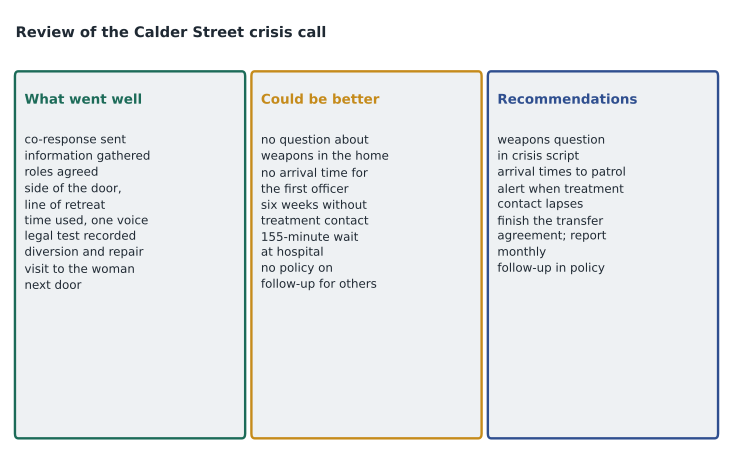
Amara lists the decisions she considers examples of good practice. The dispatcher sent the co-response team as well as a patrol car. Kaplan gathered information on the way, including the call history, Adam's diagnosis, his sister and his treatment team, and the absence of weapons or violence in his history. The call-taker kept Mrs. Halverson on the line and asked her to stay behind a locked door, which removed the most immediate risk. Malhotra waited in the lobby rather than going up alone, and the three responders agreed on roles before contact. They stood to the side of the door with a line of retreat, kept their radios down and had one person speak.
At the door, Kaplan introduced herself, explained why she was there, listened far more than she spoke and named Adam's feelings. She did not argue with his beliefs or rush him, and she offered him real choices. The broom handle was put down nine minutes after contact, without a single command. Morales's clinical assessment and the call to Claire gave Adam a chance to agree to go voluntarily. When he did not, Kaplan applied the legal test carefully, explained her decision, told him he was not under arrest and advised him of his right to counsel, searched him only with explanation, and judged that handcuffs were not needed. Her notes recorded every element of the test. Afterward, she chose not to charge him for the light fixture and arranged restitution, and visited Mrs. Halverson.
What could have gone better
Amara's review also identifies gaps. The call-taker asked Mrs. Halverson whether she had seen a weapon, but not whether Adam was known to have weapons in the apartment, a question Port Ardent's crisis script did not include. The first officer on scene had no information about the co-response team's estimated arrival, and if the team had been delayed, he would have faced a hard choice alone. Adam had not had contact with his assertive community treatment team for six weeks, and no one had been alerted that he had stopped his medication. That was a system gap, not an officer's error, but it was the reason the crisis reached the point of a 9-1-1 call.
The longest gap was at the hospital. Two officers, including half of the city's only evening co-response team, spent two hours and 35 minutes waiting while other crisis calls went to patrol officers. During that time, there were three other mental health calls in the city. Amara notes that the hospital staff were not at fault: the emergency department was full that night. The problem was the absence of an agreed handover process, which the January 2026 agreement was meant to fix but which had not yet been fully put in place by February 12.
Finally, she notes that there was no recorded plan for supporting Mrs. Halverson beyond the next day's visit, and no policy requiring officers to follow up with people who were frightened by a neighbour in crisis. Kaplan did it because she thought it was right. Amara argues that it should be standard practice.
What happened next
With Adam's permission, Morales shares what happened after the call. He was admitted to hospital as an involuntary patient for assessment, and was reviewed by a psychiatrist, who confirmed the need for admission. He agreed to try a different medication with fewer side effects, became a voluntary patient after three days and was discharged after nine days, with an appointment with his treatment team for the following morning. The co-response team called him 72 hours after discharge. He was sleeping again. He told Morales that he was embarrassed about the night but grateful that the officers had talked to him 'like a person'. He wrote a short note of apology to Mrs. Halverson, which Claire delivered. Two months later, Adam agreed to speak to the class by video about what the night had been like from his side of the door.
Adam's message to the class was simple. 'I was terrified,' he said. 'I really believed the lights were watching me. When the officer said she could hear that I was scared, that was the first time in days that anyone had said something that made sense to me. If she had come in shouting, I don't know what I would have done.' Several students said afterward that it was the moment of the course they would remember longest.
Recommendations
Amara's review ends with five recommendations, each specific and assigned to someone who can act on it. Add a question about known weapons in the home to the crisis call script, for the communication centre. Give patrol officers the co-response team's estimated arrival time on every crisis call, for dispatch. Ask the treatment team and the hospital to agree on an alert when a client with a history of crisis calls loses contact for more than a month, with the person's consent recorded in advance, for the hospital and the mental health agency. Complete the transfer agreement and report median handover times monthly, for the service and the hospital. Make follow-up with frightened neighbours and other affected people part of the crisis call policy, for the community response unit.
Scoring the review
Desjardins grades each review with a rubric of eight criteria, each scored from 0 to 2: accuracy of the timeline, use of the legal test, analysis of communication and de-escalation, attention to risk and safety, system factors, diversion and follow-up, respectful language, and specific recommendations. The program below scores Amara's review and calculates the class average.
# Capstone rubric: eight criteria scored 0-2
criteria = ["timeline", "legal test", "communication", "risk and safety",
            "system factors", "diversion and follow-up", "language", "recommendations"]
amara = [2, 2, 2, 2, 2, 1, 2, 2]
others = {"Jesse": [2, 1, 2, 2, 2, 2, 2, 1], "Priya": [2, 2, 1, 2, 2, 1, 2, 2],
          "Marco": [1, 2, 2, 2, 1, 1, 2, 1], "Linh": [2, 1, 2, 1, 2, 2, 2, 2]}
print("Amara:", sum(amara), "of", 2 * len(criteria))
for c, s in zip(criteria, amara):
    if s < 2:
        print("  lost a point on:", c)
scores = [sum(amara)] + [sum(v) for v in others.values()]
print("class average:", sum(scores) / len(scores))Amara: 15 of 16 lost a point on: diversion and follow-up class average: 13.8
Amara scored 15 of 16. She lost a point on diversion and follow-up because her review did not discuss what would have happened if the property manager had insisted on a charge, and whether a Crown diversion would then have been available. The class average was just under 14. Desjardins tells the class that the most common weakness was in the legal test: several students wrote that Adam 'was mentally ill and dangerous', which is a conclusion, not grounds. A good review, like a good note, shows how each element of the test was met by specific facts.
Closing the course
On the last evening, Morales returns to the question she asked on the first night: how many of the students have lived with, or been close to someone with, a mental illness or an addiction? Again every hand goes up. 'You will carry this with you onto every call,' she says. 'The person in front of you is someone's brother, someone's mother, someone's friend. Most of the time, what helps is not a power or a tool. It is a person who slows down, listens and treats them as a human being. You can be that person.' Desjardins adds one more thing. 'And when it is you who is struggling,' he says, 'let someone be that person for you.'
Worked problem
Writing grounds, not conclusions
A student's review says: 'Adam was mentally ill and dangerous, so the officer was right to take him to hospital.' How should this be rewritten to show the legal test?
Show solution
- Name the power: section 17 of the Mental Health Act.
- Set out each element with facts: the disorderly conduct (smashing the light, shouting), the harm or fear (telling the neighbour he would make the watchers stop), the apparent mental disorder and its likely consequences (known psychosis, untreated, fixed beliefs about the neighbour, no sleep or food for days).
- Explain why it was dangerous to wait for a Form 2: it would take hours, and he would be alone next door to the woman he blamed.
- Note that voluntary options were tried first and refused.
- Avoid labels such as 'dangerous' without facts.
Answer: The review should name the power, set out each element of the test with the specific facts that met it, note the voluntary options tried and avoid conclusions without grounds.
Common mistakes
MistakeA review looks for someone to blame.
InsteadA review asks what happened and why, and looks at system factors as well as individual decisions.
MistakeIf the outcome was good, there is nothing to learn.
InsteadEven a successful call can reveal gaps, such as long hospital waits or missing questions in a script.
MistakeRecommendations should be general, such as 'more training'.
InsteadGood recommendations are specific, achievable and assigned to someone who can act.
Mistake'Mentally ill and dangerous' is enough to explain an apprehension.
InsteadThat is a conclusion; the review must show how specific facts met each element of the test.
Summary and key terms
- A review builds a timeline, identifies key decisions, compares them with law and good practice, looks at system factors and recommends specific changes.
- On Calder Street, the time spent talking at the door was the best-spent time of the night; the hospital wait was more than half the call.
- Good practice included co-response dispatch, information gathering, agreed roles, de-escalation, a carefully applied legal test, diversion and follow-up.
- Gaps included a missing weapons question, lapsed treatment contact, the hospital wait and no policy on following up with affected neighbours.
- Recommendations should be specific and assigned.
- The person in crisis is someone's family member; slowing down, listening and treating them with dignity is what helps most.
- After-action review
- A structured review of what happened, why, and what should change.
- Sentinel event review
- A non-blaming review of a significant event that looks at system factors.
- Contributing factor
- A condition that made an outcome more likely, including system factors.
- Rubric
- A scoring guide with criteria and levels.
- Grounds
- The specific facts that show each element of a legal test is met.
Practice problems
Work each problem on paper first, then reveal the answer to check.
In the code example, how many minutes did the team spend talking before deciding to take Adam to hospital?
Show answer
46 minutes.
What share of the whole call was spent waiting at hospital?
Show answer
155 of 240 minutes, about 0.65.
Name two gaps Amara identified.
Show answer
No question about known weapons in the home; six weeks without treatment team contact; the long hospital wait; no follow-up policy for the neighbour.
Why did several students lose marks on the legal test?
Show answer
They wrote conclusions such as 'mentally ill and dangerous' instead of showing how facts met each element.
Lesson quiz · 5 questions
Score 60% or more to complete this lesson.
Create a free account to save your progress, take quizzes and earn a certificate.