
LES-114 · Lesson 1 of 12 · 19 min
Mental health and policing: why it matters
▶ Video coming soon A video version of this lesson is on the way.
On the first evening of the winter term, Professor Ray Desjardins walks into the classroom at Georgian Shores College with a second person beside him. 'You know me from the other courses,' he says. 'For the last six years of my career I ran the community response unit at Port Ardent, and the most important thing I learned there is that I did not know enough. So this course has two teachers.' He introduces Teresa Morales, a registered nurse who has worked in mental health for 17 years, and who now rides with Port Ardent's co-response team. Morales spends her shifts in an unmarked car with Constable Nora Kaplan, answering calls where someone is in a mental health or substance use crisis.
Morales starts with a question. 'Hands up if you, or someone you are close to, has lived with a mental illness or an addiction.' Every hand in the room goes up, slowly. 'That is the point of this course,' she says. 'The people you will meet on these calls are not a separate category of human being. They are your neighbours, your relatives, your classmates and, one day, your colleagues. Most of the time they are not dangerous. Almost always they are frightened, and many of them have had bad experiences with people in uniform. What you do in the first two minutes decides a great deal.'
A large share of the work
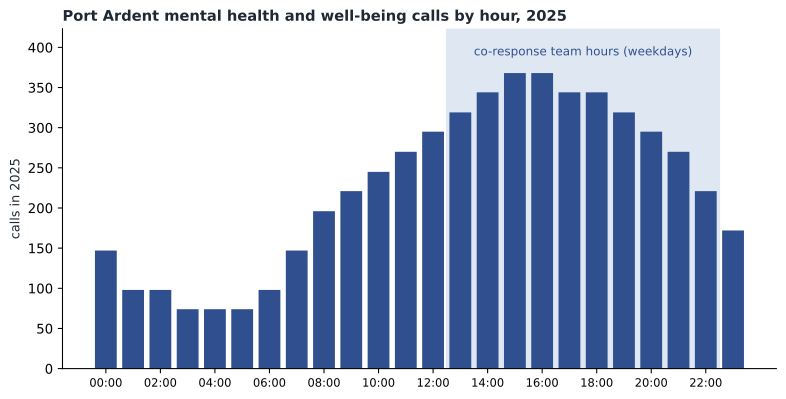
Desjardins puts Port Ardent's 2025 call data on the screen, the same numbers the class used in LES-101. Of 54,300 calls for service, 5,400 were classified as well-being checks or mental health calls. That is about one call in ten, but the share of officer time is larger, because these calls take longer. A theft report might take forty minutes. A person in crisis who needs to be taken to hospital can take an officer off the road for four hours or more, most of it waiting in an emergency department. Many other calls also involve mental health without being coded that way: a disturbance at a shelter, a shoplifter who is hearing voices, a domestic call where one partner is in a depressive crisis, or a person found sleeping in a bank vestibule in January.
Across Canada, the pattern is the same. Police services report that calls involving mental health and substance use have grown for two decades, and the Mental Health Commission of Canada has encouraged services to train officers and build partnerships with health agencies. Statistics Canada surveys have found that people with a mental or substance use disorder are considerably more likely than others to have had contact with police, often more than once.
How the police became mental health responders
Morales explains how this happened. In the middle of the twentieth century, people with serious mental illness were often housed for years in large psychiatric hospitals, sometimes in conditions that would be considered abusive today. From the 1960s onward, new medications, a growing respect for the rights of patients and the high cost of institutions led governments to close most of those beds. The idea, called deinstitutionalization, was that people would live in the community with support from clinics, housing programs and outreach teams. The beds closed, but the community services were never built at the scale that was needed.
The result, she says, is that a person in crisis at 02:00 on a Sunday has very few places to turn. Clinics are closed, family doctors are not answering, and crisis lines can talk but cannot always send someone. The police are available every hour of every day, they come when called, and they have legal powers to take a person to hospital. So the police became, by default, the front door to the mental health system for many people. Desjardins adds a phrase he heard early in his career: officers are 'street-corner psychiatrists', expected to make judgments about mental illness with little training, no clinical backup and a gun on their belt.
Jesse Morningstar raises a hand. In Nimkii Bay, he says, the nearest psychiatric bed is two hours away, and the police service is often the only one awake at night. Morales nods. Rural, remote and Indigenous communities often have the least access to mental health care and the greatest reliance on police, and some of the highest rates of suicide. Any discussion of crisis response, she says, has to include the communities that the usual city models do not reach.
Why it matters: risk, harm and trust
Desjardins is blunt about the stakes. People in mental health crisis are, as a group, far more likely to be victims of crime than perpetrators. But a small number of crisis calls involve weapons or threats, and when police encounters with people in crisis go wrong, they can end in injury or death. Coroner's inquests in Ontario, including the inquest into the death of Andrew Loku in Toronto and earlier inquests into police shootings of people in crisis, have repeatedly recommended better de-escalation training, more co-response teams and clearer policies on communicating with people in crisis. Every one of those cases began as an ordinary call.
There is also the matter of trust. People who have been handcuffed and taken to hospital in the back of a police car, sometimes several times, may come to fear the police. Families sometimes hesitate to call for help because they worry about what will happen when officers arrive. Desjardins reminds the class of the LES-101 survey, where people with recent police contact trusted the police less than people without it. 'Every crisis call is a chance to make that number better or worse,' he says. 'You will not cure anyone. But you can leave people safer than you found them, and you can make it more likely that they, and their families, will call next time.'
What officers are expected to do
Morales lists what a good crisis response achieves. First, safety: for the person, for the public and for officers. Second, stabilization: lowering the intensity of the crisis so that the person can think and talk. Third, connection: linking the person with the care or support that fits, whether that is a hospital, a crisis bed, a family member, a shelter, a detox program or a phone number for the next day. Fourth, the least intrusive outcome: using legal powers only when they are needed, and choosing options that respect the person's dignity and rights. Fifth, good records, because the next officer who meets the same person will benefit from knowing what worked.
In Ontario, these expectations are reflected in the Community Safety and Policing Act, 2019, which came into force in April 2024 and requires police services to provide adequate and effective policing, including responding to people in crisis, and allows services to arrange for other providers to respond to some calls. Provincial training at the Ontario Police College includes mental health and de-escalation, and many services add their own courses. Desjardins adds that the law gives officers specific powers for mental health calls, which the class will study in lesson 8, but that most crisis calls end without any legal power being used at all.
Words matter
Before going further, Morales sets ground rules for language. She asks the class to use person-first language: a person living with schizophrenia, not a schizophrenic; a person who uses drugs, not a junkie or an addict; a person experiencing a crisis, not an EDP or a psycho. She explains that the abbreviation for 'emotionally disturbed person', still heard on some police radios, reduces a human being to a label, and that many services have replaced it with neutral terms such as 'person in crisis' or simply describing the behaviour. Language shapes how officers think, she says, and the person in crisis can usually hear what is said about them on the radio.
Marco DiSanto asks whether this is just political correctness. Desjardins answers with an example from his own notes, written early in his career: 'Male, EDP, known to police, uncooperative.' None of those words told the next officer anything useful. A better note would have said that the man had been diagnosed with bipolar disorder, had been calm when spoken to slowly and by name, became agitated when officers stood over him, and had a sister who could be called. 'Respectful language is also accurate language,' he says. 'It describes what you saw, not what you assumed.'
Port Ardent mental health calls in numbers
Linh Tran, who now works part time as a call-taker, has been asked to look at how much time these calls take. The program below uses Port Ardent's 2025 figures for four call types, comparing the number of calls with the officer-hours they consumed. Officer-hours count every officer on the call, so a call with two officers for three hours counts as six.
# Port Ardent 2025: calls and officer-hours by type (selected types)
calls = {"well-being / mental health": 5400, "disturbance": 6900,
         "theft / property": 5900, "traffic": 9800}
avg_officers = {"well-being / mental health": 2.0, "disturbance": 2.1,
                "theft / property": 1.1, "traffic": 1.0}
avg_hours = {"well-being / mental health": 1.6, "disturbance": 0.9,
             "theft / property": 0.8, "traffic": 0.5}
total_hours = 0
rows = []
for k in calls:
    h = calls[k] * avg_officers[k] * avg_hours[k]
    rows.append((k, calls[k], round(h)))
    total_hours += h
for k, n, h in rows:
    print(f"{k:28} calls {n:5}  officer-hours {h:6}  per call {h / n:.2f}")
mh = rows[0][2]
print("share of these hours on mental health calls:", round(mh / total_hours, 3))well-being / mental health calls 5400 officer-hours 17280 per call 3.20 disturbance calls 6900 officer-hours 13041 per call 1.89 theft / property calls 5900 officer-hours 5192 per call 0.88 traffic calls 9800 officer-hours 4900 per call 0.50 share of these hours on mental health calls: 0.428
Mental health calls were fewer than traffic calls, but they used the most officer time of the four types, about 3.2 officer-hours per call, because two officers usually attend and calls often end with a long wait at hospital. That is why, Desjardins explains, Port Ardent's chief argued for a second co-response team in the 2026 budget, and why services across Canada are looking at whether some of these calls could be handled by health workers instead.
Worked problem
Reading a call summary
A call-taker's summary reads: 'Caller reports her adult son, 26, is yelling in his room and has not slept for three days. He has a diagnosis of bipolar disorder and stopped his medication. No weapons known. Caller is afraid but not injured.' What are the first things an officer should think about before arriving?
Show solution
- Safety: no weapons are reported and no one is injured, so there is likely time; the officer can plan an unhurried approach and ask for more information.
- Resources: is the co-response team on shift? Is there a history at the address, including what helped last time?
- Information from the caller: can she meet officers outside, tell them his name, what usually calms him and who his doctor is?
- Possible outcomes: a voluntary trip to hospital, a call to his psychiatrist or a crisis line, a family member staying with him, or, only if the legal test is met, an apprehension.
- Language and approach: use his name, avoid a crowd of officers in a small room, and explain who they are and why they came.
Answer: The officer should treat the call as a health emergency first, gather information on the way, plan a calm approach and keep several outcomes open.
Common mistakes
MistakeMost people with mental illness are dangerous.
InsteadPeople with mental illness are much more likely to be victims of violence than perpetrators; risk depends on specific factors, not a diagnosis.
MistakeMental health calls are not real police work.
InsteadThey are a large share of police time and among the calls where an officer's skill makes the biggest difference.
MistakeEvery crisis call ends in an apprehension.
InsteadMost crisis calls are resolved without using any legal power, through talking, support and referral.
MistakeLabels such as EDP are just efficient shorthand.
InsteadLabels reduce people to a category and tell the next officer nothing useful; describe what was seen.
Summary and key terms
- About one Port Ardent call in ten is a well-being or mental health call, and these calls take more officer time than most others.
- Deinstitutionalization closed psychiatric beds without building enough community care, leaving police as the front door to the system after hours.
- Rural, remote and Indigenous communities often have the least access to care and the greatest reliance on police.
- A good crisis response aims for safety, stabilization, connection, the least intrusive outcome and good records.
- Person-first, descriptive language is respectful and more accurate.
- Deinstitutionalization
- The closing of large psychiatric hospitals from the 1960s onward, with care meant to move to the community.
- Co-response team
- A police officer and a mental health clinician who respond to crisis calls together.
- Person-first language
- Language that names the person before the condition, such as a person living with schizophrenia.
- Well-being check
- A call asking police to check on the safety of a person, often because of concern about mental health.
- Officer-hours
- The total time spent by all officers on a call or group of calls.
Practice problems
Work each problem on paper first, then reveal the answer to check.
What share of Port Ardent's 2025 calls were well-being or mental health calls?
Show answer
5,400 of 54,300, about one in ten.
In the code example, how many officer-hours did mental health calls use per call?
Show answer
About 3.2 (2.0 officers times 1.6 hours).
Name the five goals of a good crisis response.
Show answer
Safety, stabilization, connection, the least intrusive outcome and good records.
Why does Morales object to the term EDP?
Show answer
It reduces a person to a label, is heard by the person and tells the next officer nothing useful.
Lesson quiz · 5 questions
Score 60% or more to complete this lesson.
Create a free account to save your progress, take quizzes and earn a certificate.