
LES-114 · Lesson 4 of 12 · 19 min
Developmental disabilities, dementia and conditions that can look like a crisis
▶ Video coming soon A video version of this lesson is on the way.
Desjardins opens the fourth class with a story he is not proud of. Early in his career, he was sent to a call about a young man 'acting strangely' at a bus stop: rocking, flapping his hands and not answering questions. Desjardins gave him a series of loud commands. The young man covered his ears, turned away and began to make a high-pitched sound. Desjardins took his arm, and the young man pulled away and fell. His mother arrived ten minutes later, running. Her son was autistic and did not speak; the noise and the commands had overwhelmed him. 'Nothing in my training told me what I was looking at,' Desjardins says. 'I treated a disability as defiance.'
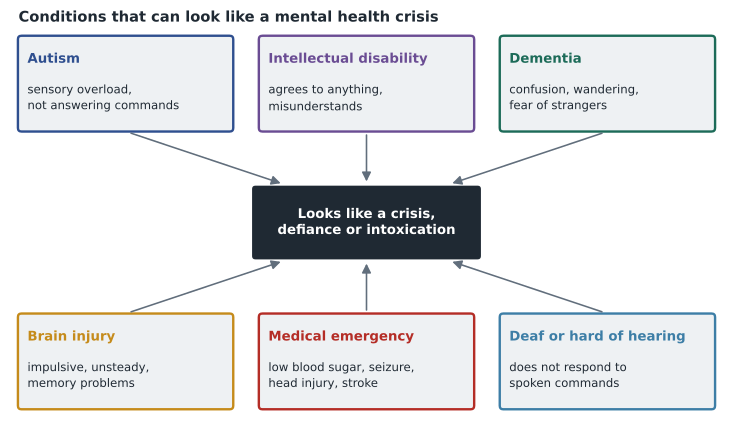
Morales explains that many conditions that are not mental illnesses can look like a crisis to an officer who does not recognize them. Some are developmental disabilities that a person has had since childhood. Some, such as dementia and brain injury, come later in life. Others are medical emergencies that change behaviour suddenly. In each case the officer's first task is the same: notice that something other than defiance or ordinary intoxication may be going on, slow down and adjust.
Intellectual and developmental disabilities
An intellectual disability involves significant limits in reasoning, learning and problem-solving, and in practical skills of daily life, starting before adulthood. People with intellectual disabilities may not understand complex questions, legal rights or the consequences of what they say. Many have learned to hide what they do not understand, and some will agree with whatever an officer suggests in order to please or to end an uncomfortable conversation. That makes them vulnerable to false confessions and to being exploited by others. Fetal alcohol spectrum disorder, which affects memory, impulse control and the ability to link actions with consequences, is especially common among people involved in the justice system, and is often undiagnosed.
Kaplan gives practical tips. Use short, simple sentences and one question at a time. Avoid slang, idioms and sarcasm. Check understanding by asking the person to say in their own words what will happen next, rather than asking 'Do you understand?', which almost always gets a yes. Allow extra time. Ask whether there is a support person, such as a family member, group home worker or caseworker, who can help. And remember that a person with an intellectual disability is an adult with the same rights as anyone else.
Autism
Autism is a developmental condition that affects communication, social interaction and how a person processes sensory information. It is a spectrum: some autistic people have intellectual disabilities and do not speak, while others have average or high intelligence, work and live independently and may simply communicate differently. Many autistic adults prefer identity-first language, such as 'autistic person', and Morales tells the class that it is reasonable to follow the person's own preference when they state it.
On a call, an autistic person may avoid eye contact, not respond to their name, repeat words or phrases, rock or flap their hands, which is called stimming and often helps them stay calm, or become distressed by lights, sirens, radios and touch. They may take language literally. Under stress, some autistic people experience a meltdown, an involuntary loss of control that can include crying, shouting or hitting themselves, or a shutdown, where they stop responding. Neither is a tantrum or a sign of defiance. Some autistic children and adults wander from safe places and are drawn to water, so a missing autistic person is a high-priority search.
Kaplan lists what helps: turn off lights and sirens when it is safe, turn down the radio, reduce the number of officers in sight, give space, speak calmly and simply, give the person time to answer, avoid touching unless it is necessary for safety, and do not interrupt stimming unless it is dangerous. If the person does not speak, ask whether they use a device, cards or writing. A family member or support worker is usually the best source of information about what calms the person.
Dementia
Dementia is a group of conditions, of which Alzheimer's disease is the most common, that damage memory, thinking and judgment over time. More than 700,000 people in Canada live with dementia, and the number is rising as the population ages. People with dementia may become lost, even in their own neighbourhood, may not remember their address or recognize family, may be frightened by strangers, may accuse others of stealing items they have misplaced, and may become agitated, especially in the late afternoon and evening, which caregivers call sundowning.
Officers meet people with dementia most often when they are reported missing, found wandering, involved in a minor collision or accused of shoplifting. A person with dementia who resists help is usually frightened and confused rather than defiant. Kaplan advises approaching from the front, at eye level, introducing yourself, using the person's name and title, such as Mrs. Vance, speaking slowly and not arguing about facts: if a woman says she is waiting for her husband who died years ago, an officer can say, 'Let's wait somewhere warm,' rather than correcting her. Programs such as MedicAlert Safely Home, run with the Alzheimer Society, provide identification that lets officers contact caregivers quickly.
Searching for a person with dementia
Port Ardent's search coordinator keeps records of where people with dementia who were reported missing were found. The program below uses the 2024 and 2025 records to show how far from their last known location they were found, which guides where searchers look first.
# Distance from last known location to where a missing person with dementia was found,
# Port Ardent 2024-2025 (km, rounded)
found_km = [0.2, 0.3, 0.4, 0.4, 0.5, 0.6, 0.7, 0.8, 0.8, 0.9, 1.0, 1.1,
            1.2, 1.3, 1.5, 1.6, 1.9, 2.2, 2.6, 3.1, 4.0, 6.5]
found_km.sort()
n = len(found_km)
median = (found_km[n // 2 - 1] + found_km[n // 2]) / 2
print("people found:", n, "median distance km:", median)
for limit in (0.5, 1.0, 2.0, 5.0):
    share = sum(1 for d in found_km if d <= limit) / n
print(f"found within {limit} km: {share:.2f}")people found: 22 median distance km: 1.05 found within 0.5 km: 0.23 found within 1.0 km: 0.50 found within 2.0 km: 0.77 found within 5.0 km: 0.95
Half the people were found within about a kilometre, and most within two. The records also show that many were found in places such as hedges, ditches, parking garages and wooded edges near roads, often close to where they were last seen, and that some did not answer when searchers called their name. Kaplan says that dementia searches should start immediately and close to home, including the person's own house and yard, and that searchers should look into places, not just call out.
Port Ardent, like a number of Ontario services, runs a voluntary registry where families and caregivers can record information about a person with autism, dementia or another disability who might one day come into contact with police: a recent photograph, how the person communicates, what calms or upsets them, places they are likely to go and who to call. When a call involves that person, the dispatcher can pass the information to officers on the way. Kaplan says the registry has been most useful in missing person searches and in calls where the person cannot speak for themselves. Morales notes that registries must be voluntary, kept up to date and limited to information that helps the person, and that the person, where possible, should agree to what is recorded about them. Some people also carry a wallet card that explains their condition, and officers should look for one when a person cannot communicate.
Brain injury, hearing loss and other conditions
An acquired brain injury, from a fall, a collision, a stroke or an assault, can change a person's personality, memory, impulse control and ability to manage anger. Many people who are homeless or in custody have a history of brain injury. Their behaviour can look like intoxication, and they may also be intoxicated. People who are deaf or hard of hearing will not respond to spoken commands, especially from behind, and may need to use their hands to communicate. Officers should arrange for an American Sign Language or Langue des signes québécoise interpreter for any important conversation, rather than relying on writing or lip-reading. People with cerebral palsy or other conditions may have slurred speech or an unsteady walk that can be mistaken for drunkenness.
Medical emergencies that look like behaviour
Some of the most dangerous mistakes happen when a medical emergency is treated as a behaviour problem. Kaplan lists the main ones. Low blood sugar in a person with diabetes can cause confusion, sweating, slurred speech and aggression, and can be fatal if untreated. A head injury may cause confusion and vomiting that look like drunkenness. A stroke can cause slurred speech, weakness on one side and confusion. After a seizure, a person may be confused, combative or sleepy for some time. Lack of oxygen, severe infection, especially in older people, heat stroke and some medication reactions can all cause sudden changes in behaviour. A sudden change in an older person's thinking is called delirium and is a medical emergency.
The class discusses a state of extreme agitation, sometimes with very high body temperature, sweating, confusion, unusual strength and resistance to restraint, often linked to stimulant use or severe mental illness. For years this state was often called 'excited delirium' in police training and on death certificates. Major medical organizations have rejected that term, and in 2023 the American College of Emergency Physicians withdrew its approval of a paper that had supported it. Morales explains why it matters: the term was often used to explain deaths that followed prolonged struggles and restraint, and it can lead officers to see a medical emergency as a fight. What the class should take away is simple. A person in extreme agitation is in a medical emergency. Call paramedics early, use time and distance where possible, avoid prolonged struggles, and if restraint is unavoidable, get the person off their stomach and onto their side as soon as they are controlled, never put weight on their back or neck, and monitor their breathing continuously.
Worked problem
A woman found in a parking lot at night
At 23:30 in February, a security guard calls about an older woman in a nightgown and slippers walking in a grocery store parking lot. When the officer arrives, she says she is going to pick up her children from school, gives her name as Eleanor and cannot say where she lives. She pulls away when the officer reaches for her arm. What should the officer do?
Show solution
- Recognize the signs: confusion about time and place, inappropriate clothing for the weather, and a belief that she is going to collect her children suggest dementia or delirium.
- Treat the cold as the immediate danger: offer a coat or a seat in the warm car, explaining slowly, rather than taking her arm.
- Approach from the front, at eye level, introduce yourself and use her name. Do not argue about her children; say something like, 'Let's get you warm first.'
- Check for identification, such as a bracelet, and check missing person reports and nearby addresses.
- Call paramedics to check her for hypothermia and for a medical cause of sudden confusion, such as an infection.
- Reunite her with family or caregivers, and suggest an identification program if she is not enrolled.
Answer: The officer should treat her as a vulnerable person who may have dementia or delirium, protect her from the cold, communicate gently without arguing, check for identification and medical causes, and reunite her with caregivers.
Common mistakes
MistakeA person who does not obey commands is being defiant.
InsteadThey may be deaf, autistic, confused, having a seizure or not understand; slow down and find out.
MistakeAsking 'Do you understand?' checks understanding.
InsteadAsk the person to explain in their own words what will happen next.
MistakeStimming should be stopped.
InsteadStimming usually helps an autistic person stay calm; leave it alone unless it is dangerous.
MistakeExtreme agitation is a fight to be won.
InsteadIt is a medical emergency; call paramedics early, avoid prolonged struggles and prone restraint, and monitor breathing.
Summary and key terms
- Developmental disabilities, dementia, brain injury, hearing loss and medical emergencies can all look like a crisis, defiance or intoxication.
- People with intellectual disabilities may agree to anything; use simple language and check understanding.
- Autistic people may be overwhelmed by sensory input; reduce noise, lights and officers, and give time.
- People with dementia should be approached from the front, by name, without arguing about facts; searches start early and close to home.
- Low blood sugar, head injury, stroke, seizures, infection and delirium are medical emergencies.
- Extreme agitation is a medical emergency; avoid prolonged struggles and keep the airway and breathing clear.
- Intellectual disability
- Significant limits in reasoning and practical life skills that begin before adulthood.
- Autism
- A developmental condition affecting communication, social interaction and sensory processing.
- Stimming
- Repetitive movements or sounds that help a person regulate their senses and emotions.
- Meltdown
- An involuntary loss of control in response to overwhelming stress or sensory input.
- Dementia
- Conditions that progressively damage memory, thinking and judgment.
- Delirium
- A sudden change in attention and thinking caused by a medical problem.
Practice problems
Work each problem on paper first, then reveal the answer to check.
Why is asking 'Do you understand?' a poor check?
Show answer
People, especially those with intellectual disabilities, almost always say yes; ask them to explain in their own words instead.
In the code example, what was the median distance at which missing people with dementia were found?
Show answer
1.05 km.
List three medical emergencies that can look like intoxication or aggression.
Show answer
Low blood sugar, head injury, stroke, seizures, lack of oxygen, severe infection or heat stroke.
Why did medical organizations reject the term 'excited delirium'?
Show answer
It was used to explain deaths after struggles and restraint and led officers to see a medical emergency as a fight.
Lesson quiz · 5 questions
Score 60% or more to complete this lesson.
Create a free account to save your progress, take quizzes and earn a certificate.