
LES-111 · Lesson 9 of 12 · 19 min
Trial rights and police duties: sections 11 to 14
▶ Video coming soon A video version of this lesson is on the way.
Most police work happens long before trial, so Marco DiSanto asks why a policing course spends a lesson on trial rights. Desjardins answers with a case from Port Ardent a few years earlier: a sexual assault charge stayed because the case took too long to reach trial. The delay was not caused by the court or the lawyers. It began with a police file that took months to complete, a forensic report that sat unrequested, and video that was disclosed in pieces. The accused walked free without a trial and the complainant never had her day in court. Section 11, he tells the class, belongs to the accused, but police decide much of whether it can be honoured.
The rights of a person charged: section 11
Section 11 gives any person charged with an offence a list of rights: to be informed without unreasonable delay of the specific offence; to be tried within a reasonable time; not to be compelled to testify against themselves; to be presumed innocent until proven guilty in a fair and public hearing by an independent and impartial tribunal; not to be denied reasonable bail without just cause; to a jury trial for offences punishable by five years or more; not to be tried again for an offence already finally decided; and to the lesser punishment where the penalty changed between the offence and sentencing. Several of these depend directly on police work.
Trial within a reasonable time
In R. v. Jordan in 2016, the Supreme Court replaced a flexible balancing test with presumptive ceilings: 18 months from charge to the end of trial in provincial court, and 30 months in superior court or provincial court after a preliminary inquiry. Delay caused or waived by the defence is subtracted. If the remaining delay exceeds the ceiling, it is presumed unreasonable and the charge is stayed unless the Crown shows exceptional circumstances, such as a discrete event like a pandemic or a genuinely complex case. Below the ceiling, the defence can still establish unreasonable delay in clear cases. In R. v. Cody in 2017, the Court emphasized that every participant, including police, shares responsibility for timely trials.
Police contribute to delay in predictable ways: slow completion of the initial file, late requests for forensic analysis, video retrieved weeks after the event, notes and reports not transcribed, and disclosure delivered in instalments. Each week of police delay comes off the time available for everyone else. Desjardins tells the class that in his last years, his platoon treated disclosure like evidence: it had a deadline, a checklist and a person responsible.
# Jordan check for four Port Ardent provincial court cases (months)
CEILING = 18.0
cases = [
    # (case, months from charge to anticipated end of trial, months of defence delay)
    ("C-1", 16.5, 0.0), ("C-2", 21.0, 4.5), ("C-3", 23.0, 2.0), ("C-4", 19.5, 0.0),
]
for name, total, defence in cases:
    net = total - defence
    status = "over ceiling" if net > CEILING else "under ceiling"
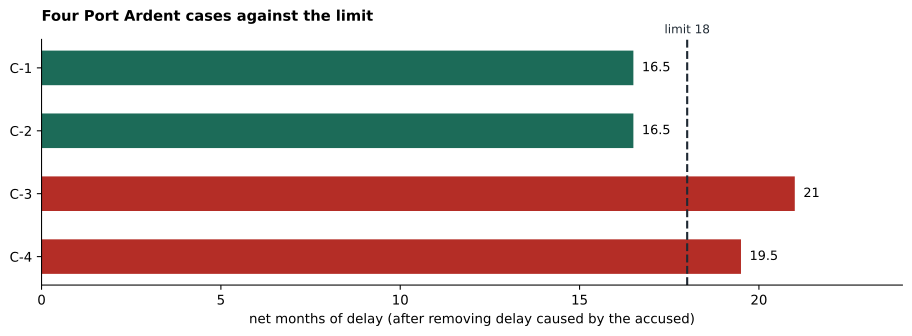
print(f"{name}: total {total:4.1f}, defence {defence:3.1f}, net {net:4.1f} -> {status}")C-1: total 16.5, defence 0.0, net 16.5 -> under ceiling C-2: total 21.0, defence 4.5, net 16.5 -> under ceiling C-3: total 23.0, defence 2.0, net 21.0 -> over ceiling C-4: total 19.5, defence 0.0, net 19.5 -> over ceiling
Two of the four cases are over the 18-month ceiling after subtracting defence delay. Case C-2 is under, because 4.5 months of its delay came from the defence. Cases C-3 and C-4 are in trouble unless the Crown can point to exceptional circumstances, and Prosecutor Liu tells the class that in C-4 the main cause was a forensic request police made five months after the charge.
Bail and the police role in release
Section 11(e) protects the right not to be denied reasonable bail without just cause. In R. v. Antic in 2017, the Supreme Court restated the ladder principle: release without conditions is the default, and each more onerous form of release must be justified before moving up the ladder. In R. v. Zora in 2020, it held that bail conditions must be necessary, reasonable, least onerous and sufficiently linked to the risks, because unnecessary conditions set people up to fail and fill jails with people charged with breaching them. Police make the first release decision in most cases: officers can release people on an appearance notice or an undertaking with conditions, and since amendments in 2019 the Criminal Code requires police and courts to consider the principle of restraint and the circumstances of Indigenous accused and vulnerable groups. Reforms in 2023 added a reverse onus for some repeat violent offences involving weapons.
Linh Tran asks why police should care about conditions of release once a person leaves the station. Desjardins gives two reasons. First, the conditions officers recommend or impose often decide whether a person keeps a job and housing while presumed innocent. Second, officers enforce those conditions, and unnecessary conditions generate breach charges that consume police time without making anyone safer. Fair, minimal conditions are both a constitutional value and good policing.
Cruel and unusual treatment: section 12
Section 12 protects against cruel and unusual treatment or punishment. It applies to punishment imposed by courts, but the word treatment also covers how people are held by the state. Conditions in police cells, the use of restraints, prolonged isolation and the denial of medical care can all raise section 12 issues, and the Supreme Court has held that treatment so excessive as to outrage standards of decency breaches the section. Ontario's Community Safety and Policing Act regulations and service policies set standards for cell checks, medical assessment and the care of intoxicated and vulnerable prisoners, many of them developed after deaths in custody and coroner's inquests.
Desjardins tells the class that the most dangerous hours for a prisoner are often the first few in a police cell: people arrive intoxicated, injured, in mental health crisis or withdrawing from drugs, and they cannot always tell anyone. Regular, real cell checks, which means looking for breathing and responsiveness rather than glancing through a window, and a low threshold for calling paramedics are basic duties. The Charter sets the floor; the coroner's reports and inquests set the practice.
Self-incrimination and interpreters: sections 13 and 14
Section 13 protects a witness who testifies from having that testimony used to incriminate them in other proceedings, except in a prosecution for perjury or giving contradictory evidence. For police, the practical point is that a person compelled to testify in one hearing cannot have that evidence turned against them later, so investigators should not rely on it. Section 14 guarantees an interpreter to a party or witness who does not understand or speak the language of the proceedings or who is deaf. The same principle runs through police work: a detainee who does not understand English must receive rights advice and be interviewed in a language they understand, with a qualified interpreter rather than a family member or a bilingual bystander, and the interpreter's involvement must be recorded.
Marco, who often works with newcomer families, adds that in the Lakeshore Hardware case and elsewhere officers sometimes ask a child to translate for a parent. Desjardins says that is one of the most common and most damaging mistakes in practice: the child may not know the words, may soften what is said, and may be traumatized by translating questions about a crime. Qualified interpreters, often available by phone within minutes, are the standard.
The presumption of innocence in everyday policing
The presumption of innocence is usually discussed as a trial rule, but it shapes police conduct long before trial. It means the accused does not have to prove anything, and it explains why officers must avoid statements and actions that treat a person charged as guilty. Public comments, such as a news release describing an arrested person as the person who committed the crime, can affect potential jurors and witnesses. Perp walks staged for cameras, mugshots shared on social media and descriptions that go beyond the facts all sit uneasily with the presumption. Many Canadian services now limit what they release about accused persons, and publication bans can apply automatically in some cases, such as those involving young persons under the Youth Criminal Justice Act.
Desjardins gives the class a simple rule for public communications: describe what was done and what the person is accused of, use the word alleged, and never describe the strength of the evidence or the person's character. He shows two versions of a news release about the Lakeshore Hardware arrest. One says that police caught the burglar red-handed with the stolen tools. The other says that a 23-year-old man has been charged with breaking and entering and theft, that the allegations have not been tested in court, and that the investigation continues. Only the second is appropriate, and only the second is accurate: at that stage, the man is accused, not proven guilty.
Police witnesses at trial
Every trial right eventually depends on the quality of the officer's evidence in court. The accused has the right to a fair hearing, which includes the right to test the evidence against them through cross-examination. Officers prepare by reviewing their notes, reports and recordings, by meeting with the prosecutor, and by being honest about what they remember independently and what they know only from their notes. Officers may refer to their notes in court to refresh their memory if the notes were made at or near the time of the events and are their own. The class practised testifying in LES-104, and Desjardins reminds them that a fair trial is as much an officer's responsibility as the prosecutor's or the judge's: accurate, candid testimony is part of honouring the accused person's rights.
Linh asks what an officer should do if, while preparing, they realize their notes contain an error. Desjardins says to tell the prosecutor immediately, correct the record through the proper procedure, and explain the error candidly in court. Errors disclosed early are rarely fatal; errors discovered by the defence during cross-examination often are, and they can damage the officer's credibility in every case that follows.
Prosecutor Liu adds one more trial right that depends on police: the accused's ability to call witnesses in their own defence. When officers canvass a scene, they sometimes record only the witnesses who support the investigation's theory. Liu tells the class that every person spoken to belongs in the notes, with contact details, because a witness who saw something different may be the one the defence needs, and a fair trial requires that the defence be able to find them. Officers who record only helpful witnesses risk both a disclosure problem and an unfair trial. She also reminds them to tell witnesses that they may be contacted by either side, and that they are free to speak to the defence if they choose.
Worked problem
Delay in a fraud file
Priya Sandhu's capstone case from LES-104, a gift-card phone scam, results in charges against two people. The investigating officer needs bank records from three institutions and a forensic examination of a seized phone. The officer plans to request the bank records after finishing two other files, about three months from now.
Show solution
- Identify the clock: the speedy trial clock started when the charges were laid, not when the officer starts working on the records.
- Calculate the risk: three months of police delay at the start uses a sixth of the 18-month Jordan ceiling before disclosure can even begin.
- Prioritize: request the production orders or subpoenas and the phone examination immediately, because outside agencies take time.
- Disclose in an organized way: deliver what is ready with an index and a schedule for the rest, rather than holding everything until the end.
- Record the dates of every request and response, so delay can be explained if challenged.
Answer: Delay at the start of a file is the most dangerous kind, because it cannot be made up later. Treat requests for outside records as urgent.
Common mistakes
MistakeTrial delay is the court's problem, not the police's.
InsteadCody makes timely trials a shared responsibility, and police delay in completing files and disclosure counts against the Crown under Jordan.
MistakeStricter release conditions are always safer.
InsteadUnder Antic and Zora, conditions must be necessary, least onerous and linked to the risk; unnecessary conditions set people up to fail.
MistakeA quick look through the cell window is a cell check.
InsteadA real check confirms breathing and responsiveness; many deaths in custody followed checks that did not.
MistakeA family member can translate in an interview.
InsteadUse a qualified interpreter and record their involvement; family members, especially children, are unreliable and easily challenged.
Summary and key terms
- Section 11 sets out the rights of a person charged, many of which depend on police work.
- Jordan sets presumptive ceilings of 18 and 30 months, net of defence delay, and police delay counts.
- Antic and Zora require the least onerous release with necessary, reasonable conditions; police make most first release decisions.
- Section 12 covers cruel treatment, including conditions in police cells.
- Sections 13 and 14 protect compelled testimony and guarantee interpreters.
- Prompt files, prompt disclosure, careful custody and qualified interpreters are how police honour trial rights.
- Jordan ceiling
- The presumptive limit on trial delay: 18 months in provincial court, 30 in superior court.
- Defence delay
- Delay caused or waived by the defence, subtracted when applying the Jordan ceilings.
- Ladder principle
- The rule that the least onerous form of release is the default, with each step up justified.
- Principle of restraint
- The Criminal Code direction to favour release at the earliest opportunity on the least onerous conditions.
- Section 12
- The protection against cruel and unusual treatment or punishment.
- Section 14
- The right to an interpreter in proceedings.
Practice problems
Work each problem on paper first, then reveal the answer to check.
What are the Jordan ceilings?
Show answer
18 months in provincial court and 30 months in superior court, after subtracting defence delay.
In the code example, why is case C-2 under the ceiling?
Show answer
Its total of 21 months includes 4.5 months of defence delay, leaving 16.5 months net.
Why should officers avoid unnecessary release conditions?
Show answer
They harm people presumed innocent, set them up to fail and generate breach charges without improving safety.
What does a real cell check involve?
Show answer
Confirming that the prisoner is breathing and responsive, not just glancing through the window.
Lesson quiz · 5 questions
Score 60% or more to complete this lesson.
Create a free account to save your progress, take quizzes and earn a certificate.