
LES-111 · Lesson 7 of 12 · 19 min
The right to counsel: section 10(b)
▶ Video coming soon A video version of this lesson is on the way.
Prosecutor Margaret Liu visits the class in Week 7 with a stack of files. In the last year, she says, more cases in her office were weakened by mistakes about the right to counsel than by any other single issue, and almost none of those mistakes involved bad faith. Officers advised people late, asked 'just one quick question' before a lawyer call, or let a detainee use a phone in a hallway where everyone could hear. She tells the class that the rules on counsel are among the clearest in Charter law, and that following them precisely is the easiest way for an officer to protect a case.
Why the right to counsel exists
A person who has just been arrested is frightened, often confused, and facing an organization that knows the law far better than they do. The Supreme Court has described the purpose of section 10(b) as helping detained persons regain their liberty and guarding against the risk of involuntary self-incrimination. A lawyer can explain the person's legal situation, including the right to remain silent, and help them make an informed choice about whether to speak to police. Desjardins adds a practical point: statements obtained after a properly handled right to counsel are far harder for the defence to attack.
Section 10(b): what officers must tell people
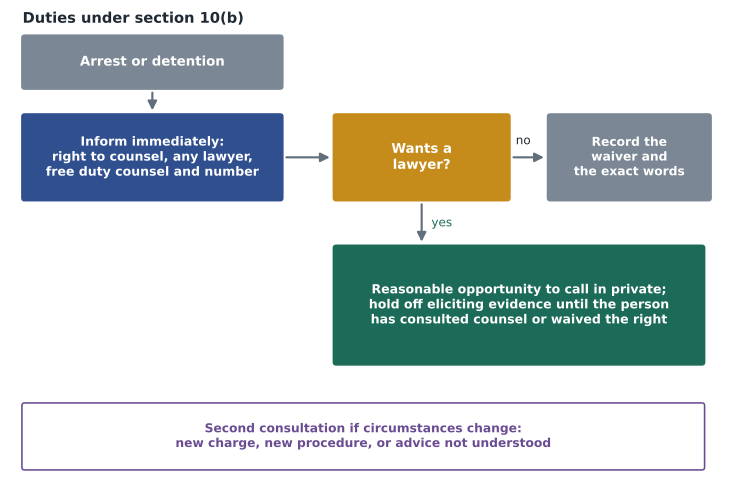
Section 10(b) gives everyone on arrest or detention the right to retain and instruct counsel without delay and to be informed of that right. The duty is triggered immediately on arrest or detention, as R. v. Suberu held in 2009, subject only to concerns for officer or public safety. The informational component requires telling the person that they have the right to speak to a lawyer without delay, that they may call any lawyer they wish, and, since R. v. Brydges in 1990, that free legal advice is available from duty counsel and how to reach it, including the toll-free number. If the person is not likely to understand, for instance because of language, intoxication or a mental condition, the officer must take reasonable steps to make sure they do, as R. v. Evans held in 1991. Most services use a standard card so the wording is complete.
Custody is judged objectively: would a reasonable person in the suspect's position have felt they were not at liberty to end the interrogation and leave? In J.D.B. v. North Carolina in 2011, the Court held that a child's age, when known to the officer or objectively apparent, is part of that analysis. Interrogation includes not only express questioning but its functional equivalent: words or actions the police should know are reasonably likely to elicit an incriminating response, as Rhode Island v. Innis held in 1980. Routine booking questions, such as name and address, are generally not interrogation.
Once a person asks for a lawyer
If the person says they want to speak to a lawyer, two implementational duties arise, as the Supreme Court explained in R. v. Manninen in 1987. Police must give the person a reasonable opportunity to exercise the right, which includes access to a phone and privacy for the call, and they must refrain from eliciting evidence from the person until that opportunity has been provided. The person must be reasonably diligent in exercising the right; if they are, police must hold off. The person may choose their own lawyer, and police must make reasonable efforts to reach that lawyer, but if the chosen lawyer cannot be reached within a reasonable time the person may be expected to call another or duty counsel, as R. v. Willier held in 2010. Police may not belittle the person's lawyer or discourage the call.
In R. v. Sinclair in 2010, the Supreme Court held that section 10(b) does not give a detained person the right to have a lawyer present during the interrogation, and that police may continue questioning after the person has consulted counsel, even if the person repeatedly says they do not want to talk. But the person has the right to a second consultation if there is a material change in circumstances, such as a new and more serious charge, a new procedure like a lineup, or reason to believe the person did not understand the first advice. Officers must stay alert for those changes. Liu tells the class that this rule is where the two countries differ most sharply, and officers who move between jurisdictions in training videos and media need to remember which rules apply where they work.
| Question | Canada (section 10(b)) | United States (Miranda and Edwards) |
|---|---|---|
| When does the duty arise? | Immediately on arrest or detention | Before custodial interrogation |
| Lawyer present during questioning? | No (Sinclair) | Yes, if the suspect asks |
| Can police keep asking after the person consults? | Yes, unless circumstances change | No, once counsel is requested, unless the suspect re-initiates |
| Free legal advice? | Duty counsel, with a toll-free number | Appointed counsel if the person cannot afford one |
Waiver and special circumstances
A detained person can waive the right to counsel, but the standard is high. In R. v. Prosper in 1994, the Court held that a waiver must be free and voluntary and made with full knowledge of the rights being given up and the consequences, and that where a person has asserted the right and then appears to change their mind, police must give them an additional warning, sometimes called a Prosper warning, explaining that they have a right to a reasonable opportunity to reach a lawyer and that police must hold off questioning until they do. Youths have additional protections: under section 146 of the Youth Criminal Justice Act, a statement by a young person is admissible only if the officer explained the rights in clear language appropriate to their age and understanding and gave them the opportunity to consult a lawyer and a parent or other adult.
Exceptions and consequences
The duty to inform can be delayed briefly for genuine officer or public safety concerns, such as an unsecured weapon or an ongoing threat, and implementation can be delayed while a person is transported to a place where a private call is possible. Police cannot delay simply because they want to search first or because a lawyer might advise silence. When a breach occurs, statements obtained afterward are at serious risk of exclusion under section 24(2), and in some cases derivative evidence can be lost too.
Timing the Lakeshore Hardware arrest
The class reviews the times recorded during Kyle Brandt's arrest after the Lakeshore Hardware break-in, from detention on the sidewalk to his first call with a lawyer. The program computes the gaps that a court would look at.
# Times from the Lakeshore Hardware arrest, March 14, 2026 (24-hour clock)
events = [
    ("detained on Pine Street", "02:29:15"),
    ("arrested", "02:29:40"),
    ("rights to counsel read", "02:36:00"),
    ("asks for a lawyer", "02:36:30"),
    ("arrives at the station", "02:58:00"),
    ("call with a lawyer begins", "03:12:00"),
]
def seconds(t):
    h, m, s = (int(x) for x in t.split(":"))
    return h * 3600 + m * 60 + s
start = seconds(events[0][1])
for name, t in events:
    print(f"{t}  +{(seconds(t) - start) / 60:5.1f} min  {name}")
delay_advice = (seconds("02:36:00") - start) / 60
delay_call = (seconds("03:12:00") - seconds("02:36:30")) / 60
print("minutes from detention to advice:", round(delay_advice, 1))
print("minutes from request to call:", round(delay_call, 1))02:29:15 + 0.0 min detained on Pine Street 02:29:40 + 0.4 min arrested 02:36:00 + 6.8 min rights to counsel read 02:36:30 + 7.2 min asks for a lawyer 02:58:00 + 28.8 min arrives at the station 03:12:00 + 42.8 min call with a lawyer begins minutes from detention to advice: 6.8 minutes from request to call: 35.5
The advice came about 6.8 minutes after detention, and the call began about 35.5 minutes after Brandt asked. Under Suberu, advice should be immediate, so the officers will need to explain the 6.8 minutes, perhaps by pointing to securing the scene and Brandt's backpack. The 35.5 minutes to the call is likely reasonable if he was taken straight to the station and given a private phone on arrival, and as long as no one questioned him in the meantime. His unprompted remark in the cruiser, that the owner's tools were not worth much, raises a separate question for Lesson 8.
Giving the rights properly
Liu shows the class two body camera clips of rights advice. In the first, an officer reads the card quickly while walking the person to the cruiser, finishes with 'Got it?', and moves on when the person mumbles. In the second, the officer stops, faces the person, reads the card at a normal pace, then asks, 'Do you understand?' and 'Do you want to call a lawyer now?', waits for the answers and repeats them back. The second clip takes about forty seconds longer. Liu says that in court the first clip invites a long argument about whether the person understood, while the second ends the argument before it starts.
Courts have held that the informational duty is not satisfied by reciting words the person plainly did not hear or understand. When an officer has reason to think the person did not understand, because of language, intoxication, injury, a hearing impairment or a mental condition, the officer must take reasonable steps to convey the right in a meaningful way, which may mean using an interpreter, waiting until the person is calmer or explaining in simpler words. Officers should record the person's exact response, including any request for a specific lawyer, and should note whether a duty counsel number was provided and when.
Desjardins adds the practical details that trip up new officers. Write down the exact time the rights were given, not an approximation. Note who was present. If the person asks a question about the rights, such as whether a lawyer will cost money, answer accurately and record the answer. If the person says they do not want a lawyer, ask once more, clearly, and record the words. And never offer opinions about whether a lawyer would help, which courts treat as undermining the right.
Young people and vulnerable detainees
Young people and vulnerable adults need particular care. Research shows that adolescents are more likely than adults to waive their rights without understanding them, more susceptible to pressure, and more likely to make false confessions. The Youth Criminal Justice Act responds by requiring officers to explain rights in language appropriate to the young person's age and understanding, and by giving the young person the right to consult a parent or other appropriate adult as well as a lawyer, and to have that person present during questioning unless the young person waives it in writing or on video. Desjardins tells the class that the safest practice with any young or vulnerable person is to slow down, use plain words, check understanding by asking the person to explain the right back, and record everything on video.
Worked problem
One quick question
At the station, while Brandt waits for the lawyer to call back, a detective walks past and says, 'Kyle, just between us, where are the other drill and the impact drivers? Help yourself out here.' Brandt says, 'I sold them already.'
Show solution
- Identify the action: a direct question about the crime is interrogation.
- Check section 10(b): Brandt had asked for a lawyer and was waiting for the call. Police had a duty to hold off from eliciting evidence until he had a reasonable opportunity to consult counsel.
- Consider the words 'just between us' and 'help yourself out': they suggest the conversation is off the record and hint at a benefit, both of which undermine voluntariness.
- Predict the result: the answer was obtained in breach of the holding-off duty and is likely to be excluded under section 24(2).
- Identify what should have happened: no questions at all until the lawyer call was complete and, if Brandt then chose to speak, a properly recorded interview.
Answer: A single question can cost the case its best evidence. The holding-off duty is absolute until the person has had a reasonable opportunity to speak to a lawyer.
Common mistakes
MistakeRights to counsel only need to be given at arrest.
InsteadSection 10(b) applies to every detention, including investigative detentions, immediately.
MistakeA quick question while waiting for the lawyer is harmless.
InsteadPolice must hold off from eliciting evidence until the person has had a reasonable opportunity to consult counsel.
MistakeA phone call in a busy hallway is enough.
InsteadThe person must have privacy for the call; others listening, including officers, can make the opportunity unreasonable.
MistakeAfter the call, the person can refuse to be questioned.
InsteadUnder Sinclair, police may continue questioning after consultation, though the person need not answer.
Summary and key terms
- Section 10(b) applies immediately on arrest or detention, with the informational duty including duty counsel and the number.
- If the person wants a lawyer, police must give a reasonable, private opportunity to call and hold off from eliciting evidence.
- Sinclair allows questioning after consultation, with a second consultation if circumstances materially change.
- Waivers must meet the Prosper standard; youths have extra protection under section 146 of the YCJA.
- Delays are allowed only for genuine safety concerns.
- Precise times and wording in notes are essential to show the right was respected.
- Informational duty
- The duty to tell a detained person about the right to counsel, including free duty counsel.
- Implementational duty
- The duty to give a reasonable opportunity to consult counsel and to hold off from eliciting evidence.
- Duty counsel
- Free legal advice available to detained persons, often by toll-free phone.
- Holding off
- Refraining from questioning until the person has had a reasonable opportunity to consult counsel.
- Prosper warning
- An extra explanation required when a person who asserted the right appears to waive it.
- Material change in circumstances
- A development that triggers the right to consult counsel again.
Practice problems
Work each problem on paper first, then reveal the answer to check.
When does the section 10(b) duty arise?
Show answer
Immediately on arrest or detention, subject only to safety concerns (Suberu).
What did Brydges add to the informational duty?
Show answer
That police must tell the person about free duty counsel and how to reach it.
How long after his request did Brandt's lawyer call begin?
Show answer
About 35.5 minutes.
Why are the words 'just between us' a problem in an interview?
Show answer
They suggest the statement is off the record and undermine the voluntariness and fairness of the questioning.
Lesson quiz · 5 questions
Score 60% or more to complete this lesson.
Create a free account to save your progress, take quizzes and earn a certificate.