
LES-111 · Lesson 6 of 12 · 20 min
Detention and arrest: sections 9 and 10(a)
▶ Video coming soon A video version of this lesson is on the way.
Desjardins asks Marco DiSanto to stand at the front of the room, then walks up to him and says, in a friendly voice, 'Hey, how's it going? Live around here?' He asks the class whether Marco is detained. Most say no. Desjardins steps closer, puts a hand on his duty belt and says, 'I need to see some ID.' Most now say yes. He then asks the harder question: at what exact moment did the conversation become a detention, and what changed? The answer matters because the moment a person is detained, section 9 protects them from arbitrary detention and section 10 gives them the right to be told why and to call a lawyer.
What is a detention?
In R. v. Grant in 2009, the Supreme Court held that detention means a suspension of liberty interest by a significant physical or psychological restraint. Physical detention is obvious: handcuffs, being held by the arm, being placed in a cruiser. Legal detention arises when the law requires compliance, as with a breath demand. Psychological detention exists where a reasonable person in the individual's position would conclude that they had no choice but to comply. The test is objective, and courts consider the circumstances giving rise to the encounter as the person would reasonably perceive them, the nature of the police conduct including the language used, physical contact, the place, the presence of others and the duration, and the person's particular characteristics such as age, stature, minority status and level of sophistication.
Two years before Grant, the Court had stressed that not every interaction is a detention: police are free to ask questions, and people are free to answer or walk away. But in R. v. Le in 2019, the Court held that three young racialized men in a Toronto backyard were detained the moment officers entered without permission and began questioning them, and that the analysis must consider how the encounter would be perceived by a reasonable person in the shoes of the accused, including the reality of race relations and the community's experience with police. The Court excluded the gun and drugs found and called the entry an arbitrary detention.
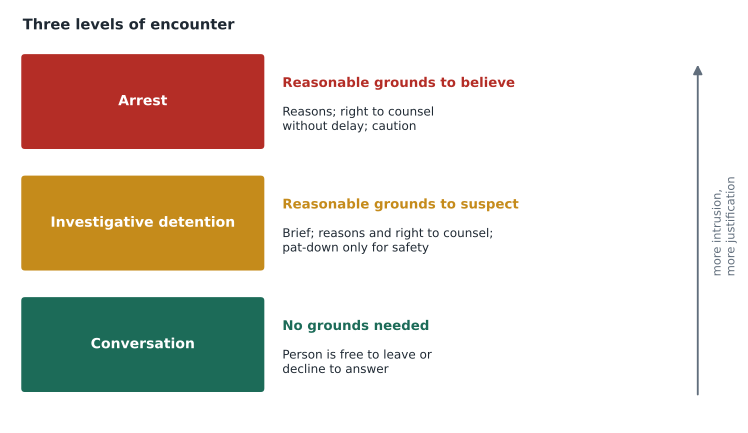
Investigative detention and reasonable suspicion
The common law power of investigative detention was confirmed in R. v. Mann in 2004. Police may detain a person for investigative purposes if there are reasonable grounds to suspect, in all the circumstances, that the individual is connected to a particular crime and that the detention is reasonably necessary. The detention must be brief, the person need not answer questions, and officers may conduct a protective pat-down search only if they reasonably believe their safety or that of others is at risk. In R. v. Chehil in 2013, the Court explained that reasonable suspicion is a lower standard than reasonable and probable grounds, dealing with possibilities rather than probabilities, but it must be based on objectively discernible facts, assessed in their totality, that can be subjected to independent judicial scrutiny. A hunch, a generalized suspicion about a neighbourhood, or a profile that would catch large numbers of innocent people is not enough.
The scope and length of a stop matter as much as its start. A detention that goes on longer than necessary, or becomes a fishing expedition, can become arbitrary. Officers who detain someone for one purpose cannot simply prolong it to look for evidence of something else unless new grounds arise. Desjardins tells the class that the best protection is to know the purpose of the stop, pursue it diligently, and end the stop when it is done unless new facts give new grounds.
Ohio is one of the states with a stop-and-identify law. Revised Code 2921.29 requires a person whom an officer reasonably suspects of committing, being about to commit or having committed a crime, or of witnessing certain serious crimes, to give their name, address and date of birth when asked. The Supreme Court upheld such laws in Hiibel v. Sixth Judicial District Court of Nevada in 2004, as long as the stop itself was lawful. Outside that situation, a person is generally not required to identify themselves to police. Desjardins notes the irony that the US class lives under a stricter identification rule than the Canadian class.
Arrest
The main arrest powers for police are in section 495 of the Criminal Code. An officer may arrest without a warrant a person who has committed an indictable offence or who, on reasonable grounds, the officer believes has committed or is about to commit one; a person the officer finds committing any criminal offence; or a person the officer has reasonable grounds to believe is the subject of an outstanding warrant. In R. v. Storrey in 1990, the Supreme Court held that the officer must subjectively believe there are reasonable grounds and those grounds must be objectively justifiable from the standpoint of a reasonable person in the officer's position; the officer does not need a prima facie case for conviction. Section 495(2) also tells officers not to arrest for less serious offences when the public interest can be met by other means, such as an appearance notice. In R. v. Tim in 2022, the Court held that an arrest based on a mistake of law, believing gabapentin was a controlled substance when it was not, was unlawful and violated section 9.
Amara Okafor asks why an officer would choose not to arrest when the law allows it. Desjardins answers with numbers from his own career: every arrest takes an officer off the street for hours, exposes the person to the stress and risks of custody, and can cost them a job even if the charge is later dropped. The Criminal Code builds this into section 495(2) and the release provisions. Arrest is a tool, not a reflex, and the fact that an arrest would be lawful does not mean it is wise.
Section 10(a): the right to be told why
Section 10(a) gives everyone who is arrested or detained the right to be informed promptly of the reasons. The person needs to know why so they can decide whether to submit, and so they can make a meaningful decision about calling a lawyer. The words need not be technical, but the substance must be clear: 'You are under arrest for breaking into the hardware store on Harbour Street tonight' is enough. If the reason for the detention changes, for instance from a traffic stop to a drug investigation, the officer must tell the person about the new reason. In R. v. Suberu in 2009, the Court held that the related duty under section 10(b) arises immediately on detention, subject only to concerns for officer or public safety, and section 10(a) is read the same way.
Measuring detention practice in Port Ardent
Haddad reviews 200 investigative detentions from the past quarter, recorded on the service's detention form. For each, she checks whether the officer wrote down specific facts supporting the suspicion and how long the detention lasted. The program summarizes the records and flags long detentions without recorded grounds, the cases most likely to be found arbitrary.
# 200 Port Ardent investigative detentions: (grounds recorded?, minutes) grouped into counts
records = [
    # (grounds recorded, duration band in minutes, count)
    (True, "under 10", 96), (True, "10 to 20", 41), (True, "over 20", 13),
    (False, "under 10", 27), (False, "10 to 20", 15), (False, "over 20", 8),
]
total = sum(r[2] for r in records)
with_grounds = sum(r[2] for r in records if r[0])
print("detentions reviewed:", total)
print("with specific grounds recorded:", with_grounds, round(with_grounds / total, 2))
long_no_grounds = sum(r[2] for r in records if not r[0] and r[1] == "over 20")
long_all = sum(r[2] for r in records if r[1] == "over 20")
print("over 20 minutes:", long_all, "of which no grounds recorded:", long_no_grounds)detentions reviewed: 200 with specific grounds recorded: 150 0.75 over 20 minutes: 21 of which no grounds recorded: 8
Three detentions in four had specific grounds recorded, but 50 did not, and 8 of those lasted more than twenty minutes. Haddad tells the class that each of those eight is a case where the officer would struggle to explain in court why the person was held at all, let alone for so long. Her next step is coaching, not discipline: most of the officers involved had reasons but did not write them down.
Traffic stops and passengers
Traffic stops are the most common way police detain people, and they raise their own rules. Provincial highway traffic laws give police the power to stop drivers to check licences, ownership, insurance, sobriety and the mechanical fitness of the vehicle, and the courts have upheld these powers as reasonable limits on section 9, though the Luamba litigation over random stops is ongoing. A stop for a traffic purpose cannot be used as a pretext for an unrelated criminal investigation without grounds, as courts have held when officers used highway powers to investigate drugs or check people because of how they looked. Passengers are not required to identify themselves unless the officer has grounds under a specific power, such as an offence the passenger is committing.
Desjardins tells the class that the most important habit at a traffic stop is clarity: telling the driver the reason at the start, keeping the stop focused on that reason, and ending it promptly when the purpose is done. A driver who is told 'I stopped you because your brake light is out' and receives a warning in four minutes has very little to complain about. A driver held for twenty minutes while officers ask about their travel plans, their friends and what is in the trunk, without any new grounds, may have a strong section 9 argument.
Detention and mental health calls
Not every detention is a criminal one. Officers often detain people who appear to be in a mental health crisis and at risk of harming themselves or others. In Ontario, section 17 of the Mental Health Act allows an officer to take a person into custody for examination by a physician when the officer has reasonable grounds to believe the person is acting in a disorderly manner and meets the criteria for serious bodily harm or deterioration. The Charter still applies: the person must be told why, must be advised of the right to counsel, and must be treated with dignity, and the detention lasts only as long as needed to get the person to care. Many services now pair officers with mental health clinicians for these calls, which the program studies in later courses.
Worked problem
Was Kyle Brandt detained before he was arrested?
At 02:22:30 dispatch broadcast a description of the Lakeshore Hardware suspect: a thin man, short dark hair, limping, carrying a black backpack, heading east. At 02:29:15, about three blocks east, Officer Patel saw Kyle Brandt, who matched the description, walking on Pine Street with a backpack. Patel stopped his cruiser beside him and said, 'Stop right there, I need to talk to you about a break-in.' At 02:29:40, after the unit 12 officers arrived and saw drills sticking out of the backpack, Brandt was arrested.
Show solution
- Decide when Brandt was detained: when Patel told him to stop and said why, a reasonable person would not feel free to leave. Detention began at 02:29:15.
- Ask whether Patel had reasonable grounds to suspect: a fresh report, a specific description, proximity in time and place, and a matching backpack together give objectively discernible facts connecting Brandt to a particular recent crime.
- Check the duties: Patel told Brandt the reason immediately. Section 10(b) advice should also have followed at once on detention, and it was not given until after the arrest, at 02:36.
- Ask whether there were grounds to arrest at 02:29:40: the drills in plain view in the backpack, together with the description and location, gave grounds to believe Brandt committed the break-in.
- Record the timeline precisely, because a court will compare the times.
Answer: The detention was justified and the arrest lawful, but the delay in rights to counsel from detention at 02:29:15 to advice at 02:36 may be a section 10(b) problem, which Lesson 7 examines.
Common mistakes
MistakeA person is only detained once handcuffed.
InsteadPsychological detention, when a reasonable person would feel they have no choice but to comply, is enough. Words, tone and positioning can create it.
MistakeBeing in a high-crime area is enough for a stop.
InsteadReasonable suspicion must connect the person to a particular crime with objectively discernible facts; location alone is not enough.
MistakeIf the arrest would be lawful, the officer should always arrest.
InsteadSection 495(2) directs officers not to arrest for less serious offences when other means will do.
MistakeA detention can continue as long as the officer needs to look for something.
InsteadA detention must be brief and tied to its purpose; prolonging it without new grounds can make it arbitrary.
Summary and key terms
- Under Grant, detention is a significant physical, legal or psychological restraint; Le requires considering the person's perspective, including race.
- Investigative detention under Mann requires reasonable grounds to suspect a connection to a particular crime; a protective pat-down needs safety concerns.
- Reasonable suspicion must rest on objective facts, not hunches or generalized profiles.
- Arrest without warrant under section 495 needs reasonable grounds, subjectively held and objectively justifiable (Storrey).
- Section 10(a) requires telling the person the reasons promptly, and again if the reason changes.
- Recording grounds and timing protects both the person and the case.
- Detention
- A suspension of liberty by significant physical, legal or psychological restraint.
- Psychological detention
- Detention that exists because a reasonable person would believe they had no choice but to comply.
- Investigative detention
- A brief detention based on reasonable grounds to suspect a connection to a particular crime.
- Reasonable grounds to suspect
- A standard based on objectively discernible facts, dealing with possibilities rather than probabilities.
- Protective search
- A pat-down for weapons during a detention, justified by safety concerns.
- Arbitrary detention
- A detention not authorized by law, or authorized by an arbitrary law, contrary to section 9.
Practice problems
Work each problem on paper first, then reveal the answer to check.
What three kinds of detention did Grant identify?
Show answer
Physical, legal and psychological detention.
What does Mann allow police to do during an investigative detention?
Show answer
Detain briefly on reasonable grounds to suspect, and pat down for weapons if safety requires.
In Haddad's review, how many detentions lacked recorded grounds?
Show answer
27 + 15 + 8 = 50.
When did Kyle Brandt's detention begin, and why?
Show answer
At 02:29:15, when Patel told him to stop and said why; a reasonable person would not have felt free to leave.
Lesson quiz · 5 questions
Score 60% or more to complete this lesson.
Create a free account to save your progress, take quizzes and earn a certificate.