
LES-111 · Lesson 8 of 12 · 20 min
The right to silence and confessions
▶ Video coming soon A video version of this lesson is on the way.
Desjardins plays the class two short clips from training interviews, with the suspects' faces blurred. In the first, an officer asks open questions, listens, and lets long silences sit until the suspect fills them. In the second, an officer leans in, tells the suspect the evidence is overwhelming, says the judge will go easy on someone who shows remorse, and keeps going for hours. Both interviews end with a confession. He asks the class which confession they would trust. Every hand goes to the first. Then he tells them the second suspect was later proven innocent by DNA. The law of confessions, he says, exists because the second kind of interview produces confessions from innocent people far more often than anyone expected before DNA testing showed it.
The right to silence
Canadian law protects silence in several overlapping ways. The common law has long recognized that a suspect has no obligation to answer police questions. Section 11(c) of the Charter protects a person charged with an offence from being compelled to testify against themselves, and section 13 protects witnesses from having their testimony used to incriminate them in other proceedings. Section 7 protects the pre-trial right to silence, as R. v. Hebert held in 1990. And in R. v. Singh in 2007, the Supreme Court held that police may continue to question a detained person who has said they do not want to talk, but that persistent questioning in the face of repeated assertions of silence can make a resulting statement involuntary.
Jesse Morningstar asks whether silence makes a person look guilty. Desjardins says many officers believe it does, but research and experience say otherwise: innocent people stay silent on lawyers' advice all the time, and guilty people often talk at length. An officer who treats silence as proof of guilt is likely to develop tunnel vision, the subject of LES-105's lesson on noble cause corruption. The legal rule and the good investigative habit point the same way: silence is a person's right, and it is not evidence.
The confessions rule: voluntariness
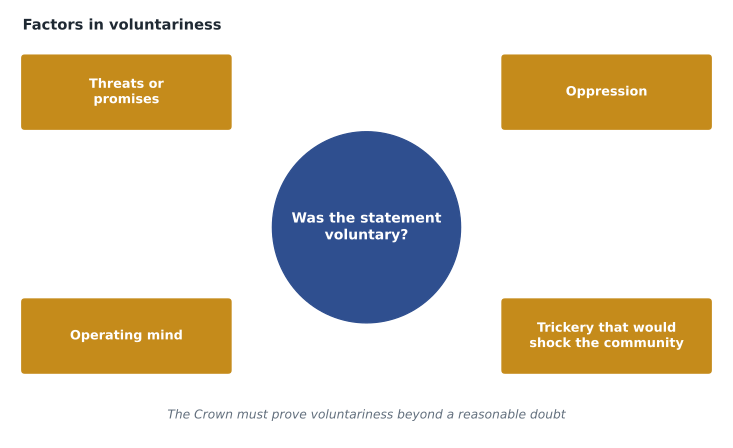
Separate from the Charter, the common law confessions rule requires the Crown to prove beyond a reasonable doubt that any statement an accused made to a person in authority was voluntary before it can be admitted. A person in authority is usually a police officer or anyone the accused reasonably believes can influence the prosecution. In R. v. Oickle in 2000, the Supreme Court set out the factors: threats or promises, especially an offer of leniency in exchange for a confession, which is a strong inducement; oppression, such as depriving the person of food, sleep, clothing, medical attention or access to counsel, or excessively aggressive questioning; the operating mind requirement, meaning the person understood what they were saying and that it could be used against them, as R. v. Whittle held in 1994; and police trickery so appalling that it would shock the community. The judge decides voluntariness in a hearing called a voir dire, held without the jury.
Why innocent people confess
Research into proven wrongful convictions has shown that false confessions are not rare curiosities. In a substantial share of convictions later overturned by DNA evidence, roughly one in four in widely cited counts by innocence organizations, the person had falsely confessed or made incriminating statements. Researchers have identified common patterns. Many false confessions follow long interrogations, often many hours. Many involve young people, people with intellectual disabilities or mental illness, and people who are exhausted, intoxicated or in crisis. Many follow interrogators' claims of overwhelming evidence combined with suggestions that confessing will lead to a better outcome. And many contain details that only the real perpetrator or the police could have known, which turn out to have been fed to the suspect, sometimes unintentionally, during questioning.
The traditional accusatory model of interrogation, associated with the Reid technique developed in the United States in the mid-twentieth century, begins from the assumption that the suspect is guilty and uses confrontation, minimization and maximization to overcome denials. Courts in Canada have criticized aspects of it, and in R. v. Oickle the Supreme Court discussed the risks of false confessions at length. Since the 1990s many services have moved toward investigative interviewing models such as PEACE, developed in England and Wales, which the class met in LES-104. PEACE treats the interview as a search for information rather than a confession, uses open questions, tests the suspect's account against the evidence, and avoids threats, promises and deception. Desjardins tells the class that the shift was driven as much by results as by law: information-gathering interviews produce more reliable statements and more useful leads.
| Accusatory approach | Information-gathering approach (PEACE) |
|---|---|
| Starts from presumed guilt | Starts from an open mind |
| Goal is a confession | Goal is accurate, reliable information |
| Confrontation and minimization | Open questions and active listening |
| Denials are overcome | Accounts are tested against the evidence |
| Higher risk of false confessions | Lower risk and better leads |
Undercover officers and statements to people not in authority
The confessions rule applies to persons in authority, so a statement to an undercover officer whom the suspect does not know is police is not covered. But section 7 still applies. In Hebert, the Court held that police violated the right to silence when they placed an undercover officer in the cell of a detainee who had refused to talk and the officer actively elicited a statement; passive listening would have been allowed. In R. v. Broyles in 1991, a friend who visited the accused in jail at police request and wore a recording device was treated as an agent of the state. Mr. Big operations, covered in Lesson 3, are governed by R. v. Hart: confessions obtained this way are presumptively inadmissible unless their probative value outweighs their prejudicial effect, and abusive conduct can amount to an abuse of process.
Spontaneous statements and recording
Not every statement comes from questioning. In the Lakeshore Hardware case, Kyle Brandt said in the cruiser, without being asked, 'That old lady's tools aren't even worth that much.' Spontaneous statements that police did not elicit do not breach the holding-off duty under section 10(b), but the Crown must still prove they were voluntary if they were made to a person in authority. The officer should record the exact words and the time immediately and should not follow up with questions, which would turn a volunteered remark into an interrogation.
Recording interviews has become standard practice. Canadian courts have increasingly expected custodial interviews of suspects in serious cases to be video recorded; in R. v. Moore-McFarlane in 2001, the Ontario Court of Appeal said that where recording facilities are readily available and the suspect is in custody, an unrecorded statement is suspect. Recording protects officers from false allegations, shows the court the tone and conditions of the interview, and preserves exactly what was said. Desjardins tells the class that he has never seen a recorded interview hurt an honest officer, and he has seen many unrecorded ones lose cases because no one could prove what happened in the room.
Statements and section 24(2)
When a statement is obtained in breach of the Charter, for example after a section 10(b) violation, the court decides admissibility under section 24(2), covered in Lesson 11. Statements are particularly vulnerable to exclusion, because they come from the accused and a breach that undermines the choice to speak goes to the heart of fair trial interests. A first statement obtained in breach can also taint later statements if they are closely connected, as the Supreme Court held in R. v. Wittwer in 2008, so officers cannot cure a breach simply by repeating the questions after proper advice.
Checking interview conditions
Port Ardent's major crime unit keeps a log of every custodial interview. Detective Ana Ferreira uses it to check the conditions that courts examine: whether the interview was recorded, how long it lasted and whether breaks were offered. The program flags interviews that need a supervisor's review.
# Port Ardent custodial interviews: (interview id, recorded, minutes, breaks offered)
interviews = [
    ("A-101", True, 75, 1), ("A-102", True, 140, 2), ("A-103", False, 50, 0),
    ("A-104", True, 410, 1), ("A-105", True, 95, 1), ("A-106", True, 260, 3),
    ("A-107", False, 180, 0), ("A-108", True, 35, 0),
]
flags = []
for iid, recorded, minutes, breaks in interviews:
    reasons = []
    if not recorded:
        reasons.append("not recorded")
    if minutes > 240:
        reasons.append("over four hours")
    if minutes > 120 and breaks == 0:
        reasons.append("long with no break")
    if reasons:
        flags.append((iid, reasons))
recorded_count = sum(1 for i in interviews if i[1])
print("recorded:", recorded_count, "of", len(interviews))
for iid, reasons in flags:
print(iid, "->", ", ".join(reasons))recorded: 6 of 8 A-103 -> not recorded A-104 -> over four hours A-106 -> over four hours A-107 -> not recorded, long with no break
Six of eight interviews were recorded. Four interviews are flagged: two that were not recorded, one of which also ran three hours with no break, and two that went past four hours, one of them nearly seven. Ferreira reviews each with the investigator. The long interviews are not automatically improper, she says, but they are exactly what defence counsel will examine, so the reasons for their length need to be documented.
Corroborating a confession
Because confessions can be false, good investigators treat them as the beginning of the work, not the end. A reliable confession usually contains details that only the true offender would know and that police had not revealed, sometimes called holdback information. Investigators should decide in advance which details to hold back from the media, witnesses and the suspect, record that decision, and avoid revealing those details during questioning. If the suspect then provides them, the confession gains real weight. If the suspect's account contains only details that were public or that the interviewer mentioned, the confession proves much less.
Desjardins describes the steps his unit followed after any confession in a serious case. They compared the account with the physical evidence, checked every verifiable claim, such as where the suspect said they bought a tool or what time they said they left, and looked for anything in the account that was wrong in a way the true offender would not get wrong. In one case, a man confessed to a break-in but described a back window that the house did not have. The confession was false, given by a frightened man who wanted the questioning to end, and the checks caught it before he was charged.
Jesse asks what happens when a confession and the other evidence conflict. Desjardins says the other evidence should win the investigation's attention: physical evidence, independent witnesses and records do not change under pressure. Officers who find a contradiction must record it and disclose it, because a confession that does not fit the facts is exactly the kind of evidence courts and juries need to weigh with care.
Worked problem
Is the cruiser remark admissible?
In the cruiser at 02:41, after being advised of his rights and asking for a lawyer, Brandt says, unprompted, 'That old lady's tools aren't even worth that much.' The probationary officer in the front seat responds, 'So you admit you took them?' Brandt says, 'I didn't say that.'
Show solution
- Separate the two statements: the first remark was volunteered; the second exchange followed a question.
- Assess the first remark: police did not elicit it, so there is no breach of the holding-off duty. The Crown must still prove it was voluntary, and there is no sign of threats, promises or oppression.
- Assess the question: 'So you admit you took them?' was an attempt to elicit evidence after Brandt asked for a lawyer, a breach of the holding-off duty. His answer, though not incriminating, is likely excluded.
- Record the exact words, times and who was present, and note that the officer's question was a mistake.
- Coach the officer: when a detained person who has asked for a lawyer volunteers something, write it down and say nothing.
Answer: The volunteered remark is likely admissible if proved voluntary. The follow-up question was improper, and the lesson for the officer is simple: record, do not respond.
Common mistakes
MistakeSilence shows that a suspect is hiding something.
InsteadSilence is a right, and innocent people exercise it often. Treating it as guilt invites tunnel vision.
MistakeA confession is the strongest evidence there is.
InsteadFalse confessions are a leading factor in proven wrongful convictions. Corroborate every confession with independent evidence.
MistakeTelling a suspect things will go easier if they confess is a harmless technique.
InsteadA promise of leniency is a strong inducement under Oickle and can make a confession involuntary.
MistakeA breach can be fixed by asking the same questions again after proper warnings.
InsteadLater statements can be tainted by an earlier breach (Wittwer).
Summary and key terms
- The right to silence is protected by the common law, sections 7, 11(c) and 13, and Singh limits persistent questioning.
- The confessions rule requires the Crown to prove voluntariness beyond a reasonable doubt, considering threats, promises, oppression, operating mind and shocking trickery.
- False confessions follow recognizable patterns: long interrogations, vulnerable suspects, claims of overwhelming evidence and fed details.
- Information-gathering interviews such as PEACE produce more reliable statements than accusatory methods.
- Undercover elicitation of detainees who have chosen silence breaches section 7; Mr. Big confessions are presumptively inadmissible.
- Volunteered statements should be recorded word for word, without follow-up questions, and interviews should be recorded.
- Person in authority
- Someone the accused reasonably believes can influence the prosecution, usually a police officer.
- Confessions rule
- The common law rule requiring the Crown to prove a statement to a person in authority was voluntary.
- Operating mind
- Enough awareness to understand what one is saying and that it may be used against one.
- Oppression
- Conditions such as deprivation of sleep or food or aggressive questioning that overbear the will.
- Voir dire
- A hearing within a trial, held without the jury, to decide admissibility.
- Mr. Big operation
- An undercover technique inviting a suspect into a fictitious criminal organization.
Practice problems
Work each problem on paper first, then reveal the answer to check.
What four factors did Oickle set out for voluntariness?
Show answer
Threats or promises, oppression, operating mind and police trickery that would shock the community.
Name three patterns found in false confessions.
Show answer
Long interrogations, vulnerable suspects such as youths or people with disabilities, and claims of overwhelming evidence with suggestions of leniency; also details fed to the suspect.
In Ferreira's log, which interviews were flagged and why?
Show answer
A-103 (not recorded), A-104 (over four hours), A-106 (over four hours) and A-107 (not recorded, long with no break).
What should an officer do when a detainee who has asked for a lawyer volunteers a remark?
Show answer
Record the exact words and time and say nothing that would draw out more.
Lesson quiz · 5 questions
Score 60% or more to complete this lesson.
Create a free account to save your progress, take quizzes and earn a certificate.