
LES-111 · Lesson 4 of 12 · 20 min
Search and seizure: section 8 and the reasonable expectation of privacy
▶ Video coming soon A video version of this lesson is on the way.
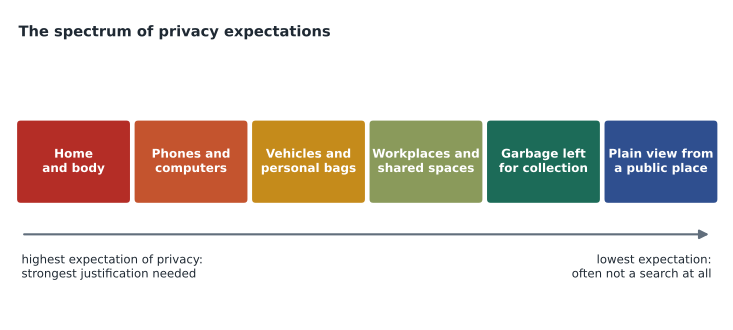
Desjardins starts Lesson 4 by asking the class to rank five places from most private to least private: a person's bedroom, a person's pockets, the inside of a parked car, a garbage bag left at the curb and a backyard visible from the street. The class mostly agrees on the order, and Desjardins tells them they have just done what judges do every day under section 8. The protection against unreasonable search and seizure does not protect places or things as such. It protects people's reasonable expectations of privacy, and those expectations are strongest in some places and weakest in others.
What counts as a search
A search, for Charter purposes, is any state intrusion on a reasonable expectation of privacy. In Hunter v. Southam in 1984, the first major Charter search case, the Supreme Court said that section 8 protects people, not places, and that its purpose is to protect individuals from unjustified state intrusions on their privacy. The Court has since identified three zones of privacy: personal privacy, meaning the body; territorial privacy, meaning places, with the home at the top; and informational privacy, meaning information about a person, especially information that reveals intimate details of their lifestyle and personal choices. If police conduct does not touch a reasonable expectation of privacy, it is not a search and section 8 is not engaged at all.
Courts decide whether an expectation of privacy is reasonable by looking at the totality of the circumstances. In R. v. Edwards in 1996, the Court listed factors including presence at the time of the search, possession or control of the place, ownership, historical use, the ability to regulate access, the person's subjective expectation and whether it was objectively reasonable. A person can have a reasonable expectation of privacy in a place they do not own; a houseguest can, for instance. And the question is normative, not just factual: it asks what privacy people ought to be able to expect in a free society, not merely what they can practically keep hidden.
When is a search reasonable? The Collins framework
In R. v. Collins in 1987, the Supreme Court said a search is reasonable if it is authorized by law, the law itself is reasonable, and the search is carried out in a reasonable manner. Hunter v. Southam had already established the default rule: where it is feasible, a search should be authorized in advance by a neutral judicial officer, on sworn evidence establishing reasonable and probable grounds to believe that an offence has been committed and that evidence will be found in the place to be searched. A warrantless search is presumed unreasonable, and the Crown must rebut the presumption by showing that the search fits a recognized power and was carried out reasonably.
Reasonable and probable grounds, sometimes called reasonable grounds to believe, require more than a suspicion. The officer must subjectively believe the grounds exist, and that belief must be objectively reasonable: a reasonable person standing in the officer's shoes would have reached the same conclusion. It is a standard of credibly based probability, not proof on a balance of probabilities and certainly not proof beyond a reasonable doubt. Lesser intrusions can sometimes be justified on reasonable suspicion, the lower standard covered in Lesson 6.
Warrants: the default
Warrants are the main way the Charter gives a neutral person a say before the state intrudes. Section 487 of the Criminal Code is the general search warrant provision, and there are others for specific purposes: telewarrants under section 487.1 when it is impracticable to appear in person, general warrants under section 487.01 for techniques not otherwise covered, production orders for records held by third parties, DNA warrants and tracking warrants. An application, called an information to obtain, must be full, fair and frank: it must include facts that weaken the case as well as those that support it. A judge reviewing a warrant later will ask whether, after removing anything misleading and adding anything left out, there was still enough to justify it.
Desjardins tells the class about the first warrant he drafted, rejected by a justice because it said only that a reliable informant had seen drugs in an apartment. The justice wanted to know how the informant knew, when they saw it, and why the officer believed them. In R. v. Debot in 1989, the Supreme Court set out the questions: was the information compelling, was the source credible, and was it corroborated by police investigation? Weaknesses in one area can be made up by strength in another, but an anonymous tip with no corroboration rarely justifies a warrant on its own.
Exceptions in brief
Searching without a warrant is lawful only when a recognized exception applies. The next course, LES-112, teaches the details of each power and how to use it; here the class learns the constitutional logic behind them. Search incident to a lawful arrest, confirmed in Cloutier v. Langlois in 1990 and R. v. Caslake in 1998, allows a search for safety, to prevent escape and to find evidence of the offence of arrest, but it must be truly connected to the arrest. Exigent circumstances, now codified in section 487.11 for many offences and recognized at common law, allow searches when getting a warrant is impracticable and evidence would be lost or someone harmed. Consent is valid only if it is voluntary and informed, including knowledge of the right to refuse, as R. v. Wills and later cases held. Plain view allows seizure of evidence an officer sees from a place they are lawfully entitled to be, when its nature is immediately apparent.
| Exception | Core idea | Key limit |
|---|---|---|
| Consent | The person waives the protection | Must be voluntary and informed, including knowing they can refuse |
| Incident to arrest | Safety, escape and evidence after a lawful arrest | Must be truly connected to the arrest |
| Exigent circumstances | No time for a warrant | Real urgency, not convenience |
| Plain view | Evidence seen from a lawful position | Nature must be immediately apparent |
| Vehicles | Lower privacy, but no general vehicle exception | Needs grounds or another power |
The body, the home and the manner of search
The manner of a search matters as much as the authority for it. In R. v. Golden in 2001, the Supreme Court held that strip searches are inherently humiliating and may be done incident to arrest only if there are reasonable grounds to believe they are necessary to find weapons or evidence related to the arrest, and normally at the station, by officers of the same gender, in private and with a record kept. In R. v. Stillman in 1997, the Court held that taking hair samples, dental impressions and buccal swabs by force was an unreasonable search. Entering a home is the most serious territorial intrusion; R. v. Feeney in 1997 held that police generally need a warrant to enter a home to make an arrest, and Parliament responded with Feeney warrants under section 529. Desjardins tells the class that a lawful search done badly, with property needlessly damaged, a person humiliated or a home ransacked, can still breach the Charter.
Do grounds make a difference? Port Ardent search outcomes
Sergeant Haddad pulls a year of Port Ardent search records to see how often searches found what officers were looking for. She separates searches where the officer recorded specific grounds before searching from searches based only on a general feeling or a vague consent request. The program compares the hit rates.
# Port Ardent searches over one year, grouped by what the officer recorded before searching
groups = {
    "warrant": {"searches": 64, "found": 49},
    "specific grounds recorded": {"searches": 212, "found": 98},
    "general consent request": {"searches": 318, "found": 41},
}
for name, g in groups.items():
    rate = g["found"] / g["searches"]
    print(f"{name:26s} {g['found']:3d} of {g['searches']:3d}  hit rate {rate:.2f}")

no_find = groups["general consent request"]["searches"] - groups["general consent request"]["found"]
print("people searched by general consent with nothing found:", no_find)warrant 49 of 64 hit rate 0.77 specific grounds recorded 98 of 212 hit rate 0.46 general consent request 41 of 318 hit rate 0.13 people searched by general consent with nothing found: 277
Searches backed by a warrant found evidence about three times in four, searches with specific recorded grounds a little under half the time, and general consent requests only about one time in eight. Haddad points to the last line: 277 people were searched by general consent and nothing was found. Each of those searches was an intrusion on someone who, as it turned out, had nothing to hide, and each was a chance to lose public trust. Grounds are not only a legal requirement; they are a sign of good police work.
Seizures of property
Section 8 protects against unreasonable seizures as well as searches. Taking a person's property, even briefly, is a seizure, and it needs legal authority just as a search does. Officers commonly seize items under a warrant, incident to arrest, in plain view or under section 489 of the Criminal Code, which allows seizure of things the officer believes on reasonable grounds were obtained by or used in an offence, or will afford evidence, when the officer is lawfully present executing duties. Seized property must then be reported to a justice under section 489.1, and the court supervises its detention under section 490. Failing to report a seizure is itself a breach of section 8, as Ontario courts have held.
Desjardins stresses that the paperwork after a seizure is part of its constitutional reasonableness. An officer who seizes a phone, a car or a bag of cash and then lets the item sit unrecorded in a locker has created a problem even if the seizure itself was lawful. Courts expect a clear record of what was taken, from whom, when, by whom, where it went and what authority allowed it to be kept. Priya, from her banking background, compares it to a chain of custody for financial records: the record is what lets anyone later trust that the evidence is what it claims to be.
Marco asks about property taken for safekeeping rather than as evidence, such as the belongings of a person taken to hospital. Desjardins says the same principles apply: take only what is necessary, record it carefully, and return it as soon as possible. Inventory searches of impounded vehicles and of property at booking are allowed when they follow a standard procedure, but they cannot be used as a pretext to look for evidence without grounds.
Worked problem
Can Malhotra look in the trunk?
Constable Malhotra stops a car for speeding. The driver is nervous and the car smells of air freshener. Malhotra has no information about any crime. He asks, 'You don't mind if I take a quick look in the trunk, do you?' The driver shrugs and says, 'I guess.'
Show solution
- Identify the action: looking in the trunk is a search of a place where the driver has a reasonable expectation of privacy, though lower than in a home.
- Look for authority: there is no warrant, no arrest and no exigency. The only possible basis is consent.
- Test the consent: under Canadian law consent must be voluntary and informed, which includes knowing the right to refuse and what the police are looking for. A shrug and 'I guess' after a question framed as 'you don't mind' is weak.
- Consider the grounds: nervousness and air freshener are common among innocent drivers and are not enough on their own for a search.
- Decide what good practice looks like: either do not search, or ask clearly, explain that the driver can refuse, record the exact words and the answer, and stop if consent is withdrawn.
Answer: On these facts the search is probably unreasonable under section 8. Clear, informed consent recorded in the officer's notes is the minimum, and a search without real grounds is rarely worth the cost to trust.
Common mistakes
MistakeIf something is on private property, police can never look at it without a warrant.
InsteadWhat anyone can see from a public place or a lawful vantage point is usually not a search; the question is the reasonable expectation of privacy.
MistakeNervousness justifies a search.
InsteadNervousness is common in innocent people during police contact; on its own it does not supply the grounds a search needs.
MistakeA warrant cures everything.
InsteadA warrant based on a misleading or incomplete information to obtain can be set aside, and a lawful warrant executed unreasonably can still breach section 8.
MistakeConsent is valid if the person does not object.
InsteadConsent must be voluntary and informed, including knowledge of the right to refuse; silence or a shrug is not enough.
Summary and key terms
- Section 8 protects reasonable expectations of privacy in three zones: personal, territorial and informational.
- Under Collins, a search must be authorized by law, under a reasonable law, and carried out reasonably.
- Hunter v. Southam makes prior judicial authorization on reasonable and probable grounds the default.
- Warrant applications must be full, fair and frank, including facts that weaken the case.
- Exceptions include consent, search incident to arrest, exigent circumstances and plain view, each with limits.
- The manner of a search, especially of the body and the home, must also be reasonable.
- Reasonable expectation of privacy
- The privacy a person can legitimately expect in a free society, judged from the totality of the circumstances.
- Reasonable and probable grounds
- A credibly based probability, subjectively believed and objectively reasonable.
- Information to obtain
- The sworn document used to apply for a search warrant.
- Search incident to arrest
- A search connected to a lawful arrest, for safety, escape or evidence.
- Exigent circumstances
- Urgent situations in which obtaining a warrant is impracticable.
- Plain view
- Seizing evidence seen from a lawful position when its nature is immediately apparent.
Practice problems
Work each problem on paper first, then reveal the answer to check.
Name the three zones of privacy recognized under section 8.
Show answer
Personal (the body), territorial (places, especially the home) and informational.
What three things make a search reasonable under Collins?
Show answer
It is authorized by law, the law is reasonable, and it is carried out reasonably.
In Haddad's data, how many general consent searches found nothing?
Show answer
318 minus 41, which is 277.
Why must a warrant application include facts that weaken the case?
Show answer
Because it must be full, fair and frank; a reviewing judge will remove misleading parts and add omitted facts and ask whether grounds remain.
Lesson quiz · 5 questions
Score 60% or more to complete this lesson.
Create a free account to save your progress, take quizzes and earn a certificate.