
LES-111 · Lesson 11 of 12 · 20 min
Exclusion of evidence: section 24(2) and the Grant test
▶ Video coming soon A video version of this lesson is on the way.
Prosecutor Margaret Liu returns for Lesson 11 with a single page from a judgment. It describes a traffic stop in which an officer, with no real grounds, searched a car and found a large quantity of drugs. The judge found the search unlawful but had to decide whether to admit the drugs anyway. Liu asks the class to vote before reading the ending. Most vote to admit: the drugs are real, the driver is guilty, and excluding them seems like letting the officer's mistake free a criminal. Liu then reads the judge's reasons for excluding them. The conversation that follows is the core of this lesson: why Canadian courts sometimes exclude reliable evidence, and how they decide when.
The purpose of section 24(2)
Section 24(2) says that where a court concludes that evidence was obtained in a manner that infringed or denied a Charter right, the evidence shall be excluded if it is established that, having regard to all the circumstances, admitting it would bring the administration of justice into disrepute. The focus is not on punishing police or compensating the accused. It is on the long-term repute of the justice system: whether a reasonable person, informed of all the circumstances and the values underlying the Charter, would think that admitting the evidence would undermine public confidence in the rule of law. The accused must show on a balance of probabilities that the evidence should be excluded.
Marco DiSanto asks why society should accept losing reliable evidence at all. Liu answers that both systems are responding to the same problem: without some consequence, constitutional rights become advice that officers can ignore whenever they think the result will be worth it. Canadian courts frame the consequence in terms of the integrity of the justice system, which is damaged when courts appear to condone serious breaches. Either way, the remedy exists because rights without remedies are not rights at all.
Obtained in a manner
Before the court weighs exclusion, it must decide whether the evidence was obtained in a manner that infringed the Charter. The Supreme Court has read this generously: a strict causal link is not required, and the connection can be temporal, contextual or causal, or a combination, as long as it is not too remote or tenuous. In R. v. Strachan in 1988, evidence found in a search was obtained in a manner that infringed section 10(b) because the breach and the search were part of the same transaction. In R. v. Tim in 2022, the Court confirmed that later evidence can be connected to an earlier breach in the same chain of events. Police cannot isolate a breach by pointing out that the evidence would have been found anyway; that argument is considered, if at all, when weighing the Grant factors.
The Grant test
In R. v. Grant in 2009, the Supreme Court set out three lines of inquiry. First, the seriousness of the Charter-infringing state conduct: courts look at where the conduct falls on a spectrum from minor or inadvertent violations to wilful, reckless or flagrant disregard of Charter rights. Good faith reduces seriousness, but negligence or ignorance of Charter standards is not good faith, and a pattern of abuse makes things worse. Second, the impact of the breach on the Charter-protected interests of the accused: a fleeting technical breach weighs less than a strip search, an unlawful entry into a home or a statement taken after counsel was denied. Third, society's interest in an adjudication on the merits: reliable, important evidence and a serious charge pull toward admission. The court then balances the three. In practice, when the first two lines both point strongly toward exclusion, the third rarely saves the evidence.
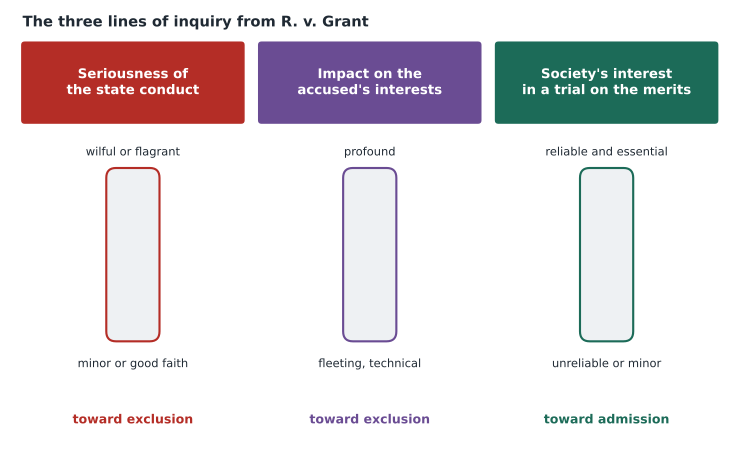
Several cases show the balance in action. In R. v. Harrison in 2009, decided with Grant, an officer stopped a car without grounds and then searched it, finding about 35 kilograms of cocaine; the Court excluded the drugs because the breaches were serious and the officer's testimony was misleading, and admitting the evidence would signal that courts tolerate such conduct when the stakes are high enough. In R. v. Le, the gun and drugs were excluded because the backyard entry was serious and affected a racialized community's trust. By contrast, evidence is often admitted where the officer made an honest, reasonable mistake in an unsettled area of law and the impact on the accused was modest.
| Question | Canada | United States |
|---|---|---|
| Main purpose of exclusion | Protecting the long-term repute of the justice system | Deterring police misconduct |
| Who bears the burden? | The accused, on a balance of probabilities | Usually the government, to show an exception |
| Is it automatic? | No; courts balance the Grant factors | Generally yes, unless an exception applies |
| Officer's good faith | Reduces seriousness; negligence is not good faith | Can admit evidence under Leon and its successors |
| Would have been found anyway? | Considered in weighing, not decisive | Admitted under inevitable discovery if shown |
What makes conduct serious
Liu walks the class through the kinds of police conduct that make exclusion most likely. Deliberate shortcuts, such as searching first and finding grounds later, are the most serious. Ignorance of well-established rules, such as not knowing that a phone search needs a warrant, comes next, because courts expect officers to know the Charter. A pattern of similar breaches, whether by one officer or across a service, makes each breach worse. And misleading testimony about what happened is especially damaging, because it attacks the court's ability to find the truth. On the other side, careful documentation, a genuine effort to comply, prompt correction of errors and candour in court all reduce seriousness, even when a mistake was made.
Desjardins adds that the attitude of the officer on the stand often decides how a judge sees the whole investigation. An officer who says, 'I made a mistake about the timing of the rights advice, here is what happened and why,' is believed on everything else. An officer who insists that nothing went wrong when the video shows otherwise can lose the evidence and their credibility in one afternoon. In Harrison, the trial judge found that the officer's testimony was misleading, and the Supreme Court treated that as aggravating.
Port Ardent applications to exclude
Liu has tracked every application to exclude evidence under section 24(2) in Port Ardent cases over three years, by the main issue raised. The program summarizes how often each kind of application succeeded.
# Port Ardent applications to exclude or suppress evidence over three years, by main issue
applications = {
    "search without grounds": (31, 14),
    "phone search": (9, 6),
    "right to counsel": (27, 12),
    "detention": (18, 5),
    "statement voluntariness": (12, 4),
}
total_apps = sum(a for a, _ in applications.values())
total_granted = sum(g for _, g in applications.values())
print("applications:", total_apps, "granted:", total_granted, "rate:", round(total_granted / total_apps, 2))
for issue, (apps, granted) in sorted(applications.items(), key=lambda kv: -kv[1][1] / kv[1][0]):
print(f"{issue:24s} {granted:2d} of {apps:2d} {granted / apps:.2f}")applications: 97 granted: 41 rate: 0.42 phone search 6 of 9 0.67 search without grounds 14 of 31 0.45 right to counsel 12 of 27 0.44 statement voluntariness 4 of 12 0.33 detention 5 of 18 0.28
About four applications in ten succeeded. Phone searches had the highest success rate, two in three, because the rule is clear and officers who search without a warrant have little excuse. Searches without grounds and right to counsel issues produced the largest numbers of exclusions. Liu tells the class that almost every one of those cases began with a step that an officer could have done differently in seconds: waiting for a warrant, writing down the grounds, or holding off on a question.
How an application to exclude unfolds
Students often imagine exclusion as a dramatic moment in the middle of a trial. In practice it is a structured process. The defence files a notice of application setting out the alleged breach and the evidence it wants excluded, usually weeks before trial. The judge hears the application in a voir dire, where the officers testify and are cross-examined about the grounds, the timing and what they did. The judge first decides whether a Charter right was breached, then whether the evidence was obtained in a manner that infringed it, and then applies the Grant analysis. The ruling may come before the trial begins or partway through.
For officers, the hearing is where the quality of their notes and reports matters most. The judge will compare the officer's testimony with the notes, the report, the dispatch records and any video, minute by minute. Inconsistencies that seem trivial, such as a time that differs by a few minutes or a detail added in the report that is not in the notes, can lead a judge to doubt the officer's whole account. Desjardins tells the class that the best preparation for a suppression hearing begins on the night of the arrest, with notes that are complete, specific and written at the time.
Exclusion and civil liability are separate questions
An officer's conduct can be judged in more than one forum, and the outcomes do not always match. Evidence may be admitted under section 24(2) even though a breach occurred, and the person may still sue for damages under section 24(1) or in tort, or file a complaint that leads to discipline. Equally, evidence may be excluded while the officer is found to have acted honestly and faces no other consequence. Marco asks which consequence officers should worry about most. Desjardins says the question misses the point: officers who follow the rules carefully rarely face any of them, and the habits that protect evidence are the same ones that protect officers from complaints and lawsuits.
Desjardins closes the section with a reminder about candour. When an officer realizes that a mistake was made, the right response is to tell the prosecutor at once, so that the prosecution can decide how to handle it and disclose it properly. Prosecutors can often work around a disclosed mistake. What they cannot work around is a mistake that surfaces for the first time during cross-examination, because by then the issue is no longer only the mistake but the officer's honesty about it.
Liu finishes with a piece of advice from her own experience. When she prepares officers for a hearing, she asks them to walk her through the night in their own words before they look at their notes, then compares the account with the notes. The gaps tell her where an officer's memory has filled in details since the night, which is natural and human but dangerous on the stand. Officers who know the difference between what they remember and what they wrote can say so clearly in court, and judges trust them for it. Officers who blur the two often find that a single confident detail, contradicted by the video, undoes an otherwise lawful investigation.
Worked problem
Would the Lakeshore Hardware statement survive?
In Lesson 7, a detective asked Brandt at the station, 'Kyle, just between us, where are the other drill and the impact drivers?' while he was waiting for his lawyer's call. Brandt answered, 'I sold them already,' and police later found two impact drivers at a pawn shop because of that answer.
Show solution
- Identify the breach: the question violated the holding-off duty under section 10(b).
- Ask whether the pawn shop evidence was obtained in a manner that infringed the Charter: it was found because of the statement, a direct causal link.
- Weigh seriousness: asking a direct question after a request for counsel is a clear departure from well-established rules, not a good faith mistake.
- Weigh impact: the breach undermined Brandt's choice whether to speak, a serious impact on a core protected interest.
- Weigh society's interest: the tools are reliable evidence, but the case against Brandt is strong without them.
Answer: Both the statement and probably the pawn shop evidence would be excluded. One improper question would cost the prosecution two pieces of evidence it did not need to lose.
Common mistakes
MistakeEvidence obtained in breach of the Charter is always excluded.
InsteadCourts balance the Grant factors; some evidence is admitted despite a breach.
MistakeGood intentions mean evidence will be admitted.
InsteadNegligence or ignorance of Charter standards is not good faith; only reasonable, honest conduct reduces seriousness.
MistakeA strong case will survive any breach.
InsteadSerious breaches with a significant impact can lead to exclusion even of reliable evidence of serious crimes.
MistakeMinimizing a mistake on the stand protects the case.
InsteadMisleading testimony aggravates the breach and destroys credibility; candour about errors reduces their seriousness.
Summary and key terms
- Section 24(2) excludes evidence when admitting it would bring the administration of justice into disrepute, judged over the long term.
- Obtained in a manner is read generously: temporal, contextual or causal connections count.
- Grant asks about the seriousness of the conduct, the impact on the accused and society's interest in a trial on the merits.
- Harrison and Le show serious breaches leading to exclusion despite reliable evidence.
- Deliberate shortcuts, ignorance of clear rules, patterns and misleading testimony make exclusion more likely.
- Careful documentation and candour about mistakes protect both the evidence and the officer's credibility.
- Section 24(2)
- The Charter provision requiring exclusion of evidence whose admission would bring the administration of justice into disrepute.
- Grant test
- The three lines of inquiry used to decide exclusion under section 24(2).
- Seriousness of the state conduct
- Where the breach falls between inadvertent and wilful or flagrant.
- Impact on protected interests
- How much the breach actually undermined the accused's privacy, liberty or choice.
- Good faith
- Honest and reasonable conduct; negligence or ignorance of Charter standards does not qualify.
- Obtained in a manner
- The connection, temporal, contextual or causal, between a breach and the evidence.
Practice problems
Work each problem on paper first, then reveal the answer to check.
What are the three lines of inquiry in Grant?
Show answer
Seriousness of the Charter-infringing state conduct, impact on the accused's protected interests, and society's interest in adjudication on the merits.
Why was the cocaine excluded in Harrison?
Show answer
The stop and search were serious breaches, the officer's testimony was misleading, and admitting the drugs would suggest courts tolerate such conduct.
In Liu's data, what share of applications succeeded overall?
Show answer
41 of 97, about 0.42.
Which kind of application succeeded most often in Port Ardent, and why?
Show answer
Phone searches, 6 of 9, because the rule is clear and searching without a warrant leaves little excuse.
Lesson quiz · 5 questions
Score 60% or more to complete this lesson.
Create a free account to save your progress, take quizzes and earn a certificate.