
LES-111 · Lesson 9 of 12 · 19 min
Trial rights and police duties: the Sixth and Eighth Amendments
▶ Video coming soon A video version of this lesson is on the way.
Most police work happens long before trial, so Marco DiSanto asks why a policing course spends a lesson on trial rights. Desjardins answers with a case from Port Ardent a few years earlier: a sexual assault charge stayed because the case took too long to reach trial. The delay was not caused by the court or the lawyers. It began with a police file that took months to complete, a forensic report that sat unrequested, and video that was disclosed in pieces. The accused walked free without a trial and the complainant never had her day in court. The Sixth Amendment, he tells the class, belongs to the accused, but police decide much of whether it can be honored.
The rights of the accused: the Sixth Amendment
The Sixth Amendment gives the accused in all criminal prosecutions the right to a speedy and public trial by an impartial jury of the state and district where the crime was committed, to be informed of the nature and cause of the accusation, to be confronted with the witnesses against them, to have compulsory process for obtaining favorable witnesses, and to have the assistance of counsel. The right to counsel at trial was applied to the states in Gideon v. Wainwright in 1963. Several of these rights depend directly on police work, especially the speedy trial right and the confrontation right.
Trial within a reasonable time
The federal speedy trial right is assessed with the four factors from Barker v. Wingo in 1972: the length of the delay, the reason for it, whether the defendant asserted the right, and prejudice to the defendant. The remedy for a violation is dismissal of the charges. States also have speedy trial statutes that are usually stricter. In Ohio, Revised Code 2945.71 requires that a person charged with a felony be brought to trial within 270 days of arrest, and each day spent in jail on the pending charge counts as three days, so a defendant held in custody must normally be tried within 90 days. Time is extended or tolled for reasons listed in 2945.72, such as defense motions and continuances.
Police contribute to delay in predictable ways: slow completion of the initial file, late requests for forensic analysis, video retrieved weeks after the event, notes and reports not transcribed, and disclosure delivered in installments. Each week of police delay comes off the time available for everyone else. Desjardins tells the class that in his last years, his platoon treated disclosure like evidence: it had a deadline, a checklist and a person responsible.
# Ohio speedy trial check (felony limit 270 days; each jail day counts as 3)
LIMIT = 270
cases = [
    # (case, days on bond, days in jail on this charge, tolled days)
    ("C-1", 200, 0, 15), ("C-2", 150, 40, 30), ("C-3", 60, 75, 10), ("C-4", 230, 0, 0),
]
for name, bond, jail, tolled in cases:
    counted = bond + 3 * jail - tolled
    status = "over limit" if counted > LIMIT else "within limit"
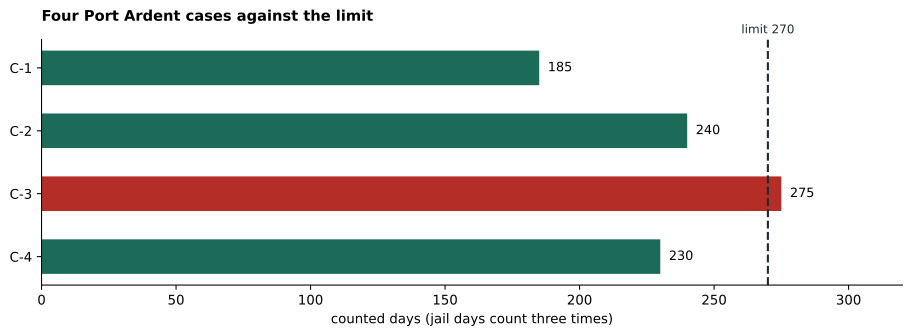
print(f"{name}: counted {counted:3d} of {LIMIT} -> {status}")C-1: counted 185 of 270 -> within limit C-2: counted 240 of 270 -> within limit C-3: counted 275 of 270 -> over limit C-4: counted 230 of 270 -> within limit
One of the four cases is over the 270-day count. Case C-3 shows why jail time matters: only 135 calendar days have passed, but 75 of them were in jail and count three times. Case C-2 is close at 240. Prosecutor Liu tells the class that in C-3 the delay came mostly from a lab request police made weeks after the arrest.
Bail, release and the Eighth Amendment
The Eighth Amendment forbids excessive bail. In Stack v. Boyle in 1951, the Supreme Court held that bail set higher than an amount reasonably calculated to ensure the defendant's appearance is excessive. In United States v. Salerno in 1987, it upheld the federal Bail Reform Act's provisions allowing pretrial detention of dangerous defendants after a hearing. States set their own bail systems, and many have reformed cash bail. In Ohio, voters approved an amendment to Article I, Section 9 of the state constitution in 2023 requiring courts to consider public safety, the seriousness of the offense and the defendant's criminal record when setting bail. Police influence release through citation in lieu of arrest, the information they give the court and how quickly they process people.
Linh Tran asks why police should care about conditions of release once a person leaves the station. Desjardins gives two reasons. First, the conditions officers recommend or impose often decide whether a person keeps a job and housing while presumed innocent. Second, officers enforce those conditions, and unnecessary conditions generate breach charges that consume police time without making anyone safer. Fair, minimal conditions are both a constitutional value and good policing.
Cruel and unusual punishment and conditions of custody
The Eighth Amendment's ban on cruel and unusual punishment applies to people convicted of crimes. For people held before trial, the Due Process Clause of the Fourteenth Amendment protects against conditions that amount to punishment, and in Kingsley v. Hendrickson in 2015 the Supreme Court held that a pretrial detainee claiming excessive force need show only that the force was objectively unreasonable. Officers who are deliberately indifferent to a detainee's serious medical needs can also be liable. State standards for jails, including Ohio's minimum jail standards, set requirements for cell checks, medical screening and the care of intoxicated and vulnerable prisoners.
Desjardins tells the class that the most dangerous hours for a prisoner are often the first few in a police cell: people arrive intoxicated, injured, in mental health crisis or withdrawing from drugs, and they cannot always tell anyone. Regular, real cell checks, which means looking for breathing and responsiveness rather than glancing through a window, and a low threshold for calling paramedics are basic duties. The Constitution sets the floor; the coroner's reports and inquests set the practice.
Confrontation: why police reports and statements matter at trial
The Confrontation Clause gives the accused the right to cross-examine witnesses. In Crawford v. Washington in 2004, the Supreme Court held that testimonial statements by a witness who does not testify at trial are inadmissible unless the witness is unavailable and the defendant had a prior opportunity to cross-examine. In Davis v. Washington in 2006, it held that statements to police during an ongoing emergency, such as a 911 call describing an assault in progress, are generally not testimonial, while statements describing past events for a later prosecution are. In Melendez-Diaz in 2009 and Smith v. Arizona in 2024, it applied the clause to forensic reports. For police, this means that statements taken to build a case often require the witness to testify, so officers should record contact information and keep witnesses engaged, and that 911 recordings and the officer's description of the emergency at the scene matter a great deal.
Marco adds that interpreters matter here too. Title VI of the Civil Rights Act of 1964 requires agencies that receive federal funds to provide meaningful access for people with limited English, and an interview through an untrained family member, especially a child, is both unreliable and easy to attack at trial. Qualified interpreters, often available by phone within minutes, are the standard.
The presumption of innocence in everyday policing
The presumption of innocence is usually discussed as a trial rule, but it shapes police conduct long before trial. It means the accused does not have to prove anything, and it explains why officers must avoid statements and actions that treat a person charged as guilty. Public comments, such as a news release describing an arrested person as the person who committed the crime, can affect potential jurors and witnesses. Perp walks staged for cameras, mugshots shared on social media and descriptions that go beyond the facts all sit uneasily with the presumption. Many agencies have limited the release of booking photos, and Ohio, like many states, restricts the release of records about juveniles. Prosecutors and police are also bound by ethics rules and court orders that limit statements likely to prejudice a trial.
Desjardins gives the class a simple rule for public communications: describe what was done and what the person is accused of, use the word alleged, and never describe the strength of the evidence or the person's character. He shows two versions of a news release about the Lakeshore Hardware arrest. One says that police caught the burglar red-handed with the stolen tools. The other says that a 23-year-old man has been charged with breaking and entering and theft, that the allegations have not been tested in court, and that the investigation continues. Only the second is appropriate, and only the second is accurate: at that stage, the man is accused, not proven guilty.
Police witnesses at trial
Every trial right eventually depends on the quality of the officer's evidence in court. The accused has the right to a fair hearing, which includes the right to test the evidence against them through cross-examination. Officers prepare by reviewing their notes, reports and recordings, by meeting with the prosecutor, and by being honest about what they remember independently and what they know only from their notes. Officers may refresh their memory from their notes, and the defense is generally entitled to see anything used to refresh memory. The class practiced testifying in LES-104, and Desjardins reminds them that a fair trial is as much an officer's responsibility as the prosecutor's or the judge's: accurate, candid testimony is part of honoring the accused person's rights.
Linh asks what an officer should do if, while preparing, they realize their notes contain an error. Desjardins says to tell the prosecutor immediately, correct the record through the proper procedure, and explain the error candidly in court. Errors disclosed early are rarely fatal; errors discovered by the defense during cross-examination often are, and they can damage the officer's credibility in every case that follows.
Prosecutor Liu adds one more trial right that depends on police: the accused's ability to call witnesses in their own defense. When officers canvass a scene, they sometimes record only the witnesses who support the investigation's theory. Liu tells the class that every person spoken to belongs in the notes, with contact details, because a witness who saw something different may be the one the defense needs, and a fair trial requires that the defense be able to find them. Officers who record only helpful witnesses risk both a disclosure problem and an unfair trial. She also reminds them to tell witnesses that they may be contacted by either side, and that they are free to speak to the defense if they choose.
Worked problem
Delay in a fraud file
Priya Sandhu's capstone case from LES-104, a gift-card phone scam, results in charges against two people. The investigating officer needs bank records from three institutions and a forensic examination of a seized phone. The officer plans to request the bank records after finishing two other files, about three months from now.
Show solution
- Identify the clock: the speedy trial clock started when the charges were laid, not when the officer starts working on the records.
- Calculate the risk: three months is about 90 days of a 270-day limit, a third of the time, and three times that if either accused is held in jail.
- Prioritize: request the production orders or subpoenas and the phone examination immediately, because outside agencies take time.
- Disclose in an organized way: deliver what is ready with an index and a schedule for the rest, rather than holding everything until the end.
- Record the dates of every request and response, so delay can be explained if challenged.
Answer: Delay at the start of a file is the most dangerous kind, because it cannot be made up later. Treat requests for outside records as urgent.
Common mistakes
MistakeTrial delay is the court's problem, not the police's.
InsteadPolice delay counts toward speedy trial limits, and in Ohio jail days count triple.
MistakeStricter release conditions are always safer.
InsteadBail must be reasonably calculated to ensure appearance and safety; excessive conditions harm people presumed innocent and burden police.
MistakeA quick look through the cell window is a cell check.
InsteadA real check confirms breathing and responsiveness; many deaths in custody followed checks that did not.
MistakeA family member can translate in an interview.
InsteadUse a qualified interpreter and record their involvement; family members, especially children, are unreliable and easily challenged.
Summary and key terms
- The Sixth Amendment gives the accused speedy trial, notice, confrontation, compulsory process and counsel rights.
- Speedy trial claims use the Barker factors; Ohio requires felony trial within 270 days, with jail days counting triple.
- Bail must not be excessive; Salerno allows preventive detention after a hearing, and Ohio's 2023 amendment adds public safety factors.
- Pretrial detainees are protected from objectively unreasonable force and deliberate indifference to medical needs.
- Crawford and Davis make testimonial statements depend on live witnesses and distinguish 911 emergency calls.
- Prompt files, prompt disclosure, careful custody and qualified interpreters are how police honor trial rights.
- Barker factors
- Length of delay, reason, assertion of the right and prejudice, used to judge speedy trial claims.
- Triple count
- The Ohio rule counting each day in jail on a pending charge as three days.
- Excessive bail
- Bail set higher than reasonably needed to ensure appearance, forbidden by the Eighth Amendment.
- Testimonial statement
- A statement made primarily to establish past facts for prosecution, subject to the Confrontation Clause.
- Ongoing emergency
- A situation, such as a 911 call during an assault, in which statements are generally not testimonial.
- Deliberate indifference
- Knowing disregard of a serious risk, such as a detainee's medical needs.
Practice problems
Work each problem on paper first, then reveal the answer to check.
How does Ohio count jail days for speedy trial purposes?
Show answer
Each day in jail on the pending charge counts as three days toward the 270-day felony limit.
In the code example, why is case C-3 over the limit despite only 135 calendar days?
Show answer
Its 75 jail days count three times: 60 + 225 - 10 = 275.
Why should officers avoid unnecessary release conditions?
Show answer
They harm people presumed innocent, set them up to fail and generate breach charges without improving safety.
What does a real cell check involve?
Show answer
Confirming that the prisoner is breathing and responsive, not just glancing through the window.
Lesson quiz · 5 questions
Score 60% or more to complete this lesson.
Create a free account to save your progress, take quizzes and earn a certificate.