
LES-111 · Lesson 2 of 12 · 20 min
How Charter rights work: application, reasonable limits and remedies
▶ Video coming soon A video version of this lesson is on the way.
In the second week, Desjardins hands each student a card with a short scenario. A mall security guard searches a teenager's bag. A city bylaw officer enters a backyard to inspect a fence. A police officer at a sobriety checkpoint stops every car. A private citizen grabs a shoplifter. He asks the class to sort the cards into two piles: situations where the Charter applies and situations where it does not. The sorting turns out to be harder than anyone expects, and the discussion that follows covers the three questions every constitutional case turns on. Does the Charter apply at all? Was a right actually infringed? And if so, what happens next?
Who the Charter binds: section 32
Section 32 says the Charter applies to Parliament and the government of Canada and to the legislature and government of each province. In practice that means it binds every government actor: police officers, bylaw officers, border officers, correctional staff, public school officials in many situations, and anyone exercising a statutory power on the government's behalf. It does not, as a rule, bind private individuals or private businesses. A mall security guard who searches a teenager is generally not bound by section 8, although the guard is bound by the Criminal Code, by provincial security licensing law and by the law of trespass and assault. Courts have held, however, that when a private person acts as an agent of the police, for example a store employee who searches at an officer's request, the Charter can apply.
Linh Tran asks about the citizen who grabs a shoplifter. Desjardins explains that a private arrest is governed by section 494 of the Criminal Code, which allows anyone to arrest a person found committing an indictable offence, and allows property owners to arrest a person found committing a criminal offence on or in relation to their property, as long as they deliver the person to police forthwith, and that misuse of that power can lead to criminal charges or lawsuits. But the Charter itself is not usually the source of the limit. Once police take custody, everything changes: from that moment the full set of constitutional rights applies.
| Scenario | Does the Charter apply? | Why |
|---|---|---|
| Mall security guard searches a bag on their own initiative | Generally no | A private actor; other law still applies |
| Store employee searches a bag because an officer asked | Likely yes | Acting as an agent of the police |
| Bylaw officer enters a yard to inspect a fence | Yes | A government actor using a statutory power |
| Officer stops every car at a checkpoint | Yes | A seizure of each driver by the state |
| Citizen holds a shoplifter until police arrive | Generally no | Private arrest law applies instead |
Was a right infringed?
The second question is whether the conduct actually limited a protected right. Not every police action engages the Charter. A conversation with a person who is free to walk away is usually not a detention. Looking at something in plain view from a public place is usually not a search, because there is no reasonable expectation of privacy in what anyone could see. A request that a person is truly free to refuse is not compulsion. The person claiming a breach generally bears the burden of proving it on a balance of probabilities, although when police search without a warrant, the Crown must show the search was reasonable.
Desjardins stresses that the line between engaging a right and not engaging it is often the most important line in a case. A conversation that turns into a detention, a look that turns into a search, a request that turns into a demand: each transition triggers new rights and new duties. Officers who are clear in their own minds about which side of the line they are on, and who make that clear to the person, avoid most of the problems that fill the prosecutor's return files from Lesson 1.
Reasonable limits: section 1 and the Oakes test
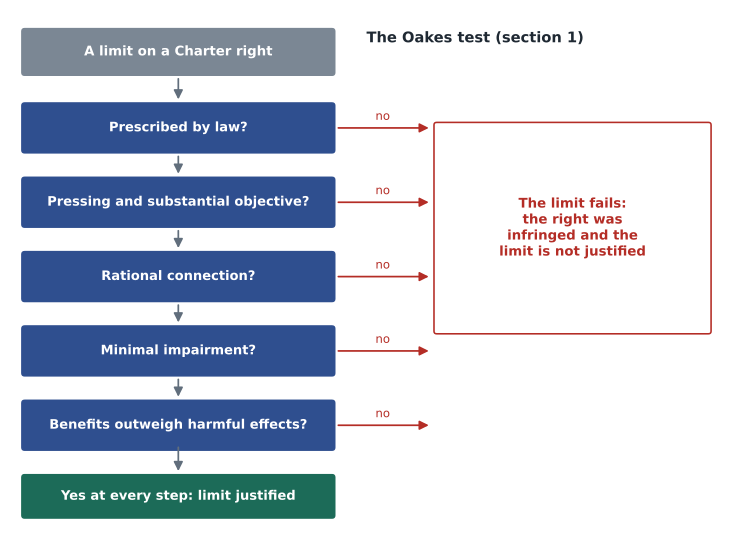
Charter rights are not absolute. Section 1 guarantees them subject only to such reasonable limits prescribed by law as can be demonstrably justified in a free and democratic society. When a law or government practice limits a right, the government can try to justify it under section 1. The Supreme Court set out the test in R. v. Oakes in 1986. First, the limit must be prescribed by law, meaning it comes from a statute, regulation or common law rule rather than an officer's discretion alone. Then the government must show a pressing and substantial objective, and that the means are proportionate: rationally connected to the objective, impairing the right as little as reasonably possible, and with benefits that outweigh the harmful effects.
Section 1 rarely saves an individual officer's conduct, because an officer's on-the-spot choice is not prescribed by law. It matters most when a court asks whether a police power itself is constitutional. Random traffic stops are the classic example. In R. v. Ladouceur in 1990, the Supreme Court held that random stops under Ontario's Highway Traffic Act were arbitrary detentions under section 9, but that they were justified under section 1 because of the importance of road safety. That ruling is now under challenge: in the Luamba case from Quebec, the trial court found in 2022 that random stops lead to racial profiling and struck down the power in that province, the Quebec Court of Appeal largely agreed in 2024, and the Supreme Court of Canada heard the appeal in January 2026. Officers should check the current state of the law before relying on random-stop powers.
Where the Charter came from in criminal procedure
Before 1982, Canadian courts rarely excluded evidence because of how police obtained it. The leading case, R. v. Wray in 1970, said relevant evidence was admissible however it was found, unless it was a confession that was not voluntary. Section 24(2) of the Charter reversed that approach. It tells courts to exclude evidence obtained in a manner that infringed a Charter right if admitting it would bring the administration of justice into disrepute. Within a few years, cases such as Hunter v. Southam in 1984 on searches, R. v. Therens in 1985 on detention and counsel, and R. v. Collins in 1987 on exclusion had reshaped police procedure. Desjardins, who started policing in the late 1980s, remembers training days devoted to these decisions.
What happens after a breach: an overview of remedies
Section 24(1) lets a person whose rights were infringed apply to a court for such remedy as the court considers appropriate and just. Remedies include a stay of proceedings in the most serious cases, a reduction in sentence, costs and, in civil actions, damages; in Vancouver v. Ward in 2010, the Supreme Court confirmed that damages can be awarded for a Charter breach, in that case an unjustified strip search. Section 24(2) deals specifically with evidence and requires exclusion when admitting it would bring the administration of justice into disrepute. Section 52 is used when the problem lies in a law itself. Officers can also face discipline under the Community Safety and Policing Act, complaints to the Law Enforcement Complaints Agency, investigation by the Special Investigations Unit where someone is seriously injured, and criminal prosecution in rare cases.
Desjardins draws a lesson from the list. The remedy most likely to touch an officer's daily work is losing evidence. But the consequence that lasts longest is often a finding of credibility: a judge who writes that an officer's account of a search was not believable has damaged that officer's ability to testify for years. Under the McNeil disclosure regime, findings of serious misconduct can follow an officer into future cases. Constitutional compliance and personal credibility turn out to be the same thing.
The notwithstanding clause
Section 33 allows Parliament or a provincial legislature to declare that a law operates notwithstanding sections 2 or 7 to 15 of the Charter, for renewable five-year periods. It has never been used by Parliament and has been used mainly by Quebec, Saskatchewan and Ontario for non-policing matters such as language and labour laws. It cannot be used for sections 3 to 6 (democratic and mobility rights) or section 24, and it is a political choice by a legislature, never a tool for an individual officer. Desjardins mentions it only so that students understand that the override exists and is rare and controversial.
Tracking how often grounds are articulated
Sergeant Lisa Haddad, who supervises the Port Ardent night shift, audits a sample of incident reports every month. One measure she tracks is whether the officer wrote down the legal basis for each detention and search. The program below compares two months, before and after a refresher on articulating grounds, and calculates the change.
# Port Ardent night shift: reports that stated the legal basis for each detention and search
months = {
    "before refresher": {"reports": 84, "basis_stated": 55},
    "after refresher": {"reports": 91, "basis_stated": 79},
}
rates = {}
for month, m in months.items():
    rates[month] = m["basis_stated"] / m["reports"]
    print(f"{month:17s} {m['basis_stated']:3d} of {m['reports']:3d}  rate {rates[month]:.3f}")

change = rates["after refresher"] - rates["before refresher"]
print("change in rate:", round(change, 3))
missing = sum(m["reports"] - m["basis_stated"] for m in months.values())
print("reports still missing a stated basis:", missing)before refresher 55 of 84 rate 0.655 after refresher 79 of 91 rate 0.868 change in rate: 0.213 reports still missing a stated basis: 41
The rate rises from about 0.65 to about 0.87 after the refresher, but 41 reports across the two months still did not state the legal basis. Haddad tells the class that every one of those reports is a potential problem at trial, because the officer will have to reconstruct the grounds from memory months later.
Rights in a federal system
Canada's division of powers adds a layer that students sometimes overlook. Criminal law and criminal procedure belong to Parliament under section 91(27) of the Constitution Act, 1867, while the provinces control the administration of justice, highways, liquor and most policing under section 92. That is why the Criminal Code applies everywhere but highway traffic acts, police services acts and provincial offences differ from province to province. An officer enforcing a provincial statute is just as bound by the Charter as one enforcing the Criminal Code, and a provincial law that gives police a power must itself be consistent with the Charter.
Desjardins gives an example from his own career. His service once adopted a practice that the courts in another province had approved, only to learn that their own appellate court had taken a stricter view. The lesson, he says, is that officers should learn the rules from their own jurisdiction's training and legal advisors, not from television, other jurisdictions' news stories or what a colleague saw on a course somewhere else. The Charter sets common principles, but how they apply in detail can vary with local statutes and decisions, and an officer is judged by the law where they work.
Priya Sandhu asks how officers keep up with all of this. Desjardins describes the system in Port Ardent: the service's legal advisor sends a short bulletin whenever an important decision comes down, sergeants discuss it at the start of each shift for a week, and the annual requalification day includes a session on the year's leading cases. He tells the class that the officers who read the bulletins are rarely the ones whose files come back from the prosecutor with constitutional concerns.
Worked problem
Is the store employee bound?
A Lakeshore Hardware clerk suspects a customer of pocketing a box of screws. The clerk calls 9-1-1. While waiting, the clerk asks the customer to open their jacket, and the customer does. When Constable Malhotra arrives, he tells the clerk, 'Go ahead and check their pockets too while I watch.' The clerk does and finds a second box.
Show solution
- Ask whether the Charter applies to the first search. The clerk acted on their own initiative before police arrived, so section 8 likely does not apply, though other law governs the clerk.
- Ask whether the second search is different. The clerk searched because the officer asked and watched. The clerk was acting as an agent of the police.
- Apply section 8: a search by a state agent without a warrant must be authorized by law and reasonable. Malhotra had not arrested the customer, so search incident to arrest did not apply.
- Decide what Malhotra should have done: assess the clerk's information, decide whether there were grounds to arrest, and if so arrest and search himself, explaining the reason.
Answer: The first search is likely outside the Charter; the second is probably a Charter search done without authority. Officers cannot get around the Charter by asking a private person to do what they could not do themselves.
Common mistakes
MistakeThe Charter binds everyone, including private businesses.
InsteadSection 32 limits the Charter to government actors. Private security is governed by other law, unless acting as an agent of the police.
MistakeSection 1 can justify an officer's decision on the spot.
InsteadSection 1 requires a limit prescribed by law; an officer's individual discretion is rarely enough.
MistakeLosing evidence is the only consequence of a breach.
InsteadRemedies include stays, damages, discipline and lasting findings about an officer's credibility.
Summary and key terms
- Section 32 means the Charter binds government actors, including police and private persons acting as their agents.
- The person claiming a breach usually has to prove it, but warrantless searches put the burden on the government.
- Section 1 and the Oakes test allow reasonable limits prescribed by law; random traffic stops were upheld this way in 1990 and are now being challenged.
- Section 24 provides remedies, including exclusion of evidence under section 24(2); section 52 deals with unconstitutional laws.
- Section 33, the notwithstanding clause, is a rare legislative override, never an officer's tool.
- Stating the legal basis for each step in notes and reports is the best protection for a case and for an officer's credibility.
- Section 32
- The provision making the Charter apply to Parliament, the legislatures and governments.
- Agent of the state
- A private person who acts at the direction or request of police, to whom the Charter can apply.
- Oakes test
- The test for justifying a limit on a Charter right under section 1.
- Prescribed by law
- A limit set out in a statute, regulation or common law rule, as section 1 requires.
- Section 24(1)
- The general remedy power for Charter breaches.
- Notwithstanding clause
- Section 33, which lets legislatures override certain Charter rights for five years.
Practice problems
Work each problem on paper first, then reveal the answer to check.
Does section 8 apply to a mall guard who searches a bag on their own initiative?
Show answer
Generally no, because the guard is a private actor, but other law applies, and the answer changes if the guard acts at police request.
Name the steps of the Oakes test.
Show answer
Prescribed by law, pressing and substantial objective, rational connection, minimal impairment and proportionate effects.
Haddad's audit found 55 of 84 and 79 of 91 reports stated the legal basis. How many reports in total lacked it?
Show answer
29 + 12 = 41 reports.
Why can a credibility finding be worse for an officer than losing evidence in one case?
Show answer
Because it can follow the officer into future cases through disclosure obligations and damage their ability to testify.
Lesson quiz · 5 questions
Score 60% or more to complete this lesson.
Create a free account to save your progress, take quizzes and earn a certificate.