
LES-111 · Lesson 1 of 12 · 21 min
Constitutional rights and policing: the Charter and the rule of law
▶ Video coming soon A video version of this lesson is on the way.
Professor Ray Desjardins begins the winter term by holding up two things: a pocket copy of the Canadian Charter of Rights and Freedoms and his old duty notebook. One of them, he tells the class, is the most important tool an officer carries, and it is not the notebook. Every power the class studied in the fall, from detaining a suspect to searching a car to taking a statement, exists inside the limits set by that small booklet. An officer who knows the criminal law but not the Charter can build a perfect case and watch it collapse in court, because the evidence was gathered in a way the Charter forbids. Worse, the officer can harm a person whose rights the officer swore to protect.
Amara Okafor asks whether the Charter is mostly a problem for prosecutors. Desjardins shakes his head. Judges apply it after the fact, he says, but officers apply it first, in the street, in seconds, without a lawyer at their elbow. That is why this course treats constitutional law as a practical skill: knowing the rule, knowing the reason behind it, and being able to explain on the witness stand exactly why each step was lawful.
The rule of law
The idea that sits beneath every lesson in this course is the rule of law: the principle that everyone, including the government and the police, is subject to the law, and that state power may be used only when the law authorizes it. A police officer cannot act simply because an action seems sensible or because a supervisor approves. The officer needs legal authority, found in a statute, the common law, or the consent of the person affected. When an officer acts without that authority, the officer is, in law, just another person interfering with someone's liberty or property.
Desjardins illustrates with a case from his early years. A sergeant ordered officers to photograph everyone leaving a bar after a fight, on the theory that one of them might be the attacker. Nothing in the law authorized compelling those photographs, and a court later criticized the practice. The sergeant's motive was good. The problem was that good motives are not legal authority. The rule of law protects the public precisely because it does not depend on the good intentions of whoever holds power at the moment.
In Canada, the rule of law is named in the preamble to the Charter, which recognizes that Canada is founded on principles that recognize the supremacy of God and the rule of law. The Supreme Court of Canada has described it as a fundamental postulate of the constitutional structure.
Where the Charter fits in Canadian law
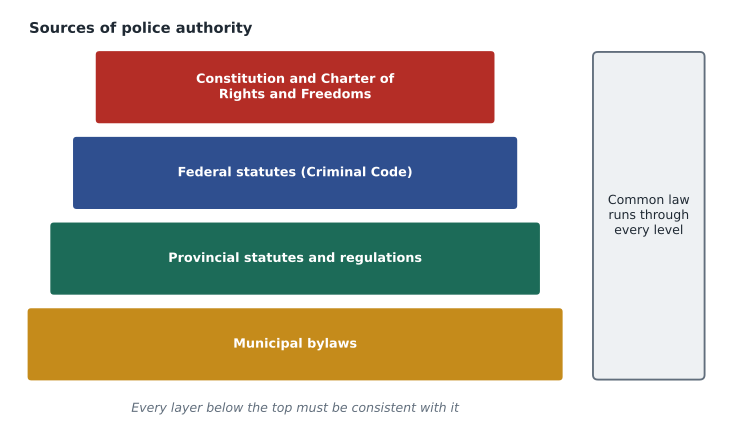
The Constitution of Canada is the supreme law of the country. Section 52 of the Constitution Act, 1982, says that any law inconsistent with the Constitution is, to the extent of the inconsistency, of no force or effect. The Charter of Rights and Freedoms forms Part I of that Act and came into force on April 17, 1982, with the equality rights in section 15 following three years later, in 1985. Before 1982, Canada had the Canadian Bill of Rights of 1960, but it was an ordinary federal statute, it did not bind the provinces and courts used it cautiously. The Charter changed that: it binds every level of government and every police service, and courts can strike down laws and exclude evidence when it is breached.
Below the Constitution sit federal statutes such as the Criminal Code, provincial statutes such as Ontario's Highway Traffic Act and Community Safety and Policing Act, regulations, municipal bylaws and the common law built up by judges. Each of these can give police authority, and each must be consistent with the Charter. A police power that the Criminal Code grants clearly can still be struck down or narrowed if it violates a Charter right and cannot be justified under section 1.
The legal rights in sections 7 to 14
The Charter's legal rights, in sections 7 to 14, are the ones police meet most often. Section 7 protects life, liberty and security of the person and the right not to be deprived of them except in accordance with the principles of fundamental justice. Section 8 protects against unreasonable search or seizure. Section 9 protects against arbitrary detention or imprisonment. Section 10 gives everyone who is arrested or detained the right to be told promptly why, the right to retain and instruct counsel without delay and to be told of that right, and the right to have the lawfulness of the detention determined by habeas corpus. Section 11 lists the rights of a person charged with an offence, including the right to be tried within a reasonable time and to reasonable bail. Sections 12 to 14 protect against cruel and unusual punishment, protect witnesses against having their testimony used to incriminate them, and guarantee an interpreter.
Two other parts of the Charter shape police work too. The fundamental freedoms in section 2, including expression, peaceful assembly and association, govern how police handle protests. The equality rights in section 15 forbid discrimination, which matters for racial profiling and how stops are distributed. Lesson 10 covers both. And section 24 gives the courts their remedies, including the power to exclude evidence, which Lesson 11 examines in detail.
Rights protect everyone, including the guilty
Marco DiSanto raises a common objection. If police find stolen tools in a suspect's backpack, why should it matter how they found them? Desjardins answers with a question of his own: how would the police know, before the search, that this person was guilty and not the next one? Constitutional rules have to be written for the moment before the search, when the officer cannot know what will be found. A rule that protected only innocent people would protect no one, because the officer could always claim to have believed the person guilty. The protections attach to everyone so that they reliably protect the innocent.
There is a second answer. Courts have found again and again that unchecked police power produces errors as well as abuses. Coerced confessions are unreliable. Searches without grounds catch far more innocent people than guilty ones. Detentions based on hunches fall disproportionately on certain neighbourhoods and communities. Constitutional limits push investigations toward methods that work: articulable grounds, corroborated information, judicial authorization and careful questioning. Desjardins tells the class that in his experience the officers who knew the Charter best were also the ones whose cases held up best.
A practical method for every encounter
Throughout this course the class will use the same four questions whenever an officer interacts with a member of the public. First, what is the officer doing: talking, detaining, arresting, searching, seizing or questioning? Second, what right is engaged by that action? Third, where does the officer's authority come from, and what conditions does it carry? Fourth, what duties does the action trigger, such as telling the person the reason or advising them of the right to counsel? Priya Sandhu, a former fraud analyst, points out that the method resembles a compliance checklist. Desjardins agrees and says that is the point: under stress, officers fall back on habits, and a good habit is asking, before each step, what gives me the authority to do this.
| Question | What to ask yourself | Example |
|---|---|---|
| 1. What am I doing? | Talking, detaining, arresting, searching, seizing or questioning | Asking a person to empty their pockets is a search |
| 2. What right is engaged? | Which Charter section applies | Section 8 for a search, section 9 for a detention |
| 3. Where is my authority? | Statute, common law or consent, and its conditions | Search incident to a lawful arrest |
| 4. What duties follow? | Reasons, rights advice, reporting | Tell the person why and advise of counsel |
Counting constitutional issues in Port Ardent case files
To see how often these questions arise in ordinary work, the class reviews a sample of 60 Port Ardent case files that the Crown attorney's office returned to the police service last year with written concerns. Prosecutor Margaret Liu, who reviews charges for Port Ardent each week, sorted each concern by the right involved. The program below tallies them and shows which issues come up most. The categories use plain labels so that the same code works for both countries.
# Concerns raised by the prosecutor's office in 60 returned Port Ardent case files
concerns = [
    ("search", 19), ("detention", 11), ("counsel", 13),
    ("statement", 7), ("delay", 6), ("other", 4),
]
total = sum(n for _, n in concerns)
print("total concerns:", total)
for issue, n in sorted(concerns, key=lambda c: -c[1]):
    bar = "#" * n
    print(f"{issue:10s} {n:3d}  {n / total:.2f}  {bar}")

top_two = sorted(concerns, key=lambda c: -c[1])[:2]
share = sum(n for _, n in top_two) / total
print("share from the top two issues:", round(share, 2))total concerns: 60 search 19 0.32 ################### counsel 13 0.22 ############# detention 11 0.18 ########### statement 7 0.12 ####### delay 6 0.10 ###### other 4 0.07 #### share from the top two issues: 0.53
Searches and the right to counsel together account for more than half of the concerns. Liu tells the class that this pattern is typical: most constitutional problems in real files are not dramatic misconduct but routine steps done in the wrong order, such as asking questions before a person has had a chance to call a lawyer, or searching a phone because it was in a pocket at the time of arrest. Those are exactly the habits this course aims to build.
Who decides, and when
Charter questions reach the courts in several ways. Most often, a defence lawyer brings an application at trial asking the judge to find a breach and exclude evidence under section 24(2) or to grant another remedy under section 24(1), such as a stay of proceedings. Sometimes a person challenges a law itself, arguing that the statute is inconsistent with the Charter and should be struck down under section 52. The Supreme Court of Canada has the final word, and its decisions bind every court and police service in the country.
Officers sometimes feel that judges second-guess decisions made in seconds. Desjardins acknowledges the feeling but tells the class that courts generally judge officers by what they knew and could reasonably believe at the time, not by hindsight. What courts will not accept is an officer who cannot explain the grounds for an action, or who explains them differently in court than in the notes. That is why LES-104's lessons on notes and reports connect directly to this course: the constitutional analysis a judge performs months later depends almost entirely on what the officer wrote down at the time.
Rights and responsibilities in Indigenous communities
Jesse Morningstar asks how the Charter applies to policing in his community. Desjardins explains that the core rights apply to everyone, everywhere, including on reserve lands. But Indigenous rights have their own constitutional protection in section 35 of the Constitution Act, 1982, which recognizes and affirms existing Aboriginal and treaty rights, and section 25 of the Charter says Charter rights must not be read to diminish those rights. First Nations police services and the officers who work with them operate within this framework, and the courts have repeatedly said that the honour of the Crown shapes how governments deal with Indigenous peoples. Later courses in the program return to this topic in detail.
Worked problem
Applying the four questions
At 1:40 a.m., Constable Dev Malhotra sees a man walking quickly through a closed strip mall, carrying a duffel bag. There have been three break-ins in the area this month. Malhotra pulls up and calls out, 'Hey, come here. What's in the bag?'
Show solution
- What is Malhotra doing? Calling the man over and asking about the bag. Depending on the tone and what follows, this may be a conversation or a detention, and asking to see inside the bag is a request to search.
- What rights are engaged? Section 9 if the man is detained, section 8 if the bag is searched, and section 10 if he is detained.
- Where is the authority? To detain for investigation, Malhotra needs reasonable grounds to suspect a connection to a particular recent crime (Lesson 6). Area break-ins alone may not be enough. To look in the bag he needs consent or another lawful basis.
- What duties follow? If he detains the man, he must tell him why and advise him of the right to counsel without delay.
- Decide the best wording: a polite request that makes clear the man can decline, or, if the grounds are there, a clear statement that he is being detained and why.
Answer: The opening line 'come here, what's in the bag' blurs a conversation into a detention and a search without the grounds for either. Malhotra should decide which he is doing, check that he has the authority, and use words that match.
Common mistakes
MistakeConstitutional rights mainly matter to lawyers and judges.
InsteadOfficers apply the Charter first, in the moment. Judges review those decisions later, mostly on the basis of the officer's notes and testimony.
MistakeGood intentions are enough to justify an action.
InsteadPolice need legal authority from a statute, the common law or consent. A sensible-seeming action without authority can breach rights and lead to excluded evidence.
MistakeRights only protect guilty people.
InsteadRules have to work before the officer knows who is guilty. Protections that attach to everyone are the only reliable way to protect the innocent.
MistakeIf the evidence is real, how it was found does not matter.
InsteadEvidence gathered in breach of the Charter can be excluded under section 24(2), and the breach can harm the person and the reputation of the justice system.
Summary and key terms
- The rule of law means police may use state power only when the law authorizes it.
- The Charter is part of the supreme law of Canada; inconsistent laws are of no force or effect.
- Sections 7 to 14 contain the legal rights police meet most often, with sections 2, 15 and 24 also central.
- Rights protect everyone because rules must work before the officer knows who is guilty.
- Four questions guide every encounter: what am I doing, what right is engaged, where is my authority, and what duties follow.
- Courts review officers' decisions later, mainly through their notes and testimony.
- Rule of law
- The principle that everyone, including government and police, is subject to the law, and state power must have legal authority.
- Charter of Rights and Freedoms
- Part I of the Constitution Act, 1982, guaranteeing rights and freedoms against government action.
- Supreme law
- The status of the Constitution under section 52: inconsistent laws are of no force or effect.
- Legal rights
- Sections 7 to 14 of the Charter, protecting liberty, privacy and fair process in the justice system.
- Police authority
- The legal basis for an action, found in statute, common law or consent.
- Section 35
- The constitutional recognition and affirmation of existing Aboriginal and treaty rights.
Practice problems
Work each problem on paper first, then reveal the answer to check.
What does the rule of law require of police?
Show answer
That every use of state power, such as a detention or search, has legal authority from a statute, the common law or consent.
When did the Charter come into force, and when did section 15 take effect?
Show answer
April 17, 1982; section 15 took effect in 1985.
In the Port Ardent sample, which two issues made up more than half of the prosecutor's concerns?
Show answer
Searches (19) and the right to counsel (13), 32 of 60 concerns.
List the four questions an officer should ask before each step of an encounter.
Show answer
What am I doing? What right is engaged? Where does my authority come from? What duties follow?
Lesson quiz · 5 questions
Score 60% or more to complete this lesson.
Create a free account to save your progress, take quizzes and earn a certificate.