
LES-111 · Lesson 7 of 12 · 19 min
The right to counsel and Miranda warnings
▶ Video coming soon A video version of this lesson is on the way.
Prosecutor Margaret Liu visits the class in Week 7 with a stack of files. In the last year, she says, more cases in her office were weakened by mistakes about the right to counsel than by any other single issue, and almost none of those mistakes involved bad faith. Officers advised people late, asked 'just one quick question' before a lawyer call, or let a detainee use a phone in a hallway where everyone could hear. She tells the class that the rules on counsel are among the clearest in constitutional law, and that following them precisely is the easiest way for an officer to protect a case.
Why the right to counsel exists
A person who has just been arrested is frightened, often confused, and facing an organization that knows the law far better than they do. The Supreme Court in Miranda v. Arizona in 1966 described custodial interrogation as inherently compelling: isolated in a police station, questioned by trained interrogators, a suspect may feel unable to stop. The Miranda warnings and the right to have counsel present during questioning exist to dispel that compulsion and protect the Fifth Amendment privilege against self-incrimination. Desjardins adds a practical point: statements obtained after a properly handled right to counsel are far harder for the defense to attack.
Miranda: when and what to tell people
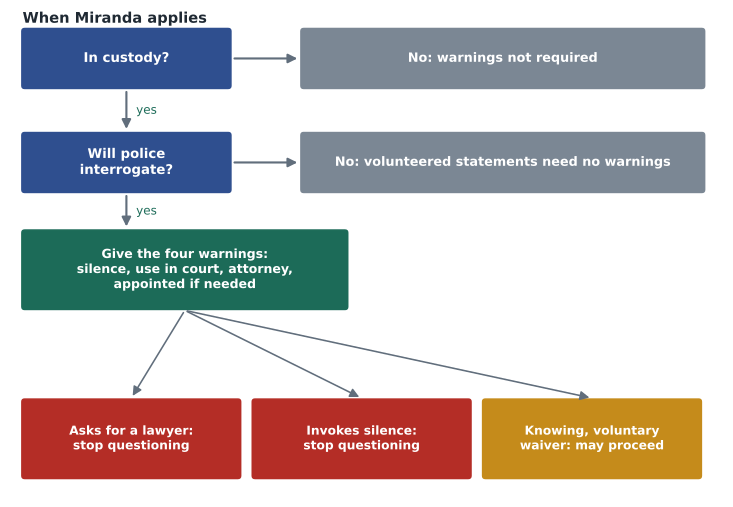
Miranda warnings are required before custodial interrogation: questioning initiated by police after a person has been taken into custody or otherwise deprived of freedom in a significant way. Both elements are needed. A person who is not in custody, such as someone briefly stopped on the street, does not need warnings, and a person in custody who volunteers a statement without being questioned has not been interrogated. The warnings tell the person that they have the right to remain silent, that anything they say can be used against them in court, that they have the right to an attorney before and during questioning, and that if they cannot afford one, one will be appointed. In Dickerson v. United States in 2000, the Court held that Miranda is a constitutional rule that Congress cannot override.
The right applies at every detention, not only arrests, including investigative detentions and many roadside stops. There are limited exceptions in the impaired driving context: in R. v. Orbanski in 2005, the Court held that the right to counsel is suspended during brief roadside screening, such as asking about drinking and administering physical coordination tests, because these are justified limits under section 1. Once the roadside stage ends and the person is arrested or required to accompany police for an evidentiary breath test, the right applies in full.
Once a person asks for a lawyer
Under Edwards v. Arizona in 1981, once a suspect in custody asks for a lawyer, police must stop the interrogation and may not resume it until counsel is present, unless the suspect personally initiates further communication. The request must be clear: in Davis v. United States in 1994, the Court held that 'Maybe I should talk to a lawyer' was too ambiguous to require police to stop, though many agencies train officers to clarify. The protection lasts while the person remains in custody and for a period after release; in Maryland v. Shatzer in 2010, the Court held that police may approach the suspect again after a break in custody of at least 14 days. If the suspect invokes the right to silence instead, police must scrupulously honor it, as Michigan v. Mosley held in 1975.
Silence alone is not an invocation. In Berghuis v. Thompkins in 2010, the Court held that a suspect who sat largely silent through nearly three hours of questioning, then answered 'yes' when asked whether he prayed to God to forgive him for the shooting, had not invoked his right to remain silent and had implicitly waived it by answering. A waiver must be knowing, intelligent and voluntary, and police should document it, ideally on video and on a signed form. Liu tells the class that this rule is where the two countries differ most sharply, and officers who move between jurisdictions in training videos and media need to remember which rules apply where they work.
| Question | Canada (section 10(b)) | United States (Miranda and Edwards) |
|---|---|---|
| When does the duty arise? | Immediately on arrest or detention | Before custodial interrogation |
| Lawyer present during questioning? | No (Sinclair) | Yes, if the suspect asks |
| Can police keep asking after the person consults? | Yes, unless circumstances change | No, once counsel is requested, unless the suspect re-initiates |
| Free legal advice? | Duty counsel, with a toll-free number | Appointed counsel if the person cannot afford one |
Waiver and special circumstances
A waiver must be voluntary, knowing and intelligent, judged by the totality of the circumstances, including the suspect's age, education, intelligence and condition. Police cannot obtain a waiver by threats, tricks or promises about the consequences of talking. Courts are cautious with juveniles; many states, including Ohio for certain custodial interrogations of children, require or strongly encourage a parent's presence or consultation. Ohio Revised Code 2933.81 creates a presumption that a recorded statement in a homicide or serious sexual offense investigation was voluntary, which is one reason many Ohio agencies record all custodial interrogations.
Exceptions and consequences
In New York v. Quarles in 1984, the Court recognized a public safety exception: officers who reasonably need to locate a gun hidden in a supermarket could ask where it was before giving warnings. The exception is narrow and applies only to questions necessary to protect police or the public from an immediate danger. When Miranda is violated, the statement generally cannot be used in the prosecution's main case, though it may be used to impeach a defendant who testifies inconsistently, and physical evidence found as a result is usually admissible if the statement was voluntary. In Vega v. Tekoh in 2022, the Court held that a Miranda violation alone does not support a civil lawsuit under 42 U.S.C. 1983.
Timing the Lakeshore Hardware arrest
The class reviews the times recorded during Kyle Brandt's arrest after the Lakeshore Hardware break-in, from detention on the sidewalk to his first call with a lawyer. The program computes the gaps that a court would look at.
# Times from the Lakeshore Hardware arrest, March 14, 2026 (24-hour clock)
events = [
    ("detained on Pine Street", "02:29:15"),
    ("arrested", "02:29:40"),
    ("rights to counsel read", "02:36:00"),
    ("asks for a lawyer", "02:36:30"),
    ("arrives at the station", "02:58:00"),
    ("call with a lawyer begins", "03:12:00"),
]
def seconds(t):
    h, m, s = (int(x) for x in t.split(":"))
    return h * 3600 + m * 60 + s
start = seconds(events[0][1])
for name, t in events:
    print(f"{t}  +{(seconds(t) - start) / 60:5.1f} min  {name}")
delay_advice = (seconds("02:36:00") - start) / 60
delay_call = (seconds("03:12:00") - seconds("02:36:30")) / 60
print("minutes from detention to advice:", round(delay_advice, 1))
print("minutes from request to call:", round(delay_call, 1))02:29:15 + 0.0 min detained on Pine Street 02:29:40 + 0.4 min arrested 02:36:00 + 6.8 min rights to counsel read 02:36:30 + 7.2 min asks for a lawyer 02:58:00 + 28.8 min arrives at the station 03:12:00 + 42.8 min call with a lawyer begins minutes from detention to advice: 6.8 minutes from request to call: 35.5
The advice came about 6.8 minutes after detention, and the call began about 35.5 minutes after Brandt asked. Because he was not interrogated in the cruiser, no warnings were required until questioning, and he was read his rights at 02:36. Once he asked for a lawyer, Edwards meant no one could question him about the break-in until counsel was present or he re-initiated contact. His unprompted remark in the cruiser, that the owner's tools were not worth much, raises a separate question for Lesson 8.
Giving the rights properly
Liu shows the class two body camera clips of rights advice. In the first, an officer reads the card quickly while walking the person to the cruiser, finishes with 'Got it?', and moves on when the person mumbles. In the second, the officer stops, faces the person, reads the card at a normal pace, then asks, 'Do you understand?' and 'Do you want to call a lawyer now?', waits for the answers and repeats them back. The second clip takes about forty seconds longer. Liu says that in court the first clip invites a long argument about whether the person understood, while the second ends the argument before it starts.
Courts have held that warnings must be conveyed reasonably, though no precise wording is required; in Florida v. Powell in 2010, the Court upheld warnings that conveyed the substance of the right to counsel during questioning. When an officer has reason to think the person did not understand because of language, intoxication, injury or a mental condition, the waiver may be found invalid. Officers should use the agency's standard card, record the person's exact response, and obtain a written or recorded waiver before any interrogation.
Desjardins adds the practical details that trip up new officers. Write down the exact time the rights were given, not an approximation. Note who was present. If the person asks a question about the rights, such as whether a lawyer will cost money, answer accurately and record the answer. If the person says they do not want a lawyer, ask once more, clearly, and record the words. And never offer opinions about whether a lawyer would help, which courts treat as undermining the right.
Young people and vulnerable detainees
Young people and vulnerable adults need particular care. Research shows that adolescents are more likely than adults to waive their rights without understanding them, more susceptible to pressure, and more likely to make false confessions. Courts consider age in deciding whether a juvenile was in custody, under J.D.B. v. North Carolina, and whether a waiver was knowing and voluntary. Many agencies, and some states by law, require that a parent or guardian be contacted and that a juvenile consult a lawyer before a custodial interrogation, and several states, including Illinois in 2021, have banned the use of deception when questioning juveniles. Desjardins tells the class that the safest practice with any young or vulnerable person is to slow down, use plain words, check understanding by asking the person to explain the right back, and record everything on video.
Worked problem
One quick question
At the station, while Brandt waits for the lawyer to call back, a detective walks past and says, 'Kyle, just between us, where are the other drill and the impact drivers? Help yourself out here.' Brandt says, 'I sold them already.'
Show solution
- Identify the action: a direct question about the crime is interrogation.
- Check Miranda and Edwards: Brandt was in custody and had asked for a lawyer. Questioning had to stop until counsel was present unless he re-initiated.
- Consider the words 'just between us' and 'help yourself out': they suggest the conversation is off the record and hint at a benefit, both of which undermine voluntariness.
- Predict the result: the answer was obtained in violation of Edwards and cannot be used in the prosecution's main case.
- Identify what should have happened: no questions at all until the lawyer call was complete and, if Brandt then chose to speak, a properly recorded interview.
Answer: A single question can cost the case its best evidence. After a request for counsel, the only safe answer is no questions until counsel is present or the suspect re-initiates.
Common mistakes
MistakeMiranda warnings are required whenever police talk to a suspect.
InsteadMiranda warnings are required only for custodial interrogation; non-custodial questioning and volunteered statements do not need them.
MistakeA quick question while waiting for the lawyer is harmless.
InsteadUnder Edwards, questioning must stop after a request for counsel until a lawyer is present or the suspect re-initiates.
MistakeA phone call in a busy hallway is enough.
InsteadThe person must have privacy for the call; others listening, including officers, can make the opportunity unreasonable.
MistakeA suspect must say nothing at all to invoke the right to silence.
InsteadSilence alone is not invocation under Thompkins; the suspect must say clearly that they want to remain silent or want a lawyer.
Summary and key terms
- Miranda warnings are required before custodial interrogation.
- Once a suspect clearly asks for a lawyer, questioning must stop until counsel is present or the suspect re-initiates.
- Thompkins requires a clear invocation of silence; waivers may be implied but must be knowing and voluntary.
- Courts consider age and condition in judging custody and waiver; Ohio presumes recorded statements in some serious cases voluntary.
- Quarles allows a narrow public safety exception.
- Precise times and wording in notes are essential to show the right was respected.
- Custodial interrogation
- Questioning initiated by police after a person has been taken into custody.
- Miranda warnings
- Advice of the right to silence, that statements can be used, the right to an attorney and to appointed counsel.
- Invocation
- A clear statement that the suspect wants a lawyer or wants to remain silent.
- Waiver
- A knowing, intelligent and voluntary decision to give up the right.
- Functional equivalent
- Words or actions police should know are reasonably likely to elicit an incriminating response.
- Public safety exception
- The narrow exception allowing questions needed to address an immediate danger before warnings.
Practice problems
Work each problem on paper first, then reveal the answer to check.
What two conditions trigger the Miranda requirement?
Show answer
Custody and interrogation.
What did Edwards v. Arizona hold?
Show answer
That once a suspect in custody asks for a lawyer, questioning must stop until counsel is present unless the suspect re-initiates.
How long after his request did Brandt's lawyer call begin?
Show answer
About 35.5 minutes.
Why are the words 'just between us' a problem in an interview?
Show answer
They suggest the statement is off the record and undermine the voluntariness and fairness of the questioning.
Lesson quiz · 5 questions
Score 60% or more to complete this lesson.
Create a free account to save your progress, take quizzes and earn a certificate.