
LES-111 · Lesson 4 of 12 · 19 min
Search and seizure: the Fourth Amendment and the reasonable expectation of privacy
▶ Video coming soon A video version of this lesson is on the way.
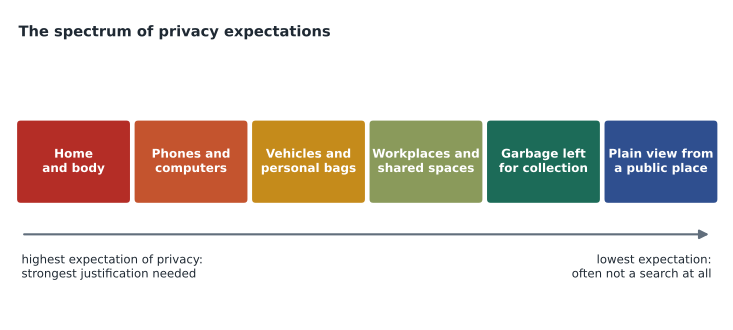
Desjardins starts Lesson 4 by asking the class to rank five places from most private to least private: a person's bedroom, a person's pockets, the inside of a parked car, a garbage bag left at the curb and a backyard visible from the street. The class mostly agrees on the order, and Desjardins tells them they have just done what judges do every day under the Fourth Amendment. The protection against unreasonable search and seizure does not protect places or things as such. It protects people's reasonable expectations of privacy, and those expectations are strongest in some places and weakest in others.
What counts as a search
A search happens in either of two situations. First, under Katz v. United States in 1967, when police intrude on an expectation of privacy that the person actually holds and that society is prepared to recognize as reasonable; in Katz, FBI agents had attached a listening device to the outside of a public phone booth. Second, under United States v. Jones in 2012, when police physically intrude on a person's property to gather information; in Jones, agents attached a GPS tracker to a car. A seizure of property happens when police meaningfully interfere with a person's possessory interest in it. If police conduct is neither, the Fourth Amendment is not engaged.
Courts have drawn many lines over the years. There is no reasonable expectation of privacy in garbage left at the curb for collection, California v. Greenwood held in 1988, or in open fields beyond the area immediately around a home, Oliver v. United States held in 1984. But the curtilage, the area immediately surrounding and associated with the home such as a porch or fenced yard, receives the same protection as the home itself, and in Florida v. Jardines in 2013 the Court held that bringing a drug-sniffing dog onto a front porch to investigate was a search.
When is a search reasonable? The warrant requirement
The Fourth Amendment's text requires that warrants issue only on probable cause, supported by oath or affirmation, particularly describing the place to be searched and the things to be seized. The Supreme Court has said that searches conducted outside the judicial process, without prior approval by a judge, are per se unreasonable, subject only to a few specifically established and well-delineated exceptions. Probable cause means a fair probability that contraband or evidence will be found, judged from the totality of the circumstances, as Illinois v. Gates held in 1983. The government bears the burden of showing that a warrantless search fits an exception.
Probable cause is a practical, common-sense standard, not a technical one. It is more than reasonable suspicion but less than proof beyond a reasonable doubt or even proof by a preponderance of the evidence. Officers can rely on their training and experience and on information from others, including informants whose reliability and basis of knowledge can be shown. Lesser intrusions, such as brief investigative stops, can be justified on reasonable suspicion, the lower standard covered in Lesson 6.
Warrants: the default
Warrants are the main way the Constitution gives a neutral person a say before the state intrudes. Federal and state rules govern warrants: in Ohio, Criminal Rule 41 and Revised Code Chapter 2933 set out the procedure. Many courts now accept electronic warrant applications sworn by video or phone, which makes warrants practical even in the middle of the night. There are also court orders for records held by third parties, wiretap orders under strict federal and state statutes, and tracking warrants. An application, called an affidavit, must be full, fair and frank: it must include facts that weaken the case as well as those that support it. A judge reviewing a warrant later will ask whether, after removing anything misleading and adding anything left out, there was still enough to justify it.
Desjardins tells the class about the first warrant he drafted, rejected by a justice because it said only that a reliable informant had seen drugs in an apartment. The justice wanted to know how the informant knew, when they saw it, and why the officer believed them. Courts ask similar questions under Illinois v. Gates: how reliable is the source, what is the basis of their knowledge, and has police investigation corroborated the details? Weaknesses in one area can be made up by strength in another, but an anonymous tip with no corroboration rarely justifies a warrant on its own.
Exceptions in brief
Searching without a warrant is lawful only when a recognized exception applies. The next course, LES-112, teaches the details of each power and how to use it; here the class learns the constitutional logic behind them. The main exceptions are consent, which must be voluntary under the totality of the circumstances, though Schneckloth v. Bustamonte in 1973 held that officers need not tell people they can refuse; search incident to a lawful arrest, limited by Chimel v. California in 1969 to the person and the area within their immediate control; the automobile exception, dating to Carroll v. United States in 1925, allowing searches of vehicles on probable cause; plain view, which Horton v. California in 1990 described as seizure of evidence whose incriminating character is immediately apparent from a lawful vantage point; and exigent circumstances, including hot pursuit, imminent destruction of evidence and emergency aid. In Case v. Montana in January 2026, a unanimous Supreme Court confirmed that officers may enter a home to give emergency aid when they have an objectively reasonable basis for believing someone inside needs immediate help; they do not need probable cause.
| Exception | Core idea | Key limit |
|---|---|---|
| Consent | The person waives the protection | Must be voluntary under the totality of the circumstances |
| Incident to arrest | Safety, escape and evidence after a lawful arrest | Person and area within immediate control |
| Exigent circumstances | No time for a warrant | Real urgency, not convenience |
| Plain view | Evidence seen from a lawful position | Nature must be immediately apparent |
| Automobile exception | Mobility; search on probable cause | Probable cause still required |
The body, the home and the manner of search
The manner of a search matters as much as the authority for it. Courts judge the manner of a search for reasonableness too. Strip searches and body cavity searches require strong justification and careful procedure, and many states, including Ohio under Revised Code 2933.32, regulate them by statute. Payton v. New York in 1980 held that police need a warrant to enter a home to make a routine arrest, absent exigent circumstances or consent. Officers executing a warrant must normally knock and announce their presence, as Wilson v. Arkansas held in 1995, although Hudson v. Michigan in 2006 held that a knock-and-announce violation does not require suppression. Desjardins tells the class that a lawful search done badly, with property needlessly damaged, a person humiliated or a home ransacked, can still breach the Constitution.
Do grounds make a difference? Port Ardent search outcomes
Sergeant Haddad pulls a year of Port Ardent search records to see how often searches found what officers were looking for. She separates searches where the officer recorded specific grounds before searching from searches based only on a general feeling or a vague consent request. The program compares the hit rates.
# Port Ardent searches over one year, grouped by what the officer recorded before searching
groups = {
    "warrant": {"searches": 64, "found": 49},
    "specific grounds recorded": {"searches": 212, "found": 98},
    "general consent request": {"searches": 318, "found": 41},
}
for name, g in groups.items():
    rate = g["found"] / g["searches"]
    print(f"{name:26s} {g['found']:3d} of {g['searches']:3d}  hit rate {rate:.2f}")

no_find = groups["general consent request"]["searches"] - groups["general consent request"]["found"]
print("people searched by general consent with nothing found:", no_find)warrant 49 of 64 hit rate 0.77 specific grounds recorded 98 of 212 hit rate 0.46 general consent request 41 of 318 hit rate 0.13 people searched by general consent with nothing found: 277
Searches backed by a warrant found evidence about three times in four, searches with specific recorded grounds a little under half the time, and general consent requests only about one time in eight. Haddad points to the last line: 277 people were searched by general consent and nothing was found. Each of those searches was an intrusion on someone who, as it turned out, had nothing to hide, and each was a chance to lose public trust. Grounds are not only a legal requirement; they are a sign of good police work.
Seizures of property
The Fourth Amendment protects against unreasonable seizures as well as searches. Taking a person's property, even briefly, is a seizure, and it needs legal authority just as a search does. Officers commonly seize items under a warrant, incident to arrest, under the plain view doctrine or under the automobile exception. Holding property must also be reasonable in duration: in United States v. Place in 1983, the Supreme Court held that detaining a traveler's luggage for 90 minutes to bring a drug-sniffing dog was unreasonable. Seized property must be inventoried and held under the agency's procedures and state law, and owners can seek its return when it is no longer needed as evidence.
Desjardins stresses that the paperwork after a seizure is part of its constitutional reasonableness. An officer who seizes a phone, a car or a bag of cash and then lets the item sit unrecorded in a locker has created a problem even if the seizure itself was lawful. Courts expect a clear record of what was taken, from whom, when, by whom, where it went and what authority allowed it to be kept. Priya, from her banking background, compares it to a chain of custody for financial records: the record is what lets anyone later trust that the evidence is what it claims to be.
Marco asks about property taken for safekeeping rather than as evidence, such as the belongings of a person taken to hospital. Desjardins says the same principles apply: take only what is necessary, record it carefully, and return it as soon as possible. Inventory searches of impounded vehicles and of property at booking are allowed when they follow a standard procedure, but they cannot be used as a pretext to look for evidence without grounds.
Worked problem
Can Malhotra look in the trunk?
Constable Malhotra stops a car for speeding. The driver is nervous and the car smells of air freshener. Malhotra has no information about any crime. He asks, 'You don't mind if I take a quick look in the trunk, do you?' The driver shrugs and says, 'I guess.'
Show solution
- Identify the action: looking in the trunk is a search of a place where the driver has a reasonable expectation of privacy, though lower than in a home.
- Look for authority: there is no warrant, no arrest and no exigency. The only possible basis is consent.
- Test the consent: consent must be voluntary under the totality of the circumstances. Officers need not say the driver can refuse, but a shrug and 'I guess' after a question framed as 'you don't mind' may be challenged.
- Consider the grounds: nervousness and air freshener are common among innocent drivers and are not enough on their own for a search.
- Decide what good practice looks like: either do not search, or ask clearly, explain that the driver can refuse, record the exact words and the answer, and stop if consent is withdrawn.
Answer: On these facts the consent may survive but is open to challenge. Clear wording, a recorded answer and respect for withdrawal of consent are the minimum, and a search without real grounds is rarely worth the cost to trust.
Common mistakes
MistakeIf something is on private property, police can never look at it without a warrant.
InsteadWhat anyone can see from a public place or a lawful vantage point is usually not a search; the question is the reasonable expectation of privacy.
MistakeNervousness justifies a search.
InsteadNervousness is common in innocent people during police contact; on its own it does not supply the grounds a search needs.
MistakeA warrant cures everything.
InsteadA warrant based on a misleading affidavit can be challenged, and a lawful warrant executed unreasonably can still violate the Fourth Amendment.
MistakeConsent is valid if the person does not object.
InsteadConsent must be voluntary under the totality of the circumstances; acquiescence to a claim of authority is not consent.
Summary and key terms
- A search occurs when police intrude on a reasonable expectation of privacy (Katz) or physically intrude on property to gather information (Jones).
- Warrantless searches are unreasonable unless a well-delineated exception applies.
- Warrants require probable cause, an oath and a particular description.
- Warrant applications must be full, fair and frank, including facts that weaken the case.
- Exceptions include consent, search incident to arrest, exigent circumstances and plain view, each with limits.
- The manner of a search, especially of the body and the home, must also be reasonable.
- Reasonable expectation of privacy
- An actual expectation of privacy that society is prepared to recognize as reasonable (Katz).
- Probable cause
- A fair probability that evidence or contraband will be found, judged from the totality of the circumstances.
- Affidavit
- The sworn statement used to apply for a search warrant.
- Curtilage
- The area immediately around a home, protected like the home itself.
- Exigent circumstances
- Urgent situations, such as hot pursuit or emergency aid, in which a warrant is impractical.
- Plain view
- Seizing evidence seen from a lawful position when its incriminating character is immediately apparent.
Practice problems
Work each problem on paper first, then reveal the answer to check.
What are the two ways a Fourth Amendment search can occur?
Show answer
An intrusion on a reasonable expectation of privacy (Katz) or a physical intrusion on property to gather information (Jones).
What does the Fourth Amendment require for a valid warrant?
Show answer
Probable cause, an oath or affirmation, and a particular description of the place and things.
In Haddad's data, how many general consent searches found nothing?
Show answer
318 minus 41, which is 277.
Why must a warrant application include facts that weaken the case?
Show answer
Because it must be full, fair and frank; a reviewing judge will remove misleading parts and add omitted facts and ask whether grounds remain.
Lesson quiz · 5 questions
Score 60% or more to complete this lesson.
Create a free account to save your progress, take quizzes and earn a certificate.