
LES-111 · Lesson 2 of 12 · 20 min
How constitutional rights work: state action, incorporation and remedies
▶ Video coming soon A video version of this lesson is on the way.
In the second week, Desjardins hands each student a card with a short scenario. A mall security guard searches a teenager's bag. A city bylaw officer enters a backyard to inspect a fence. A police officer at a sobriety checkpoint stops every car. A private citizen grabs a shoplifter. He asks the class to sort the cards into two piles: situations where the Constitution applies and situations where it does not. The sorting turns out to be harder than anyone expects, and the discussion that follows covers the three questions every constitutional case turns on. Does the Constitution apply at all? Was a right actually infringed? And if so, what happens next?
Who the Constitution binds: the state action doctrine
The Constitution's protections generally limit government, not private parties. Courts call this the state action doctrine. Federal agents, state troopers, sheriff's deputies, city police, campus police at public universities and public school officials are all state actors. A private security guard at a mall generally is not, although the guard is bound by state criminal law, licensing rules and the law of false imprisonment and battery. When a private person acts at the direction of police or performs a function traditionally reserved to the state, courts can treat the person as a state actor. An off-duty officer working private security can also be a state actor if the officer uses police authority, such as displaying a badge or making an arrest.
Linh Tran asks about the citizen who grabs a shoplifter. Desjardins explains that a private arrest is governed by state law; in Ohio, for example, a private person may arrest someone in limited situations under Revised Code 2935.04, and merchants have a separate power to detain suspected shoplifters for a reasonable time under 2935.041, and that misuse of that power can lead to criminal charges or lawsuits. But the Constitution itself is not usually the source of the limit. Once police take custody, everything changes: from that moment the full set of constitutional rights applies.
| Scenario | Does the Constitution apply? | Why |
|---|---|---|
| Mall security guard searches a bag on their own initiative | Generally no | A private actor; other law still applies |
| Store employee searches a bag because an officer asked | Likely yes | Acting as an agent of the police |
| Bylaw officer enters a yard to inspect a fence | Yes | A government actor using a statutory power |
| Officer stops every car at a checkpoint | Yes | A seizure of each driver by the state |
| Citizen holds a shoplifter until police arrive | Generally no | Private arrest law applies instead |
Was a right infringed?
The second question is whether the conduct actually limited a protected right. Not every police action engages the Constitution. A conversation with a person who is free to walk away is usually not a detention. Looking at something in plain view from a public place is usually not a search, because there is no reasonable expectation of privacy in what anyone could see. A request that a person is truly free to refuse is not compulsion. The person claiming a breach generally bears the burden of proving it on a balance of probabilities, although when police search without a warrant, the government must show that an exception to the warrant requirement applies.
Desjardins stresses that the line between engaging a right and not engaging it is often the most important line in a case. A conversation that turns into a detention, a look that turns into a search, a request that turns into a demand: each transition triggers new rights and new duties. Officers who are clear in their own minds about which side of the line they are on, and who make that clear to the person, avoid most of the problems that fill the prosecutor's return files from Lesson 1.
Balancing: how courts weigh rights against government interests
Constitutional rights in the United States are not absolute either, but courts handle limits differently from many other countries. Some provisions, like the Fourth Amendment, build the balance into the right itself: only unreasonable searches are forbidden, and courts decide reasonableness by weighing the intrusion on the individual against the government's interests. Other rights are analyzed using tiers of scrutiny: laws that burden fundamental rights or use suspect classifications such as race must survive strict scrutiny, meaning they are narrowly tailored to a compelling government interest, while most ordinary laws need only a rational basis.
Balancing explains many police powers that seem to sit uneasily with the warrant requirement. In Michigan v. Sitz in 1990, the Supreme Court upheld sobriety checkpoints, reasoning that the brief stop of every driver was a modest intrusion justified by the state's strong interest in preventing drunk driving. By contrast, in Indianapolis v. Edmond in 2000, the Court struck down checkpoints whose main purpose was general crime control and drug detection. The difference was the purpose: special public safety needs can justify suspicionless stops, ordinary crime fighting cannot. Some states, including Michigan itself, go further and forbid sobriety checkpoints under their own constitutions.
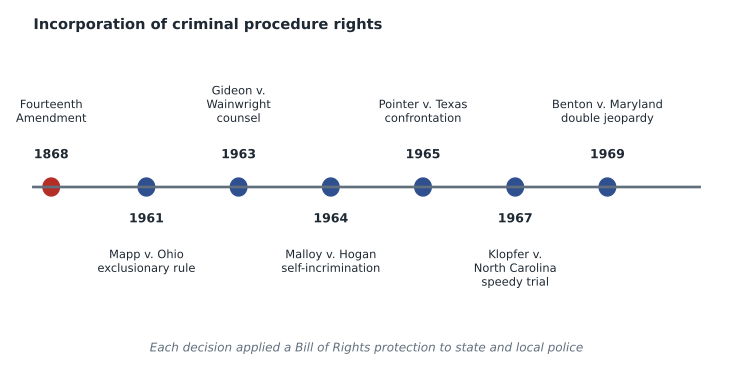
Ohio cases that changed policing nationwide
Two of the most important constitutional policing cases came from Ohio, a fact the Maumee Valley students find surprising. In Mapp v. Ohio in 1961, Cleveland police forced their way into Dollree Mapp's home without a valid warrant. The Supreme Court held that evidence obtained in violation of the Fourth Amendment must be excluded in state courts as well as federal courts. Seven years later, in Terry v. Ohio in 1968, the Court considered a Cleveland detective who stopped and patted down men he believed were casing a store. It held that officers may briefly stop a person on reasonable suspicion of criminal activity and frisk for weapons if they reasonably believe the person is armed and dangerous. Between them, Mapp and Terry define much of what a patrol officer does.
What happens after a breach: an overview of remedies
The main remedies are suppression of evidence, which Lesson 11 covers, and civil lawsuits. Under 42 U.S.C. 1983, a person can sue a state or local officer who violated their federal constitutional rights while acting under color of law. Officers can raise qualified immunity, which shields them unless they violated clearly established law that a reasonable officer would have known. Agencies can be liable when an official policy or custom caused the violation. The Justice Department can bring pattern-or-practice suits, although it withdrew from several such cases in 2025. Officers also face internal discipline, state decertification through bodies such as the Ohio Peace Officer Training Commission, and, in rare cases, criminal prosecution.
Desjardins draws a lesson from the list. The remedy most likely to touch an officer's daily work is losing evidence. But the consequence that lasts longest is often a finding of credibility: a judge who writes that an officer's account of a search was not believable has damaged that officer's ability to testify for years. Under the Brady and Giglio rules, prosecutors must disclose findings that an officer was untruthful, and some prosecutor offices keep lists of officers whose credibility is in question. Constitutional compliance and personal credibility turn out to be the same thing.
Changing the Constitution
The Constitution can be amended only through the demanding process in Article V, which normally requires two-thirds of both houses of Congress and ratification by three-quarters of the states. No amendment has changed criminal procedure rights since the Bill of Rights and the Fourteenth Amendment, so the law in this area develops almost entirely through court decisions interpreting the existing text. That is why officers need to follow Supreme Court and state supreme court decisions, which can change the rules overnight.
Tracking how often grounds are articulated
Sergeant Lisa Haddad, who supervises the Port Ardent night shift, audits a sample of incident reports every month. One measure she tracks is whether the officer wrote down the legal basis for each detention and search. The program below compares two months, before and after a refresher on articulating grounds, and calculates the change.
# Port Ardent night shift: reports that stated the legal basis for each detention and search
months = {
    "before refresher": {"reports": 84, "basis_stated": 55},
    "after refresher": {"reports": 91, "basis_stated": 79},
}
rates = {}
for month, m in months.items():
    rates[month] = m["basis_stated"] / m["reports"]
    print(f"{month:17s} {m['basis_stated']:3d} of {m['reports']:3d}  rate {rates[month]:.3f}")

change = rates["after refresher"] - rates["before refresher"]
print("change in rate:", round(change, 3))
missing = sum(m["reports"] - m["basis_stated"] for m in months.values())
print("reports still missing a stated basis:", missing)before refresher 55 of 84 rate 0.655 after refresher 79 of 91 rate 0.868 change in rate: 0.213 reports still missing a stated basis: 41
The rate rises from about 0.65 to about 0.87 after the refresher, but 41 reports across the two months still did not state the legal basis. Haddad tells the class that every one of those reports is a potential problem at trial, because the officer will have to reconstruct the grounds from memory months later.
Rights in a federal system
The federal system adds a layer that students sometimes overlook. Most criminal law in the United States is state law, enforced by state and local police, while federal agencies enforce federal law. A state may give people more protection than the federal Constitution requires, through its own constitution, statutes or court decisions, but never less. An officer in Toledo must therefore know both the federal rules and Ohio's, and must follow whichever protects the person more.
Desjardins gives an example from his own career. His service once adopted a practice that the courts in another state had approved, only to learn that their own appellate court had taken a stricter view. The lesson, he says, is that officers should learn the rules from their own jurisdiction's training and legal advisors, not from television, other jurisdictions' news stories or what a colleague saw on a course somewhere else. The Constitution sets common principles, but how they apply in detail can vary with local statutes and decisions, and an officer is judged by the law where they work.
Priya Sandhu asks how officers keep up with all of this. Desjardins describes the system in Port Ardent: the service's legal advisor sends a short bulletin whenever an important decision comes down, sergeants discuss it at the start of each shift for a week, and the annual requalification day includes a session on the year's leading cases. He tells the class that the officers who read the bulletins are rarely the ones whose files come back from the prosecutor with constitutional concerns.
Worked problem
Is the store employee bound?
A Lakeshore Hardware clerk suspects a customer of pocketing a box of screws. The clerk calls 9-1-1. While waiting, the clerk asks the customer to open their jacket, and the customer does. When Constable Malhotra arrives, he tells the clerk, 'Go ahead and check their pockets too while I watch.' The clerk does and finds a second box.
Show solution
- Ask whether the Constitution applies to the first search. The clerk acted on their own before police arrived, so the Fourth Amendment likely does not apply, though state law governs the clerk.
- Ask whether the second search is different. The clerk searched because the officer asked and watched. The clerk was acting as an agent of the police.
- Apply the Fourth Amendment: a search directed by police without a warrant needs an exception. Malhotra had not arrested the customer, so search incident to arrest did not apply.
- Decide what Malhotra should have done: assess the clerk's information, decide whether there were grounds to arrest, and if so arrest and search himself, explaining the reason.
Answer: The first search is likely outside the Constitution; the second is probably a Fourth Amendment search without a valid exception. Officers cannot get around the Constitution by asking a private person to do what they could not do themselves.
Common mistakes
MistakeThe Constitution binds everyone, including private businesses.
InsteadThe state action doctrine limits constitutional rights to government actors. Private security is governed by other law, unless acting at police direction.
MistakeA good reason can always justify an intrusion.
InsteadCourts weigh intrusions against government interests, but ordinary crime control does not justify suspicionless stops, as Edmond showed.
MistakeLosing evidence is the only consequence of a breach.
InsteadConsequences include civil liability, discipline, decertification and lasting findings about an officer's credibility.
Summary and key terms
- The state action doctrine means the Constitution binds government actors, including private persons acting at police direction.
- The person claiming a breach usually has to prove it, but warrantless searches put the burden on the government.
- Courts balance intrusions against government interests; sobriety checkpoints were upheld in Sitz, crime-control checkpoints struck down in Edmond.
- Remedies include suppression of evidence and civil suits under 42 U.S.C. 1983, subject to qualified immunity.
- Mapp v. Ohio and Terry v. Ohio, both from Cleveland, shaped modern policing nationwide.
- Stating the legal basis for each step in notes and reports is the best protection for a case and for an officer's credibility.
- State action doctrine
- The rule that constitutional rights limit government, not private parties.
- Under color of law
- Acting with the authority of government, a requirement for a 1983 lawsuit.
- Strict scrutiny
- The demanding test for laws that burden fundamental rights or use suspect classifications.
- Qualified immunity
- A defense shielding officers from damages unless they violated clearly established law.
- Incorporation
- Applying Bill of Rights protections to the states through the Fourteenth Amendment.
- Suppression
- Excluding unconstitutionally obtained evidence from trial.
Practice problems
Work each problem on paper first, then reveal the answer to check.
Does the Fourth Amendment apply to a mall guard who searches a bag on their own?
Show answer
Generally no, because the guard is a private actor, but other law applies, and the answer changes if the guard acts at police request.
What was the difference between the checkpoints in Sitz and Edmond?
Show answer
Sitz upheld checkpoints aimed at drunk driving; Edmond struck down checkpoints aimed at general crime control and drugs.
Haddad's audit found 55 of 84 and 79 of 91 reports stated the legal basis. How many reports in total lacked it?
Show answer
29 + 12 = 41 reports.
Why can a credibility finding be worse for an officer than losing evidence in one case?
Show answer
Because it can follow the officer into future cases through disclosure obligations and damage their ability to testify.
Lesson quiz · 5 questions
Score 60% or more to complete this lesson.
Create a free account to save your progress, take quizzes and earn a certificate.