
INS-230 · Lesson 7 of 12 · 21 min
Who is allowed to remove asbestos
▶ Video coming soon A video version of this lesson is on the way.
On the Thursday after Devon's stop at Kellerton, the abatement contractor's crew arrived at 7:00 to remove the tee cover. Devon was working in the engine room, but at lunch he walked past the roped-off area and saw what he had only heard about: a plastic glove bag sealed around the tee, a worker in disposable coveralls and a full-face respirator working through the bag's built-in gloves, another keeping the material wet, a HEPA vacuum and a pile of labelled waste bags. "They made it look easy," he told Mei later. "Like it was routine." "It is routine," she said, "for them. That's the point. It's their trade, not yours."
This lesson explains how Ontario's rules classify asbestos work by risk, who is allowed to do each kind, what training and certification are required, and how to recognize an abatement work area when you see one. It is not a course in doing that work. The goal is that you know what is going on around you, what you may and may not do, and why Coldstream's crews leave all asbestos removal to the specialists.
Types of operation in Ontario
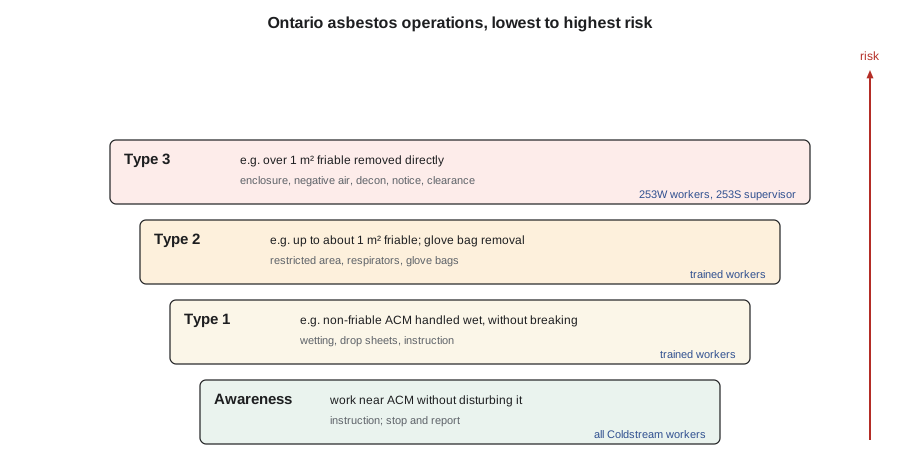
Ontario Regulation 278/05 classifies every operation that may disturb asbestos-containing material as Type 1, Type 2 or Type 3. The classification depends on the kind of material (friable or non-friable), the amount, and the method, because those decide how many fibres the work is likely to release. In general terms:
- Type 1 operations are low-risk work in which exposure is unlikely to exceed the limit if the required precautions are followed. Examples include handling or removing non-friable ACM, such as some tiles or asbestos cement products, without breaking them or with hand tools while keeping the material wet, and removing a limited area of ACM-containing ceiling tiles.
- Type 2 operations are moderate-risk work in which exposure is likely to exceed the limit without controls. Examples include removing a small amount of friable material (no more than about one square metre), removing insulation from pipe with a glove bag, enclosing friable ACM, and removing a larger area of ceiling tiles.
- Type 3 operations are high-risk work that can release large amounts of fibres. Examples include removing more than about one square metre of friable material other than by glove bag, spraying a sealant onto friable ACM, and breaking non-friable ACM with power tools without dust collection.
The regulation lists the operations in each type in detail and sets out the measures each one requires. The higher the type, the more extensive the measures: from wetting and drop sheets for Type 1, to glove bags, respirators and restricted areas for Type 2, to full enclosures under negative pressure, decontamination facilities, certified workers, notice to the Ministry and clearance air testing for Type 3.
Insulators sometimes ask why glove bag removal of pipe insulation is a Type 2 operation even for long runs. It is because a glove bag, used correctly, contains the material inside a sealed bag at the point of removal. The regulation still requires notice to the Ministry when a glove bag removal covers one square metre or more of insulation.
Who may do the work
Every worker in a Type 1, Type 2 or Type 3 operation must first be instructed and trained by a competent person in the hazards of asbestos, personal hygiene and work practices, and the use, care and disposal of respirators and protective clothing. For Type 3 operations, more is required: workers must have completed a Ministry-approved asbestos abatement worker training program and hold the Asbestos Abatement Worker certificate (253W), and their supervisors must hold the Asbestos Abatement Supervisor certificate (253S), which requires the worker certificate first. A further optional program, Hazardous Materials Worker (253H), builds on 253W for people who work with a wider range of hazardous materials.
In practice, Type 3 work is done by specialist abatement contractors whose crews hold the certificates and whose supervisors are certified. Many Type 2 operations are also done by abatement contractors, although an employer whose workers are properly trained and equipped may do them.
Coldstream's policy is stricter than the law requires: its crews do not do Type 1, Type 2 or Type 3 operations on any material known or suspected to contain asbestos. All Coldstream field workers receive asbestos awareness instruction so that they can recognize suspect material, stop, and work safely near controlled areas, but removal is always left to the owner's abatement contractor. "We insulate," Walt Lowery says. "We don't abate. If somebody wants to hire us to abate, they've got the wrong company."
Other insulation contractors make different choices. Some have trained crews that do limited asbestos work within the rules, especially on plant maintenance. If you work for such a company in the future, you will receive the training and certification the work requires before you do it. Until you have that training, the rule is simple: you do not disturb asbestos-containing material.
Recognizing an abatement work area
You will often work near abatement, because insulation work usually follows it. Knowing what you are looking at helps you stay out of the way and notice when something is wrong.
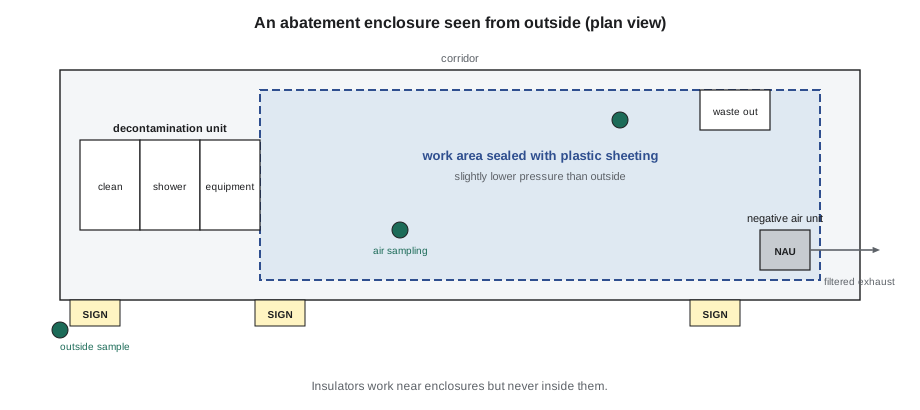
- Signs and barriers. Every entrance has warning signs, caution tape or rigid barriers, and often a sign-in log. Do not enter unless you are part of the work.
- Polyethylene sheeting. Walls, floors and openings covered and sealed with heavy plastic sheeting, often in two layers, to make an enclosure and to seal off vents and doorways.
- Negative air units. Boxy fan units with large filters, exhausting air from the enclosure through high-efficiency filters, so that air leaks into the work area rather than out of it. The plastic walls often bow slightly inward.
- Decontamination facility. A series of small rooms at the entrance to a large enclosure, where workers change, shower and leave contaminated clothing behind.
- Glove bags. For small removals from pipe, clear bags sealed around the pipe with built-in gloves, used without a full enclosure.
- Wet methods and HEPA vacuums. Sprayers keeping the material wet, and vacuums with high-efficiency filters, never brooms or compressed air.
- Air sampling pumps. Small pumps with filter cassettes, on stands around the area or clipped to workers' collars, collecting air samples for analysis.
- Labelled waste. Sealed, labelled bags or containers moved out through a waste route, never thrown down chutes or into ordinary bins.
If you notice a problem at an abatement area near your work, such as torn plastic, a negative air unit that has stopped, dust outside the barrier, a door left open or workers leaving in contaminated clothing, tell your supervisor at once. Your supervisor will tell the abatement contractor's supervisor and the owner's consultant.
After abatement: clearance
Before a Type 3 enclosure is taken down, the area must pass a clearance air test: air samples are taken in the enclosure after cleaning, and the work area passes only if no sample exceeds 0.01 fibres per cubic centimetre. If the first test by phase contrast microscopy fails, a more specific analysis may be used. Only then is the enclosure removed and the area released. As an insulator, ask to see the clearance before you start work in a former abatement area.
Clearance applies to the area that was abated, not to the whole building. If your work will extend beyond that area, the survey and the rules still apply there.
Worked problem
Classifying removals by area
The Mountview abandoned line (lesson 12) had aircell with an outside diameter of about 140 mm. (a) What is the surface area of aircell on a 0.3 m damaged section? (b) On the whole 18 m line? (c) How would each removal be classed in Ontario if it were done by removing the material directly, and how would a glove bag change the answer?
Show solution
- Surface area = π × D × L.
- (a) π × 0.140 × 0.3 = 0.13 m², which is under 1 m² of friable material: a Type 2 operation.
- (b) π × 0.140 × 18 = 7.9 m², well over 1 m² of friable material: a Type 3 operation if removed directly.
- (c) Removal of pipe insulation with glove bags is a Type 2 operation; because the 18 m line is over 1 m², notice to the Ministry would be required.
- The consultant chose a Type 3 enclosure for the corridor because debris had fallen onto the ceiling tiles and the whole ceiling space had to be cleaned, which glove bags cannot do.
Answer: About 0.13 m² (Type 2) and 7.9 m² (Type 3 if removed directly, or Type 2 with notice by glove bag). Debris pushed the project to Type 3.
Removal is not the only option
Owners do not always remove asbestos-containing material. Depending on its condition and on the work planned, an owner may choose to:
- Leave it in place and manage it, if it is in good condition and will not be disturbed.
- Repair it, by patching small areas of damage with suitable materials.
- Encapsulate it, by coating it with a sealant that binds the surface and the fibres.
- Enclose it, by building an airtight barrier or a new jacket around it so that it cannot be disturbed or release fibres.
- Remove it, when it is badly damaged or in the way of work.
Repair, encapsulation and enclosure are themselves asbestos work, because they can disturb the material. Enclosing friable ACM is one of the operations listed in the regulation, and spraying a sealant onto friable ACM is a Type 3 operation. An insulator might be asked to put a new metal jacket over old asbestos pipe covering as a way of enclosing it. That is asbestos work, not ordinary jacketing, and Coldstream does not do it. If you are ever asked to jacket over old insulation of unknown content, stop and ask for the survey and the owner's abatement plan.
Working alongside an abatement contractor
On renovation and plant shutdown work, insulators often follow an abatement contractor area by area: the abatement crew removes the old insulation from one section, the area is cleared, and the insulators reinsulate it while the abatement crew moves to the next section. That sequence works well when the trades coordinate closely.
- Know the abatement schedule and which areas are active, cleared or not yet started.
- Respect the abatement contractor's barriers, decontamination units and waste routes; do not use them as shortcuts or storage areas.
- Ask to see the clearance for each area before you enter it, and check that it covers the whole of your work area.
- Keep your materials and tools out of active abatement areas, so they do not become contaminated waste.
- Report anything you find in a cleared area that looks like missed material or debris; abatement crews can miss pieces behind supports or inside chases, just as earlier insulators did.
At Kellerton, the abatement contractor removed the asbestos from two valves and a flange pair the Friday before the November outage, and the clearance report was in Mei's file before the Coldstream crew started work on Monday. When Devon found the unlisted tee, the same contractor came back the next day. That kind of working relationship, built over years, makes stops quick and painless.
Asbestos work and the insulator's trade
Some insulators move into abatement work during their careers, because the skills of working on pipe and equipment carry over and because abatement contractors value people who understand insulation systems. Doing so means taking the full training and certification for that work, and accepting the discipline of enclosures, decontamination and air monitoring. It is a legitimate and important trade in its own right. It is simply not part of an insulator's job without that training.
In Ontario, the Ministry's inspectors can check the certificates of workers and supervisors on Type 3 projects, and an employer who uses uncertified workers for Type 3 work is in breach of the regulation. If you are ever asked to help an abatement crew, even by carrying materials into the enclosure, the answer is no: entry is for certified, protected workers only.
Common mistakes
MistakeThinking a small amount of asbestos is fine for anyone to remove.
InsteadEven Type 1 work requires trained workers and precautions, and Coldstream does none.
MistakeEntering an abatement area to check measurements or fetch a tool.
InsteadNever enter a signed abatement area unless you are part of that work.
MistakeAssuming a glove bag is something you can pick up and use.
InsteadGlove bag removal is asbestos work that requires training and authorization.
MistakeStarting work in a former abatement area without seeing the clearance.
InsteadAsk for the clearance result first, and check that it covers your area.
MistakeIgnoring torn plastic or a stopped negative air unit next door.
InsteadReport it at once; the barrier protects you too.
Summary and key terms
- Ontario classifies asbestos work as Type 1, 2 or 3 by material, amount and method; higher types need stronger measures.
- All workers in Type 1 to 3 operations need instruction by a competent person; Type 3 workers need the 253W certificate and supervisors the 253S.
- Glove bag removal of pipe insulation is Type 2, with notice to the Ministry at one square metre or more.
- Coldstream crews do no asbestos removal; all removal is left to the owner's abatement contractor.
- Abatement areas have signs, plastic sheeting, negative air units, decontamination facilities, glove bags, wet methods, HEPA vacuums, air sampling and labelled waste.
- Ask for the clearance result before starting work in a former abatement area, and report problems at abatement areas near your work.
- Type 1, 2 and 3 operations
- Ontario's categories of asbestos work, from lowest to highest risk.
- Asbestos Abatement Worker (253W)
- Ontario's certificate required for workers in Type 3 operations.
- Asbestos Abatement Supervisor (253S)
- Ontario's certificate required for supervisors of Type 3 operations.
- Glove bag
- A sealed plastic bag with built-in gloves used to remove asbestos insulation from pipe.
- Enclosure
- A sealed work area of plastic sheeting under negative pressure, used for high-risk removal.
- Negative air unit
- A fan unit with high-efficiency filters that exhausts air from an enclosure so air leaks inward.
- Decontamination facility
- The rooms at an enclosure entrance where workers change, shower and leave contaminated clothing.
Practice problems
Work each problem on paper first, then reveal the answer to check.
Which type of operation is removing more than about one square metre of friable insulation directly?
Show answer
Type 3.
Which certificates do Type 3 workers and supervisors need?
Show answer
Asbestos Abatement Worker (253W) for workers and Asbestos Abatement Supervisor (253S) for supervisors.
What clearance result must a Type 3 area meet?
Show answer
No air sample may exceed 0.01 fibres per cubic centimetre.
Aircell with a 110 mm outside diameter covers 4 m of pipe. What is its surface area?
Show answer
π × 0.110 × 4 = 1.38 m².
What should you do if you see torn plastic at an abatement enclosure next to your work?
Show answer
Tell your supervisor at once so the abatement supervisor and consultant can deal with it.
Lesson quiz · 5 questions
Score 60% or more to complete this lesson.
Create a free account to save your progress, take quizzes and earn a certificate.