
INS-230 · Lesson 6 of 12 · 21 min
Stopping work when you suspect asbestos
▶ Video coming soon A video version of this lesson is on the way.
Mei's last session fell on Wednesday, November 4, the evening of the day Devon had stopped work at Kellerton. She asked him to tell the group what had happened. He described the boiler house, the header, the newer aluminum jacket and the tee under it, and the moment he saw that the cement on the tee was not the same as anything around it. "I didn't know what it was," he said. "I just knew it wasn't on the sheet. So I stopped, and I told Tessa to stop, and I called Bernie." Mei wrote his words on the whiteboard: Didn't know. Not on the sheet. Stopped. Told others. Called. "That," she said, "is the whole lesson."
This lesson turns that attitude into a procedure: what to do, in what order, when you find something that may contain asbestos; what to do if it has already been disturbed; how the right to refuse unsafe work fits in; and why stopping is always the right call, even when it costs time.
When to stop
Stop work when you find, or suspect, any material that may contain asbestos and that is not clearly identified as asbestos-free for your work. Typical triggers are:
- Old insulation, cement, cloth, rope or gaskets that are not on the survey, or that do not match the survey's description.
- Material in an area the survey lists as not accessed, or not covered at all.
- Layers: an old material under a newer one.
- Debris, crumbled material or dust near old insulation, on ceiling tiles, beams or floors.
- Damage to known asbestos-containing material, whether caused by you, another trade, a leak or anything else.
- Another trade disturbing material near you that may contain asbestos.
- An asbestos label, or a sign or barrier you did not expect.
You do not need to be sure. The point of stopping is that you are not sure. If the material turns out to be asbestos-free, the cost was an hour or two. If it turns out to be asbestos and you had carried on, the cost could be counted in lives.
The stop procedure
Coldstream teaches the procedure in six steps, in this order:
- 1. Stop. Stop what you are doing immediately. Do not finish the cut, do not pull off the last piece, do not tidy up.
- 2. Do not disturb. Leave the material exactly as it is. Do not touch it, break it, brush it, wet it, wrap it, sample it or move it. Do not run tools or vacuums near it. If you are holding a piece, set it down gently where it is.
- 3. Warn others and keep them out. Tell everyone working nearby to stop, including other trades. Keep people out of the area by stepping back, closing doors where you can, and putting up caution tape or a barrier if you have one. Do not walk the material through other areas.
- 4. Report. Tell your supervisor or foreperson at once, and they will contact the owner's representative and your safety coordinator. Say what you found, exactly where, what it looks like, and what had been done to it.
- 5. Deal with yourself. If you may have dust on you, do not brush it off or blow it off. Stay near the area until your supervisor or the consultant tells you how to remove and bag your outer clothing and clean up. If you were wearing a respirator, keep it on until you are out of the dusty area.
- 6. Record and wait. Write down the date, time, place, material and what you were doing. Wait for the owner's consultant to assess and sample the material. Go back to work in that area only when the result is known and, if it is asbestos, when it has been removed or controlled and the area has been cleared.
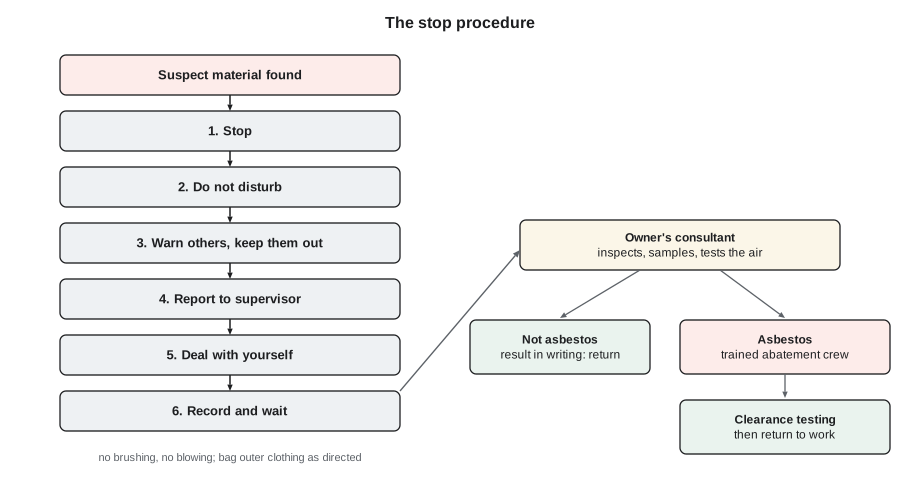
Look at what is not in the procedure: deciding for yourself whether the material is asbestos, cleaning up, finishing the job carefully, or moving on to another part of the same area. Each of those has caused exposures on real jobs.
What the supervisor and owner do next
Once you report, the response passes to people with the authority and training to manage it. Your supervisor stops the crew's work in the area and confirms that other trades have stopped. The owner's representative calls the owner's asbestos consultant, who inspects the material, takes samples under controlled conditions, and may take air samples to check whether fibres were released. If dust or debris was spread, the consultant decides how far the affected area extends and how it will be cleaned.
If the laboratory confirms asbestos, the owner arranges for an abatement contractor. The work is classified under the rules, the necessary notices are given, the material is removed or controlled, and the area is cleaned and cleared by air testing. Your crew returns when the consultant and the owner release the area. If the result is none detected, work resumes once the result is confirmed in writing.
At Kellerton, the whole sequence took about a day: Devon stopped on Wednesday, the consultant sampled within the hour, the result came back at 4:00, the abatement contractor removed the cover on Thursday morning, and the area was cleared by air testing before the crew returned.
If the material has already been disturbed
Sometimes you realize what a material might be only after it has been disturbed: a piece has broken off, a cut has been made, debris has been swept, or another trade has opened a ceiling. The procedure is the same, with more care about spreading contamination.
- Stop immediately and do not try to clean up or cover what has happened.
- Keep everyone out of the area, including people who want to help. Close doors if you can do so without walking through the debris.
- Do not walk out through clean areas in dusty boots or clothing if you can avoid it; wait for direction on how to remove and bag outer clothing.
- Tell your supervisor exactly what was disturbed and how: cut, broken, swept, vacuumed. This decides how far the consultant must look.
- Do not empty, open or reuse a vacuum, bag or tool that may contain the material. Seal it or set it aside and tell the consultant.
- Tell your supervisor about any ventilation fans or air handlers that may carry dust from the area, so the owner can decide whether to shut them down.
- Make sure the exposure is recorded, with your name and the names of everyone who was there.
The worst responses to an accidental disturbance are the well-meant ones: sweeping up the debris, vacuuming it with a shop vacuum, which blows fine fibres straight through the filter, or carrying the broken piece outside. Each spreads the fibres further and exposes more people.
Stopping, refusing and your rights
Stopping work on suspect material is a normal part of the job, expected by your employer and required by the rules. You do not need to invoke any special right to do it. Ontario's OHSA also gives every worker the right to refuse work they have reason to believe is likely to endanger them. To refuse, you tell your supervisor or employer that you are refusing and why. The employer investigates with you and a worker member of the joint health and safety committee or a health and safety representative present. If the matter is not resolved and you still believe the work is unsafe, a Ministry inspector is called to investigate and decide. Your employer may not penalize you for using this right in good faith.
At a good company, these rights rarely need to be used, because stopping is supported. Coldstream's written policy gives every worker, including first-year apprentices, the authority to stop work on suspected asbestos without asking permission first, and says that nobody will be disciplined for a stop made in good faith, even if the material proves to be harmless.
Some sites do not have that culture. If a supervisor or another trade's foreman tells you to carry on with suspect material, explain that you need the survey or a result first, and call your own supervisor or safety coordinator. Do not let schedule pressure make the decision.
Why stopping is worth the time
Stopping costs time and money, and on a busy job it can feel like letting the crew down. It helps to put numbers on it.
Worked problem
The cost of stopping at Mountview
When Tessa stopped work in the Mountview corridor on Tuesday, September 22 (lesson 12), three Coldstream workers and two Harcourt fitters were in the corridor. The Coldstream crew lost about 1.5 hours each before they were moved to work in the new addition; the two fitters lost about 2 hours each. The corridor was then closed for nearly two weeks for abatement and clearance. How many worker-hours were lost on the day, and how should the crew weigh that?
Show solution
- Coldstream: 3 × 1.5 = 4.5 worker-hours.
- Harcourt: 2 × 2 = 4 worker-hours.
- Total on the day = 4.5 + 4 = 8.5 worker-hours.
- The closure delayed the corridor work, but both contractors had other work in the addition, so most of the time was rescheduled rather than lost.
- Against that: carrying on would have meant cutting through an aircell-covered line and working in asbestos debris, exposing at least five workers and possibly hospital staff and patients beyond the hoarding.
Answer: About 8.5 worker-hours were lost on the day. The alternative was exposing at least five workers, and possibly others, to a material that proved to be about half chrysotile.
Mei put it more bluntly: "Nobody has ever been diagnosed with mesothelioma because they stopped work for an afternoon."
Stop-work in practice
A few practical habits make stopping easier:
- Carry caution tape or a small roll of barrier tape in your tool bag on renovation and plant jobs.
- Know who to call before you need to: your foreperson, the site supervisor and your safety coordinator, with their numbers in your phone.
- Ask at the start of each job where the survey is kept and who the owner's representative is.
- Keep a notebook; write down what you found while it is fresh.
- Speak up early. It is easier to stop before the first cut than after the tenth.
Devon's notebook entry for November 4 was four lines long. Mei kept a copy and uses it in every new hire's orientation.
Speaking up to other trades and occupants
Stopping your own work is straightforward. Asking someone from another trade to stop can be harder, especially for an apprentice speaking to an experienced foreman. A few principles help:
- Be direct and specific: "Please stop. That material isn't on the survey, and it might be asbestos."
- Explain what you are going to do: "I'm calling my foreperson and the owner's rep."
- Do not argue about whether it is asbestos. Nobody on site can know until it is tested.
- If the other worker will not stop, step back, keep yourself and others away, and call your supervisor at once. Your supervisor will deal with the other trade's supervisor and the owner.
Building occupants, such as hospital staff, office workers or plant employees, may notice the stop and ask what is going on. Do not speculate about what the material is or whether anyone was exposed. Say that work has been paused while the owner checks something, and refer them to the owner's representative. The owner is responsible for informing occupants, and a careless remark can cause needless alarm or, worse, false reassurance.
When the result is none detected
Many stops end with a laboratory result of none detected. That is a good outcome, not a wasted afternoon. Before you go back to work, make sure:
- The result is in writing and covers the exact material you found, not just a similar material nearby.
- Every layer of a layered material was analysed.
- The owner or your supervisor has released the area for work.
- The survey or record has been updated, so that the next crew does not have to stop at the same place.
If another, different-looking material turns up later in the same area, it needs its own check. One clean result does not clear an area.
Common mistakes
MistakeFinishing the cut before stopping, because you are nearly done.
InsteadStop immediately; every extra cut releases more fibres.
MistakeWrapping or wetting the material yourself to make it safe.
InsteadDo not disturb it at all; the consultant decides how to control it.
MistakeSweeping or shop-vacuuming debris after an accidental disturbance.
InsteadLeave debris alone; sweeping and ordinary vacuums spread fine fibres.
MistakeBrushing dust off your clothing before leaving.
InsteadWait for direction; remove and bag outer clothing as instructed.
MistakeCarrying on because another trade's foreman says it is fine.
InsteadGet the survey or a result first, and call your own supervisor.
Summary and key terms
- Stop whenever you find or suspect asbestos-containing material that is not clearly cleared for your work; you do not need to be sure.
- The procedure is: stop, do not disturb, warn others and keep them out, report, deal with yourself, record and wait.
- The owner's consultant assesses and samples the material; if it is asbestos, a trained abatement contractor removes it and the area is cleared before work resumes.
- If material has already been disturbed, keep everyone out, do not clean up, seal vacuums and tools, and make sure the exposure is recorded.
- Stopping is a normal part of the job; Ontario workers also have the right to refuse unsafe work under section 43 of the OHSA.
- The time lost by stopping is small compared with the harm of an exposure.
- Stop-work authority
- A worker's authority, given by the employer, to stop work on a hazard without asking permission first.
- Work refusal
- A worker's refusal, under section 43 of the OHSA, to do work they believe is likely to endanger them.
- Joint health and safety committee (JHSC)
- A committee of worker and management members that helps identify and resolve workplace hazards.
- Accidental disturbance
- Damage to or release from suspect material before its nature was known.
- Owner's representative
- The person who acts for the building or plant owner on a project.
- Consultant
- The owner's asbestos specialist, who inspects, samples and monitors.
Practice problems
Work each problem on paper first, then reveal the answer to check.
List the six steps of the stop procedure in order.
Show answer
Stop; do not disturb; warn others and keep them out; report; deal with yourself; record and wait.
Why shouldn't you wet or wrap suspect material to make it safe?
Show answer
Doing so disturbs it; the consultant decides how to control it.
Why is an ordinary shop vacuum dangerous around asbestos debris?
Show answer
Its filter lets fine fibres pass straight through and blows them into the air.
What should you do with a vacuum that may have picked up suspect debris?
Show answer
Do not open or empty it; seal it or set it aside and tell the consultant.
Four workers stop for 2.5 hours each. How many worker-hours are lost?
Show answer
4 × 2.5 = 10 worker-hours.
Lesson quiz · 5 questions
Score 60% or more to complete this lesson.
Create a free account to save your progress, take quizzes and earn a certificate.