
INS-230 · Lesson 5 of 12 · 21 min
Surveys, sampling and labelling
▶ Video coming soon A video version of this lesson is on the way.
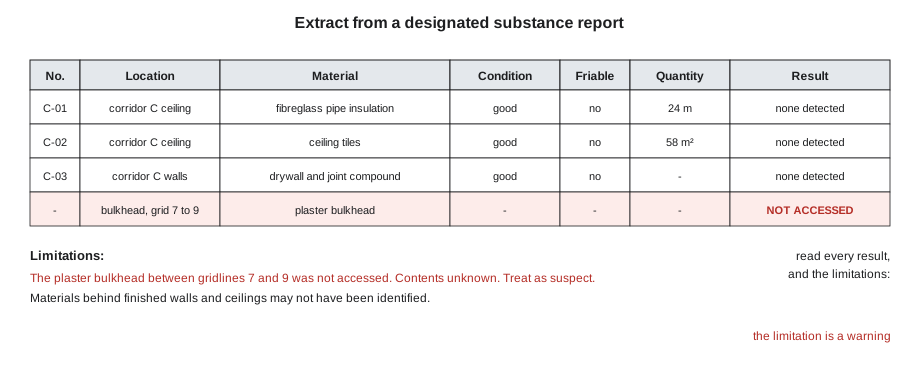
On Wednesday, September 16, before Mei's first evening session, Raj Sandhu and Bernie sat in the Mountview site office with the hospital's designated substance report for the link corridor in the 1974 south wing, where the new mains would connect to the old building. Raj had marked one line in yellow: "Plaster bulkhead, corridor C, gridlines 7 to 9: not accessed. Contents unknown. Treat as suspect." He asked the hospital's facilities manager, Colm Draper, whether any work was planned inside it. "Not by us," Colm said. Six days later, the bulkhead was the centre of the job. Lesson 12 tells that story. This lesson explains the documents that tell you where asbestos is, how samples are taken and analysed, how to read a survey and a laboratory result, and what labels and signs mean.
As an insulator, you will not usually take samples or write surveys. You will read them, compare them with what you find, and decide when something does not match. That is a skill, and it is the skill this lesson teaches.
The documents that tell you where asbestos is
Several documents may describe the asbestos in a building or plant:
- The designated substance list in the tender documents. Under section 30 of the OHSA, the project owner must list the designated substances present at the project, and contractors must pass the list to their subcontractors.
- The designated substance report (DSR) or asbestos survey. A consultant inspects the areas affected by the project, takes samples and reports what was found, where, in what condition and in what quantity. A pre-construction or pre-renovation survey is usually more thorough than a general building survey, because it may open up walls and ceilings in the work area.
- The owner's asbestos record for the building. In buildings that contain ACM, the owner must keep a record of the type and location of the material, update it at least every twelve months or when new information comes in, and make it available to workers and occupants.
- The plant's own procedures. Industrial owners such as Kellerton keep a survey of their insulation systems and a permit procedure that requires a check of the survey before any insulation is opened.
- Abatement records and clearance reports. These show what was removed, when, by whom, and the clearance air test results that confirmed the area was clean.
Before you start work in an older building, ask your supervisor what the documents say about your work area. Read them yourself if you can. If they do not cover your area, or if they are old, ask whether they are still current.
How a survey is done
A surveyor walks the area systematically, identifies every material that might contain asbestos, and groups them into homogeneous materials: materials that look the same, were applied at the same time and serve the same purpose, such as "aircell on heating pipe, corridor ceilings, first floor" or "cement on elbows, steam header." Each homogeneous material is sampled, usually in more than one place, or is assumed to contain asbestos without sampling.
Ontario's regulation sets a minimum number of bulk samples for each homogeneous material, rising with the area the material covers, and treats the material as ACM if any one of its samples contains asbestos at or above the threshold. An owner can also choose to treat a material as ACM without sampling it, which is common for small quantities that will be removed anyway.
The surveyor also records the condition of each material (good, damaged or significantly damaged), whether it is friable, how much there is, and any areas that could not be inspected. That last item, often called limitations or areas not accessed, is one of the most important parts of the report for a contractor. It tells you where the survey's knowledge ends.
Who takes samples, and how
Taking a bulk sample means cutting or coring a small piece out of the material, which disturbs it. It must be done by a trained person, usually the owner's consultant, with controls to keep fibre release to a minimum: wetting the spot, wearing a respirator, catching debris, sealing the sample in a labelled container, and patching the sampled spot so it does not keep releasing fibres.
Insulators do not take asbestos samples. Even if you have seen it done, do not cut a piece off a fitting to send to a laboratory yourself. You would be disturbing suspect material without the training, equipment or authority, and a sample taken without the proper method may not be accepted anyway. When something needs sampling, stop, report it, and let your supervisor arrange for the owner's consultant.
In the laboratory, bulk samples are usually analysed by polarized light microscopy (PLM). The analyst identifies the asbestos type and estimates how much is present. Results are reported as the type of asbestos and an amount, such as "chrysotile 2 to 5 parts in 100," or as "none detected." When a result is near the threshold, a more precise method may be requested. Laboratories should be accredited for asbestos analysis.
Reading a laboratory result
A laboratory report lists each sample, its description and the result. The rules for deciding what the results mean are simple but strict:
- If any sample of a homogeneous material contains asbestos above the threshold, the whole material is asbestos-containing, everywhere it occurs.
- "None detected" in one sample does not clear a material if another sample of the same material is positive.
- Each layer of a layered material should be analysed separately, because a modern finish can sit on an old asbestos cement.
- A result applies only to the material sampled. A cement on one elbow says nothing about a different-looking cement on the next tee.
Worked problem
Interpreting results
The consultant's results for three materials in the Mountview corridor are: (1) fibreglass pipe insulation, three samples, all none detected; (2) aircell on an abandoned line, two samples, chrysotile 50 to 60 parts in 100 and none detected; (3) plaster in the bulkhead, one sample, chrysotile 0.7 parts in 100. Which materials are ACM in Ontario?
Show solution
- Material 1: all samples none detected, so it is not ACM.
- Material 2: one sample is positive, so the whole material is ACM. The none-detected sample does not clear it; it may have been taken from a patch or a later repair.
- Material 3: 0.7 parts in 100 is above Ontario's threshold of 0.5 parts in 100, so it is ACM.
- Work that would disturb materials 2 or 3 must be classified and done as asbestos work.
Answer: The aircell and the plaster are ACM; the fibreglass is not.
The example shows why you should read the actual numbers and the notes, not just a summary line. It also shows why a surveyor's choice of sample locations matters: a material repaired with a different product in one spot can give a misleading "none detected."
Comparing the survey with what you find
The most valuable thing an insulator can do with a survey is compare it with the work in front of them. Before you open up insulation, ask:
- Is my exact work area covered by the survey, including ceiling spaces, chases and the insides of walls I will open?
- Does the material I see match the description? Same type, same colour, same layering?
- Are there materials here that the survey does not mention, such as an abandoned line, a different cement on one fitting, or debris?
- Has anything changed since the survey: damage, leaks, other trades' work?
- Does the survey list limitations or areas not accessed near my work?
If the answer to any of these suggests a gap, stop and report it before you go further. At Kellerton, the tee Devon found was under a jacket that matched the 2004 reinsulation, but the cement under it did not match anything on the survey. At Mountview, the plaster bulkhead was listed as not accessed. In both cases the survey itself pointed to the gap for anyone who read it carefully.
Labels and signs
Many owners label asbestos-containing insulation where it remains in place, with stickers or stencilled warnings on the jacket or on the pipe nearby. Labels help, but their absence proves nothing: many buildings have no labels at all, labels fall off, and new jackets go over old material.
During asbestos work, Ontario's regulation requires warning signs at Type 3 work areas and at other areas where asbestos work is being done, telling people that an asbestos hazard is present and who may enter. Waste containers must be labelled as asbestos waste. Never enter a signed asbestos work area unless you are part of that work and properly trained and protected.
If you see an asbestos label on a jacket in your work area, treat the material under it as ACM, whatever the survey says, and ask your supervisor to resolve the difference.
Keeping the record up to date
When a contractor finds something new, the owner's documents must be updated. At Kellerton, the consultant added the tee to the survey after it was sampled. At Mountview, the abandoned line and the plaster went into the hospital's record. Your report is often how the record gets corrected, so make it clear: what you found, exactly where (gridlines, room numbers, line numbers), what it looked like, and what had been done to it before you stopped.
What a laboratory report contains
A laboratory report for bulk asbestos samples is usually a few pages long. Besides the results, it contains information that tells you how much to trust them:
- The laboratory's name and accreditation for asbestos analysis.
- The method used, such as polarized light microscopy, and its detection limit or reporting limit.
- A sample list with the client's sample numbers, matching the numbers in the survey, and a description of each sample as received.
- For layered samples, a separate result for each layer, such as "layer 1: white finish, none detected; layer 2: grey cement, chrysotile 10 to 15 parts in 100."
- The asbestos types found and their estimated amounts, or none detected.
- The name of the analyst and the date of analysis.
- A chain of custody form showing who took the samples, when, and who handled them until they reached the laboratory.
If a result seems wrong, or a sample description does not match the material it was supposed to come from, raise it with your supervisor. Samples can be mislabelled, and a surveyor may have sampled a later patch rather than the original material.
Managing asbestos that stays in place
Not all asbestos is removed. Owners often decide to leave asbestos-containing material in place when it is in good condition and not in the way of planned work, and to manage it under an asbestos management program. Such a program usually includes:
- The record or plan of where the material is and its condition.
- Regular inspections to check that the material is still in good condition.
- Labels, signs or other warnings at the material or at the entrances to the spaces that contain it.
- A permit or approval system, so that nobody works on or near the material without the asbestos coordinator knowing.
- Repair or removal when the material is damaged or when work will disturb it.
On a plant maintenance contract, Coldstream's crews meet managed asbestos constantly: old fittings in a boiler house, labelled lines in a tunnel, a breeching that is scheduled for abatement next year. The plant's permit system is how the crew learns about them. Never treat a permit as paperwork to get through; read what it says about hazardous materials and ask if anything is unclear.
One last point about surveys: they age. A survey done ten years ago may not reflect repairs, abatement or new damage since then, and an owner's record that has not been updated may still list material that was removed, or miss material that was found later. When the date on a survey is old, ask whether it has been reviewed recently and whether any work has been done in the area since. A current, project-specific survey for the exact work area is always the best basis for planning.
Common mistakes
MistakeReading only the summary page of a survey.
InsteadRead the details for your area, including the limitations and areas not accessed.
MistakeTaking a sample yourself to save time.
InsteadSampling disturbs the material; it is done by a trained consultant with controls.
MistakeAssuming one none-detected result clears a material.
InsteadIf any sample of a homogeneous material is positive, the whole material is asbestos-containing.
MistakeAssuming unlabelled insulation is asbestos-free.
InsteadMany buildings have no labels; check the survey and treat unknown old material as suspect.
MistakeTrusting a survey for a different area or an older version.
InsteadMake sure the survey covers your exact work area and is current.
Summary and key terms
- The designated substance list, the designated substance report or survey and the owner's asbestos record tell contractors where asbestos is.
- Surveyors group materials into homogeneous materials, sample each one or assume it is ACM, and record condition, friability, quantity and limitations.
- Bulk samples are taken only by trained people with controls, and are usually analysed by polarized light microscopy.
- If any sample of a homogeneous material is positive, the whole material is asbestos-containing; read each layer and each result.
- Compare the survey with what you see, and stop if there is any gap or mismatch.
- Labels and signs warn of asbestos, but missing labels prove nothing.
- Designated substance report (DSR)
- A consultant's report on the designated substances, including asbestos, in the area of a project.
- Homogeneous material
- A material that looks the same, was applied at the same time and serves the same purpose throughout an area.
- Bulk sample
- A small piece of a material taken for laboratory analysis.
- Limitations
- The areas or materials a survey could not inspect or sample.
- None detected
- A laboratory result meaning no asbestos was found in that sample by the method used.
- Point counting
- A more precise microscope method for measuring low asbestos contents.
- Asbestos management plan
- An owner's record of where asbestos is in a building, its condition and how it is managed.
Practice problems
Work each problem on paper first, then reveal the answer to check.
What is the single most important thing to look for in a survey before opening up a ceiling?
Show answer
Whether the ceiling space is covered, and any limitations or areas not accessed in or near it.
Two samples of the same aircell give none detected and chrysotile 40 parts in 100. Is the aircell asbestos-containing?
Show answer
Yes. If any sample of a homogeneous material is positive, the whole material is ACM.
Why should each layer of a layered fitting cover be analysed separately?
Show answer
A modern layer can sit over an old asbestos cement; one result would hide the other.
Why don't insulators take their own asbestos samples?
Show answer
Sampling disturbs the material and needs training, controls and an accepted method.
What should a good report of a new find include?
Show answer
What it was, exactly where, what it looked like, and what had been done to it before work stopped.
Lesson quiz · 5 questions
Score 60% or more to complete this lesson.
Create a free account to save your progress, take quizzes and earn a certificate.