
INS-230 · Lesson 12 of 12 · 25 min
Case study: a renovation that uncovers old pipe covering
▶ Video coming soon A video version of this lesson is on the way.
This lesson follows a renovation at Mountview Hospital from September 16 to October 9, 2026, when new heating and domestic water mains from the new addition were connected through the ground-floor link corridor of the hospital's 1974 south wing. It brings together everything in this course: surveys and their limits, recognizing suspect material, stopping work, the roles of the owner, the consultant and the abatement contractor, the rules for classifying asbestos work, silica and lead on the same job, respirators, hygiene and records. As you read, notice who knew what, and when, and ask yourself what you would have done at each point. The questions after each part are worth answering before you read on.
The job
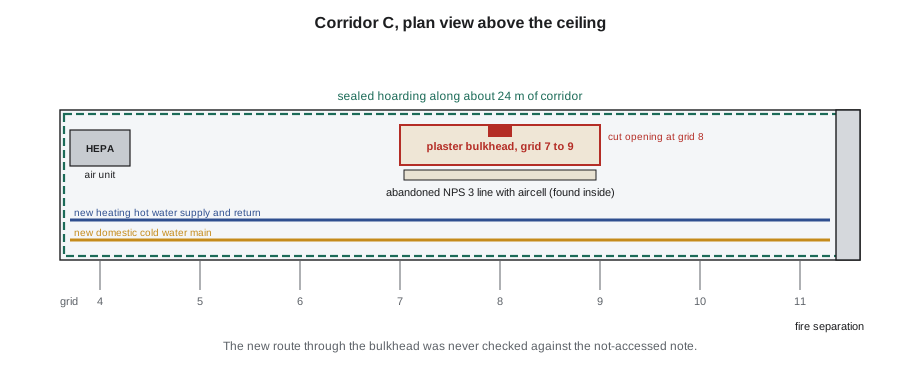
The new Mountview addition is fed from the hospital's existing central plant in the old south wing. To connect them, Harcourt Mechanical was installing an NPS 4 heating hot water supply and return and an NPS 2 domestic cold water main along about 24 m of the ground-floor link corridor, called corridor C, above its suspended T-bar ceiling. Coldstream's scope, as a subcontractor to Harcourt, was to insulate the new mains as they were installed and to firestop the insulated pipes where they passed through the concrete block fire separation at the end of the corridor.
Because the corridor is in a working hospital, the work was done behind a sealed hoarding, with a HEPA-filtered air unit keeping the work zone at slightly lower pressure than the hospital, as the hospital's infection control plan required. Abel Mensah, the hospital's infection control nurse, inspected the hoarding every morning. Colm Draper, the facilities manager, was the owner's representative.
Before the work: what the documents said
The hospital had a designated substance report for the south wing, prepared in 2019 and updated for this project in August 2026. For corridor C it said:
- Pipe insulation above the ceiling: fibreglass with an all-service jacket, installed in 1996 when the corridor's original lines were replaced. Three samples, none detected.
- Ceiling tiles: none detected.
- Drywall and joint compound on the corridor walls: none detected.
- Plaster bulkhead between gridlines 7 and 9: not accessed. Contents unknown. Treat as suspect.
The report also listed asbestos-containing pipe insulation in the old boiler room, labelled and managed, and lead-containing paint on structural steel and old hangers throughout the 1974 building.
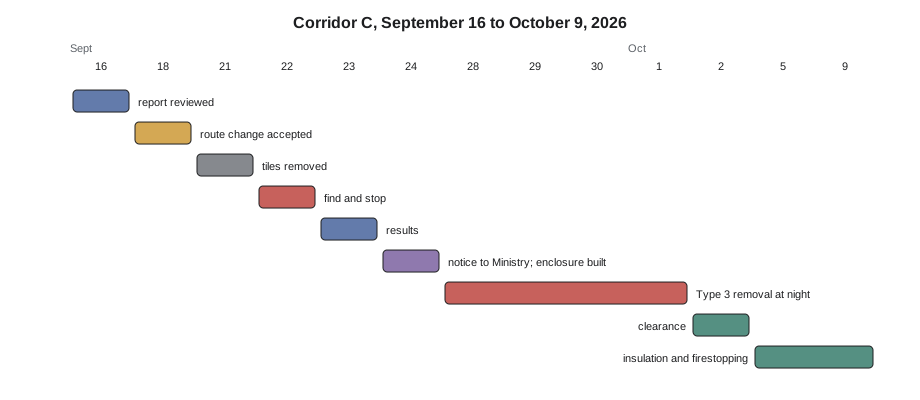
On Wednesday, September 16, Raj Sandhu and Bernie reviewed the report in the site office (lesson 5). Raj asked Colm whether any work was planned in the bulkhead, and Colm said no. At that time, the drawings showed the new mains passing below the bulkhead. Harcourt's foreman, Gord Fennimore, had a copy of the same report.
What Raj did not know was that Harcourt had issued a request for information the week before, proposing to route the heating mains through the bulkhead to gain headroom, and that the engineer had accepted it verbally on Friday, September 18. The change reached Harcourt's fitters on Monday morning. Nobody connected it to the line in the report that said "not accessed."
Questions before you read on: Whose job was it to check the route change against the report? What could Raj and Bernie have asked on September 16 that might have caught it?
Monday and Tuesday: the find
On Monday, September 21, the ceiling contractor removed the T-bar tiles along the corridor inside the hoarding, and Harcourt began hanging the new domestic water main. Coldstream's crew, Bernie and Tessa Moreau, followed, insulating the domestic water main as it was tested.
On Tuesday morning, September 22, one of Harcourt's fitters cut a rectangular opening about 300 mm by 450 mm into the side of the plaster bulkhead at gridline 8 with an oscillating saw, to see where the heating mains could pass through. Behind the plaster was something nobody had expected: an old NPS 3 pipe running the length of the bulkhead, wrapped in grey-white corrugated paper under a torn canvas skin, with cement-covered elbows at each end. The saw had cut into the paper wrap, and crumbled pieces and dust had fallen onto the ceiling tiles stacked below and onto the floor.
Tessa was on a stepladder at gridline 7, insulating the domestic water main, when she saw the opening. She recognized aircell from Mei's photographs. She told the fitter to stop cutting and to come down without touching anything, climbed down herself, and called Bernie, who was at the other end of the corridor.
Bernie followed the stop procedure (lesson 6). She told everyone inside the hoarding to stop work and stay where they were. She called Gord, who stopped Harcourt's crew, and Colm, who called the hospital's environmental consultant, Ingrid Solvik, and told Abel Mensah. The hoarding stayed closed, and the HEPA air unit was left running, as the infection control plan required, so that the zone stayed at lower pressure than the hospital. Nobody swept, vacuumed or moved the debris. The fitter set the saw down on the floor where he stood.
Ingrid arrived about forty-five minutes later. She directed the five people inside the hoarding to HEPA vacuum and remove their outer coveralls at the hoarding exit, bag them, and wash; the fitter, who had been closest, had been wearing a disposable mask, not a fitted respirator. She then took bulk samples of the aircell, the elbow cement and the plaster under controlled conditions, a sample of the settled dust on the tiles, and air samples inside the hoarding and in the hospital corridor outside it. She wetted and wrapped the damaged section of aircell to stop further release and taped the opening shut.
Mei came to the site that afternoon and wrote an exposure incident report for Tessa and Bernie, and Harcourt did the same for its two fitters. The Coldstream crew moved to work in the new addition for the rest of the week.
Questions before you read on: What did Tessa do right, and in what order? Why was the fitter's saw left where it was? Why did Ingrid wet and wrap the damaged section?
The results
On Wednesday afternoon, September 23, the laboratory reported:
| Sample | Result |
|---|---|
| Aircell on the abandoned NPS 3 line | Chrysotile, 50 to 60 parts in 100 |
| Cement on the elbows | Chrysotile and amosite, about 20 parts in 100 in total |
| Plaster of the bulkhead | Chrysotile, 0.7 parts in 100 |
| Settled dust on the ceiling tiles below the opening | Chrysotile fibres present |
| Air inside the hoarding, afternoon of September 22 | 0.004 f/cc (phase contrast) |
| Air in the hospital corridor outside the hoarding | Below the detection limit |
Ingrid explained what the results meant. The aircell and the elbow cement were clearly ACM. The plaster, at 0.7 parts in 100, was above Ontario's threshold of 0.5 parts in 100, so it was ACM too. The debris on the tiles contained asbestos, so the tiles and the whole ceiling space below the opening had to be treated as contaminated. The air results showed that the hoarding and the HEPA unit had kept fibres from reaching the hospital, and that the levels inside the hoarding after the disturbance were low, though nobody could know what the peak had been while the saw was cutting.
Worked problem
Sizing and classifying the abatement
The abandoned line was about 18 m long with aircell about 140 mm in outside diameter. The contaminated ceiling space extended over about 24 m of the 2.4 m wide corridor. Find the surface area of aircell and the area of ceiling space to be cleaned, and decide how the work is classified in Ontario.
Show solution
- Aircell surface area = π × 0.140 × 18 = 7.9 m².
- Ceiling space to clean = 24 × 2.4 = 57.6 m².
- Removing 7.9 m² of friable aircell directly, rather than by glove bag, is well over 1 m², a Type 3 operation.
- Glove bags could have removed the pipe insulation as a Type 2 operation (with notice, since it is over 1 m²), but they cannot clean debris from a ceiling space or remove plaster, so the consultant specified a Type 3 enclosure for the whole area.
- A Type 3 operation requires oral and written notice to a Ministry inspector before it starts, certified 253W workers and a 253S supervisor, and a clearance air test with no sample above 0.01 f/cc.
Answer: About 7.9 m² of aircell and 57.6 m² of ceiling space; the work was a Type 3 operation in an enclosure.
The abatement
The hospital hired Halden Abatement, whose crew held 253W certificates under a 253S supervisor. Halden gave notice to the Ministry inspector by phone and in writing on Thursday, September 24, and built the enclosure inside the existing hoarding over the weekend, with a three-stage decontamination unit at the hoarding entrance and negative air units exhausting through high-efficiency filters. To keep the noise and traffic away from patients, the removal was done at night, from Monday, September 28, to Thursday, October 1.
Halden removed the abandoned line with its aircell and elbows, the plaster bulkhead, the contaminated ceiling tiles and the debris, and cleaned the ceiling space and the floor with HEPA vacuums and wet wiping. The old hangers on the abandoned line had lead-containing paint, so Halden cut them with hand tools instead of a torch, and they went out with the asbestos waste. Ingrid's technician monitored the air inside and outside the enclosure every shift.
On Friday, October 2, after the final cleaning, Ingrid took clearance air samples inside the enclosure. All five were at or below 0.006 f/cc, below the 0.01 f/cc that O. Reg. 278/05 requires. The enclosure came down that afternoon, and Colm released the corridor for work on Monday.
Questions before you read on: Why was the plaster removed in the same enclosure? What did the clearance result allow, and what did it not tell anyone about the rest of the building?
Back to work: silica and the firestopping
Coldstream and Harcourt returned on Monday, October 5. Harcourt hung the heating mains through the space where the bulkhead had been, with new hangers fixed to the concrete slab above. Its fitters drilled the anchor holes with hammer drills fitted with dust shrouds connected to HEPA vacuums, and cored the two new openings in the concrete block fire separation with a water-fed core drill, collecting the slurry as they went.
Bernie and Tessa insulated the new mains from October 5 to 8. On Friday, October 9, Tessa firestopped the four insulated pipe penetrations in the fire separation. Before installing the firestop system, she cleaned out the cored openings with a HEPA vacuum, not compressed air, and wore her fitted half-mask with P100 filters while she drilled the anchor holes for the firestop collars, as the Ministry's silica guideline calls for when drilling holes in concrete or masonry.
Bernie's final inspection, with Gord, found no deficiencies. The hospital's facilities team updated the building's asbestos record to show the removal, the clearance and the date.
What went right and what went wrong
At the project wrap-up meeting on Thursday, October 15, Colm asked each contractor what they would do differently. The answers, written up by Mei for Coldstream's files, are a good summary of this course.
| What happened | Why it mattered | Course lesson |
|---|---|---|
| The report listed the bulkhead as not accessed | The survey itself pointed to the gap | Lesson 5 |
| A route change reached the fitters without a hazard review | The change moved work into an unsurveyed area | Lessons 4 and 5 |
| A fitter cut into the bulkhead without checking the report | Suspect material was disturbed | Lessons 2 and 6 |
| Tessa recognized aircell and stopped the work | The disturbance went no further | Lessons 2 and 6 |
| Bernie stopped all trades and kept the hoarding closed | Fibres did not reach the hospital | Lesson 6 |
| The consultant sampled, wetted and wrapped the damage | Release was stopped; results came within a day | Lessons 5 and 6 |
| The work was classified and done by certified abatement workers | Removal was safe and legal | Lesson 7 |
| Lead-painted hangers were cut with hand tools | No lead fume was created | Lesson 10 |
| Silica controls were used for drilling and coring | Dust was captured at the source | Lesson 8 |
| Outer clothing was bagged at the hoarding; exposures were recorded | No contamination went home; records exist for the future | Lessons 3 and 11 |
Harcourt changed its procedure so that every request for information that moves work into a new area is checked against the designated substance information by the foreman and the owner before it goes to the crew. Coldstream added a line to its pre-job checklist: ask whether any route changes have been made since the hazardous materials documents were issued.
Worked problem
Counting the cost
The stop on September 22 cost 8.5 worker-hours on the day (lesson 6). The corridor was closed from the afternoon of Tuesday, September 22, until Monday, October 5. Coldstream's insulation of the corridor mains was planned to take 4 working days and took 4 working days once it resumed. How many calendar days and working days was the corridor closed, and what did the delay actually cost Coldstream?
Show solution
- Calendar days from September 22 to October 5 = 13 days.
- Working days lost in the corridor: September 23, 24, 25, 28, 29, 30 and October 1 and 2 = 8 working days.
- Coldstream's crew worked in the new addition during those days, so most of the time was rescheduled rather than lost; the direct loss was the 4.5 Coldstream worker-hours on September 22 plus a few hours of moving equipment.
- The insulation itself took the planned 4 days after the corridor reopened.
Answer: The corridor was closed 13 calendar days, 8 of them working days. The real cost to Coldstream was a few hours; the exposure that stopping prevented could not be priced.
When Mei showed the case at the Wednesday session on October 21, Devon asked Tessa what had gone through her mind on the ladder. "Honestly?" she said. "Mei's photographs. And Bernie's uncle. I didn't know it was aircell for sure. I knew it looked like it, and I knew it wasn't supposed to be there. That was enough."
Common mistakes
MistakeTreating a surveyor's "not accessed" note as somebody else's problem.
InsteadA limitation is a warning; check it against every change in the work.
MistakeLetting a route change go to the crew without a hazard review.
InsteadCheck every change that moves work into a new area against the survey first.
MistakeOpening a bulkhead or wall to have a look.
InsteadOpening an unsurveyed space is a disturbance; have the consultant inspect it first.
MistakeCleaning up debris after a disturbance so work can continue.
InsteadLeave debris for the abatement contractor; it is contaminated.
MistakeAssuming clearance in one area clears the whole building.
InsteadClearance applies only to the area abated and tested.
Summary and key terms
- The hospital's report listed the corridor's materials and warned that the plaster bulkhead had not been accessed.
- A route change moved work into the bulkhead without a hazard review, and a fitter cut into it, exposing and damaging an abandoned aircell-covered line.
- Tessa recognized suspect material, stopped the work and called Bernie, who stopped all trades and kept the hoarding closed.
- The consultant sampled and controlled the damage; the aircell, elbow cement, plaster and debris all contained asbestos.
- The work was a Type 3 operation in an enclosure, with notice to the Ministry, certified workers and a clearance air test below 0.01 f/cc.
- Lead-painted hangers and silica-producing drilling were controlled, and exposures were recorded.
- The delay cost a few hours; both contractors changed their procedures to catch route changes in unsurveyed areas.
- Request for information (RFI)
- A formal question from a contractor to the designer, often used to propose a change.
- Infection control plan
- A hospital's measures, such as sealed hoarding and air filtration, that protect patients from construction dust.
- Hoarding
- A temporary wall or enclosure that separates a work area from occupied space.
- Exposure incident report
- A record of an unplanned exposure, listing who was exposed, to what, where, when and for how long.
- Wrap-up meeting
- A meeting at the end of a job to review what went well and what to change.
- Firestop system
- A tested combination of materials that seals a penetration through a fire separation.
Practice problems
Work each problem on paper first, then reveal the answer to check.
What line in the report should have stopped the cut into the bulkhead?
Show answer
The bulkhead was listed as not accessed, contents unknown, treat as suspect.
Name three things Tessa and Bernie did right on September 22.
Show answer
Tessa recognized the aircell, stopped the fitter and called Bernie; Bernie stopped all trades, kept the hoarding closed and called the owner; nobody cleaned up (any three).
Why was the work a Type 3 operation even though glove bags can remove pipe insulation as Type 2?
Show answer
Debris had to be cleaned from the ceiling space and the plaster removed, which glove bags cannot do.
An abandoned line 12 m long has aircell 120 mm in diameter. What is the surface area?
Show answer
π × 0.120 × 12 = 4.5 m².
What did Coldstream add to its pre-job checklist?
Show answer
Ask whether any route changes have been made since the hazardous materials documents were issued.
Lesson quiz · 5 questions
Score 60% or more to complete this lesson.
Create a free account to save your progress, take quizzes and earn a certificate.