
INS-230 · Lesson 8 of 12 · 21 min
Crystalline silica and other dusts
▶ Video coming soon A video version of this lesson is on the way.
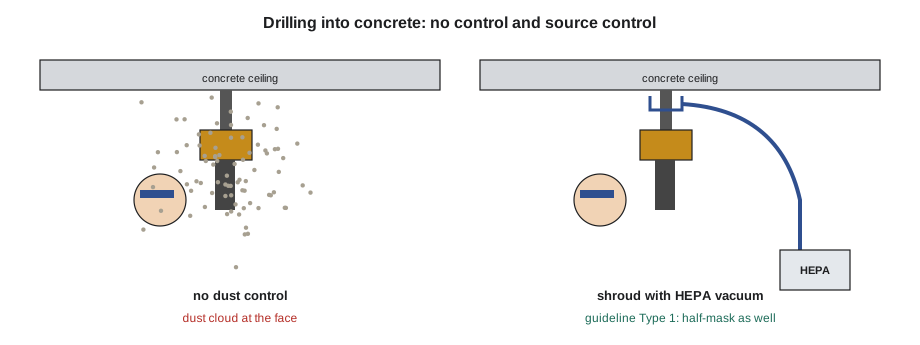
On Thursday, October 1, Priya Lam spent the day on Coldstream's firestopping crew in the new Mountview addition, sealing the openings where insulated pipes pass through concrete fire separations. One opening had been cored too small for the insulated pipe, so Harcourt's crew enlarged it with a water-fed core drill, and Priya then drilled sixteen small anchor holes for firestop collars with a hammer drill fitted with a dust shroud connected to a HEPA vacuum. Mei used photographs from that day at her session on Wednesday, October 14. "Asbestos gets all the attention," she said, "but you are far more likely to breathe silica on a modern job than asbestos. Concrete is everywhere, and every hole you drill in it makes silica dust."
This lesson covers crystalline silica, where an insulator meets it, how it harms the lungs and the rules that control it. It also covers the other dusts and biological hazards that turn up when old insulation systems are opened.
What crystalline silica is
Silica is silicon dioxide, one of the most common substances on earth. In its crystalline forms, it is a major part of sand, gravel, granite, sandstone and many other rocks, and therefore of concrete, mortar, brick, block, tile and many refractories. The most common crystalline form is quartz. Cristobalite and tridymite are other crystalline forms, made naturally in volcanic rock or created when some silica-containing materials are heated to high temperatures, as happens to some refractory products and to diatomaceous earth.
Intact concrete and rock are not hazardous to touch or to be near. The hazard is respirable crystalline silica: particles small enough to reach the deepest part of the lungs, produced when these materials are drilled, cut, ground, chipped, crushed, abrasive-blasted or swept up dry. The particles that matter are far too small to see, so a cloud of visible dust is a sign that a great many respirable particles are also present.
Amorphous silica, which is not crystalline, is found in some insulation products such as certain glass fibres and precipitated silica. It is much less hazardous than crystalline silica. The rules discussed here concern crystalline silica.
Where insulators meet silica
Insulators are not concrete workers, but silica turns up in their work more often than many people expect:
- Drilling anchor holes in concrete or masonry for supports, hangers, channels, firestop collars and equipment insulation fasteners.
- Cleaning out cored or drilled holes and sleeves before firestopping, especially by blowing or brushing.
- Chipping or grinding concrete, mortar or grout around penetrations so that insulation or a firestop system will fit.
- Cutting or grinding masonry, brick or block to install sleeves or insulation on equipment.
- Removing old refractory, castable or brick linings near boilers, kilns, ovens and breeching. Old refractories may also contain asbestos, so they are checked against the survey first.
- Working near other trades who are coring, saw-cutting, chasing, grinding or demolishing concrete and masonry.
- Dry sweeping concrete dust, or using compressed air to clean a work area.
- Working with or removing some heat-aged high-temperature insulations that may have formed cristobalite (lesson 9).
How silica harms the body
Respirable crystalline silica damages the lungs in several ways.
- Silicosis: scarring of the lung tissue around silica particles, which forms nodules and stiffens the lung. Chronic silicosis develops after ten or more years of exposure; accelerated silicosis can appear within five to ten years of heavy exposure; acute silicosis, from very heavy exposure such as uncontrolled abrasive blasting, can appear within months and can kill quickly. There is no cure, and silicosis can keep getting worse after exposure stops.
- Lung cancer: crystalline silica is classified as a known human carcinogen.
- Chronic obstructive pulmonary disease (COPD), including bronchitis and emphysema.
- Kidney disease and autoimmune diseases have also been linked to silica exposure, and silicosis greatly increases the risk of tuberculosis.
Like asbestos, silica gives little warning at the time of exposure. The dust may make you cough, but the damage that matters develops slowly and silently. Unlike asbestos, silica is present on nearly every construction site, so control has to be part of ordinary work, not something reserved for special projects.
Silica rules in Ontario
Silica is a designated substance in Ontario. Ontario Regulation 490/09 sets occupational exposure limits for respirable crystalline silica of 0.10 mg/m³ for quartz and 0.05 mg/m³ for cristobalite, as eight-hour time-weighted averages. That regulation does not apply to construction projects, but construction employers must still take every precaution reasonable in the circumstances under clause 25(2)(h) of the OHSA, and the construction regulation requires that hazardous dust be controlled or, where it cannot be, that suitable respirators and protective equipment be provided and used.
To help employers, the Ministry publishes a guideline, Silica on Construction Projects. It sorts common tasks into Type 1, Type 2 and Type 3 operations by the exposure they are expected to produce, and sets out the controls and respirators for each. For example, drilling holes in concrete or rock is generally a Type 1 operation, for which the guideline calls for a half-mask respirator with a particulate filter (an assigned protection factor of 10) along with dust control. Using a power tool to cut, grind or polish concrete, masonry or refractory is a Type 2 operation, calling for a respirator with a protection factor of 50, such as a full-facepiece respirator with high-efficiency filters or a tight-fitting powered respirator. Abrasive blasting is Type 3.
The guideline also calls for wet methods or HEPA vacuums for clean-up instead of dry sweeping or compressed air, for restricted access to dusty areas, for washing facilities and for training. Because silica is a designated substance, project owners must include it in the section 30 list in tender documents.
| Task | Main control | Respirator (guideline) |
|---|---|---|
| Drilling anchor holes in concrete | Drill shroud with HEPA vacuum, or water | Half-mask particulate, APF 10 (Type 1) |
| Core drilling a sleeve opening | Water-fed core drill | Half-mask particulate, APF 10 (Type 1) |
| Grinding concrete or mortar around a penetration | Grinder shroud with dust collector, or water | APF 50 respirator (Type 2) |
| Cleaning out holes and sleeves | HEPA vacuum, never compressed air | As for the task that made the dust |
| Clean-up of concrete dust | Wet sweeping or HEPA vacuum, never dry sweeping | Depends on the conditions |
Controlling silica on the job
Good silica control is mostly about the tools and habits you bring to the job:
- Use tools with dust extraction: drills and grinders with shrouds connected to a vacuum with a high-efficiency filter, set to the airflow the tool maker recommends, or water-fed tools where water can be used safely.
- Keep the extraction working: empty the vacuum and change filters as the maker directs, check hoses for blockages, and replace damaged shrouds.
- Clean holes and surfaces with a HEPA vacuum, not by blowing them out with compressed air or your breath.
- Clean up with wet methods or a HEPA vacuum; never dry sweep concrete dust.
- Position yourself upwind or away from the dust, and keep other workers out of the dusty zone.
- Wear the respirator the task requires, fit-tested and maintained (lesson 11), and safety glasses or goggles.
- Do not eat, drink or smoke in dusty areas, and wash before breaks.
Priya's sixteen anchor holes at Mountview produced almost no visible dust because the shroud and vacuum were working properly. On another floor the same day, a different trade's worker was drilling with a bare hammer drill and no vacuum, and the dust hung in the air for minutes afterwards. Bernie spoke to that trade's foreman.
Worked problem
Checking a silica exposure result
A consultant sampled a worker grinding mortar around a penetration for 2 hours, with a result of 0.18 mg/m³ of respirable quartz during the grinding. For the other 6 hours of the shift, the same worker did insulation work with a result of 0.01 mg/m³. What is the eight-hour TWA, and how does it compare with the 0.10 mg/m³ limit in O. Reg. 490/09?
Show solution
- Grinding: 0.18 × 2 = 0.36 mg/m³·h.
- Other work: 0.01 × 6 = 0.06 mg/m³·h.
- TWA = (0.36 + 0.06) ÷ 8 = 0.42 ÷ 8 = 0.0525 mg/m³.
- The TWA is about half of the 0.10 mg/m³ limit, but the grinding period was almost twice the limit, so the grinding itself needed better dust control and an APF 50 respirator under the guideline.
Answer: About 0.053 mg/m³ over the shift, below the limit, but the two hours of grinding were the problem to fix.
Other dusts from old insulation work
Opening up old insulation systems releases many other kinds of dust. Most are less hazardous than asbestos or silica, but none is harmless in quantity:
- Calcium silicate, perlite and mineral wool dust from cutting and removing modern insulation. These are irritants and nuisance dusts; cut with knives and saws designed for the material, and use dust control and a respirator where cutting is heavy.
- Gypsum and joint compound dust from opening drywall and plaster. Old joint compounds and plasters may contain asbestos (check the survey); newer ones may contain some silica.
- Old paint and coating dust, which may contain lead or other metals (lesson 10).
- General dust and dirt that has collected on old jackets, beams and ceiling tiles for decades. It may contain asbestos debris, lead and biological material, so it is treated with care until the survey says otherwise.
Exposure limits exist for general dusts as well. Insulation work that makes visible dust for long periods needs dust control and respirators, whatever the dust is.
Biological hazards
Old insulation, ceiling spaces and plant structures can harbour biological hazards that are easy to overlook.
- Mould. Insulation that has been wet for a long time, especially fibrous insulation with paper or canvas facings, can grow mould. Disturbing it releases spores that can cause allergic reactions, asthma and, in people with weak immune systems, infections. Hospitals are particularly careful about mould because of vulnerable patients.
- Bird and bat droppings. In plant rafters, pipe racks and old ceiling spaces, dried droppings can carry fungi that cause histoplasmosis and other lung infections when the dust is breathed. Droppings should be wetted and removed by trained people before work, not swept up by the insulation crew.
- Sewage and drain contamination. Insulation on leaking drain and sewage lines can be contaminated with bacteria. Use gloves, wash thoroughly, and report leaks.
Where these hazards are present, the controls are similar to those for other dusts: avoid creating dust, wet methods, HEPA vacuums, respirators, gloves, coveralls and good hygiene. In hospitals, insulation crews also follow the infection control measures set by the hospital, such as sealed hoarding and air filtration, which protect patients from the dust the work creates.
Silica in insulation and refractory products
Most modern insulation products contain little or no crystalline silica, but a few do, and some old products contain a great deal:
- Many refractory bricks, castables and mortars used in boilers, ovens and kilns contain quartz or cristobalite. Cutting, chipping or demolishing them produces respirable silica.
- Some older high-temperature insulations were made from diatomaceous earth, a natural material of fossil diatoms. When diatomaceous earth is heated during manufacture or in service, part of it can turn into cristobalite.
- Some insulating and finishing cements contain fillers with crystalline silica. Mixing dry cement powder can release it.
- Calcium silicate insulation is made from lime and silica, but the silica reacts during manufacture; check the SDS for any crystalline silica content in the product you use.
The SDS for each product lists crystalline silica if it is present above a small threshold. For removal of old material, the survey or the plant's records should show what the material is; if they do not, treat old refractories and cements as possible sources of both silica and asbestos.
Medical checks for silica
The Ministry's silica guideline recommends medical surveillance for workers who are regularly exposed to silica, and some employers include chest X-rays and breathing tests in their health programs. Coldstream offers breathing tests every two years to workers on its firestopping and refractory crews.
Medical checks do not prevent silicosis, but they can find early changes, help a worker and doctor decide what to do, and confirm that controls are working across a crew.
Common mistakes
MistakeBlowing out drilled holes with compressed air.
InsteadClean holes with a HEPA vacuum; compressed air throws silica dust into the air.
MistakeDry sweeping concrete dust at the end of the day.
InsteadUse wet methods or a HEPA vacuum.
MistakeUsing a drill shroud with an ordinary shop vacuum.
InsteadUse a vacuum with a high-efficiency filter and the airflow the tool maker recommends.
MistakeThinking silica is only a concern for concrete workers.
InsteadEvery hole drilled, cored or ground in concrete or masonry makes silica dust.
MistakeSweeping up droppings in a pipe rack before insulating.
InsteadHave droppings wetted and removed by trained people first.
Summary and key terms
- Crystalline silica, mainly quartz, is in concrete, mortar, brick, block, stone and many refractories; respirable dust is released by drilling, cutting, grinding, chipping and dry sweeping.
- Silica causes silicosis, lung cancer, COPD and kidney disease, with little warning at the time.
- O. Reg. 490/09 limits are 0.10 mg/m³ for quartz and 0.05 mg/m³ for cristobalite; on construction, the OHSA's general duty and the Ministry's silica guideline apply.
- The guideline sorts tasks into Type 1, 2 and 3 and sets controls and respirators for each.
- Use tools with shrouds and HEPA vacuums or water, clean with HEPA vacuums or wet methods, and wear the respirator the task requires.
- Old insulation work can also release other dusts, mould and dried droppings, which need dust control and hygiene.
- Crystalline silica
- Silicon dioxide in crystalline form, mainly quartz, found in sand, stone, concrete and masonry.
- Respirable crystalline silica
- Silica particles small enough to reach the deepest part of the lungs.
- Cristobalite
- A crystalline form of silica, sometimes formed when silica-containing materials are heated strongly.
- Silicosis
- Scarring of the lungs caused by breathing respirable crystalline silica.
- Dust shroud
- A cover around a drill bit or grinder wheel that captures dust for a vacuum.
- HEPA vacuum
- A vacuum with a high-efficiency particulate air filter that captures very fine particles.
- Histoplasmosis
- A lung infection caused by a fungus that grows in bird and bat droppings.
Practice problems
Work each problem on paper first, then reveal the answer to check.
Name three insulation tasks that can produce silica dust.
Show answer
Drilling anchor holes in concrete, cleaning out holes or sleeves, chipping or grinding around penetrations, cutting masonry, removing old refractory (any three).
How is drilling holes in concrete classified in the Ministry's silica guideline, and what respirator does it call for?
Show answer
Type 1; a half-mask particulate respirator (APF 10), with dust control.
What are the O. Reg. 490/09 limits for quartz and cristobalite?
Show answer
0.10 mg/m³ for quartz and 0.05 mg/m³ for cristobalite.
A worker has 0.20 mg/m³ for 1 hour and 0.02 mg/m³ for 7 hours. What is the TWA?
Show answer
(0.20 + 0.14) ÷ 8 = 0.0425 mg/m³.
Why should droppings in a pipe rack not be swept up dry?
Show answer
The dust can carry fungi that cause lung infections such as histoplasmosis.
Lesson quiz · 5 questions
Score 60% or more to complete this lesson.
Create a free account to save your progress, take quizzes and earn a certificate.