
INS-230 · Lesson 2 of 12 · 22 min
Asbestos: where it was used and what it looks like
▶ Video coming soon A video version of this lesson is on the way.
At the second session, on Wednesday, September 23, Mei brought no samples. Instead she passed around a binder of photographs from old surveys: white pipe covering with a canvas skin, grey cement on a boiler head, a corrugated paper wrap on a basement heating line, a rope gasket on a breeching door. "Every one of these is asbestos," she said. "And every one of them has a twin that looks exactly the same and isn't. That's why I don't bring samples, and why you never make your own." The day before, Tessa had found something at Mountview Hospital that made the photographs very real, and lesson 12 tells that story. This lesson is about what asbestos is, the products it went into, and the places on a piping system where it is most likely to be hiding.
The aim is recognition, not identification. You will learn which materials and locations should make you suspicious. You will not learn to decide whether something is asbestos, because nobody can do that by eye.
What asbestos is
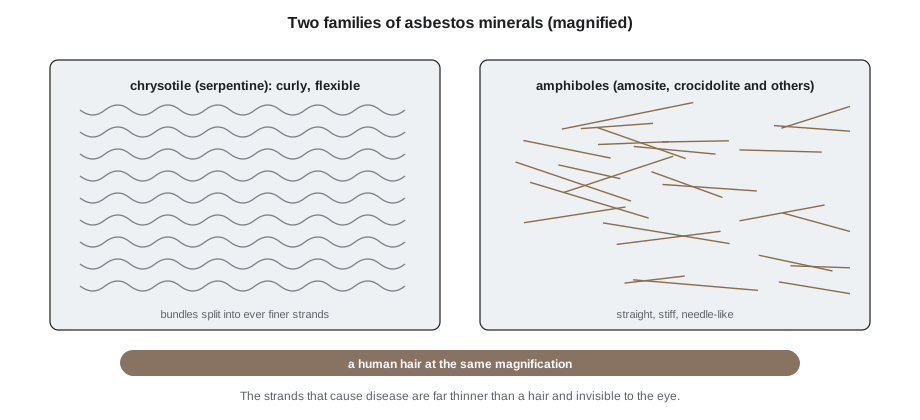
Asbestos is not a single mineral. It is a commercial name for six naturally occurring silicate minerals that grow as bundles of long, thin fibres. The fibres can be split lengthwise again and again into finer and finer fibrils, far thinner than a human hair. That property made asbestos useful, because the fibres reinforce whatever they are mixed into, and it is also what makes it dangerous, because the fine fibres float in air and reach deep into the lungs.
The six minerals fall into two families:
- Serpentine: chrysotile, or white asbestos. Its fibres are curly and flexible, like fine wavy hair. Chrysotile was by far the most widely used type, in North America and around the world.
- Amphiboles: amosite (brown asbestos), crocidolite (blue asbestos), tremolite, actinolite and anthophyllite. Their fibres are straight, stiff and needle-like. Amosite was used heavily in pipe and block insulation and in some calcium silicate products; crocidolite appeared in some high-temperature and marine insulation; tremolite turned up as a contaminant in other minerals such as some talc and vermiculite.
Amphibole fibres stay in the lung far longer than chrysotile and are generally considered more potent in causing mesothelioma, but all six types cause disease, and the rules treat all of them as asbestos. The names white, brown and blue are traditional and do not describe what a product looks like: a chrysotile product may be grey, and an amosite product may be white.
Products an insulator may meet
Asbestos went into thousands of building and industrial products. The list below concentrates on the ones insulators meet most often on pipe, equipment and ductwork. Any of them may or may not contain asbestos, depending on when and by whom it was made.
| Product | Where it is found | What it often looks like |
|---|---|---|
| Moulded pipe sections (magnesia, calcium silicate) | Steam, condensate and hot water pipe | White or off-white rigid half-sections, often under canvas or a metal jacket; chalky when broken |
| Aircell | Heating pipe in houses, schools and older commercial buildings | Layers of corrugated grey-white paper, like cardboard, under a paper or canvas wrap |
| Insulating cement (mud) and finishing cement | Elbows, tees, valves, flanges, boiler and tank heads | Hard grey, white or tan coating trowelled on by hand; sometimes over block or pipe sections |
| Block insulation | Boilers, breeching, tanks, ovens, turbines | Rigid slabs held with wire mesh and finished with cement |
| Cloth, tape and lagging | Over pipe insulation, on fittings and at joints | Woven fabric, often painted; sometimes asbestos cloth, sometimes canvas with asbestos coatings |
| Rope, wick and packing | Boiler doors, valve stems, expansion joints, breeching | Braided or twisted grey or white rope |
| Gaskets | Flanges, manways, boiler doors | Compressed sheet or woven gaskets, grey or black |
| Duct vibration isolators and tape | Connections between ducts and fans | Flexible grey or white fabric collars |
| Sprayed fireproofing and acoustic plaster | On steel beams and decks in ceiling spaces | Fluffy or textured spray coating on structure above ceilings |
| Asbestos cement pipe and board | Old drains, flues, panels | Hard grey sheet or pipe, non-friable unless broken or cut |
Several of these deserve a closer look.
Magnesia pipe covering, often sold as "85 magnesia" (the name referred to its magnesium carbonate content of about 85 parts in 100), typically had about 15 parts in 100 of asbestos fibre as reinforcement. It was standard on steam lines for decades. Calcium silicate replaced it from the 1950s and 1960s, and early calcium silicate also often contained asbestos, frequently amosite. Asbestos-free calcium silicate came later. You cannot tell from the appearance, or from the knowledge that a material is calcium silicate, whether it contains asbestos.
Aircell was cheap and common on low-temperature heating pipe. It is often in poor condition, because the paper layers break down with age and moisture, and it crumbles easily. It is a classic find in old basements and corridor ceilings.
Asbestos cement on fittings is probably the most common surprise on industrial work. When a line was reinsulated with modern pipe covering, crews often left the old cement on the fittings and jacketed over it, or patched old fittings with new cement on top of old. That is exactly what happened to the tee Devon found at Kellerton.
Sprayed fireproofing and acoustic plaster above ceilings matter to insulators because duct and pipe insulation work in ceiling spaces brushes against them, and dust from damaged fireproofing settles on everything below.
In 2018, the federal regulation that banned asbestos products in Canada also ended the long tradition of asbestos-containing gaskets and packing being sold for repairs. Older stock and installed gaskets remain, especially in plants. Treat old gaskets as suspect when flanges are opened.
Where it hides on a piping system
On a real system, asbestos is rarely where it is easy to see. Think about the history of the system and the places where old material survives.
- Fittings, valves and flanges on lines that were otherwise reinsulated. The straight pipe was easy to replace; the cement on the fittings was left.
- Under newer insulation or jackets. A newer layer may have been applied over old pipe covering to add thickness or to cover damage.
- At hangers, supports and wall penetrations, where the old insulation was hard to reach and was left in place.
- On abandoned lines. A line taken out of service may have kept its original insulation for decades, often in a ceiling, chase or crawl space that has not been opened since.
- In debris: on top of ceiling tiles, on beams, ledges and the floor of tunnels and crawl spaces, where damaged insulation has fallen over the years.
- Inside equipment: on boiler and tank shells under newer finishes, on breeching, in fire doors and in old ovens.
- In other trades' materials nearby: plaster, drywall joint compound, floor tile and mastic, roofing, and caulking. These are not insulation, but your work may disturb them.
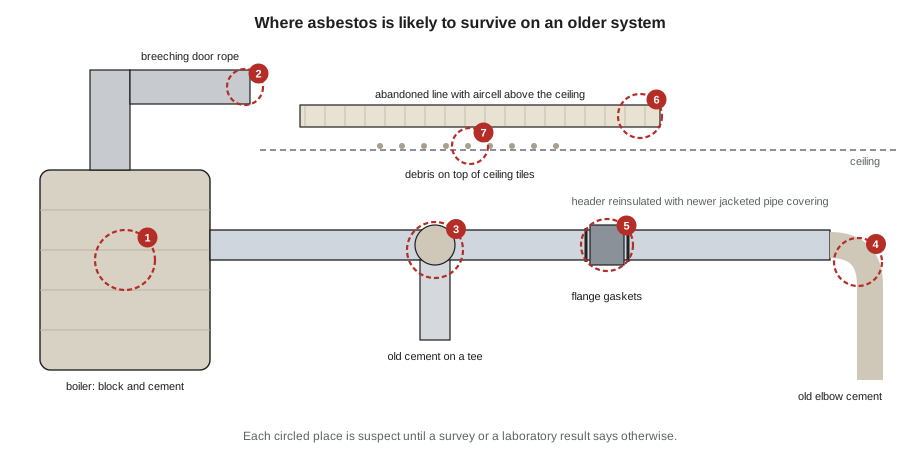
The question to ask on any job in an older building is not only what the survey says, but what the survey might have missed. Surveyors sample what they can reach without damaging the building. A wall, a plaster bulkhead, a sealed chase or a pipe buried in newer insulation may have been listed as not accessed, or may not have been noticed at all.
Clues that should make you suspicious
No clue proves that asbestos is present or absent, but some should make you stop and check the survey before you go further:
- The building or the system was installed before about 1990, and especially before about 1980.
- The material is a hard cement on a fitting, block on equipment, a corrugated paper wrap, or a white or grey rigid section under canvas.
- The insulation is older than the jacket over it, or does not match the rest of the system.
- There are layers: a newer insulation over an older one, or new cement patched over old.
- The material is labelled with an old warning, or the survey lists the same kind of material elsewhere in the building.
- There is dust or crumbled debris near damaged old insulation.
A modern-looking material is not proof of safety either. Asbestos-free substitutes look almost identical to the products they replaced. The point of these clues is to make you check, not to let you decide.
The limits of what you can tell
Mei was firm about this. "People in this trade have been told, for years, that you can tell asbestos by the colour, or by how heavy a section feels, or by breaking a piece and looking for fibres. All of those are myths. Breaking a piece to look at it is exactly the kind of disturbance that releases fibres. And even a microscope in the hands of a trained analyst needs a properly taken sample and a proper method."
Laboratory analysis is the only way to confirm the presence and type of asbestos. The usual method is polarized light microscopy, in which an analyst looks at the sample under a special microscope and identifies the fibres by their optical properties. Lesson 5 explains how samples are taken, who takes them and how to read the results. For now, remember that taking a sample is itself a disturbance, done by a trained person with the right controls, and is not something an insulator does on the side.
Worked problem
Estimating the asbestos content of a pipe section
An old survey describes a steam line covered with moulded magnesia sections, which the manufacturer's literature from the time says contained about 15 parts asbestos in 100 by weight. A one-metre section of the old pipe covering weighs about 2.4 kg. How much asbestos fibre is in a 20-metre run? Why does the answer not mean that a small amount is safe?
Show solution
- Asbestos in one section = 2.4 kg × 15 ÷ 100 = 0.36 kg.
- Asbestos in the run = 0.36 kg × 20 = 7.2 kg.
- A single gram of asbestos can contain millions of fibres, so 7.2 kg represents an enormous number of fibres.
- The hazard depends on how many fibres reach the air, not on the weight of the material; even a small, broken piece can release many fibres.
Answer: About 7.2 kg of asbestos fibre in the run. Whether the material is 15 or 1 part in 100 asbestos, disturbing it can release large numbers of fibres, so the rules treat even low-content material as asbestos-containing above a small threshold.
In Ontario, a material is asbestos-containing if it has 0.5 parts in 100 or more asbestos by dry weight. Lesson 4 explains where that threshold comes from and what it triggers.
Asbestos in other trades' materials
Insulation work often disturbs materials installed by other trades, and many of those also contained asbestos in older buildings. You will not usually work on them directly, but cutting a hole for a pipe, removing a ceiling to reach a duct, or drilling through a wall can disturb them. Check the survey for these before your work touches them:
- Plaster and textured finishes on walls and ceilings, including decorative and acoustic plasters.
- Drywall joint compound and some older drywall products.
- Vinyl floor tiles and sheet flooring, and the mastic under them.
- Vermiculite loose fill in walls and attics, some of which was contaminated with tremolite asbestos; treat it as asbestos-containing unless it has been tested.
- Asbestos cement board, panels, siding, flues and drain pipe.
- Roofing felts, flashing cements and some roof coatings.
- Caulking, glazing putty and fire-stopping materials in older buildings.
- Fire doors, some electrical panels and arc chutes, and old laboratory bench tops.
If your work will cut, drill, sand or break any of these in a building of uncertain age, the survey must cover them, just as it covers the insulation.
Reading the condition of old insulation
Surveys record the condition of asbestos-containing material because damaged material releases fibres far more easily than intact material. You should recognize the signs of damage too, because damage that has happened since the survey changes the risk:
- Torn, missing or water-stained jackets and lagging, with the insulation underneath exposed.
- Crumbling, cracked or powdery edges at joints, hangers and fittings.
- Insulation that has been crushed, kicked or knocked by people, equipment or other trades' work.
- Debris on the floor, on beams or on ceiling tiles below the insulation.
- Wet or leaking areas, where water has softened the material.
Report new damage to known or suspect material even if it is not in your way. The owner needs to know, and the damaged material may need to be repaired or removed before anyone else works near it.
Common mistakes
MistakeAssuming that white pipe covering is asbestos-free because asbestos is grey.
InsteadColour says nothing reliable; white, brown and blue are traditional names, not descriptions.
MistakeBreaking a piece off to look for fibres.
InsteadBreaking material releases fibres. Leave sampling to a trained person working under controlled conditions.
MistakeTrusting that a reinsulated line is clean because the straight pipe is new.
InsteadOld cement is often left on fittings, at supports and under jackets.
MistakeIgnoring an abandoned line in a ceiling because it is not part of the job.
InsteadAbandoned lines often keep their original insulation and may be disturbed by the work around them.
MistakeTreating calcium silicate as automatically safe.
InsteadEarly calcium silicate often contained asbestos; only analysis can tell.
Summary and key terms
- Asbestos is a group of six fibrous minerals: chrysotile (serpentine) and five amphiboles, including amosite and crocidolite.
- All types cause disease; amphiboles stay in the lung longer and are generally more potent for mesothelioma.
- Insulation products that often contained asbestos include magnesia and early calcium silicate sections, aircell, insulating cement, block, cloth, rope and gaskets.
- Asbestos hides on fittings, under newer insulation, at supports, on abandoned lines, in debris and inside equipment.
- Clues such as age, type of material and layering should make you check the survey, but nothing you can see proves that asbestos is present or absent.
- Only laboratory analysis of a properly taken sample confirms asbestos.
- Chrysotile
- White asbestos, a serpentine mineral with curly fibres; the most widely used type.
- Amosite
- Brown asbestos, an amphibole with straight fibres, used heavily in pipe and block insulation.
- Crocidolite
- Blue asbestos, an amphibole with very fine straight fibres.
- Amphibole
- The family of asbestos minerals with straight, needle-like fibres.
- Magnesia pipe covering
- Moulded pipe insulation of magnesium carbonate, usually reinforced with asbestos fibre.
- Polarized light microscopy (PLM)
- The usual laboratory method for identifying asbestos in bulk samples.
- Abandoned line
- A pipe taken out of service but left in place, often with its original insulation.
Practice problems
Work each problem on paper first, then reveal the answer to check.
Name the two families of asbestos minerals and one mineral in each.
Show answer
Serpentine (chrysotile) and amphiboles (amosite, crocidolite, tremolite, actinolite or anthophyllite).
Why is old cement on fittings such a common surprise?
Show answer
When lines were reinsulated, crews often left the old cement on fittings and jacketed over it.
Why are abandoned lines in ceilings a concern?
Show answer
They often keep their original insulation, unseen and unsampled for decades, and nearby work can disturb them.
Is it safe to break a small piece off a fitting to see whether it contains fibres? Why or why not?
Show answer
No. Breaking releases fibres, and you cannot tell asbestos by eye anyway.
A section weighs 1.8 kg and contains 15 parts in 100 asbestos. How much asbestos is in 12 sections?
Show answer
1.8 × 0.15 × 12 = 3.24 kg.
Lesson quiz · 5 questions
Score 60% or more to complete this lesson.
Create a free account to save your progress, take quizzes and earn a certificate.