
INS-230 · Lesson 3 of 12 · 23 min
Health effects of asbestos exposure
▶ Video coming soon A video version of this lesson is on the way.
At the third session, on Wednesday, September 30, Mei invited an occupational health nurse from a local clinic that sees many retired trades workers. She began with a question: "Who here has ever felt sick from asbestos?" Nobody raised a hand. "Good," she said. "Neither did any of my patients, on the day it happened. That's the problem." This lesson explains how asbestos fibres get into the body, what they do there, the diseases they cause, and why the delay between exposure and disease makes prevention the only real protection.
You do not need medical training to work safely, but you do need to understand why the rules are so strict. A worker who understands that a few minutes of careless sweeping can cause a cancer forty years later is far more likely to stop and call for help than one who has only been told to follow the procedure.
How fibres reach the lungs
When asbestos material is disturbed, it releases fibres of many sizes. The large ones fall quickly. The fine ones stay in the air for hours and drift with air currents, so they can travel far from the place where they were released.
When you breathe, the nose and the upper airways catch most large particles. Fine, thin fibres pass through and travel down the branching airways into the deepest part of the lungs, the tiny air sacs called alveoli, where oxygen passes into the blood. Fibres that are long and thin are especially hard for the body to deal with. The lung's cleaning cells, called macrophages, try to engulf them, but a long fibre is too big for a single cell, and asbestos does not dissolve. Amphibole fibres in particular can stay in lung tissue for decades.
Some fibres work their way through the lung tissue to the pleura, the thin membrane that lines the chest wall and covers the lungs, and to the lining of the abdomen. That is where mesothelioma begins. Fibres that are swallowed, for example when dust is cleared from the throat, can also reach the digestive tract.
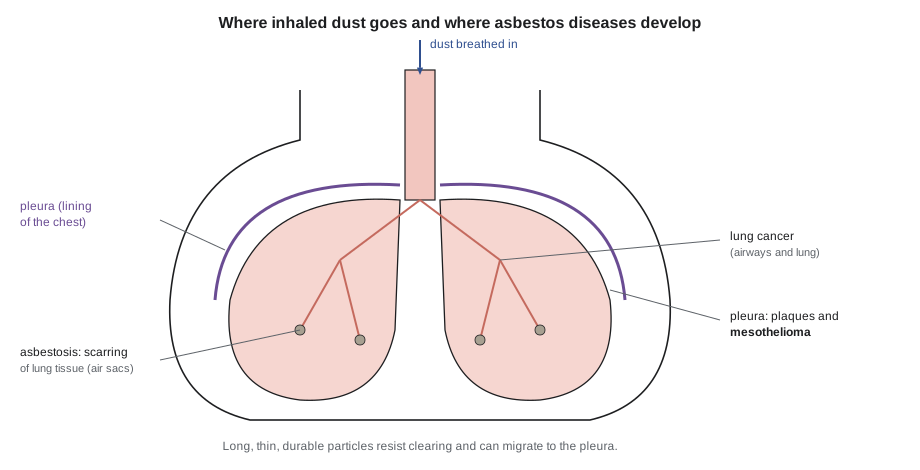
The main diseases
Asbestos causes several distinct diseases. All of them can be serious, and the cancers are usually fatal.
- Asbestosis: scarring (fibrosis) of the lung tissue, caused by heavy or long-term exposure. The scarred lung becomes stiff, and breathing gets steadily harder. It usually appears ten to twenty or more years after the exposure began and can continue to get worse after exposure stops. There is no cure.
- Lung cancer: asbestos increases the risk of lung cancer, and the risk rises with the amount of exposure. Smoking and asbestos together multiply the risk far beyond either one alone.
- Mesothelioma: a cancer of the pleura or of the lining of the abdomen. It is rare in people who have not been exposed to asbestos, so almost every case is linked to asbestos. It can follow relatively low or brief exposures, and it typically appears thirty to fifty years after first exposure. Most people die within a year or two of diagnosis.
- Pleural plaques and pleural thickening: patches of thickened, sometimes calcified tissue on the pleura. Plaques are a marker of past exposure and usually cause no symptoms, but widespread thickening can restrict breathing.
- Other cancers: international health agencies have also found sufficient evidence that asbestos causes cancer of the larynx (voice box) and of the ovary, and it may contribute to others.
| Disease | Part of the body | Typical delay after first exposure | What drives the risk |
|---|---|---|---|
| Asbestosis | Lung tissue | 10 to 20 years or more | Heavy or long-term exposure |
| Lung cancer | Airways and lung | 15 to 35 years or more | Amount of exposure; greatly increased by smoking |
| Mesothelioma | Lining of chest or abdomen | 30 to 50 years | Can follow low or brief exposure; amphiboles more potent |
| Pleural plaques | Lining of chest | 15 to 30 years or more | A marker of exposure |
| Cancer of larynx or ovary | Voice box, ovary | Decades | Amount of exposure |
The long delay
The time between first exposure and the appearance of disease is called the latency period. For asbestos diseases it is very long: often thirty years or more for mesothelioma. That delay has three consequences that matter on the job.
- You get no warning. Asbestos fibres do not burn, itch or make you cough at the levels that cause disease. Nothing tells you at the time that you have been exposed.
- The damage cannot be undone. Once fibres are lodged in the lung or pleura, there is no treatment that removes them. Stopping exposure prevents further harm but does not reverse what has been done.
- Today's exposures show up decades from now. The insulators dying of mesothelioma today were mostly exposed in the 1960s and 1970s. An apprentice exposed carelessly in 2026 might not become ill until the 2060s.
Worked problem
Latency in a real case
Bernie's uncle Gerard started as an insulator's helper in 1963, at age eighteen. He was diagnosed with mesothelioma in 2010 and died in 2011. How long was the latency period, how old was he when he was diagnosed, and what would the same latency mean for an apprentice exposed in 2026?
Show solution
- Latency = 2010 − 1963 = 47 years from first exposure to diagnosis.
- Age at diagnosis = 18 + 47 = 65.
- An apprentice exposed at age 20 in 2026 with the same latency would be diagnosed in 2026 + 47 = 2073, at age 67.
- Gerard worked with asbestos for many years, so the exposure that started his disease cannot be pinned to one day; this is typical.
Answer: 47 years; he was 65 at diagnosis. The same delay would carry a 2026 exposure to the 2070s, which is why nobody can judge today's exposure by how they feel.
Dose and the question of a safe level
For most asbestos diseases, the risk rises with the dose: the concentration of fibres in the air multiplied by the time spent breathing it, added up over a working life. Asbestosis in particular is a disease of heavy exposure. Lung cancer risk climbs steadily with dose.
Mesothelioma is different. It has occurred in people with relatively low or short exposures, including family members who washed workers' clothes and people who lived near mines and factories. Health agencies have not identified any level of exposure below which there is no risk of cancer. Occupational exposure limits are therefore not a line between safe and unsafe. They are legal maximums set to reduce risk, and good practice is to keep exposure as far below them as possible, ideally at zero.
Fibre type also matters. Amphibole fibres, especially crocidolite and amosite, are generally considered more potent for mesothelioma than chrysotile, mainly because they stay in the body much longer. But chrysotile causes all the asbestos diseases too, and the rules make no exception for it.
Smoking and asbestos
Smoking and asbestos exposure together multiply the risk of lung cancer. A classic study of insulation workers in the 1970s compared lung cancer death rates in four groups of men. Taking men who neither smoked nor worked with asbestos as the baseline, the death rate was roughly five times as high for non-smoking insulators, about eleven times as high for smokers who did not work with asbestos, and more than fifty times as high for insulators who smoked.
Worked problem
Comparing risks
Using the approximate figures above, in a group of men with a baseline lung cancer death rate of 10 per 100,000 per year, what would the rates be for non-smoking insulators, smokers without asbestos exposure, and smoking insulators? Is the combined effect added or multiplied?
Show solution
- Non-smoking insulators: 10 × 5 = 50 per 100,000 per year.
- Smokers, no asbestos: 10 × 11 = 110 per 100,000 per year.
- Smoking insulators: 10 × 53 = 530 per 100,000 per year.
- If the effects simply added, the combined increase would be about (5 − 1) + (11 − 1) + 1 = 15 times the baseline. The observed figure of about 53 is close to 5 × 11 = 55, so the effects multiply.
Answer: About 50, 110 and 530 per 100,000. The risks multiply, so quitting smoking is one of the most effective things an exposed worker can do for their lungs.
Smoking does not increase the risk of mesothelioma in the same way, but it adds to every other lung disease. Quitting reduces lung cancer risk over time even after years of asbestos exposure. Coldstream's health program, run by Mei, offers help to anyone who wants to quit.
Exposure at home and to bystanders
Asbestos disease is not limited to the person doing the work. Fibres carried home on clothing, hair, boots, tools and vehicles have caused mesothelioma in spouses and children, often decades later. Other trades working nearby, building occupants and the public can be exposed when asbestos is disturbed carelessly. That is why the rules require the work area to be isolated, why debris must not be swept or blown, and why contaminated clothing never goes home in a work bag (lesson 11).
The nurse ended with a story from her clinic: a retired schoolteacher with mesothelioma whose only known exposure was shaking out her father's work clothes as a child in the 1950s. Her father had been an insulator in a refinery.
Records, medical checks and compensation
Because asbestos disease appears so late, records of who was exposed, to what, and for how long are important. They help doctors make a diagnosis and help workers and families make claims years later.
In Ontario, employers whose workers do asbestos work of the higher-risk types must send an asbestos work report on each such worker to the Provincial Physician at least once every twelve months and when the worker's employment ends, and give the worker a copy. The Provincial Physician keeps a register of asbestos workers. Asbestos-related diseases are recognized occupational diseases under Ontario's workplace insurance system (the WSIB), and claims can be made by workers and, after a death, by survivors.
If you are ever exposed unexpectedly, because something was disturbed before anyone knew what it was, the exposure should be recorded. Report it to your supervisor and your safety coordinator, write down the date, place, material and what you were doing, and keep a copy. It may matter thirty years from now.
Symptoms to know about
Asbestos diseases usually show themselves only after many years, with symptoms such as shortness of breath that gets worse over time, a persistent dry cough, chest pain or tightness, and, with the cancers, unexplained weight loss or fatigue. These symptoms have many causes. Anyone who has worked around asbestos and develops them should tell their doctor about the work history, because doctors may not think to ask. Some clinics specialize in workers' occupational health and can advise on screening.
Exposure then and now
It helps to understand how much exposure has changed. In the 1950s and 1960s, air sampling during dusty insulation work, such as mixing asbestos cement, cutting pipe covering and ripping out old insulation in ships and boiler rooms, often found fibre levels many times, sometimes hundreds of times, today's limit of 0.1 f/cc. Insulators did this work day after day for decades, with no respiratory protection, and the result was the epidemic of disease the studies described.
Today's rules, used properly, keep exposures for trades workers near asbestos far lower. But the rules work only when people follow them. Most serious exposures today happen when nobody realizes asbestos is present, which is why recognition and stopping, rather than respirators, are the heart of this course.
Diagnosis and the work history
Because asbestos diseases appear so late, doctors rely on the work history to recognize them. Diagnosis usually involves a chest X-ray or CT scan, breathing tests, and for the cancers, a tissue sample. Pleural plaques on an X-ray are a strong sign of past exposure.
Many people who were exposed decades ago do not remember it clearly, and many doctors do not ask about work in trades. Keep your own record: the employers you have worked for, the main jobs and plants, any known asbestos exposure, and any incident reports. Coldstream gives every new worker a work history form and keeps a copy on file. If you ever see a doctor about breathing problems, bring the history and mention your trade.
Some occupational health clinics run screening programs for workers with past asbestos exposure, and some unions and employers offer them. Screening cannot prevent disease, but it can find some problems earlier and makes sure the exposure is documented.
Common mistakes
MistakeThinking that feeling fine after a dusty job means no harm was done.
InsteadAsbestos gives no warning; the diseases appear decades later.
MistakeTreating the exposure limit as a safe level.
InsteadNo safe level for cancer has been identified; keep exposure as low as possible.
MistakeBelieving chrysotile is harmless because amphiboles are more potent.
InsteadChrysotile causes all the asbestos diseases, and the rules treat all types as asbestos.
MistakeTaking dusty work clothes home to wash.
InsteadFamily members have developed mesothelioma from fibres on work clothes.
MistakeNot reporting an unexpected exposure because it was brief.
InsteadRecord it; mesothelioma can follow brief exposures, and the record may matter decades later.
Summary and key terms
- Fine asbestos fibres reach the deepest part of the lungs, resist the body's clearing mechanisms and can migrate to the pleura.
- Asbestos causes asbestosis, lung cancer, mesothelioma, pleural plaques and thickening, and cancers of the larynx and ovary.
- The latency period is long, often thirty to fifty years for mesothelioma, and exposure gives no warning at the time.
- Risk generally rises with dose; no safe level for cancer has been identified, and exposure limits are not safe lines.
- Smoking and asbestos multiply lung cancer risk; quitting smoking reduces it.
- Fibres carried home or released carelessly expose families and bystanders.
- Exposure records, medical checks and reports matter because disease appears so late.
- Asbestosis
- Scarring of the lung tissue caused by asbestos fibres, making breathing progressively harder.
- Mesothelioma
- A cancer of the lining of the chest or abdomen, almost always caused by asbestos.
- Pleura
- The thin membrane lining the chest wall and covering the lungs.
- Pleural plaques
- Patches of thickened tissue on the pleura that mark past asbestos exposure.
- Latency period
- The time between first exposure and the appearance of disease.
- Alveoli
- The tiny air sacs deep in the lungs where oxygen passes into the blood.
- Dose
- The amount of exposure: concentration in the air multiplied by the time breathed, added up over time.
Practice problems
Work each problem on paper first, then reveal the answer to check.
Why does asbestos give no warning at the time of exposure?
Show answer
The fibres cause no immediate symptoms at the levels that cause disease; the diseases appear decades later.
Which asbestos disease is almost always linked to asbestos, and how long is its typical latency?
Show answer
Mesothelioma; typically 30 to 50 years.
A worker was first exposed in 1971 and diagnosed in 2016. What was the latency?
Show answer
2016 − 1971 = 45 years.
Why is an exposure limit not a safe level?
Show answer
No level without cancer risk has been identified; limits reduce risk but do not remove it.
How do smoking and asbestos combine for lung cancer?
Show answer
They multiply: the combined risk is roughly the product of the two separate risks.
Lesson quiz · 5 questions
Score 60% or more to complete this lesson.
Create a free account to save your progress, take quizzes and earn a certificate.