
HSE-360 · Lesson 2 of 12 · 23 min
Rights and duties of school staff in Ontario
Every worker in a school has legal rights that protect their health and safety, and every worker, supervisor and employer has legal duties. Knowing them is not about being ready for a fight. It is about knowing what you can ask for, what is expected of you, and what to do when something is wrong. This lesson sets out the law that applies to school staff in Ontario, explains the duties of the employer, supervisors and workers, and walks through the right to refuse unsafe work, which works a little differently in schools than in other workplaces.
In Ontario, the main law is the Occupational Health and Safety Act (OHSA) and its regulations. It applies to school boards and to almost everyone they employ, including teachers, educational assistants, early childhood educators, custodians, trades staff, office staff and cafeteria workers. It is enforced by inspectors from the Ministry of Labour (formally the Ministry of Labour, Immigration, Training and Skills Development). One regulation, Regulation 857, deals specifically with teachers and changes how some parts of the Act apply to them; it is covered later in this lesson. Workers' compensation for injured staff is handled by the Workplace Safety and Insurance Board (WSIB).
The internal responsibility system
Ontario's law is built on an idea called the internal responsibility system. It means that everyone in the workplace shares responsibility for health and safety, in proportion to their authority and ability, and that problems should be found and fixed inside the workplace rather than waiting for an inspector. The inspector is a backstop, not the main safety system. In a school, that means the board, principals, staff and the joint health and safety committee are expected to work together on hazards every day.
Duties of the employer
The employer here is Riverbend District School Board as a whole, acting through its trustees, superintendents, managers and principals. Its duties are broad. The table sets out the main ones and what they look like in a school.
| Employer duty | What it looks like in a school |
|---|---|
| Take every precaution reasonable in the circumstances to protect workers | Assessing hazards in each school and putting controls in place, from wet floor procedures to safety plans for students whose behaviour can be unsafe |
| Provide information, instruction and supervision | Orientation for new staff, training in lifting, WHMIS and violence prevention, and principals who know and enforce the procedures |
| Provide and maintain equipment, materials and protective devices | Working eyewash stations, lifts for student transfers, gloves and other protective equipment |
| Prepare a written health and safety policy and program, reviewed at least yearly | A board policy signed by the director of education and posted in every school |
| Have workplace violence and harassment policies and programs, reviewed at least yearly | Risk assessments for violence, procedures for summoning help, and investigation of complaints |
| Post the OHSA and other required material | A health and safety board in each school with the Act, the policy, committee member names and inspection reports |
| Support the joint health and safety committee | Paid time for members, responses to recommendations within 21 days |
The phrase 'every precaution reasonable in the circumstances' is the heart of the employer's duty under the OHSA. It is not a promise that nobody will ever be hurt, but it is a high standard. When something goes wrong, the question an inspector or a court asks is whether the employer did what a reasonable employer would have done to prevent it. This is often called due diligence.
Duties of supervisors
Under the OHSA, a supervisor is anyone who has charge of a workplace or authority over a worker. In a school, principals and vice-principals are supervisors, and so are head custodians, department heads with authority over others, and anyone else who directs staff. A supervisor must make sure workers follow the Act and the procedures, make sure they use the protective equipment required, tell workers about any hazards they know of, and take every precaution reasonable in the circumstances to protect workers. A supervisor must also be competent: they need to know the Act and regulations that apply, know the hazards of the work, and be qualified by knowledge, training and experience to organize it.
For Marion, this means she cannot treat safety as something the board office handles. If she knows the stairs to the music room have a loose tread, she must act: tape it off, ask for a repair, and warn staff and students. If Victor tells her a custodian on the night shift is mixing cleaning products, she must deal with it. And if Jenna's principal at Willow Park knows that a student has hurt staff before, she must make sure the staff who work with that student know about the risk and have a plan.
Duties of workers
Workers have duties too. In plain terms, every staff member must:
- Work in compliance with the law and the employer's procedures.
- Use or wear the equipment, protective devices and clothing the employer requires, such as gloves for bodily fluids or eye protection in a lab.
- Report any hazard or defect in equipment they know about to their supervisor.
- Report any injury, however small, and any violation of the law they know of.
- Not remove or make ineffective any guard or protective device.
- Not use equipment or work in a way that endangers themselves or others.
- Not engage in horseplay, pranks or rough behaviour at work.
These duties apply to everyone, including principals as workers. They also explain why a teacher who props open a fire door, a custodian who takes the guard off a floor machine, or a coach who skips a spotter is not just making a personal choice: each is breaking a legal duty that protects others.
Three rights
The OHSA gives workers three basic rights, often summed up as the right to know, the right to participate and the right to refuse.
- The right to know: workers have the right to be told about hazards in their work, including the hazards of chemicals (through WHMIS labels, safety data sheets and training), and in some cases information about a person with a history of violent behaviour whom they are likely to encounter, where that person poses a risk of physical injury.
- The right to participate: workers can take part in health and safety through the joint health and safety committee or a health and safety representative, and can raise concerns without being punished.
- The right to refuse: workers can refuse work they believe is likely to endanger them, following a set procedure. For teachers, this right is limited by Regulation 857, as explained below.
There is also protection against reprisal. An employer cannot fire, discipline, threaten or penalize a worker for following the law, asking for it to be followed, reporting a hazard or injury, or using their right to refuse properly.
In Ontario, a worker who believes they have faced a reprisal can file a complaint with the Ontario Labour Relations Board, or, if they are covered by a collective agreement, through the grievance procedure. Most school staff in Ontario are unionized, so the grievance route is common.
The right to refuse in schools
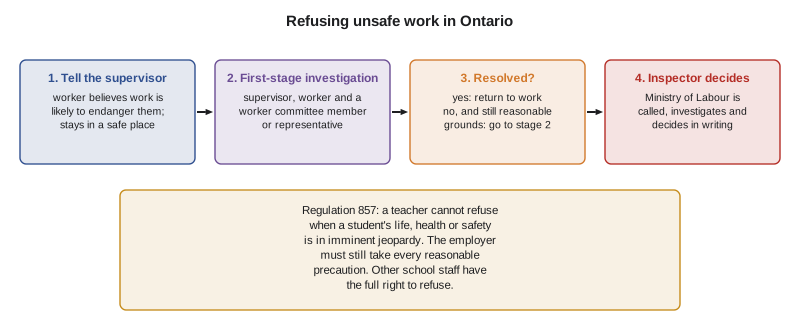
Under the OHSA, a worker who has reason to believe that equipment, the physical condition of the workplace or workplace violence is likely to endanger them can refuse to work. The process has two stages. First, the worker tells their supervisor, stays in a safe place nearby and the supervisor investigates with the worker and a worker member of the joint committee or a health and safety representative. If the problem is fixed, the worker returns to work. If it is not and the worker still has reasonable grounds, the second stage begins: the Ministry of Labour is called, an inspector investigates and gives a decision in writing. While the inspector is on the way, the employer can assign the worker other work, and can ask another worker to do the refused work only after telling them about the refusal and the reasons.
Regulation 857 changes this for teachers. A teacher cannot use the right to refuse when the circumstances are such that the life, health or safety of a student is in imminent jeopardy. In other words, a teacher cannot walk away from a class or a student when doing so would put a student in immediate danger. When there is no such imminent danger, a teacher can refuse in the normal way, for example refusing to work in a lab with a broken fume hood or to supervise a student whose violence is likely to endanger them when no plan is in place. Even when the right to refuse is not available, the employer and the supervisor must still take every precaution reasonable in the circumstances to protect the teacher. The limit applies only to teachers as defined in the Education Act. Educational assistants, early childhood educators, custodians, office staff and other non-teaching staff have the full right to refuse, including where they have reason to believe workplace violence is likely to endanger them.
In practice, formal refusals in schools are rare, and the better outcome is almost always that the problem is fixed before anyone needs to refuse. But knowing the process matters. Staff who do not know their rights tend either to keep working in conditions they should not accept, or to walk away in ways that are not protected.
Supply staff, student teachers and volunteers
Schools rely on people who are not there every day: occasional or substitute teachers and educational assistants, student teachers on placement, coop students, contractors and parent volunteers. The law's protections and duties reach most of them, and the gaps are where incidents tend to happen. A supply teacher who arrives at 8:20 for a class she has never met may not know that one student has a safety plan, where the eyewash station is, or how to call the office from the portable. A contractor fixing the gym lights may not know that the gym is booked for a class at 10:00.
Riverbend District School Board uses three simple measures. Every school keeps a one-page orientation sheet for supply staff with the emergency procedures, how to call for help, and a note to check the day book for any safety plans. Principals or office staff point out any student safety plans before the day starts, giving only the information the supply worker needs to stay safe. And contractors sign in at the office, are told about any hazards in the area they will work in, such as asbestos or a class in session, and are told who to contact. Volunteers are not employees, but the board still has duties to them as people in its building, and it gives them a short briefing too.
Student teachers and coop students on placement are generally treated as workers for the purposes of the OHSA, so they have the same right to know and the same duty to follow the rules. Their placement agreement usually spells out who is responsible for training and for reporting injuries.
What an inspector can do
A Ministry of Labour inspector can enter a school at any reasonable time without warning, look at records, take photographs and samples, talk to workers in private and issue orders. Orders might require a board to fix a hazard by a date, stop the use of a piece of equipment, or produce a workplace violence assessment. Inspectors also investigate complaints, work refusals, critical injuries and deaths. Failing to comply with an order is an offence, and boards and individuals, including supervisors, can be prosecuted and fined.
Worked problem
The broken fume hood
Hannah is due to run a lab with her Grade 10 class that involves heating a small amount of a chemical that gives off irritating vapour. The fume hood in her lab failed its airflow check last week and has a sign on it saying 'do not use'. Her department head tells her to go ahead anyway, with the windows open. What should Hannah do?
Show solution
- The fume hood is a protective device, and it has failed. The lab is likely to expose Hannah and her students to the vapour. This is a real hazard, not a matter of preference.
- Hannah tells her department head and the principal that she will not run that lab until the hood is fixed, and explains why. She offers to run a different lab that does not need a hood.
- There is no imminent danger to any student, because the lab has not started, so Regulation 857 does not limit her right to refuse. If the principal did not agree, the formal refusal process could begin. In this case, Marion agrees and the lab is rescheduled.
- Hannah also reports the delay in repairing the hood to the JHSC so it can follow up.
Answer: Raise the hazard, decline to run that lab until the hood is fixed, offer safe alternative work and follow up through the committee.
Common mistakes
MistakeThinking the law only covers teachers, or only support staff.
InsteadThe law covers almost every school employee, with only narrow differences.
MistakeAssuming a principal is not responsible for safety because the board office handles it.
InsteadPrincipals and vice-principals have supervisor duties every day.
MistakeNot reporting a hazard because someone else probably has.
InsteadEvery worker has a duty to report hazards they know about.
MistakeBelieving teachers can never refuse unsafe work.
InsteadTeachers cannot refuse only when a student is in imminent jeopardy; otherwise the normal process applies.
MistakeFearing punishment for raising a safety concern.
InsteadReprisal for raising safety concerns is against the law.
Summary and key terms
- The OHSA applies to Ontario school boards and almost all their staff, enforced by the Ministry of Labour.
- The internal responsibility system means everyone shares responsibility for safety.
- Employers must protect workers, provide training and equipment and have the required policies and programs.
- Supervisors, including principals, must know the hazards, enforce procedures and protect workers.
- Workers must follow the rules, use protective equipment and report hazards and injuries.
- Workers have the right to know, to participate and to refuse, and are protected from reprisal.
- Regulation 857 stops teachers refusing only when a student's life, health or safety is in imminent jeopardy.
- OHSA
- Ontario's Occupational Health and Safety Act, the main workplace safety law.
- Internal responsibility system
- The idea that everyone in a workplace shares responsibility for health and safety.
- Due diligence
- Taking every precaution reasonable in the circumstances to prevent harm.
- Regulation 857
- The OHSA regulation that limits teachers' right to refuse when a student is in imminent jeopardy.
- Reprisal
- Punishing a worker for exercising their health and safety rights.
Practice problems
Work each problem on paper first, then reveal the answer to check.
Which law governs health and safety for Ontario school staff?
Show answer
The Occupational Health and Safety Act and its regulations.
Name three duties of a school employer.
Show answer
Any three of: protect workers, provide training and information, provide and maintain equipment, have the required written policies and programs, support the committee, record and report injuries.
Who are the supervisors in a typical school?
Show answer
The principal and vice-principals, and others who direct staff such as head custodians.
What are the three basic worker rights?
Show answer
The right to know, the right to participate and the right to refuse.
When can an Ontario teacher not refuse unsafe work?
Show answer
When the life, health or safety of a student is in imminent jeopardy.
What protection do workers have when they raise safety concerns?
Show answer
Protection against reprisal or retaliation, such as being fired or disciplined.
Lesson quiz · 5 questions
Score 60% or more to complete this lesson.
Create a free account to save your progress, take quizzes and earn a certificate.